Generative engine optimization strategies for AI visibility: what we tested, and what came back null
Almost every generative engine optimization strategy we have read describes a property of a page: its structure, its schema, its length, its authority, its crawler permissions. The citation decision we measured is made about a sentence. The gap between page-level advice and passage-level selection is the most useful thing we know about AI visibility, and four separate page-level tactics came back null in our own harvest of the pages ChatGPT actually cited — each measured its own way, and not one of them able to tell us who got quoted.
We should say what we are before you weigh any of this. LiamVi builds a tool in this category, so read our criteria as our view of what matters rather than as a neutral standard. We are small and new, and the dataset behind everything below is small and early: 33 keywords across three related industries, mostly ChatGPT, with a much thinner sample on other assistants. The dataset grows with every weekly sweep, and when a conclusion changes we change it in public. Our methods, samples and limits are written up on our research page.
This article is not a ranked list of strategies, because we have not run the test that would justify one. What follows is the shorter, less satisfying thing: the four tactics we tested and could not make work, the one decision that moved the number in our own pre-registered test, and what the top-ranked page on this subject — Google's own guide to optimizing for generative AI features — says about the rest of the list.
What is generative engine optimization actually trying to do?
Generative engine optimization is the name for work aimed at getting your words quoted inside an AI answer rather than listed as a blue link. Google does not treat it as a separate discipline at all. Google's guide, last updated 10 July 2026, takes the terms head-on: "'AEO' stands for 'answer engine optimization' and 'GEO' for 'generative engine optimization'... From Google Search's perspective, optimizing for generative AI search is optimizing for the search experience, and thus still SEO." The same page says the best practices for SEO "continue to be relevant because our generative AI features on Google Search are rooted in our core Search ranking and quality systems."
That scope matters more than the sentence does. Google is describing its own generative AI features — AI Overviews and AI Mode, sitting on top of the Google index. Most of what we measured is ChatGPT, which is a different surface, reached by a different crawler, with its own retrieval step. GEO advice routinely discusses the two as one thing, and they are not one thing. When we say a tactic came back null, we mean in our 33-keyword harvest, on the surfaces we sampled. When Google says a tactic is unnecessary, Google means for Google Search. Neither statement transfers to the other automatically, and our read is that a large share of the confusion in this category comes from pretending it does.
Two questions hide inside "how do I do GEO", and they have different answers. The first question is whether an assistant looks anything up for your reader's query at all. The second is whether, having looked, it lifts one of your sentences. Almost every published tactic is aimed at the second question. Our own test suggests the first one carries more leverage, and it is settled before a word is written.
Which strategies did we test, and what came back null?
We tested four widely recommended strategies — question coverage, domain authority, ranking position and crawler permissions — and across a harvest of 33 keywords not one of them told us which pages ChatGPT quoted. The four were not measured the same way, and each paragraph below says what its own test was. All four share a shape, which turns out to be the point.
Answering more of the questions searchers ask. This was our own hypothesis and we were confident about it. Across the 33-keyword harvest, cited pages and ignored pages answered searcher questions at effectively the same rate, and we published that null with its numbers. We kept the measure, because question coverage is still our strongest single signal of article quality when independent reviewer agents judge drafts cold — a human blind read of the same set is prepared and not yet done. We stopped saying it buys citations.
Higher domain authority. Across 21 pairs of pages competing on the same keyword, one from a higher-authority domain and one from a lower, the higher-authority page won 11 and lost 10. The pairs were matched on the keyword and on nothing else — two pages on two domains also differ in their content, their links, their age and how squarely they answer the query — so the 11–10 is a count of what happened rather than a controlled test of authority. Twenty-one pairs cannot rule out a small effect; they rule out a decisive one in that sample. Our weekly sweeps keep finding recently created sites holding citation slots beside household names.
Ranking well on Google. In the same harvest, 9 of the 73 pages ChatGPT cited also sat in Google's top ten for the query that produced the citation — 12.3% of the citations we collected. That figure describes the overlap between two sets rather than a citation rate by rank: we never measured how often a page outside the top ten was cited against how often a top-ten page was, so nothing in it says that ranking well makes a citation less likely. What it does say is that the ranking funnel and the citation funnel barely touch, and that a page assembled from the consensus of everything already ranking is, by that measurement, competing in the wrong set. The overlap counts are pages rather than domains, and one harvest is one moment.
Blocking or allowing AI crawlers in robots.txt. What came back null here is narrower than it sounds: whether a domain carried an AI-crawler block at all did not separate the cited domains from the ignored ones in our harvest. The permission OpenAI documents as deciding whether a site can appear in ChatGPT's search answers was blocked by 1 of the 230 domains we looked at — too little variation to test at all. Crawler permissions get their own section below, because the vendors' own documentation settles more of the question than the advice about it does.
All four tested strategies are properties of a whole page — its coverage, its domain, its rank, its access rules. All four can be checked, scored and sold as a line on a checklist. And all four, in the one place we could measure them, told us nothing about which pages got quoted.
Why did the page-level tactics come back null?
Our read is that the page-level tactics returned nothing because the unit an assistant selects is a passage rather than a page — an explanation of the nulls, not a second measurement of them. Some of the assistant citations we collected point at a single highlighted sentence inside a page rather than at the page itself, and one article in that harvest was cited four separate times, each citation pointing at a different sentence in it. One page, four selections, four different reasons.
The evidence for that is physical rather than inferred, which is rare in this field. The citations that pointed at a sentence came back carrying a text fragment — the `#:~:text=` form. Its syntax is `#:~:text=[prefix-,]start[,end][,-suffix]`, specified in URL Fragment Text Directives, a draft community group report dated 13 December 2023 and edited by Nick Burris and David Bokan. The specification describes the purpose as "specifying a text snippet in the URL fragment" so that "the user agent can quickly emphasise and/or bring it to the user's attention." When only `start` is given, the target is the first instance of that exact string; adding `end` makes the directive name a range inside the page.
Be precise about what a text-fragment citation proves. It shows the citing system selected a span of words, because the span is written into the link itself. The fragment does not tell us why that span was chosen over another, and it does not mean every assistant behaves this way. It also does not mean the page around the passage counts for nothing. Google's guide describes the technique behind its own AI features — retrieval-augmented generation, which it also calls grounding — as "relying on our core Search ranking systems to retrieve relevant, up-to-date web pages from our Search index", adding that "Our systems then review the specific information from those retrieved pages to generate a more reliable and helpful response." That is Google documenting Google's own surface rather than measuring ChatGPT's, and it is documentation rather than a result of ours — but on that surface the page is retrieved first and the passage is chosen second, which means page-level properties may still decide whether a passage is ever considered at all. We wrote up how the retrieval step behaves on one assistant in how to get citations from ChatGPT. For anyone building a strategy the consequence is narrower than a slogan: the page-level properties we tested were not what decided the citation, so a strategy that stops at the container stops too early.
What actually moved the number in our test?
Changing how the question was framed moved the citation rate further than anything else we tried, and framing is chosen before the writing starts. Our pre-registered framing ladder is the test, and we wrote the prediction down before we ran it.
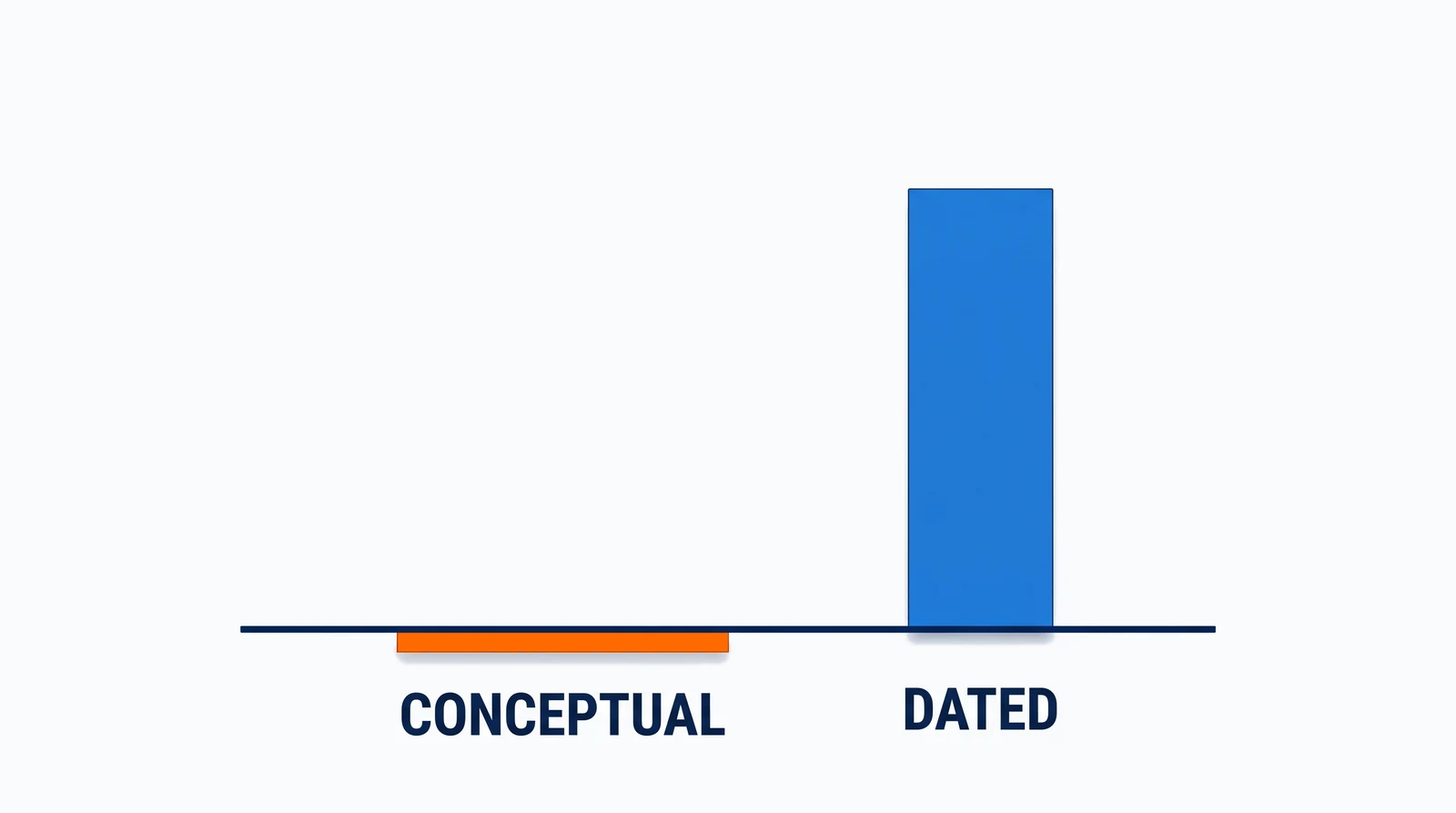
The ladder held five topics constant and phrased each of them four ways: conceptual ("what is X"), entity-state, dated, and a recommendation with a jurisdiction attached. Our prediction was that citation rates would rise from the first framing to the fourth. None of the five conceptual framings drew a citation from anyone. All five dated framings drew citations, and so did all five recommendation-plus-jurisdiction framings. Mean pages cited across the five topics moved from 0.0 at the conceptual end of the ladder to 6.4 at the dated one.
The limits belong here rather than in a footnote. Five topics, one engine primarily; engines differ, and Perplexity cites far more freely than the assistant we measured most. The direction was unambiguous; the exact rates are not portable, and we do not publish them as a law. The ladder replicates on Gemini as a second engine at two queries, which is suggestive and not established. Two individual topics moved against the trend at the top of the ladder — one fell from six pages cited to two, another from twelve to one — so per-row behaviour is not monotonic, and we record those two rows rather than tidy them away. The ladder's design, its sample and its published limits are on our research page; the per-topic counts above come from that same run.
Question framing is worth a practitioner's attention because of where it sits in the process: it is a commissioning decision, not an editing pass. A stable, conceptual subject may simply not be one an assistant searches for, and no amount of page craft buys a citation on a query that never triggered a search. The same subject, framed around a current state, a named entity, a jurisdiction or a comparison, becomes a question the assistant looks up. Commissioning is the cheapest point at which anything in this article can be changed, and most GEO checklists never reach it, because a checklist arrives after the topic has already been chosen.
We put the finding internally the way we will put it here: do this and your odds rise. Not do this and get cited.
Does blocking AI crawlers cost you citations?
Blocking an AI crawler can genuinely cost you citations, but across the 230 domains we looked at, the crawler being blocked was almost never the one that decides whether an assistant can quote you. The crawler names do different jobs, the difference is not intuitive, and both vendors document it themselves.
OpenAI documents its crawlers one by one. "GPTBot is used to make our generative AI foundation models more useful and safe. It is used to crawl content that may be used in training our generative AI foundation models." Separately: "OAI-SearchBot is for search. OAI-SearchBot is used to surface websites in search results in ChatGPT's search features. Sites that are opted out of OAI-SearchBot will not be shown in ChatGPT search answers, though can still appear as navigational links." OpenAI's page states the two settings are independent, giving the example of a site that allows OAI-SearchBot "in order to appear in search results while disallowing GPTBot."
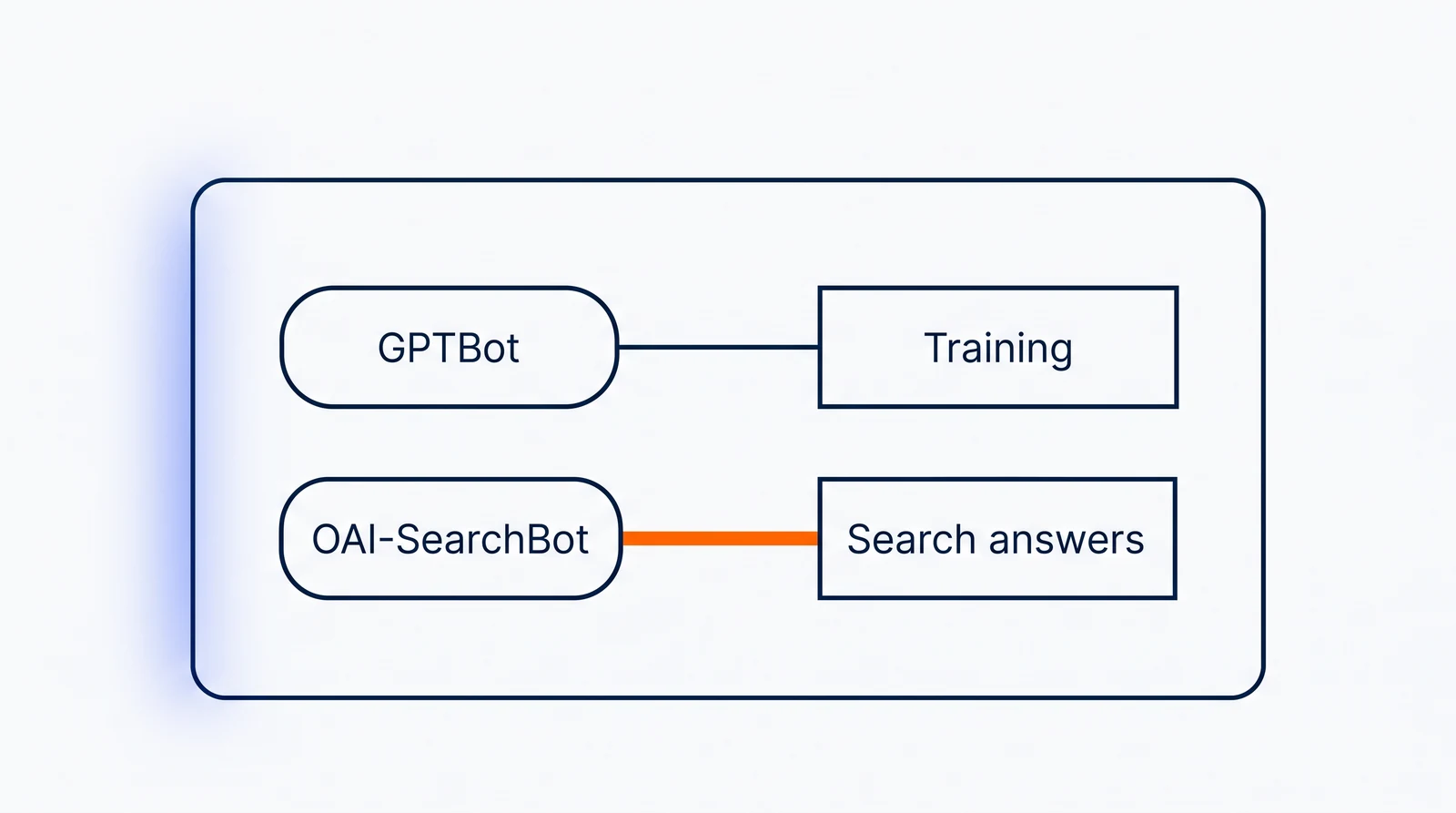
Google draws the same line and writes it down. Google's crawler documentation, last updated 14 July 2026, describes `Google-Extended` as a token publishers use to manage whether crawled content may be used for training future Gemini models and for grounding in Gemini Apps and Vertex AI, then adds the sentence worth pinning up: "Google-Extended does not impact a site's inclusion in Google Search nor is it used as a ranking signal in Google Search."
Our own crawler measurement is early and, unlike every other finding in this article, not yet written up on our research page, so it carries no link and you should weigh it accordingly. Whether a domain blocked an AI crawler did not separate the cited domains from the ignored ones in our harvest: blocks turned up on both sides at similar rates. The figure worth reporting is the one with a clean denominator — only 1 of the 230 domains we looked at blocked OAI-SearchBot, the crawler OpenAI names as the search one. Two of the cited domains blocked GPTBot and were cited anyway, which is exactly what OpenAI's documentation predicts.
That single blocker is also the limit of the test. With one domain in 230 opting out of the search crawler, our harvest cannot tell you whether blocking OAI-SearchBot costs citations — OpenAI's own documentation says it does, and we have no sample to weigh against it. What our harvest tests is narrower: whether carrying an AI-crawler block at all separated the cited domains from the ignored ones, and it did not. The conclusion that survives is that the block most sites carry is not the block that decides citation, not that crawler permissions have no effect.
The practical reading is narrow and useful. A robots.txt line written to opt out of AI training is not an opt-out of citation, and a site that believes it has closed the door may have closed a different one. Check which token your robots.txt actually disallows before drawing any conclusion about why you are not being quoted.
So what does a GEO strategy look like, if the tactics are null?
On our own evidence, a GEO strategy comes down to two decisions: choose a question an assistant will actually search for, and write sentences worth lifting out of the page. Two decisions is deliberately smaller than a checklist, and it is as much as our evidence supports.
Decide the question, not just the topic. Before commissioning a piece, ask whether the question it answers is one an assistant would look something up for. In our ladder, the conceptual framing of a subject drew nothing at all while the dated and comparison-shaped framings of the same subject drew citations for several pages each. If the honest answer is that nobody's assistant will search for this, the piece may still be worth writing for readers — but it is not a citation play, and nobody should sell it to you as one.
Then carry passages worth lifting. A sentence that survives being quoted alone is self-contained, carries a specific figure with its source, names a real thing, and states the fact in your own voice rather than handing it onward. Attribution has a cost most style guides never mention: "according to a report, the market grew" gives the quotable sentence to the report rather than to you.
Google's guide reaches a neighbouring place from a different direction, and the agreement is convergence rather than confirmation, because the two measurements are not the same measurement. Google asks for "a unique point of view" on the grounds that "our AI systems take a look at a variety of sources, so it can be helpful to have a unique viewpoint that stands out," and is blunt about the alternative: "Don't just recycle what others on the internet have already said, or could easily be produced by a generative AI model."
Read those two decisions as our view of what matters, shaped by the product we build, not as a neutral standard. We have not tested them against every alternative and we will not imply that we have.
Which GEO tactics does Google say you can ignore?
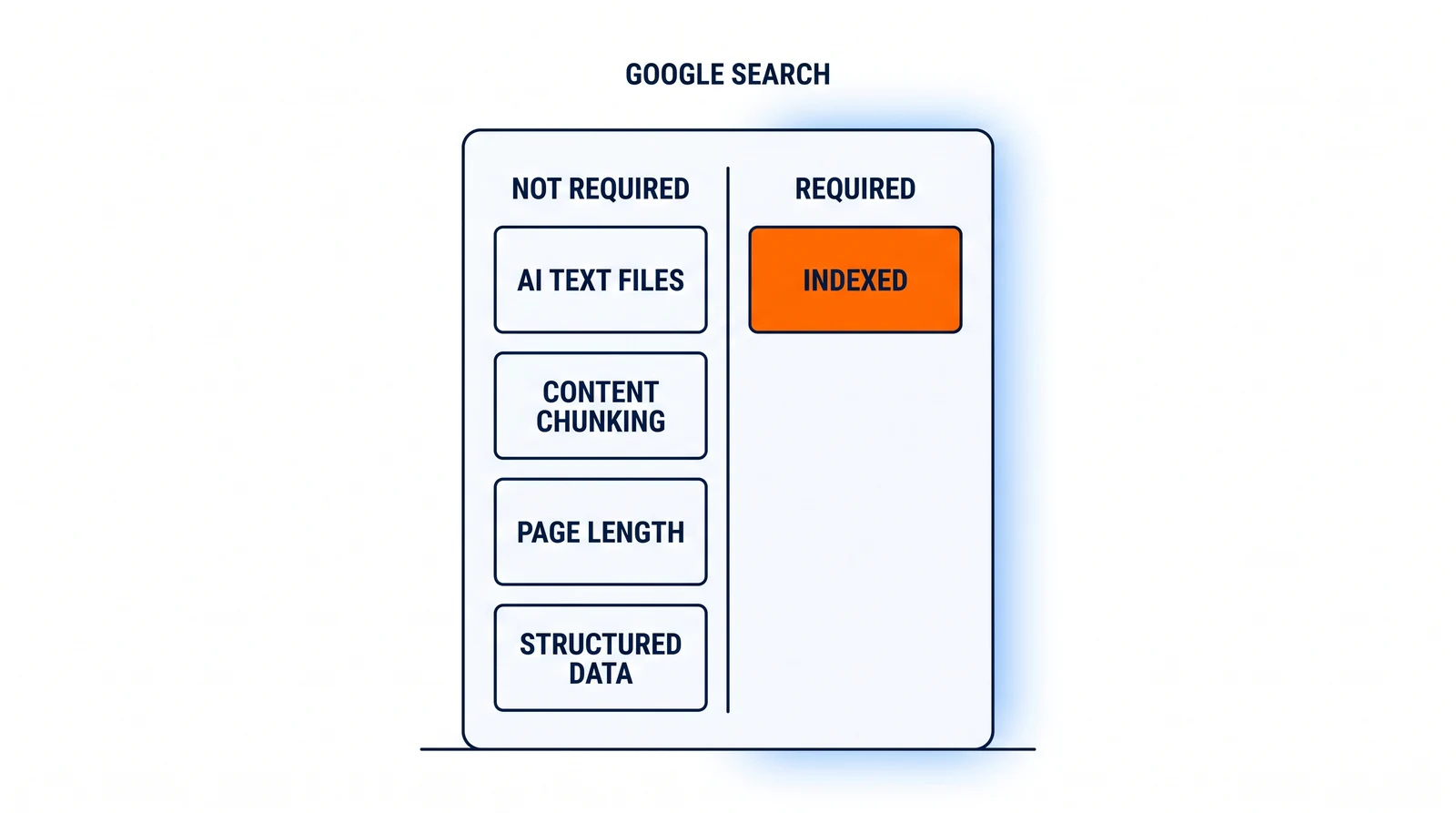
Google publishes a mythbusting list of GEO tactics you can ignore, and it is blunter than most of the advice we have read. On file formats: "You don't need to create new machine readable files, AI text files, markup, or Markdown to appear in Google Search (including its generative AI capabilities), as Google Search itself doesn't use them." On breaking pages up: "There's no requirement to break your content into tiny pieces for AI to better understand it," and "There's no ideal page length." On style: "You don't need to write in a specific way just for generative AI search." On markup: "Structured data isn't required for generative AI search, and there's no special schema.org markup you need to add" — though the guide recommends keeping structured data for rich results. Google's summary line is "Prioritize effective SEO strategies over 'AEO/GEO hacks'."
The scope guard applies again and it cuts both ways. Google is telling you how Google Search's AI features work, not what ChatGPT cites, and we did not test any of those five items ourselves — we are quoting documentation, not corroborating it. Our four null results and Google's mythbusting list do point the same way on one specific thing: adding page-level machinery was not where movement came from.
The one requirement Google does state deserves the same attention as its refusals. "To be eligible to be shown in generative AI features on Google Search, a page must be indexed and eligible to be shown in Google Search with a snippet." Eligibility is a floor rather than a strategy, and the guide says plainly that meeting every requirement still guarantees nothing.
How do you check a GEO claim — including ours?
Three questions will tell you whether a GEO claim has been tested, and they work on this article as well as on anyone else's. LiamVi is a third-party tool making claims about AI search, which is precisely the category Google's guidance on third-party SEO tools, services and advice tells you to treat carefully. Last updated 5 June 2026, that page says "Third-party tools don't have access to our internal ranking data" and "They can't guarantee performance. Any predictions are their own and like predictions generally, may not happen." Both sentences describe us. We have no access to anyone's internal ranking systems, and we cannot promise you a citation.
What was measured, on how many of what? A tactic presented without a sample size, a comparison group and a date is an opinion wearing the clothes of a result. Our own sample is 33 keywords across three related industries, measured mostly on ChatGPT in July 2026.
What came back null, and did they publish it? Anyone running real tests has failures, because most hypotheses are wrong. A provider with a list of things that work and no list of things that did not has either not tested or not told you. Four of our own nulls are in this article.
Is this about the surface you care about? Google AI Overviews, ChatGPT search, Gemini and Perplexity behave differently and are measured differently, so a finding about one is not a finding about the others. A strategy sold without naming its surface has not been checked on yours.
Readers wanting to know who sells this as a service, and what to ask them, will find that in generative engine optimization companies. Readers choosing a tracking product rather than a service should read our comparison of AI visibility tools instead. This article recommends neither, on purpose.
What people actually ask
Five questions dominate the searches around generative engine optimization, and each answer below stands on its own.
How do you do GEO in practice? Start with two decisions, in order: choose a question an assistant will actually look something up for, then write sentences that can be lifted out of the page and still stand — specific, self-contained, carrying their own figure and source. Everything else we tested at the level of the whole page came back null across our 33-keyword harvest, so page-level work is not where we would spend first.
What counts as a GEO best practice? Most of the best-practice lists we have read give no sample size, no comparison group and no date, which is what a tested claim would carry. We can tell you about the four we did test and could not make work — question coverage, domain authority, ranking position and crawler permissions — and Google publishes a separate list of things you can skip for its own AI features, including AI text files, content chunking and AI-specific rewriting. Beyond those two lists, treat "best practice" as a claim awaiting a sample size.
What does a GEO example look like? The clearest example in our own data is a single article cited four times in one harvest, with each citation pointing at a different sentence inside it. Nothing about the page changed between those four selections; four different passages in it answered four different things. Passage-level selection is the behaviour a strategy has to be built around, and it is not a page-level behaviour.
Are GEO courses, tools or services worth it? We have measured no course and no vendor's GEO service, so we have no result to give you and will not invent one. What we can offer is the three questions above — what was measured, what came back null, and which surface — put to whoever is selling. A provider who answers all three clearly is a different proposition from one who answers none, whatever the price.
Is generative engine optimization different from SEO? Google says it is not, for its own features: optimizing for its generative AI search "is optimizing for the search experience, and thus still SEO." Our own measurement says the two funnels barely overlap on the surface we sampled, where 9 of the 73 pages ChatGPT cited also sat in Google's top ten. Both answers are true because they answer different questions — Google is describing how its AI features are built, and we are describing which pages a different assistant quoted. Traditional rankings still do what they have always done; a second funnel now sits beside them and is measured another way.
What we cannot tell you
Three limits sit on the measurements above, and the first is causation. We observe what cited pages share, and we cannot yet prove that adding those properties causes a citation; our weekly tracking is accumulating the outcome data that would test it. Most of our measurement is ChatGPT, while Gemini, Perplexity and Google's AI surfaces are sampled far more thinly and behave differently. One harvest is one moment, and retrieval policies can move without notice.
We cannot tell you how our own articles have performed either. Our citation standing was last taken before any of these pieces had time on the web, and quoting a stale zero as a current one is exactly the failure this desk exists against.
The awkward limit belongs here too, since this article is partly about spotting motivated advice. Our own early scoring model rewarded matching the consensus of the pages that already rank — close to the opposite of the set our harvest shows gets cited. We found that by testing our own product, we published it, and we rebuilt the score as a coverage checklist rather than a quality grade. Any tool that fits a number to what already ranks, ours included, should be asked for that measurement.
Sources
- Google — Optimizing your website for generative AI features on Google Search — what Google says about AEO/GEO, and its list of tactics you can ignore. Last updated 10 July 2026; verified 3 September 2026.
- Google — Guidance on using third-party SEO tools, services, and advice — internal ranking data and performance guarantees. Last updated 5 June 2026; verified 3 September 2026.
- Google — List of Google crawlers — what `Google-Extended` controls and what it does not. Last updated 14 July 2026; verified 3 September 2026.
- OpenAI — Bots and crawlers — GPTBot, OAI-SearchBot and ChatGPT-User, and what each is used for. Verified 3 September 2026.
- W3C Community Group — URL Fragment Text Directives — the `#:~:text=` syntax. Draft Community Group Report, 13 December 2023; verified 3 September 2026.
- LiamVi — Research: our methods, samples and limits — the framing ladder, the passage evidence, the ranking-versus-citation overlap, the matched pairs and the null we published against ourselves. Last updated 12 August 2026; verified 3 September 2026.
- LiamVi — How to get citations from ChatGPT — the retrieval step on one assistant. Verified 3 September 2026.
- LiamVi — Generative engine optimization companies — who sells this as a service, and what to ask them. Verified 3 September 2026.
- LiamVi — Best AI visibility tool — tracking products, for readers choosing one. Verified 3 September 2026.