
Does earned media drive AI citations: press coverage is one part of what the study calls earned
Muck Rack's May 2026 edition of What Is AI Reading? puts earned media at 84% of the AI citations in an analysis of more than 25 million links cited by ChatGPT, Claude and Gemini across 17 industries. Its full report counts journalism, academic research, government and NGO sources, encyclopedic sites, social platforms and third-party corporate content as earned. It is the figure you are most likely to be handed on this subject, and journalism alone is 27% of those links. The 84% describes a wide category of sources that a brand neither published nor paid for, with press coverage inside it, and it records which AI citations the assistants made rather than what caused them.
A disclosure first: our own product tracks which pages AI assistants cite, and Muck Rack sells a product in the same area, Generative Pulse, which it says helps PR and communications teams "understand and influence how AI platforms describe their brands"; its platform also offers what it calls "Generative Engine Optimization (GEO) insights". Several of the other pages quoted below come from companies that sell AI visibility services as well. We have no measurement of our own on earned media or on how often the press is cited. No figure below is ours; each is given with the company or researchers who produced it.
This article draws on the nine results Google returned in the United States on 28 September 2026 for the search "does earned media drive ai citations", Muck Rack's releases for all three editions of the study and its full May report, and the studies behind the other figures those pages repeat, each opened on 28 or 29 September 2026.
What does the "earned" in the 84% figure include?
Muck Rack's 84% earned share covers five kinds of source in its release and six in its full report, from journalism to third-party corporate content. In the words of the release it distributed on 7 May 2026: "Earned media accounts for 84% of all AI citations in the May 2026 edition, including journalism, academic research, government sources, encyclopedic sites, and third-party corporate content." The report adds social platforms to that list, and its category list gives LinkedIn and Reddit as examples. The definition is printed plainly, and that deserves credit: the list is there for anyone who reads past the headline. Paid and advertorial content came to 0.3% of the citations in the same edition.
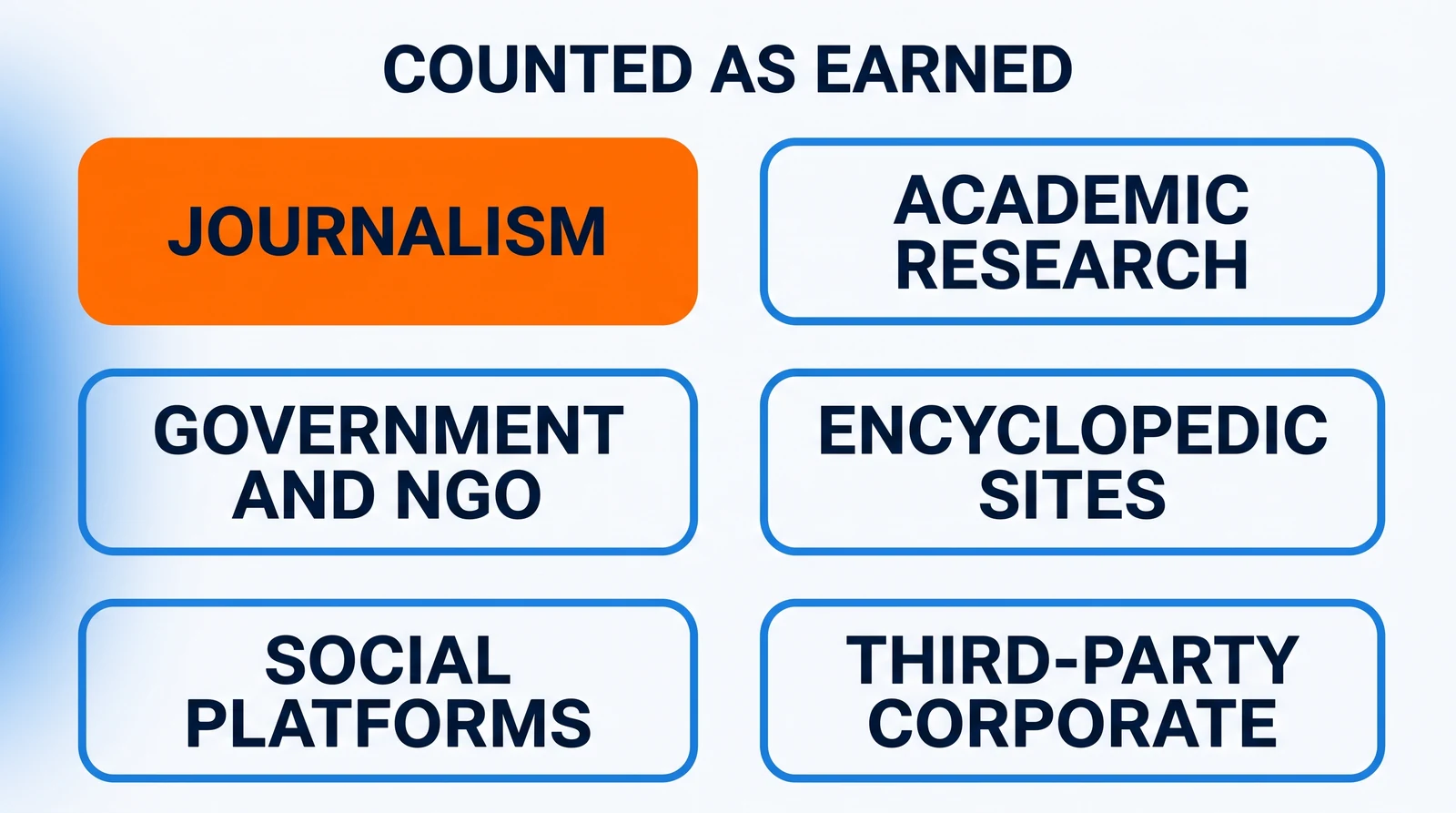
On that list, an encyclopedia entry counts as earned, and so do a government page, a research paper and a post on a social platform. The report defines third-party corporate content as "Third party corporate blogs and content not owned by a company/product targeted in the query": another company's page counts as earned whenever that company is not the one the query targets, which is how one of the pages below reads it too.
Neither the release nor the report's summary pages divide the 84% among those kinds, and the only part of it either sizes is journalism's.
Earned media's share has held steady, ranging "from 82% to 89%" across the three editions and "suggesting these are consistent patterns and not tied to a particular model update or time period." A steady total says the category keeps its size from edition to edition; it says nothing about what is inside it, and the December edition shows the inside moving.
The December 2025 release, the second edition, sized one slice. Covering more than one million links cited between July and December 2025 by four assistants, Perplexity among them, it reports "a decrease in citations from third-party corporate and blogs from 37% to 24% during the same period". In that edition earned media stood at 82% and journalism at about 20% to 30%. That label joins company pages with blogs, and the December text does not say how much of the slice sits inside the earned figure, so neither figure can be subtracted from the other. In the study's own data, that slice ran at a size comparable to journalism's.
The first edition worded its figure on a different base: the July 2025 release said "More than 95% of citations come from unpaid media sources and 85% of those come from earned sources", a share of the unpaid citations rather than of all of them. The May edition sets the three editions in the 82% to 89% range and does not say whether the first figure was recalculated on the later base. Neither wording is wrong; they answer slightly different questions, and anyone comparing editions should know which base they hold.
How much of it is press coverage?
Journalism made up 27% of all the links ChatGPT, Claude and Gemini cited in Muck Rack's May 2026 edition, about a third of the 84% earned share by our arithmetic. Every other figure in this section comes from the same release. The May release puts that share between 25% and 27% across the three editions, where the December release had described it as about 20% to 30%.
Cited journalism in the May edition is spread across more than 20,000 distinct outlets. Axios sits in ChatGPT's top three cited domains in 13 of 17 industries, the only news outlet to do so on any of the three platforms, and neither the New York Times nor Reuters reaches the top three in any industry. More than half of those citations come from articles published in the previous 12 months.
The kind of query moves the mix. Industry trend queries draw citations of news reporting at more than double the rate of how-to questions, and press releases "appear almost exclusively in industry trend responses". The sample itself spans 17 industries and "multiple query types".
The three platforms also cite in different ways, in the study's own words: "Citation behavior varies by platform, with each AI system showing distinct sourcing patterns". ChatGPT cites sources in 96% of responses with an average of five, Gemini in 82% with an average of eight, and Claude in 55% with an average of 13. ChatGPT's most cited domain is Wikipedia, Claude's is PubMed Central and Gemini's is Reddit: in each case a reference, research or community site rather than a news outlet. The 84% is a single figure drawn from three quite different citing habits.
How do the pages that repeat the figure read it?
Four of the six ranking pages that repeat Muck Rack's earned share leave third-party corporate content out of their reading, and two separate earned media from journalism. The six are among the nine results Google returned for this search on 28 September 2026; the other three results are the study's own release and blog post and a Content Marketing Institute guide that cites none of the study's figures.
The reading that leads starts with the study's owner. Muck Rack's blog post of the same day gives the 84% without the list and describes it as "the work PR teams do every day to earn credible coverage in trusted outlets", and the May announcement quotes Greg Galant, its co-founder and CEO: "If your brand is not showing up in the media coverage AI is reading, you are not showing up in the answers AI is giving."
The page at the top of the results, Shadow's guide by its chief executive Jessen Gibbs, updated on 24 July 2026, reads the figure the same way: "Brands without third-party editorial coverage are structurally invisible to AI search engines." The same page cites Ranqo's finding, from 149,912 citations, that the dominant class of AI citations, at 75.2%, "consists of corporate pages owned by competitors, peers, and vendors in the same category". By the plain words of Muck Rack's list, pages of that kind would count as third-party corporate content, and so as earned. Shadow sells an operations system for communications teams. Both facts sit on the same page, and the class it quotes as the largest is not editorial coverage. Megan Braverman's LinkedIn post draws the conclusion in a line: "This means public relations isn't optional."
Two pages print a list of what earned holds. authoritytech, on 30 June 2026, writes that the 84% "spans journalism, Wikipedia, Reddit, PubMed, and government and academic sources", naming Reddit, which the report files under social platforms and the release's list leaves out, and leaving out third-party corporate content, which both name. Machine Relations, on 6 July 2026, gives earned media as "journalism, third-party editorial, academic research, and government sources"; Machine Relations' list also leaves the corporate slice out.
Two pages keep earned media and journalism apart, as the release does. Axia PR, on 10 December 2025, separates the categories directly: "Many readers assume these two categories are interchangeable. They aren't." Kimberly J.'s LinkedIn post says earned does not equal standard journalism and names the corporate part: "Third-party corporate blogs count as earned".
A second figure changes shape as it travels. authoritytech writes that brands are "6.5x more likely to earn citations through third-party coverage than owned properties", citing AirOps. In AirOps' own report on 21,311 brand mentions across ChatGPT, Claude and Perplexity for top-of-funnel commercial queries, 85% of the mentions sat on external domains and 13.2% on the brand's own. By our arithmetic 85 divided by 13.2 is about 6.4, so the 6.5x matches the ratio of those two shares. A ratio of two shares is not a measured chance of being picked. The third-party pages behind it were mostly not news articles either: AirOps says "nearly 90% of third-party mentions came from listicles, comparisons, or reviews."
What sits in the part that is not press coverage?
Other companies' pages took 75.2% of 149,912 AI citations in Ranqo's study of 102 brands, against 3.8% for press and analyst coverage. Ranqo, which sells an AI visibility platform, collected its data across ChatGPT, Gemini, Perplexity, Claude and Grok between March and May 2026 and published the study as a preprint on arXiv on 18 June 2026. Ranqo describes that largest group as "third-party sites describing the category, including your rivals' own pages". Tech and business media, labelled "Earned press and analyst coverage", took 3.8%, video 4.2% and the brand's own domain 2.9%.
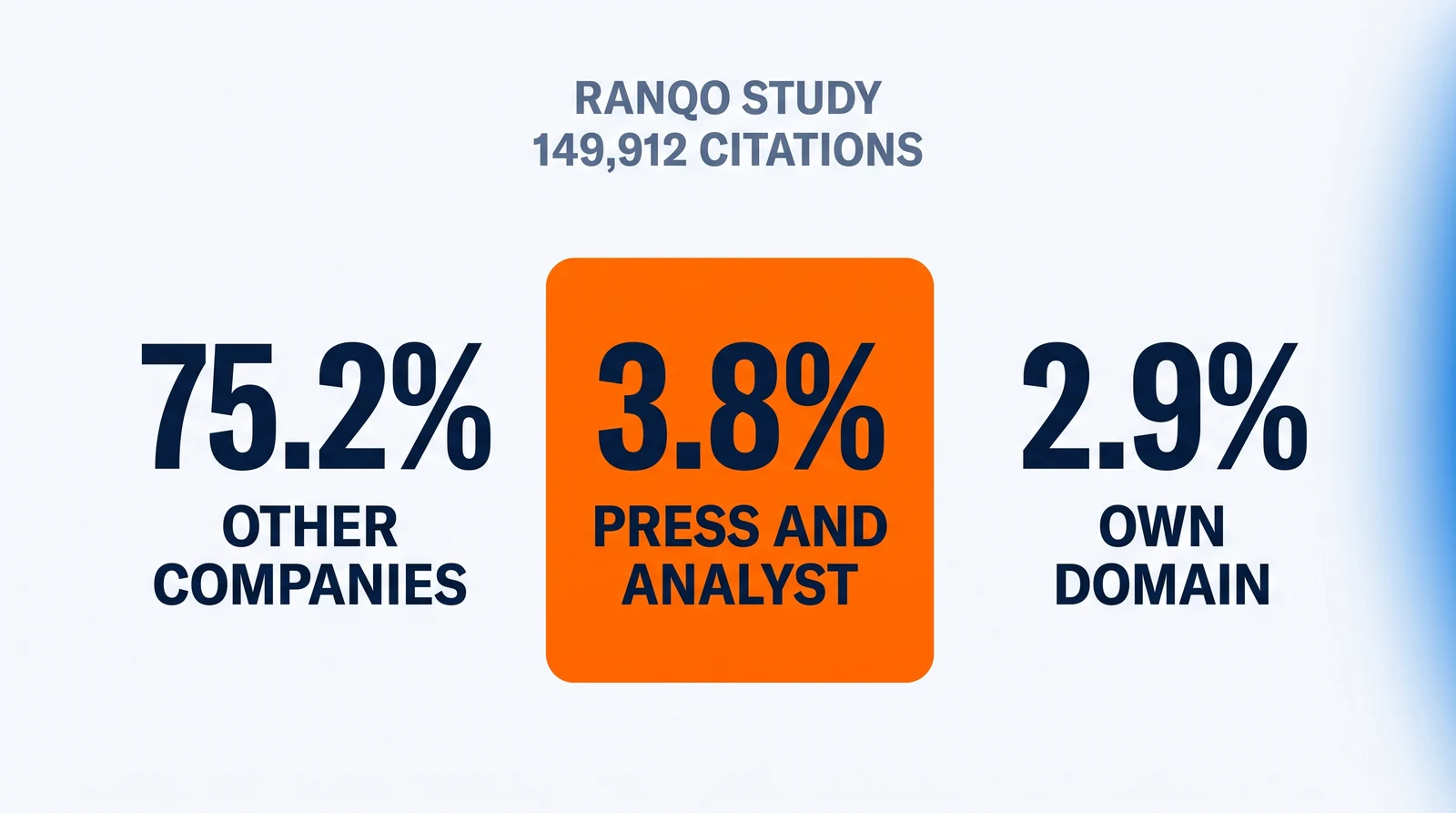
Ranqo's sample, assistants and sort all differ from the May edition's, so the two cannot be added together or subtracted. What Ranqo shows is how much can sit in a slice that a broad earned label folds in with the news.
A second vendor draws the line elsewhere. In Meltwater's May 2026 data, its "Earned/News" label covered 37.6% of citation domain count across more than 8 million citations from "eight major LLMs". The largest bucket, at 53.7%, is labelled Other. Meltwater's report, published on 3 July 2026, comes from a company that sells an AI visibility product called GenAI Lens, and its data month, May 2026, is the month Muck Rack released its latest edition. Meltwater's 37.6% and Muck Rack's 84% do not contradict each other; they are two companies' labels over two samples, and the word earned names whichever bucket its owner drew.
Muck Rack's study is also one of six that Everything PR folded into a single ranking of domains, which our page on the most-cited websites examines.
Does earned media drive AI citations?
Muck Rack's 84% records what ChatGPT, Claude and Gemini cited, not what made them cite it, because a share of cited links cannot show cause. The readings built on it are shares too, and none of the pages we read that repeat it tests whether being covered leads to more AI citations.
The counter-case deserves its full weight: journalism at 27% of more than 25 million links is a large share of what three assistants cite, and it has held across three editions. Two studies go further than one share of citations, though neither describes a controlled test of coverage, and both define earned their own way. A University of Toronto preprint, Generative Engine Optimization: How to Dominate AI Search, by Mahe Chen, Xiaoxuan Wang, Kaiwen Chen and Nick Koudas, submitted on 10 September 2025, ran 1,000 consumer ranking prompts through Google's search engine and a web-enabled GPT model, with a GPT-4o model classifying each cited domain. Its earned category means "independent media, review, or comparison sites", and it classes Reddit, Quora and YouTube as social rather than earned. For automotive questions in the United States, the AI search results were 81.9% earned against Google's 45.1%. Its authors write that the study "can accurately describe what is happening" while "the definitive why remains inferred".
Stacker, which calls itself "the earned media distribution platform", published its study on 16 March 2026. Stories it distributed saw "a median 239% increase in AI citations compared to brand-owned content alone", across 87 stories, 30 clients and 8 AI platforms over 30 days, by Stacker's own count; that is a company's study of its own service. The same release says the study "measured citations at two levels simultaneously", the brand's own domain and the copies on Stacker's network, in "a post-distribution snapshot", so the 239% sets one against the other at one time rather than counting a brand's citations before and after.
Neither study isolates the press: Toronto's earned category includes review and comparison sites, and Stacker's is the republication of a brand's own stories on publishers' sites. Whether mentions of a brand count for more than backlinks is a separate argument.
Nothing here shows that press coverage does not help, and we have not measured it either way. What the 84% cannot carry is the sentence it is most often asked to carry: that press coverage produces 84% of AI citations.
What to take into the next conversation about the figure
Two questions about any earned-media figure, Muck Rack's 84% included, settle in our view most of what it can tell you: what the category contains, and what the number is a share of. For the first, ask for the breakdown by type, which neither the release nor the report's summary pages print, and check whether other companies' pages are counted in it. For the second, check whether the share is of all citations, of the unpaid ones only, or of a count of domains, since the editions and vendors above used each.
After that the decision is yours, because it depends on your category and on what your buyers ask. A story in a news publication, a place in the roundups, comparisons and reviews on other companies' sites, and entries in reference sources would each work on a different slice of that 84%, and nothing in the figure says which slice a given brand can move or what moving it would return. The study has had a new edition roughly every five months since the first; we will keep following them as they appear and say what changes.
Sources
- Muck Rack, Generative Pulse: Earned Media Consistently Drives AI Citations, Holding at 84% — GlobeNewswire release of 7 May 2026 (the May 2026 edition of What Is AI Reading?), read on Yahoo Finance — https://finance.yahoo.com/sectors/technology/articles/generative-pulse-earned-media-consistently-150000630.html — checked 28 September 2026
- Muck Rack, Muck Rack Study: Generative AI Relies Heavily on Earned Media and Journalism — GlobeNewswire release of 23 July 2025, read on Yahoo Finance — https://finance.yahoo.com/news/muck-rack-study-generative-ai-104500079.html — checked 28 September 2026
- Muck Rack, Earned Media Still Drives Generative AI Citations as Press Release Visibility Grows — GlobeNewswire release of 2 December 2025, read on AI Magazine — https://aimagazine.com/globenewswire/3198248 — checked 28 September 2026
- Muck Rack, What Is AI Reading? May 2026 — the full report, a PDF hosted by Muck Rack — https://media.muckrack.com/documents/What_Is_AI_Reading__May_2026.pdf — checked 29 September 2026
- Linda Zebian, Muck Rack blog, Earned media still drives 84% of AI citations. Here's what that means for PR., 7 May 2026 — https://muckrack.com/blog/what-is-ai-reading-may-2026 — read through an Internet Archive copy of 19 September 2026, checked 28 September 2026
- Jessen Gibbs, Shadow, How Earned Media Drives AI Citations, updated 24 July 2026 — https://www.shadow.inc/resources/earned-media-ai-citations — checked 28 September 2026
- Megan Braverman, LinkedIn post — https://www.linkedin.com/posts/mbraverman_earnedmedia-prstrategy-marketingstrategy-activity-7475616243371364352-7B5y — checked 28 September 2026
- authoritytech, 84% of cited links in Muck Rack's observed sample came from sources brands neither own nor pay for, 30 June 2026 — https://authoritytech.io/curated/jaxon-parrott-earned-media-framework-ai-search-brand-citations-2026 — checked 28 September 2026
- Machine Relations Research, Earned Media vs. Owned Content: AI Citation Rates and Top Sources Ranked (2026), 6 July 2026 — https://machinerelations.ai/research/earned-vs-owned-ai-citation-rates-2026 — checked 28 September 2026
- Axia Public Relations, What's the difference between earned media and journalistic content in AI search?, 10 December 2025 — https://www.axiapr.com/blog/whats-the-difference-between-earned-media-and-journalistic-content-in-ai-search — checked 28 September 2026
- Kimberly J., LinkedIn post, Muck Rack Stat: 84% of AI Citations Come from Earned Media, But What Does That Really Mean? — https://www.linkedin.com/posts/jeffersonkimberly_pr-teams-are-collectively-losing-their-minds-activity-7472323568417128448-UFz9 — checked 28 September 2026
- AirOps, Third-Party Sources Drive 85% of Brand Discovery — https://www.airops.com/report/the-influence-of-offsite-signals-in-ai-search — checked 28 September 2026
- Nisha Kumari, Ranqo, Your Website Is Only 2.9% of AI Citations, 21 June 2026 — https://ranqo.ai/blog/where-ai-citations-come-from — checked 28 September 2026
- Pratyush Kumar (Ranqo), Generative Engine Optimization at Scale: Measuring Brand Visibility Across AI Search Engines, arXiv 2606.20065, submitted 18 June 2026 (a preprint) — https://arxiv.org/abs/2606.20065 — checked 28 September 2026
- Meltwater, AI Search Visibility Report - June 2026, 3 July 2026 — https://www.meltwater.com/en/blog/ai-search-visibility-report-june-2026 — checked 28 September 2026
- Mahe Chen, Xiaoxuan Wang, Kaiwen Chen and Nick Koudas, University of Toronto, Generative Engine Optimization: How to Dominate AI Search, arXiv 2509.08919, submitted 10 September 2025 (a preprint) — https://arxiv.org/abs/2509.08919 — checked 28 September 2026
- Stacker, New Stacker Research: Earned Media Distribution Triples AI Search Visibility, Delivers 239% Median Lift in Brand Citations — GlobeNewswire release of 16 March 2026, read on Yahoo Finance — https://finance.yahoo.com/news/stacker-research-earned-media-distribution-131500850.html — checked 28 September 2026