How many sources does an AI Overview cite? A university audit's answer, and its limits
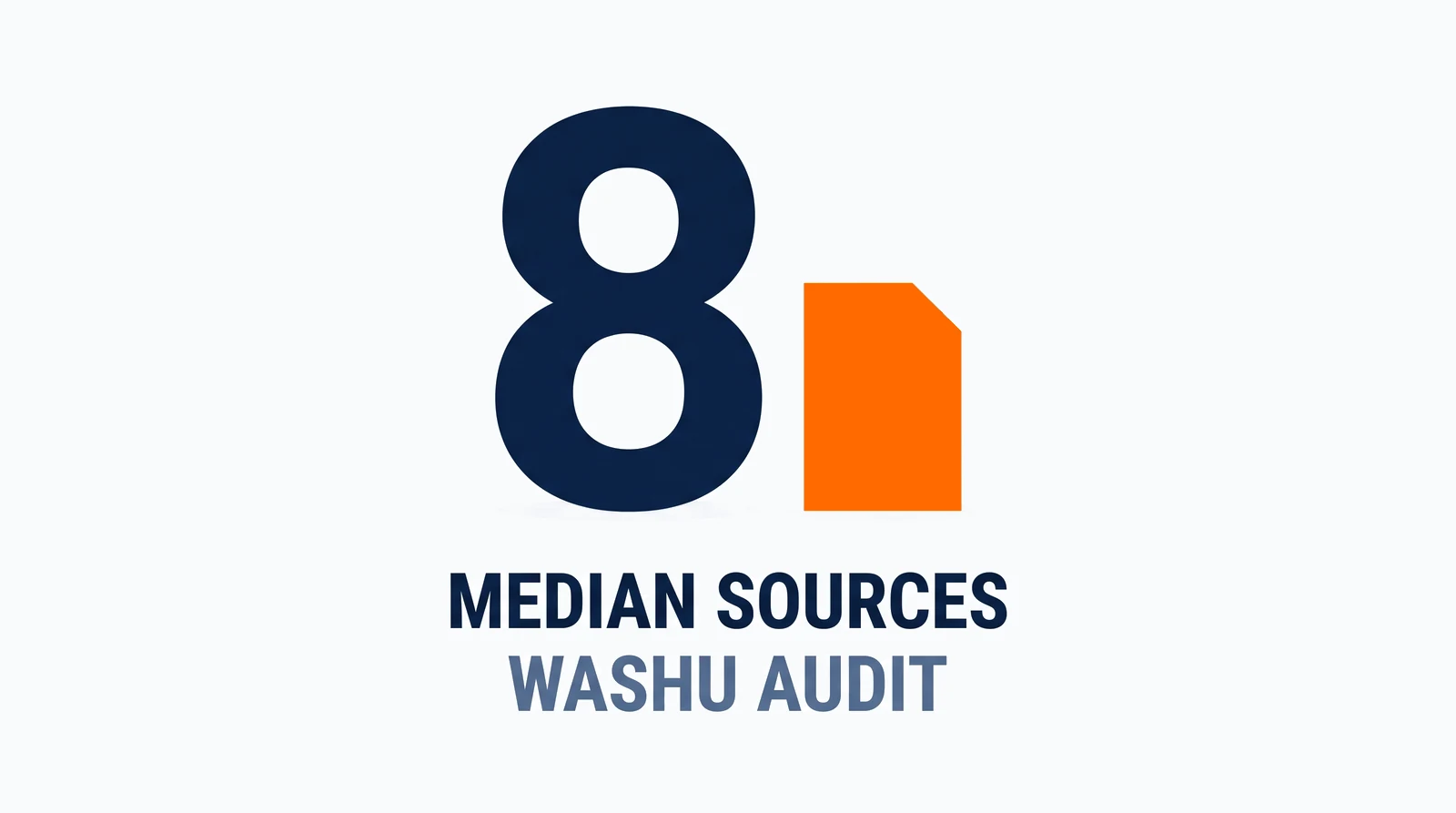
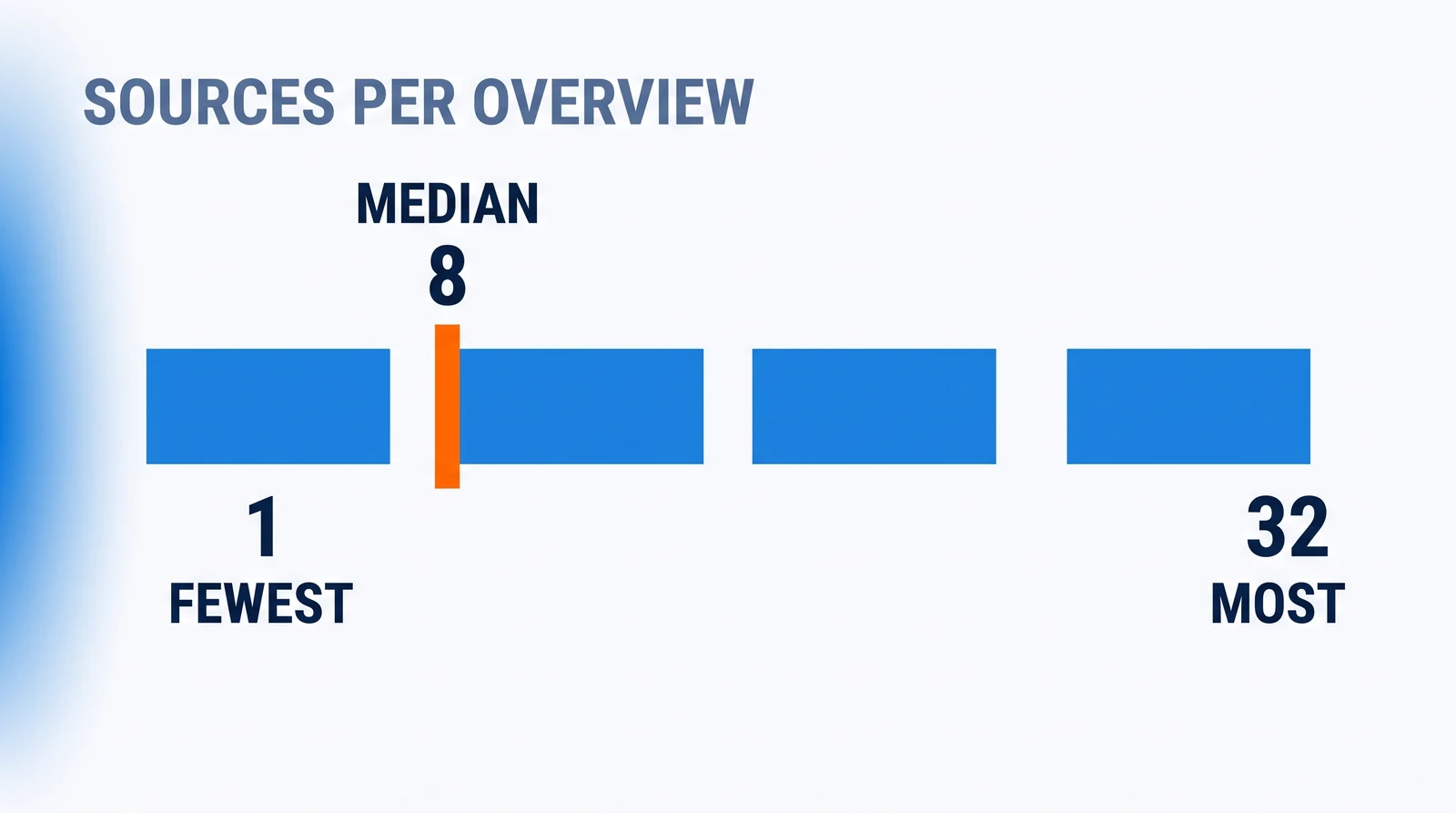
AI Overviews in the independent audit by researchers at Washington University in St. Louis cited a median of 8 sources each: 61,212 reference links across 7,583 overviews, with a mean of 8.1, a minimum of 1 and a maximum of 32. A Google AI Overview is the AI answer shown above the ordinary search results, and the audit's searches were US searches on trending topics, run between 13 March and 21 April 2026. That scope travels with every number from the audit below.
You may have met other figures. Surfer publishes an average of 5 sources per query in a large study and 8 per response in a second. They count the same visible feature, the sources listed with each answer, but on other samples with other designs, and a section further down sets out how each was taken.
Before going further, something you should know about us. We make software that logs the sources AI answers point to, but we have not counted AI Overview sources ourselves. Every number on this page belongs to the team that published it, and it arrives with that team's sample.
What we read: the paper itself, the vendors' own study pages, the search engine's documentation for site owners, and the nine results shown in US search for this question, listed with their dates at the end. Those ranking pages explain how a source gets picked; none of the seven we could open gives a count, and none mentions this audit.
What did the audit count, and how?
The Washington University audit counted every reference citation inside each expanded AI Overview, summary by summary, across 7,583 overviews from US searches.
The design is set out in the paper's full text. Haofei Xu, Umar Iqbal and Jacob M. Montgomery took trending queries from the US version of Google Trends, across 19 topic categories, and ran 55,393 of them over 40 days. Their crawler ran from a single location, a cloud region in Northern Virginia. Every search started from a fresh browser profile with no cookies, no cache and no saved session, so no account was signed in, and the browser presented itself as desktop Chrome on a Mac.
When a summary appeared, the crawler clicked "Show more". The results page truncates long AI Overviews by default, so the authors expanded each summary before collecting every embedded citation. For each citation the crawler recorded the title, the URL and the text fragment the citation was attached to, and it saved the traditional results on the same page, which is what lets the paper compare the two lists. The expand step matters for anyone comparing counts: a tally taken from the collapsed view could turn out different, and we have not tested by how much.
Of the 55,393 searches in the audit, 7,583 produced an AI Overview. How often the feature appears at all is a separate question with its own traps, and we cover it in our read of how often AI Overviews appear. The 7,583 overviews held 61,212 reference URLs from 7,479 distinct hostnames, the web addresses the links point to. The median was 8 per overview, the mean 8.1, and the range ran from 1 to 32. Every overview in the data carried at least one citation.
Weighting each distinct query once, so that queries trending on several days count no more than the rest, moved the average from 8.07 to 7.96, close enough to treat the figure as stable within this sample.
The paper was accepted to the 2026 ACM Internet Measurement Conference, and arXiv's record for it lists it in the conference proceedings, pages 529 to 546. The university's own news story rounds the result to "about eight" sources; the paper's figures are the precise ones, and they agree with that summary.
Does the count change from one topic to another?
The source count changes with the topic, from a median of 7 citations to a median of 12. Across the audit's 19 categories, the low end included sports and climate, and the high end was travel and transportation.
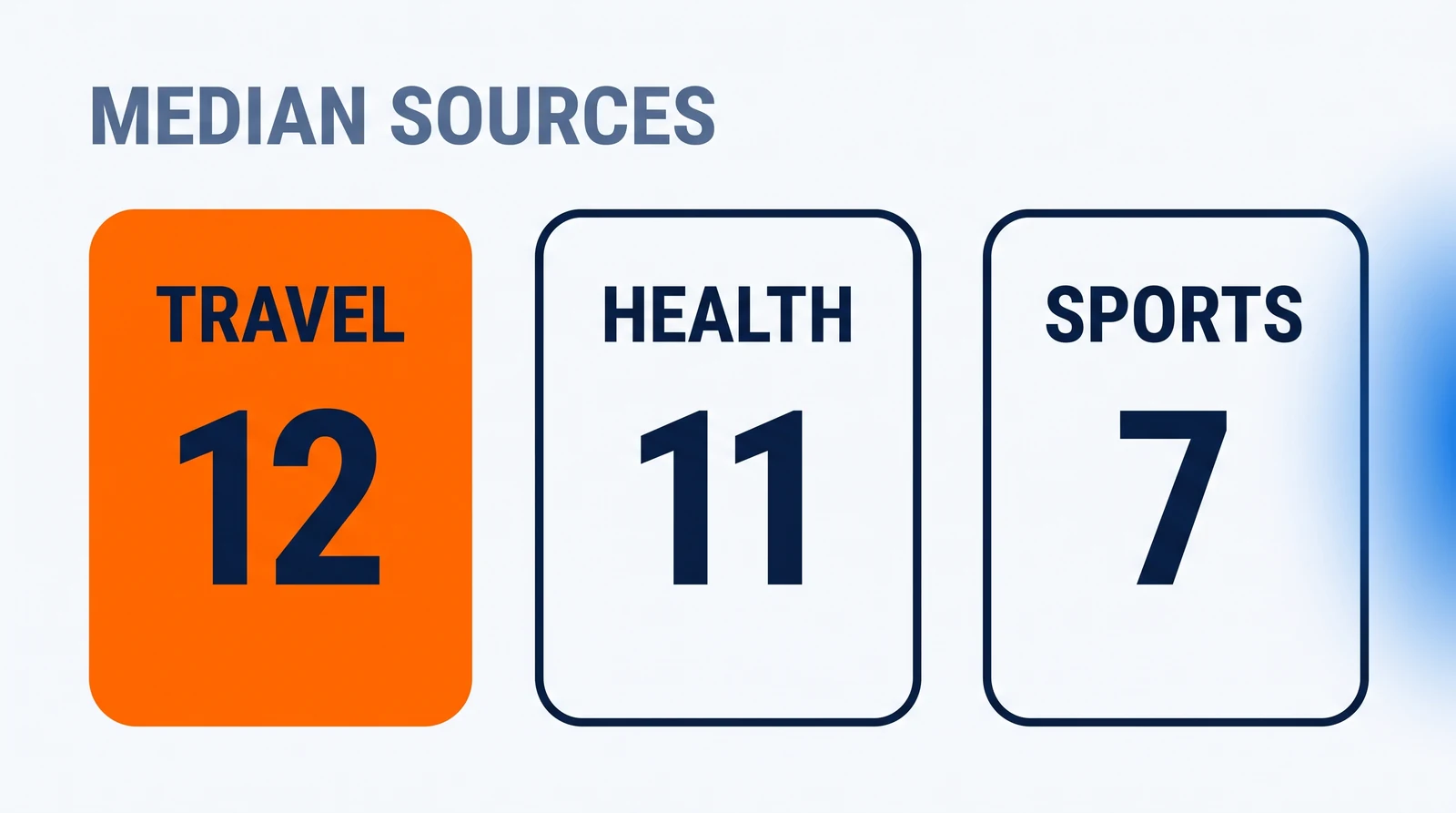
Travel and transportation overviews carried the most citations, with a median of 12. Health followed at 11, and shopping and autos and vehicles at 10. Sports, jobs and education, hobbies and leisure, and climate sat at the bottom, each with a median of 7. The categories are the topic labels on the trends dashboard, so the buckets belong to the trends tool, not the researchers.
Surfer offers a reason in its own words that fits this spread: the number of sources "depends on what Google determines the intent of the query to be and the availability of credible information." The category medians are consistent with that, though neither source proves the mechanism.
The practical consequence is simple. A figure taken from a sample heavy in a single kind of query will not transfer cleanly to another kind. If your work sits in travel or health, a count built mostly on sports searches would likely understate what you see, and the reverse holds too.
Is it the same handful of sources every time?
The sources behind an AI Overview change almost every time the same query runs. The audit compared 17,867 pairs of the same query observed on adjacent days. Among the pairs in which both days produced a summary, a subset whose size the paper does not print, only 0.24% carried an identical set of links.
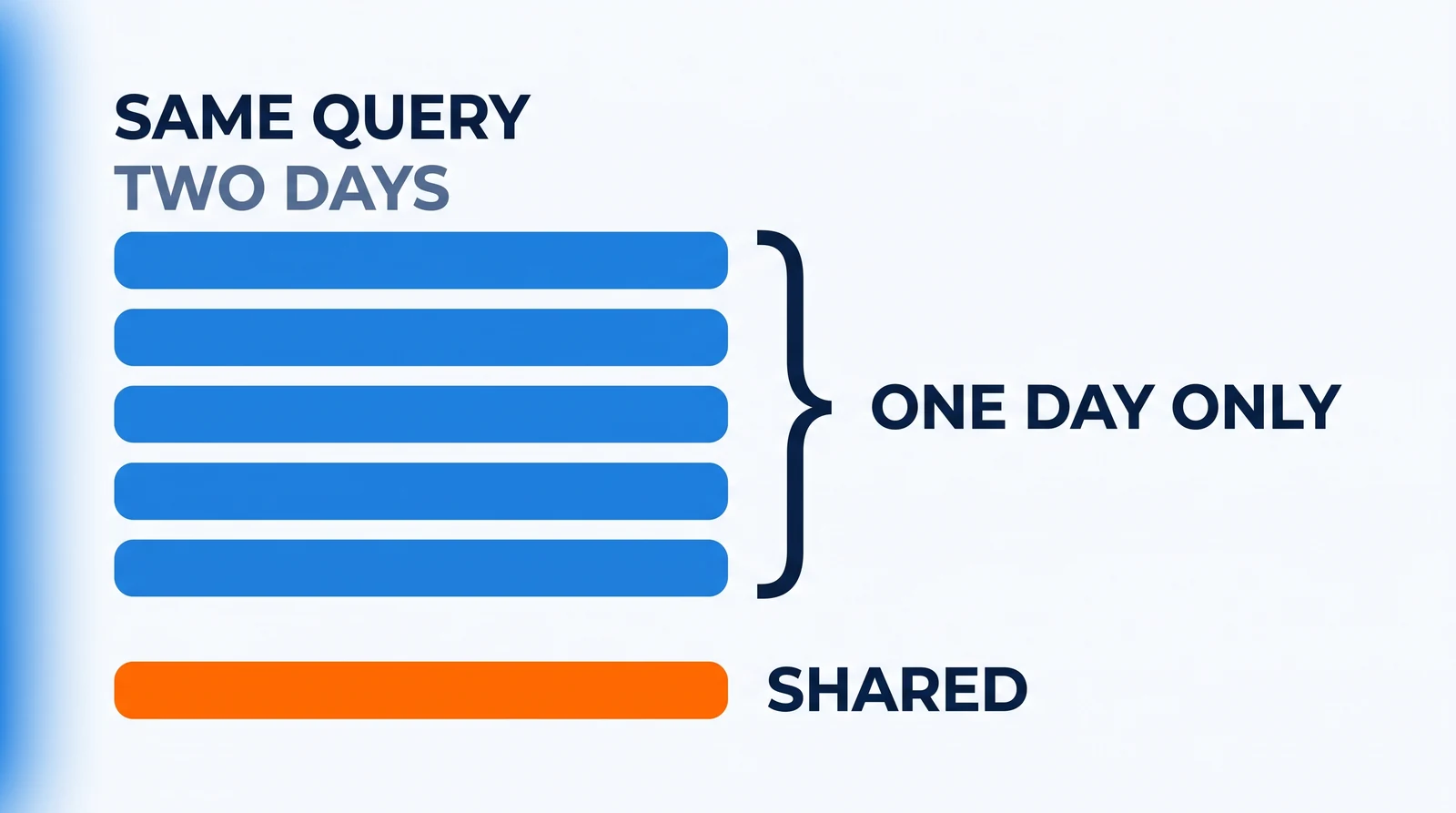
Two observations of the same query a day apart shared, on average, about one link in six of their combined citations, a Jaccard overlap of 0.157 across those same pairs. The average count barely moved under re-weighting; the list behind it changed from one day to the next.
The citations were also spread thin. The 100 hostnames with the most citations took 57.1% of all 61,212 citations, and 4,199 of the 7,466 hostnames in the comparison sample, or 56.2%, appeared exactly once in 40 days. Which sites lead those lists is another question, and our look at which websites AI models cite most covers it. On average, nearly 30% of the domains cited per answer did not appear among the traditional results for the same search, which raises the question of how they are chosen, one this page leaves alone.
Put together, the average looks steady and the sources filling it do not. A snapshot of who appeared for a query is a single draw from a moving list, not a fixed roster. If you follow these citations through an AI visibility tool, this is a likely reason one day's list can look unlike the next: in the paper's data, that churn is how the system normally behaves, not by itself a sign the tool got it wrong.
What do the vendor counts of 5 and 8 measure?
Surfer's 5 and 8 are averages of the sources listed per answer, from two separate studies by Surfer, an SEO software company. They count the same visible feature as the audit, but each study has its own sample and design, and nothing in the three methods as published shows that the figures can be compared directly.
Surfer's large study, last updated on 17 September 2026, rests on 405,576 AI Overviews from queries classified as English. Its count reads: "an average of 5 sources per query, and 90% of the time Google lists 8 or fewer." The page prints its query filter and its intent caveat next to that number, a step most published figures skip. The page gives no collection dates, no country for the searches, and no word on whether each summary was expanded before counting.
Surfer's sources study, written by Jakub Sadowski and last updated on 9 September 2026, reports: "On average, AIO shows 8 sources per response." Half of the time, by the same study, the list holds 7 or fewer, and 2.7% list more than 25. The study ran the same prompts multiple times, over a single day and over a week. Only about 9 to 12% of URLs came back when Surfer ran the same prompts again, which points the same way as the audit's 0.24% identical-set result. The page does not state the number of queries or responses behind the average.
Our read, and it is a read rather than a finding: the gap between 5, 8 and the audit's median of 8 comes from separate query sets, separate periods, and possibly separate counting rules. We say possibly because neither Surfer page states its counting rule.
SE Ranking adds a third figure. Its study of 10,000 US keywords, run in June 2025, reported 13.3 sources per AI Overview, a figure our read of the AI Mode counts covers in context. SE Ranking's own write-up adds that 4,368 of the 10,000 keywords showed the feature at all.
What does the count not tell you?
The audit's median of 8 describes US trending searches in spring 2026, not the source count of the answer on your own queries today, and the figure is not a number to aim for.
The audit ran from one location in the United States. If you search from somewhere else, the paper gives you no basis to assume the same count, and its authors scope their findings to the US experience themselves.
It used trending queries, which are popular or rising topics, not the keyword list a business tracks. It covers one 40-day window in the spring of 2026, and the system changes without notice. It saw the page as a signed-out desktop user. And it could only count pages eligible to appear: a website using noindex or nosnippet controls may be missing from the pool or under-counted, as the paper notes. The search engine's documentation for site owners sets the same limit from the other side: to appear as a supporting link, a page has to be indexed and allowed to show a snippet in Search.
That documentation states no count. The same page says the models "identify more supporting web pages" so it can show "a wider and more diverse set of helpful links associated with the response than with a classic web search", and it notes that AI Mode and AI Overviews can use separate models and techniques, so the links each shows may differ. It also tells site owners to apply "the same foundational SEO best practices" they use for Search overall.
About 11% of the roughly 98,000 claims checked were not supported by the text the researchers could collect from the pages listed as sources, and the authors treat that 11% as an upper limit: their pipeline could not collect every page in full, missing much of what ordinary users post on Reddit, forums and YouTube, and fast-changing pages such as weather forecasts may have been updated before they were saved. Even as a ceiling, the figure is a reminder that a citation shows where an answer looked, not that the answer was faithful to it.
Eight slots on average is not a chance of being one of them, and no SEO tactic follows from the count. Nothing in the paper says a page can earn a place by any particular means, and we will not pretend otherwise.
How should you read the next AI Overview source count you meet?
A published AI Overview source count is only as useful as the method printed with the number, and five questions test that method. If you work in SEO, content or AI search, they take a minute:
- Which surface was counted: AI Overviews, or AI Mode?
- Was each summary expanded, or counted as it first loaded?
- Whose queries: trending topics, a vendor's keyword list, or searches like yours?
- When, and from which country?
- Is it a mean or a median, and across what number of overviews?
These five are our choice of what to check first, and another careful reader might choose others. Whether any count should change your work is your call. What a count tells you is the number of links shown in someone else's sample, during someone else's window.
We will keep reading the counts as they are published and say what changes.
What people actually ask us
Three questions about AI Overview sources arise beyond the count itself: the share of overviews with no link at all, how other AI search tools compare, and what the search engine itself states.
Does every AI Overview cite a source?
All 7,583 overviews in the university audit carried at least one reference citation. Surfer's sources study put the share with no source at all below 1% of its sample, usually on simple common-knowledge queries. Both statements hold for their own samples and periods, and neither covers every search everywhere.
Do ChatGPT and Perplexity cite a similar number of sources to Google?
ChatGPT cited fewer sources than the other two tools in a separate preprint by Zhang Kai, He Xinyue and Yao Jingang, posted in April 2026: a mean of 6.88 per prompt, against 12.06 for Google and 16.35 for Perplexity, across 602 controlled prompts (587 with a usable ChatGPT answer). It is a preprint, it groups the AI Overview with Gemini, its prompts are not a sample of real searches, and it counts the citations logged per prompt rather than links in an expanded answer. We have not counted this ourselves.
Does Google say how many sources an AI Overview shows?
Its documentation for site owners gives no number. It describes a wider and more diverse set of links than a classic search page, and says the links shown will vary between its two AI features.
Sources
- Xu, Iqbal and Montgomery, "Measuring Google AI Overviews: Activation, Source Quality, Claim Fidelity, and Publisher Impact", arXiv 2605.14021, v2 of 1 October 2026 (checked 13 October 2026) — abstract https://arxiv.org/abs/2605.14021 · full text https://arxiv.org/html/2605.14021v2
- Washington University in St. Louis, news story on the audit, 29 September 2026 (checked 13 October 2026) — https://source.washu.edu/2026/09/washu-research-finds-gaps-in-google-ai-overview-citations-claims/
- Surfer, "Google AI Overviews Study: 25+ Statistics from 405,576 searches", last updated 17 September 2026 (checked 13 October 2026) — https://surferseo.com/blog/ai-overviews-study/
- Surfer, Jakub Sadowski, "AI Search Study: Sources in Google AI Overviews", last updated 9 September 2026 (checked 13 October 2026) — https://surferseo.com/blog/ai-overviews-sources/
- SE Ranking, AI Mode research, published 29 August 2025, on a study run in June 2025 (checked 13 October 2026) — https://seranking.com/blog/ai-mode-research/
- Google Search Central, "AI features and your website", last updated 10 December 2025 (checked 13 October 2026) — https://developers.google.com/search/docs/appearance/ai-features
- Zhang, He and Yao, "From Citation Selection to Citation Absorption: A Measurement Framework for Generative Engine Optimization Across AI Search Platforms", arXiv 2604.25707, v2 of 29 April 2026 (checked 13 October 2026) — abstract https://arxiv.org/abs/2604.25707 · full text https://arxiv.org/html/2604.25707v2
- LiamVi, AI Mode citations — https://liamvi.com/blog/ai-mode-citations
- LiamVi, what percentage of searches have AI Overviews — https://liamvi.com/blog/what-percentage-of-searches-have-ai-overviews
- LiamVi, most cited websites by AI models — https://liamvi.com/blog/most-cited-websites-by-ai-models
The ranking set we read. The nine results shown in US search for "how many sources does an ai overview cite", read on 12 October 2026:
- ClickRank, "AI Overviews: How Sources Are Selected in 2026", 26 January 2026 — https://www.clickrank.ai/how-ai-overviews-select-the-source/
- The HOTH, "How to Get Cited in AI Overviews: An Engine-by-Engine Guide for 2026", 9 July 2026 — https://www.thehoth.com/blog/how-to-get-cited-in-ai-overviews/
- OMCP, a Facebook post (could not be opened) — https://www.facebook.com/OMCPCertified/posts/only-38-of-google-ai-overview-citations-now-come-from-top-10-ranking-pages-last-/1368106598685859/
- SISTRIX, "The Path to AI Citations: What the Top 100 Most Cited Websites are Doing Right", 4 December 2025 — https://www.sistrix.com/blog/the-path-to-ai-citations-what-the-top-100-most-cited-websites-are-doing-right/
- Finch, "How AI Overviews Choose What to Cite: A Guide to GEO", 22 March 2026 — https://finch.com/blog/how-ai-overviews-choose-citations/
- LLM Pulse, "AI Citations: what they are, sources, and how to earn them", updated 5 October 2026 — https://llmpulse.ai/blog/glossary/ai-citations/
- AuthorityTech, "Track AI Visibility: ChatGPT, Perplexity, Google AI Mode", 3 April 2026 — https://authoritytech.io/curated/ai-citation-11-percent-platform-overlap-per-engine-audit-2026
- Brandlight, "Where AI Citations Actually Come From - And Why Traffic Isn't the Answer", 11 August 2026 — https://www.brandlight.ai/blog/where-ai-citations-actually-come-from---and-why-traffic-isnt-the-answer
- A Reddit thread in r/AI_SearchOptimization (could not be opened) — https://www.reddit.com/r/AI_SearchOptimization/comments/1w809qt/ai_search_sources_are_extremely_concentrated_15/
Of the seven we could open, none states a source count for an AI Overview, and none mentions the Washington University audit.