Does ChatGPT cite its licensing partners more? What the deals say, and what has been measured
Nothing published that we could find shows that a licensing deal causes ChatGPT to cite a publisher more often. The deal announcements we read promise attribution, summaries and links when a partner's journalism appears. One large study of June 2026 data found that news pages from OpenAI's licensees were cited more times per cited page than pages from publishers with no deal, and it calls that an association rather than a cause. A separate capture from July 2026 found that the company's own index handed the model licensed and unlicensed pages in the same form, though the contracts showed up in the word limits the company's search API sets for some publishers.
Our own product measures which sources AI assistants cite. One of the two companies behind that study of June 2026 data works in the same field. We have measured nothing about licensing ourselves. Each figure below stays with the organisation that produced it, together with its sample and the limits it states.
What do OpenAI's licensing deals promise on display?
The public terms of the OpenAI news partnerships we read describe how a partner's journalism will look when ChatGPT uses it: credited, summarised and linked. None of the announcements we read promises a partner a share of answers or a place among the sources. Guardian Media Group's partnership was announced on 14 February 2025, and the Guardian's release says that "Guardian reporting and archive journalism will be available as a news source within ChatGPT, alongside the publication of attributed short summaries and article extracts." OpenAI's chief operating officer, Brad Lightcap, gave the aim in the same release as "providing access to relevant, real-time news content."
The company's own posts on earlier partnerships use the same vocabulary. The Axel Springer partnership dates from 13 December 2023, and its announcement says ChatGPT users "will receive summaries of selected global news content" from brands including Politico, Business Insider, Bild and Welt, "including otherwise paid content", with answers that "will include attribution and links to the full articles". The Atlantic followed on 29 May 2024; that post says the magazine's articles "will be discoverable within OpenAI's products" and that "Queries that surface The Atlantic will include attribution and a link to read the full article". OpenAI's site refused our requests on 6 October 2026, so we read both posts through Internet Archive copies of 4 October and 8 September 2026.
"More discoverable", from the opening line of the Atlantic post, is the nearest any of these texts comes to a promise about visibility, and it is a promise about being findable, not about being cited more often than anyone else. The Financial Times and News Corp terms read much the same, and we quoted them in our look at the paywall test. The contracts themselves are private; what the deals are worth, and how little of that is public, is covered in our read of the licensing deals.
What does any site need in order to appear in ChatGPT search?
OpenAI's crawler documentation sets one condition for appearing in ChatGPT's search answers, and it applies with or without a deal: the company's search crawler must be let in. The documentation puts it directly: "To help ensure your site appears in search results, we recommend allowing OAI-SearchBot in your site's robots.txt file and allowing requests from our published IP ranges". The training crawler, GPTBot, is a separate switch, since "Each setting is independent of the others", and the documentation we read says nothing about partners or licensing. Being reachable is only the start: a page can be fetched often and quoted never, which is why we count the quote rather than the visit.
Partners may also have a second way in. Resoneo, whose capture is taken up below, reports a mechanism described to it by Jérôme Salomon of Oncrawl: "partners have an API to push their articles to OpenAI, and those articles are available without ever having needed a first crawl." By Resoneo's account, articles that arrive that way are crawled less afterwards than others. That is an outside observation, not documentation, and the company's crawler documentation does not describe a partner channel.
What did the OtterlyAI and PressRanger study count?
The OtterlyAI and PressRanger study counted citations per cited news page, and on ChatGPT it found OpenAI's licensees ahead. OtterlyAI, which sells AI search monitoring, and PressRanger, a PR platform that compiled the list of deals, published the AI Licensing Deals Study in August 2026. Its data is 129.3 million AI citations from June 2026, across 19,812,878 cited-URL records on seven AI search platforms: ChatGPT, Google AI Overviews, Google AI Mode, Perplexity, Microsoft Copilot, Gemini and Claude. PressRanger's licensing research supplied 91 confirmed agreements mapped to 314 publisher domains, with public evidence up to 28 July 2026.
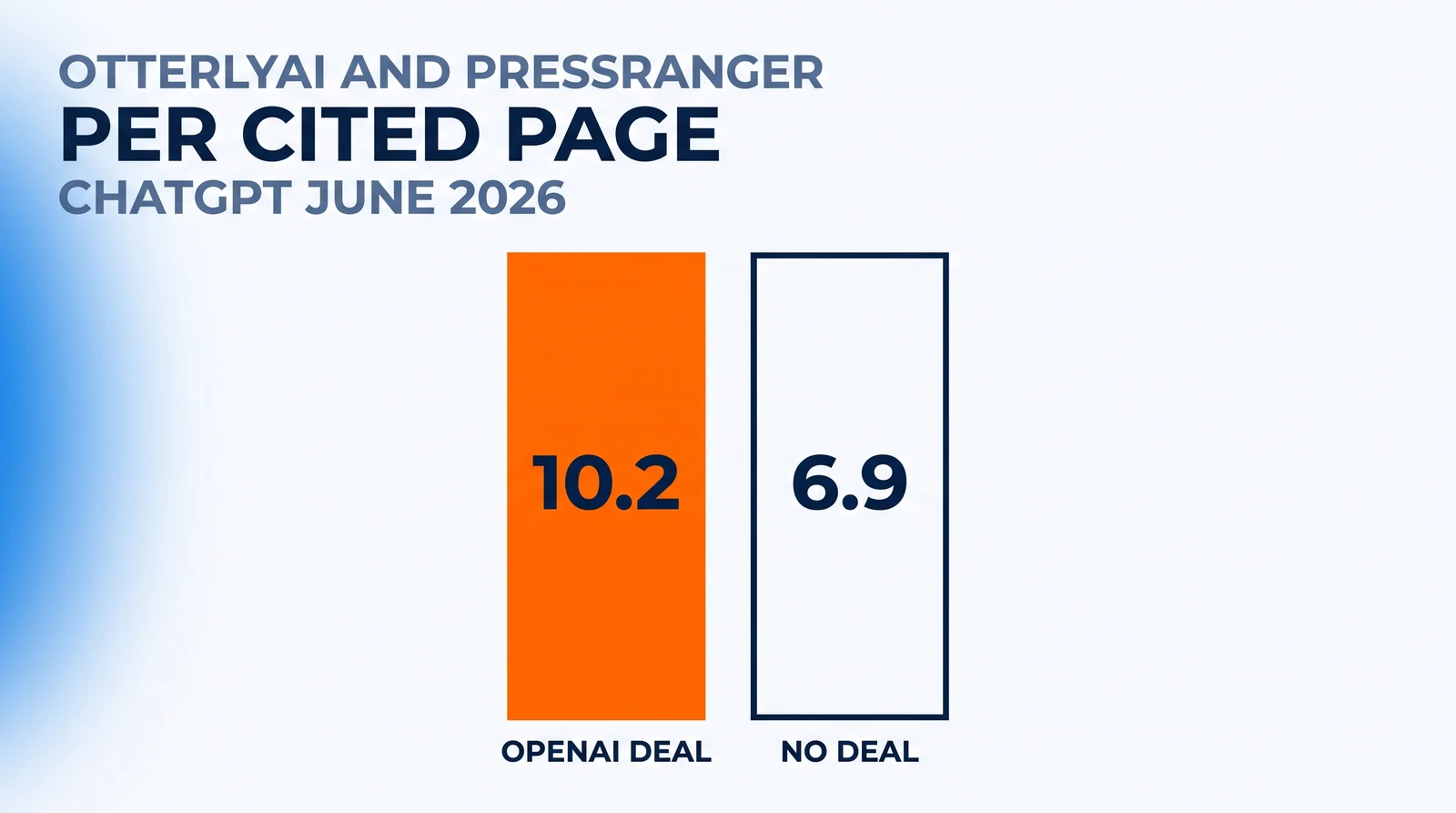
On ChatGPT in June 2026, news pages from publishers with an OpenAI deal were cited 10.2 times each on average, against 6.9 for pages from news publishers with no licensing deal at all. The study calls that gap a 48% premium. Both averages count only pages cited at least once, so the figure compares one set of cited pages with another. It does not tell you how likely a page is to be cited in the first place, and the study's write-up does not say how many pages sit in each group. Publishers that signed with OpenAI and nobody else show 112% more citations per cited page on ChatGPT than unlicensed publishers.
The study is open about its unit, and its design meets part of the first objection most readers will have, that big publishers simply get cited more. It divides each group's citations by its cited pages, so neither group comes out ahead just by having more of them, and it says it also checked the ChatGPT result against unlicensed publishers of similar citation volume. It reports where deals showed nothing, too: Google's licensees were cited at a slightly lower rate than comparable unlicensed publishers on Google AI Overviews, and Perplexity's licensees came out level on Perplexity.
The study draws its own line under the finding. Its June data is a one-month snapshot, and its authors write that "all findings describe association, not causation." It also records a change in ChatGPT's citation behaviour on 8 August 2026, after the June window had closed. The Media Copilot, reporting the study on 24 August 2026, added limits of its own: the analysis "has not been peer reviewed", it publishes no method for choosing the comparable unlicensed publishers, it comes from two companies with products tied to media distribution and AI visibility, and OpenAI "has largely signed prominent, English-language news organizations that may already have been more likely to appear in AI answers." The Media Copilot also notes that dividing by cited page "helps account for publisher size" but "does not control for every difference between licensed and unlicensed outlets."
What did Resoneo see inside OpenAI's own index?
Resoneo's July 2026 capture of ChatGPT found that OpenAI's own index handed the model licensed and unlicensed pages in the same form, although the contracts did show up in another channel Resoneo measured. Resoneo is a French search engine optimisation consultancy that gives away the browser extension it used to capture the data, as Search Engine Journal described it on 11 August 2026, before the OtterlyAI study was published. Its own write-up, dated July 2026 and updated in August, rests on a capture of 1,249 ChatGPT answers across free, paid and logged-out accounts in several countries, plus two instruments run by Salomon; it gives no count of the partner pages behind its licensing comparison.
Comparing results from the same engine, Resoneo writes that "having a licensing deal or not changes nothing about the treatment: hundreds of outlets with no agreement get exactly the same format, the same length, the same freshness as the partners." On news, it adds that the long machine-written summary the model receives "is not a licensing perk".
The contracts did show up elsewhere in Resoneo's data. Through OpenAI's web search API, on 7,782 results analysed with Salomon's instrument, each domain carries a fixed word budget for each channel, and the default is 200 words. Resoneo's 100-word class held 11 domains, "all of them known licensees", among them Le Monde, the Wall Street Journal and Politico, and Resoneo says it "Looks like a contract clause". A 25-word class mixes publishers with deals and publishers without. A smaller word budget is not obviously an advantage; it shows that terms differ, not that citations rise.
Resoneo did not reach the step the OtterlyAI and PressRanger study counted. Of 58,000 URLs ChatGPT retrieved in its capture, 7,600 were promoted to sources and 5,000 were cited in the answer text, and we found no comparison in the write-up of how often licensed and unlicensed pages were cited.
Do the two findings contradict each other?
Resoneo's July capture and the OtterlyAI study do not contradict each other, because one counted how OpenAI's own index serves a page and the other counted citations per cited page. Resoneo looked at how a page reaches the model through one route; the study looked at how often a page, once cited, was cited again across a month. A deal can leave the first step untouched and still go together with more of the second.
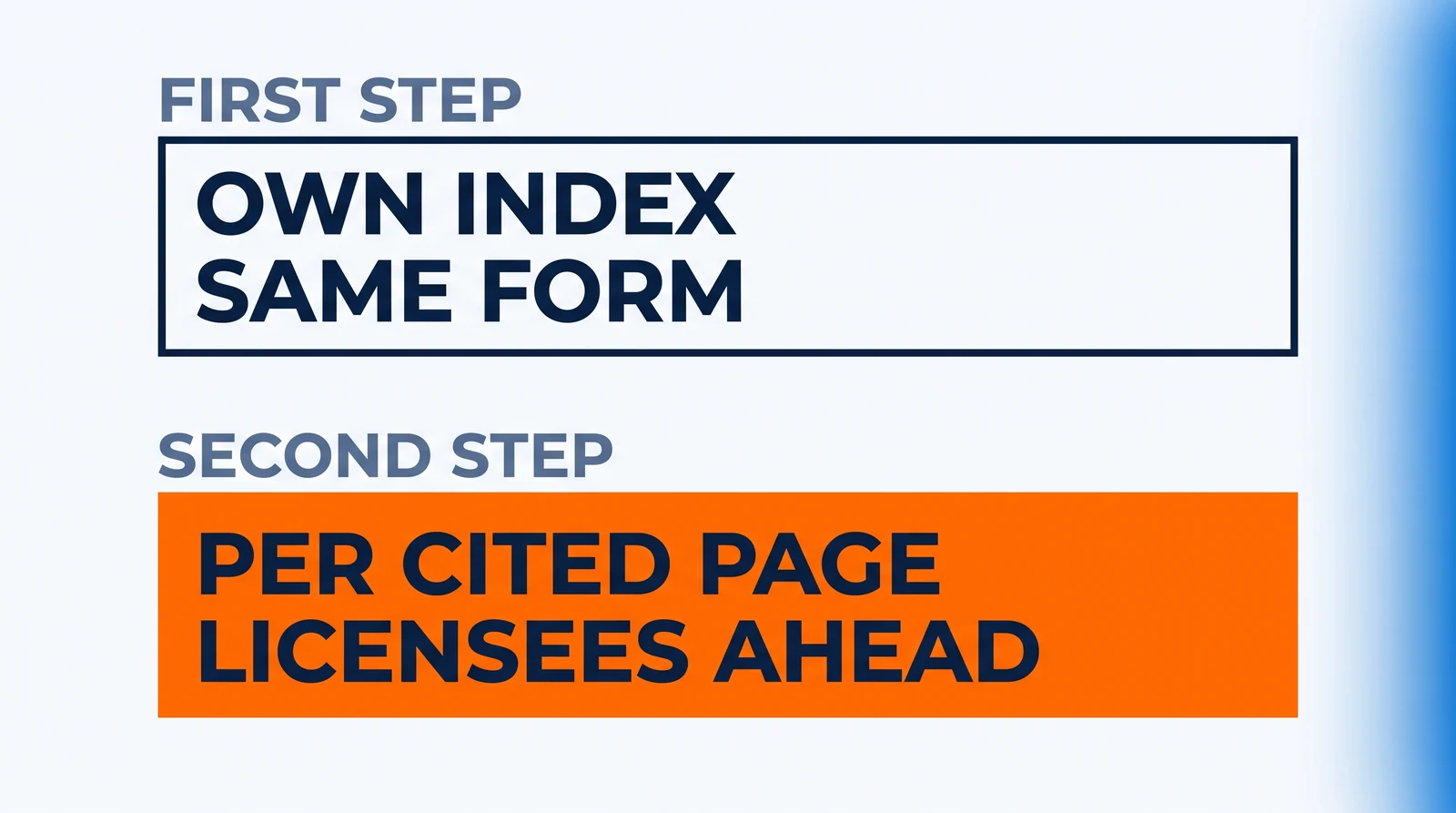
Several things could sit in that gap: articles pushed in through a partner channel, the different word budgets, the kind of outlets the company chose to sign, or something neither study measured. Neither shows which of these, if any, is at work. A test that followed the same pages before and after a partnership, or one that compared cited and uncited pages from the same publishers, could start to separate them. Of the pages we read on 6 October 2026, none set these two findings side by side; each reported one.
So the reading the evidence supports is narrower than either headline. A deal and more citations per cited page went together on ChatGPT in June 2026, and in July those agreements did not change what the company's own index handed the model. That stops short of saying deals cause citations, and short of saying they make no difference.
What does IPPR's news test add?
IPPR's 100-query UK news test found ChatGPT's most-cited outlets often lining up with OpenAI's deals, and IPPR says it cannot tell whether the deals caused that. The Institute for Public Policy Research published the report on 30 January 2026, written by Roa Powell and Carsten Jung. Its queries were generated with Claude Sonnet 4.5 and checked by people, then put once to four AI tools, GPT-5, Google AI Overviews, Google Gemini and Perplexity, between October and November 2025; more than 2,500 links were analysed.
In IPPR's test, ChatGPT cited the Guardian, an OpenAI partner, in 58 per cent of its responses to the 100 queries. The BBC, which blocks AI companies from scraping its content, appeared in none of them, and IPPR says the BBC's block, together with its threats of legal action, "may explain this". The report finds that "licensed publications appeared prominently in AI answers" and titles one figure "ChatGPT's top citations often align with OpenAI's publisher deals". It also asks the question this article asks: "Questions need answering around how financial relationships between AI companies and news brands shape AI answers." Its own limit is stated plainly: "Whether and how these deals affect content visibility in AI responses remains unclear." The test was run once, on UK news, months before either 2026 study and before the 8 August change.
What can a publisher check for itself?
Letting OpenAI's OAI-SearchBot crawler in is the one condition OpenAI's crawler documentation sets, and every publisher controls it; whether a deal adds anything beyond that is still unresolved, but the rest can be checked from your own side. These are the checks we would run, offered as our view rather than a standard:
- OAI-SearchBot is allowed in your robots.txt, and OpenAI's published IP ranges can reach your server. GPTBot, the training crawler, is a separate setting, and blocking it does not take you out of search.
- If you hold a deal, read its display term, and ask your contact at OpenAI whether your articles are pushed to it or crawled; Resoneo's work suggests the route changes how they arrive.
- When you count your own citations in ChatGPT, keep two numbers apart: how many of your pages were cited at all, and how often each cited page was cited. The study's figure describes the second.
- Date every count. The study records a change in ChatGPT's citation behaviour on 8 August 2026, and figures from either side of it may not compare.
Whether a deal is worth seeking depends on money, terms and readers we cannot see, and that call is yours. The measurements so far say an OpenAI deal and more citations per cited page went together on ChatGPT in June 2026; they do not yet say why. A published matching method, a test at the citation step itself, or a statement from OpenAI on how it treats partner content would move the answer, and we will read whichever arrives first.
Sources
- The Guardian — Guardian Media Group announces strategic partnership with OpenAI (14 February 2025). Checked 6 October 2026.
- OpenAI — Axel Springer partnership (13 December 2023). Read through the Internet Archive copy of 4 October 2026; the live page answered 403 on 6 October 2026.
- OpenAI — A content and product partnership with The Atlantic (29 May 2024). Read through the Internet Archive copy of 8 September 2026; the live page answered 403 on 6 October 2026.
- OpenAI — Overview of OpenAI Crawlers — OAI-SearchBot, GPTBot and the published IP ranges. Checked 6 October 2026.
- OtterlyAI and PressRanger — AI Licensing Deals Study (August 2026; citation data from June 2026). Checked 6 October 2026.
- The Media Copilot — OpenAI-licensed publishers got 48% more ChatGPT citations in June, study finds (24 August 2026). Checked 6 October 2026.
- Resoneo — What ChatGPT pulls, what it shows, what it cites (July 2026, updated August 2026). Checked 6 October 2026.
- Search Engine Journal — ChatGPT's Search Index Serves Small Sites Too, Data Shows (Matt G. Southern, 11 August 2026). Checked 6 October 2026.
- IPPR — AI's got news for you: Can AI improve our information environment? (Roa Powell and Carsten Jung, 30 January 2026; report PDF and press release). Checked 6 October 2026.