Most cited websites by AI models: the same handful of domains turns up in every index
Five separate indexes of the most cited websites by AI models have been published since November 2025, and they were built five different ways. The collection windows run from seven days to six months. The surfaces run from a single Google feature to five. The samples run from three million queries to more than a hundred million citations. None of them compares itself with any of the others.
They still name the same handful of cited domains. Reddit and YouTube sit in the top five of all five indexes. Wikipedia and LinkedIn sit in the top five of three. That agreement survives every methodological difference, and it is the part worth acting on.
The percentages beside those names are another matter. Three of these indexes publish a citation share for YouTube, and the three read 22.9%, 13.8% and 2.1%, because each is a share of something else.
Which websites do AI models cite most?
Reddit and YouTube are in the top five of every index we opened.
Counting each index's top five as published, read on 17 September 2026: Reddit appears in five of five, YouTube in five of five, Google in four of five, and Wikipedia and LinkedIn in three of five each. That count is ours, taken off their published lists rather than from any claim they make, with Semrush's three per-surface lists counted as one index — Reddit is on all three, YouTube on the AI Mode list alone. Peec ranks ten cited domains and attaches no figure to any of them, so its top five is an ordering and nothing more.
No percentage appears in the table below on purpose: a column of percentages from five separate indexes would be five quantities pretending to be one.
| Published by | Sample | Window | Surfaces | The unit, in its own words | Domains it names at the top | |---|---|---|---|---|---| | Semrush, 10 Nov 2025 | 230K prompts, 100M+ citations | 14 Jul – 12 Oct 2025 | ChatGPT search, Google AI Mode, Perplexity | never labelled; figures are phrased as a domain "appearing in" a share of prompt responses | Reddit, Wikipedia (ChatGPT); LinkedIn, YouTube, Reddit, Google (AI Mode) | | Peec, 31 Mar 2026 | 30 million sources, US | not stated on the page | ChatGPT, Google AI Mode, Gemini, Perplexity, AI Overviews | "we counted actual sources that were directly cited by LLMs" | Reddit, YouTube, LinkedIn, Wikipedia, Forbes | | Ahrefs, 2 Sep 2026, refreshed monthly | 3M+ US queries, via Brand Radar | September 2026 | Google AI Overviews only | "mention share — a domain's citations as a percentage of the summed citations of the top 50 most-cited sources" | YouTube, Reddit, Facebook, Google, Instagram | | LLM Pulse, snapshot 16 Sep 2026, rebuilt daily | millions of answers weekly; locale not stated | rolling 7 days | ChatGPT, Perplexity, Gemini, Google AI Mode, AI Overviews | "the percentage of AI answers in the last 7 days that cited at least one link on a given domain" | YouTube, Google, Reddit, Facebook, Instagram | | Goodie, 27 Apr 2026 | 58,642,927 citations; locale not stated | Oct 2025 – Mar 2026 | ChatGPT, Gemini, Claude, Perplexity | "the percentage of AI answers that reference a given domain" | Wikipedia, YouTube, Reddit, Google, LinkedIn |
Two of these publish no locale and Peec publishes no collection window, which are not small omissions in a document whose whole output is a ranked list.
What can be checked is what each page states and what each says its figure measures. Whether the arithmetic behind any of these numbers is right is not something a reader can check, and that applies to every figure below.
Why three shares of YouTube read 22.9%, 13.8% and 2.1%
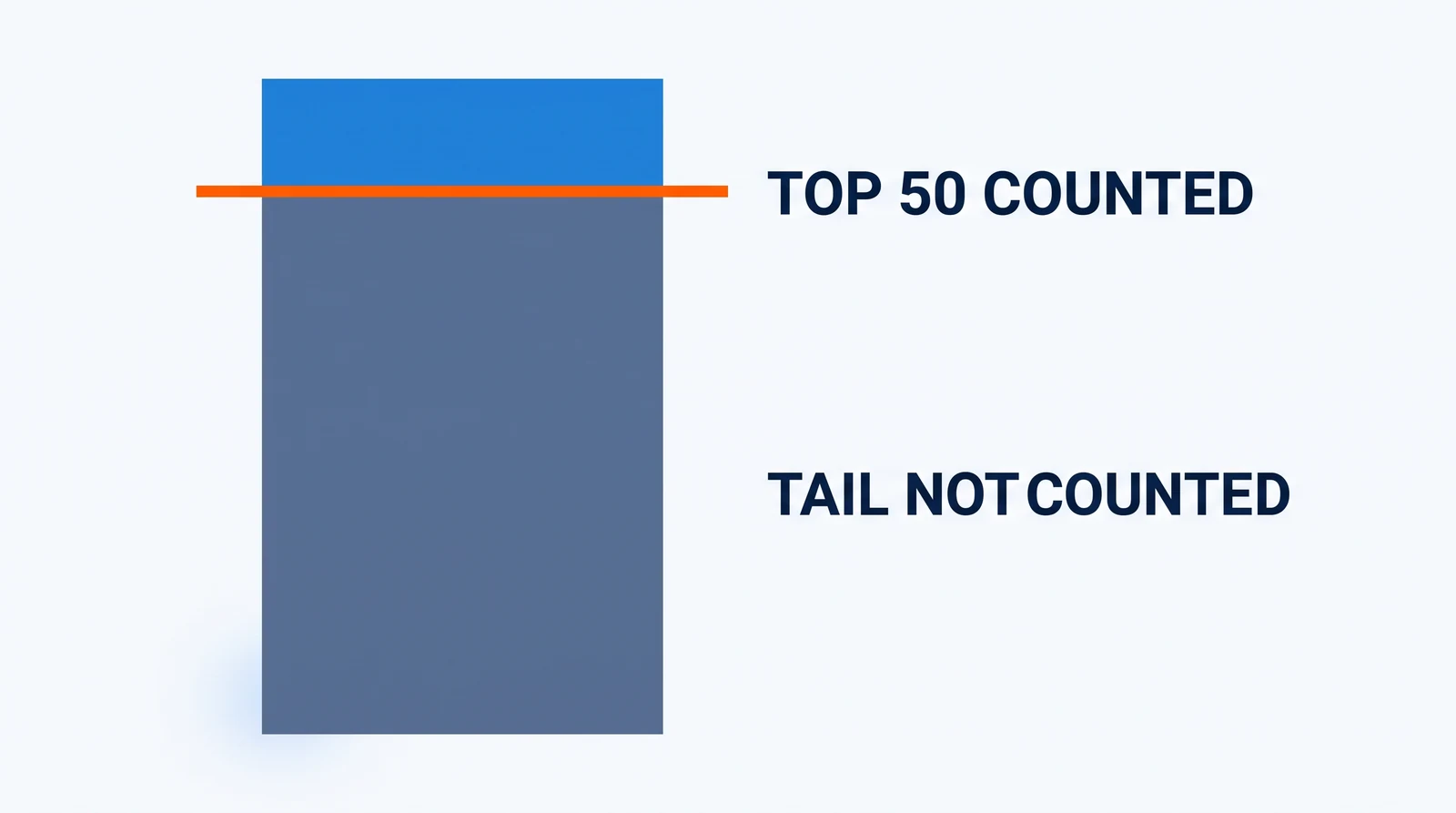
Ahrefs reports youtube.com at 22.9% mention share across more than three million US queries in Google AI Overviews during September 2026. Its denominator is a restricted pool rather than everything: the page defines mention share as "a domain's citations as a percentage of the summed citations of the top 50 most-cited sources", so the entire tail below the fiftieth domain is cut off the bottom of the fraction. On the same basis reddit.com reads 18.5%.
LLM Pulse and Goodie both divide by answers instead. LLM Pulse's snapshot dated 16 September 2026 covers a rolling seven days across ChatGPT, Perplexity, Gemini, Google AI Mode and AI Overviews, and reports youtube.com at 13.8%, google.com at 8.58% and reddit.com at 6.29%. Its ranking is rebuilt daily, so a figure quoted from it has a shelf life measured in days.
Goodie puts en.wikipedia.org at 3.4%, youtube.com at 2.1% and reddit.com at 1.4%, from an analysis of 58,642,927 citations collected between October 2025 and March 2026 across ChatGPT, Gemini, Claude and Perplexity.
A share of fifty domains and a share of every answer are two fractions that happen to use the same word, and they cannot be ranked against each other at all. Setting Ahrefs' 22.9% beside Goodie's 2.1% and reading a disagreement into the gap is an arithmetic mistake rather than a dispute between researchers.
Two indexes define citation share almost identically and one reports YouTube six times higher
LLM Pulse reports youtube.com at 13.8% and Goodie at 2.1%, and both describe the unit as a percentage of answers. LLM Pulse: "Citation share is the percentage of AI answers in the last 7 days that cited at least one link on a given domain." Goodie: "Citation share is the percentage of AI answers that reference a given domain." A reader comparing those two sentences would expect the same quantity.
Window and surfaces explain part of the gap. The rest sits in a line only one page carries. LLM Pulse states outright that "a domain counts once per answer, even if cited multiple times" and that "an answer with zero citations is excluded from the denominator"; Goodie's page does not say. Asked directly whether answers containing no citations are part of its denominator, and how many answers the 58,642,927 AI citations came out of, that page is silent on both. The second figure would settle it, and it is not published.
We have written about that silence before, about monitoring dashboards rather than published indexes: a share figure hides its denominator, and where a tracked prompt comes back citing nobody, dropping that cell as no-data and scoring it as a loss are both defensible — and they send the same raw observations in opposite directions. An index has the same choice to make on a far larger pool, and Goodie's page does not tell you which way it went. A companion piece on how often AI Overviews actually appear works through the same problem on another quantity.
Everything PR sorted six studies into a single ranking without separating their units
Everything PR's AI citation source index, dated 16 August 2026, prints one ranking whose top five entries alone carry four kinds of quantity. It says it is "synthesized from six independent studies" — Profound, Semrush, Ahrefs, Search Engine Land, Muck Rack and Visual Capitalist. Reddit appears at "~40% multi-engine aggregate", Wikipedia at "26-48% of ChatGPT's top-10 citations", YouTube at "~19% of Google AI Overviews top-source share", and LinkedIn and Forbes at "Top-5 multi-platform" and "Top-5 across all platforms". An aggregate, a share of one engine's top ten, a share of one Google surface and two ordinal positions, in one list. The page nowhere states that the units of its six studies differ.
A LinkedIn post by Evan Bailyn goes further than anyone else on this results page and sets two studies against each other directly, describing how "in June 2025, an infographic began circulating showing the websites most cited by AI Models based on a SEMrush study of 150,000+ citations", then answering it with its own research team's run of 36,127 buying-intent queries on ChatGPT: Reddit and similar communities "only make up around ~11% of their commercial recommendation algorithm". That is the most careful reading on this results page, and it still does not say what its own 11% is a percentage of.
First Page Sage, an SEO blog, last updated 2 July 2026, names the problem in a sentence — "the problem is that these datasets do not separate according to search intent" — and names intent, never the unit. Its own output is not a domain share: across 36,140 buying-intent queries on ChatGPT, Perplexity, Claude and Gemini it publishes raw citation counts by website category, product recommendation media at 7,228 and consumer review platforms at 5,746. A sixth kind of quantity, and a perfectly reasonable one.
Three of the eight pages we could open try the comparison; none separates the units.
Domain authority is not a prerequisite for citation, and we tested that rather than assumed it
Large, authoritative websites is the obvious explanation, and our own small test of it came out a coin flip. Domain authority is an SEO metric, and our eight-signal review reported 21 pairs matched on a shared keyword in which the higher-authority page came out ahead 11 times and behind 10. A far larger dataset points the same way on the conversion rate: across 82,108 citations, AirOps reported on 12 March 2026 that the DA 80–100 tier converted retrieval into citation 15.0% of the time, against 21.5% to 23.6% for every tier beneath it. Neither result shows a large brand being penalised: ours is 21 pairs, and theirs is a conversion rate among pages that had already been retrieved. Neither rules authority out: AirOps also puts the DA 80–100 tier at 25.4% of all citations. What both support is narrower — high domain authority is not a prerequisite for being cited — and we are not going to swap a tested answer for a fresh guess.
Assistant market share is a share of users or of queries; citation share is a share of answers, or of the citations inside them. A move in either implies nothing about the other.
Almost every domain at the top of these lists hosts somebody else's work
Reddit, YouTube and LinkedIn publish what their users post. So does Facebook, which Ahrefs and LLM Pulse both place in their top five. Wikipedia is a reference work. Forbes and TechRadar are publishers. Almost nothing near the top of any of these indexes is a brand's own marketing site — a description of the list's shape, not advice.
For somebody who owns an ordinary domain, the honest read follows from that. An open-web index measures a population you are mostly not in: it can tell you which categories of page hold ground in AI search, and it cannot tell you who holds the specific queries your buyers ask. We published a category-level reading that answers the second question, and the framework it sets out for reading any citation index — measured where, over what set, on what date, and then what exactly is being counted — is the one applied above, the fourth question doing all the work. Those questions are ours, and so is the interest behind them: we build a measurement tool, and telling people to interrogate measurements suits us.
When the next citation share arrives, in a pitch or an SEO report, the useful move is small. Ask what sits on top of the fraction and what sits underneath it. If the page does not say, you do not have a number yet. You have a ranking — and the ranking is the part that survived five separate attempts to measure the same thing.
What people actually ask us
Is there one definitive top ten of most cited websites by AI models? No, and there cannot be while the published indexes measure different surfaces over different windows with different units. What exists instead is a stable core — Reddit and YouTube in every top five we read on 17 September 2026, with Wikipedia, LinkedIn and Google close behind in most — and a tail that reorders with the method. Treat the core as the finding and the ordering as an artefact of the instrument.
Why is Reddit at the top of nearly every list? Every index we opened reports it there, and none publishes a test of why. Semrush's own data shows the position is not even stable inside one instrument: ChatGPT cited Reddit in close to 60% of prompt responses in early August 2025 and around 10% by mid-September, within a single thirteen-week window. Any explanation you read for Reddit's position is an inference rather than a measured result.
Can I get the top 100 cited domains in ChatGPT? Not from these. Ahrefs computes mention share against a pool of the top 50 sources and shows the leaders of it, LLM Pulse and Goodie publish ten rows each, and Peec lists ten domains with no figures attached. You can read the counts and the dates; you cannot audit them.
Which index should I use? The one whose surface and window match the query you are asking about. Ahrefs measures Google AI Overviews and nothing else; LLM Pulse covers five surfaces on a rolling week; Goodie's window runs six months. Reading two of them as rival estimates of one number is the mistake.
Are "most popular AI websites" the same thing as most-cited websites? No — two questions that share a shape. The popular-AI-websites question is about which AI products people use, a traffic or market-share measurement. The most-cited-websites question is about which sources turn up inside AI answers, which is what every index above counts. A site can be cited constantly by assistants and have no AI product of its own.
Sources
All URLs checked 17 September 2026.
- Semrush, Most cited domains in AI, published 10 November 2025 — 230K prompts, 100M+ citations, 14 July to 12 October 2025, ChatGPT search / Google AI Mode / Perplexity. The unit is never labelled in a methods line — https://www.semrush.com/blog/most-cited-domains-ai/
- Peec AI, Top domains cited by AI search, published 31 March 2026 — 30 million sources, US, five platforms. No collection window stated on the page — https://peec.ai/blog/top-domains-cited-by-ai-search-analysis-based-on-30m-sources
- Ahrefs, Most cited domains in Google AI Overviews, published 2 September 2026, refreshed monthly — 3M+ US queries, September 2026, Google AI Overviews only — https://ahrefs.com/blog/most-cited-domains-ai-overviews/
- LLM Pulse, Top cited domains, snapshot 16 September 2026, rebuilt daily — rolling 7-day window, five surfaces. No locale stated on the page — https://llmpulse.ai/data-studies/top-cited-domains
- Goodie, Most cited domains in LLMs, published 27 April 2026 — 58,642,927 citations, October 2025 to March 2026, four models. No locale stated, and no denominator treatment stated — https://higoodie.com/blog/most-cited-domains-in-llms-industry-breakdown/
- Everything PR, AI platform citation source index 2026, 16 August 2026 — a synthesis of six named studies — https://everything-pr.com/ai-platform-citation-source-index-2026
- Evan Bailyn, Most cited websites by AI models for buying-intent queries, LinkedIn — 36,127 buying-intent queries, October 2025. The 11% figure carries no stated denominator — https://www.linkedin.com/pulse/most-cited-websites-ai-models-buying-intent-queries-evan-bailyn-hbaje
- First Page Sage, The most cited websites by AI models for buying-intent queries, last updated 2 July 2026 — 36,140 queries, four models, citation counts by website category. No locale stated — https://firstpagesage.com/seo-blog/the-most-cited-websites-by-ai-models-for-buying-intent-queries/
- AirOps, The influence of retrieval, fan-out and Google SERPs on ChatGPT citations, 12 March 2026 — the DA-tier figures quoted above, confirmed at source 17 and 18 September 2026 — https://www.airops.com/report/influence-of-retrieval-fanout-and-google-serps-in-chatgpt
- LiamVi, What does ChatGPT cite in 2026 — the framework for reading a citation index — https://liamvi.com/blog/what-does-chatgpt-cite-in-2026
- LiamVi, How to get cited by ChatGPT in 2026 — the matched-pairs result and the AirOps figures — https://liamvi.com/blog/how-to-get-cited-by-chatgpt-in-2026
- LiamVi, Best AI visibility analytics for search optimization — share of voice and its denominator — https://liamvi.com/blog/best-ai-visibility-analytics-for-search-optimization
- LiamVi research — our citation work, its samples and its limits. It publishes no index of cited domains — https://liamvi.com/research/