AI search market share in 2026: the unit changes, and so does the answer
There is no single AI search market share figure. The six assistant-usage figures in circulation are not rival estimates of one number — they measure different things, under the same phrase, and get quoted against each other as though the gap meant somebody had measured badly.
This desk has measured nothing about how many people use an AI assistant, and states no figure of its own below. Every number here was published by somebody else and is named as theirs. One set turned out not to appear on the pages of the company credited with it, and those we attribute to the publication that printed them.
Who has the biggest AI market share?
OpenAI's ChatGPT leads every source that ranks assistants, by between 46.4% and 79.4%. The spread is 33 points and it tracks what each source counted. The low end is Sensor Tower's, reported by TechCrunch on 16 June 2026: 46.4% at the end of May 2026, Google Gemini 27.7%, Anthropic's Claude 10.3%, no geography stated in the sentence carrying it. The high end is StatCounter's tracker for August 2026, worldwide, which states no unit anywhere on its page.
What each published figure actually counts
Nine pages rank for ai search market share in the United States, and they count at least five different quantities. We read that results page on 17 September 2026 and opened each of the nine at its own source the same day.
| Source | ChatGPT | What it counts | Period, geography | |---|---|---|---| | StatCounter | 79.4% | no unit, source, population or method stated | Aug 2026, worldwide | | FirstPageSage | 51.5% | estimated monthly active users, web and mobile | Aug 2026, United States | | Digital Applied | Google ~80% | weekly query volume, quoted from other publishers | 2026, unstated | | Wix AI Search Lab | 61% and 54% | AI search visits, and unique monthly users | Q1 2026, worldwide | | Momentic | 53.9% | web visits, as a share of seven assistants' visits | May 2026, worldwide | | Similarweb | about 53% | generative AI website visits, worldwide panel | May 2026, worldwide | | Precedence Research | no usage share | market size in US dollars | 2025–2035 forecast, global | | TechCrunch → Sensor Tower | 46.4% | unique users across mobile apps and web | May 2026, unstated | | Search Engine Journal → SE Ranking | Google 94.8% | organic traffic across 13,700 websites | pub. Apr 2025, 2024 data |
Two of the nine count Google's share of traditional search, not assistant usage; Digital Applied credits its query-volume figure to StatCounter, which says it does not measure searches performed.
A visit is not a user, because one person can open a site repeatedly in a month. A user is not a query, because one person can ask many questions in a session. And a dollar is not either. A sixth unit hides in the same evidence — TechCrunch notes that OpenAI counts weekly active users, and last reported 900 million of them in February.
Hidden denominators are the failure our piece on AI visibility analytics works through for share of voice. Here it is worse: on six of these nine pages the denominators differ from each other.
The clearest case is on a single page
Wix's AI Search Lab published two market shares for ChatGPT in one quarter, seven points apart, because the unit changed between them. Its research of 30 April 2026 states it in a sentence:
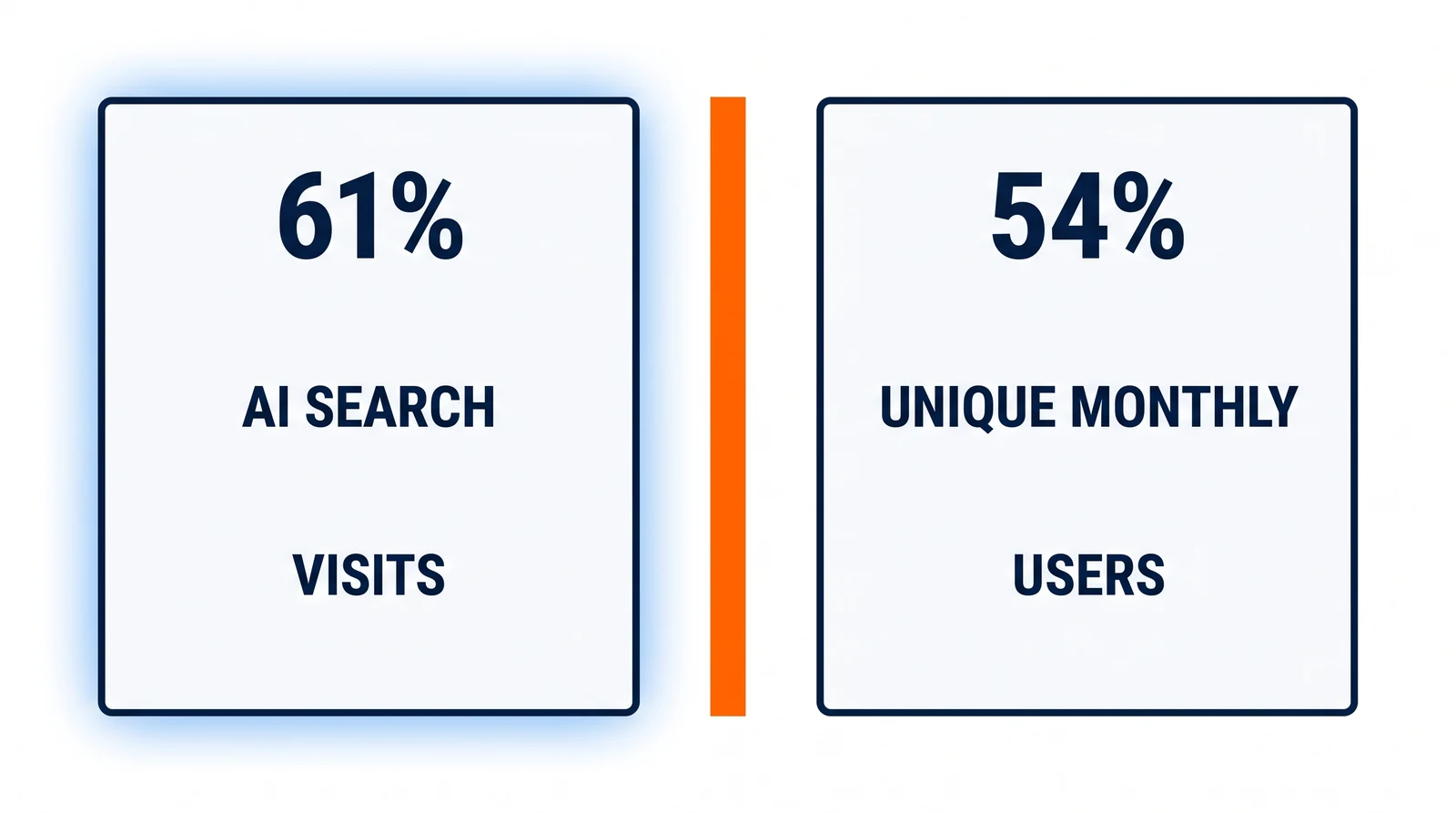
> "ChatGPT receives 61% of AI search visits but has 54% of AI unique monthly users."
Same team, same quarter, same six platforms; the page says the traffic was assessed from Similarweb and looks at a worldwide audience.
Neither is an error. They are two correct answers to two different questions, printed side by side by a team honest enough to print both. Nothing else varies, so the seven-point gap is the unit. If one page can move a share by seven points by changing what it counts, six pages can move it by 33.
The highest figure is the one with no unit on it
StatCounter puts ChatGPT at 79.4% of the AI chatbot market worldwide for August 2026, and names no unit, no data source, no population and no method anywhere on the page. The rest of its tracker reads Google Gemini 10.9%, Perplexity 4.31%, Microsoft Copilot 2.79%, Claude 2.57%, DeepSeek 0.02%. It is the highest figure in the set and the least documented where it is published.
One level up, StatCounter's About page does describe a sample: "Stats are based on aggregate data collected by Statcounter on a sample exceeding 3 billion pageviews per month collected from across the Statcounter network of more than 1 million websites."
The FAQ goes further about the statistics it covers. On search engines: "Our search engine stats are based on what we call search engine referrals, not the number of searches performed." On Bing's chat: "We have no way of measuring the number of queries performed in bing chat."
Here is the part worth checking yourself. The FAQ's answer to "What statistics are provided by Statcounter Global Stats?" lists thirteen, from browser and mobile browser through search engine and social media to device vendor. An AI chatbot statistic is not among them, and the word chatbot does not appear on the FAQ at all, on the date we read it.
So we do not know what the 79.4% counts, and we are not going to guess: the referral method above is what StatCounter states for its search and social statistics, not for this one. A missing unit is a missing unit, not a lie.
The page ranking seventh is measured in dollars
Precedence Research puts the AI search engine market at USD 16.30 billion in 2025, USD 20.75 billion in 2026 and approximately USD 182.17 billion by 2035, a compound annual growth rate of 27.30%, with global coverage and a 2025 base year. It is not a share of usage at all.
The report, last updated 9 September 2026, does publish shares, and every one is a share of that dollar market: "North America held the largest revenue share of 40% in the AI search engine market in 2025", and "by application, the enterprise search segment held a 40% share of the market in 2025". No assistant is given a usage share anywhere on it.
That is an ordinary market-size forecast, clearly labelled as one. It simply ranks seventh for a usage query, so a reader asking how many people use ChatGPT can carry away a percentage that was never about use.
Market share by country changes the ranking
Momentic's August 2026 report puts ChatGPT at 53.9% of worldwide AI chatbot web visits for May 2026, Google Gemini at 27.9% and Claude at 9.2% — and at 58.3%, 19.3% and 13.4% for the same month in the United States. Both cuts come from one Similarweb dataset, with the absolute counts beside them: 5.6 billion visits for ChatGPT, 2.9 billion for Gemini, 952.6 million for Claude and 138.1 million for Perplexity.
Gemini loses more than eight points and Claude gains more than four on the same data, purely by changing the country counted. Momentic's own explanation: "a US-only ranking inflates US-concentrated apps such as Claude and understates Asia-heavy apps such as DeepSeek; a worldwide ranking does the reverse".
Now change the unit as well. FirstPageSage's report of 11 September 2026 puts ChatGPT at 51.5% of estimated United States monthly active users, Gemini at 27.6% and Claude at 10.2%: "All figures are estimated based on monthly active users across U.S. web and mobile platforms." That report also folds Bing's Copilot into ChatGPT's share, a choice it discloses in a note. Two United States figures, seven points apart — the unit changed, and so did the month, the devices counted and the platform set.
One page in the set does say what it counts
Momentic states its unit, estimator, denominator, window, geography and exclusions, and names this problem before we do: published figures disagree, it says, because they "measure different things without disclosing it". Its methodology reads: "AI chatbot market share in this report is web-visit share: each assistant's monthly sessions on its primary web domain, estimated by Similarweb, expressed as a percentage of the seven assistants' combined visits." It names what it leaves out — Meta AI inside Meta's apps, companion apps, answer aggregators and major non-English assistants — and tells readers to treat the lower positions as shares "of this defined set, not of all AI chatbot usage worldwide".
We went in expecting none of the nine to do this. One does, so that is what we report. It measures seven assistants on one unit, transparently; it does not check what the other publishers' figures counted.
One thing we noticed and cannot resolve from outside: the three sources naming a unit land within about a point of each other on Gemini (27.6%, 27.7%, 27.9%) and on Claude (9.2%, 10.2%, 10.3%), while the source naming none puts Gemini at 10.9% and Claude at 2.57%. Two of the three name Similarweb, so we cannot tell independent agreement from shared upstream data, and we do not treat it as evidence of accuracy. On agreement between measurements, the AI Mode citations piece works through a cleaner case.
What to do when someone hands you one of these numbers
Checking what a figure counted settles most of these arguments faster than debating whose number is right:
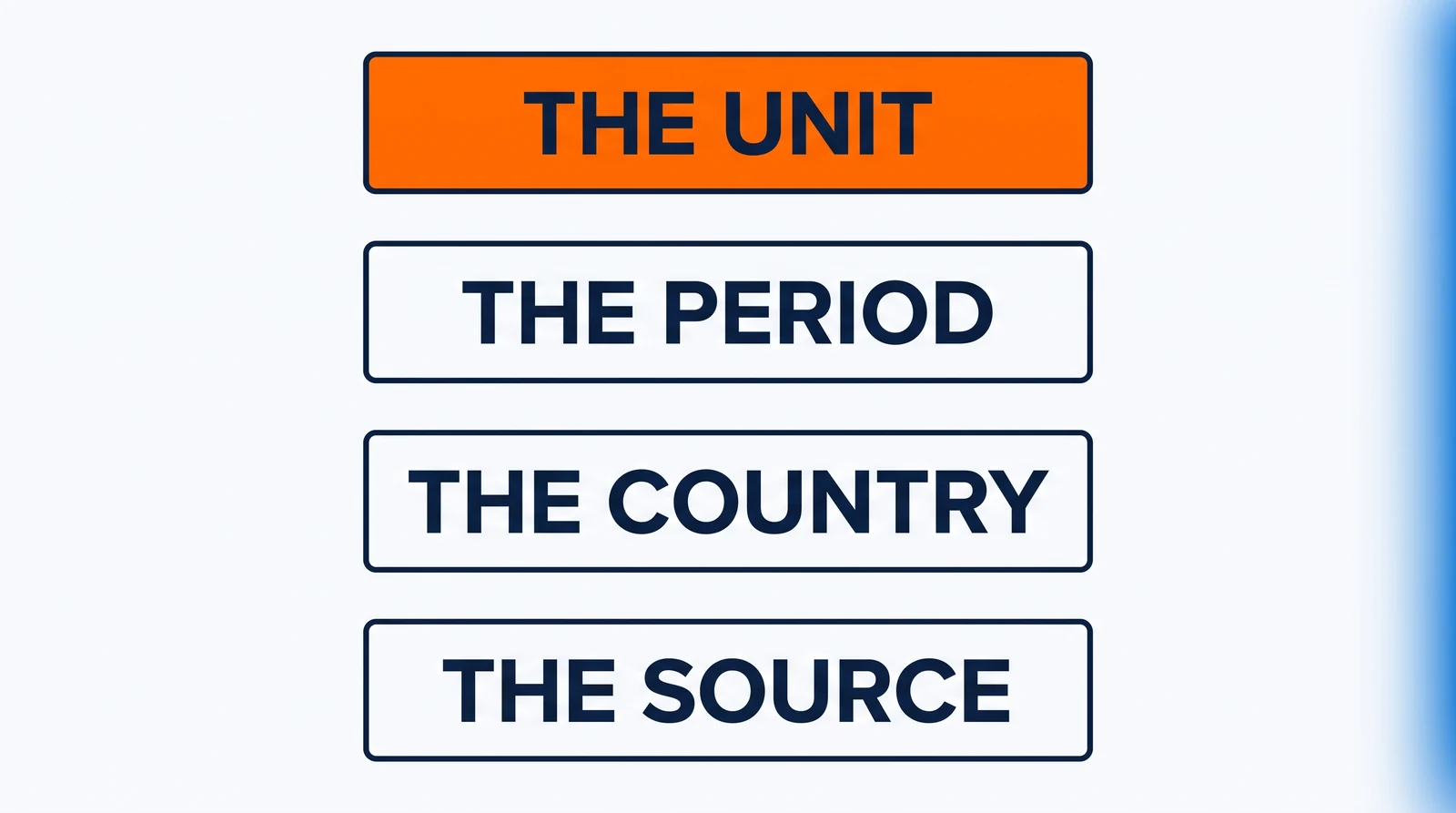
- Ask for the unit. Visits, unique users, queries, active users or revenue — five answers, five numbers. A share with no unit named cannot be reconciled with any other.
- Ask for the period and the country. May 2026 worldwide and May 2026 United States are different rankings from the same dataset.
- Open the page of the company the figure is credited to. Sensor Tower's own pages name its metric as "True Audience share, measuring unique users across mobile apps and web" and date ChatGPT's fall below 50% to March 2026; TechCrunch's report of that study says ChatGPT held over 50% until January. The figures themselves — 46.4%, 27.7%, 10.3% — appear on neither of Sensor Tower's public pages, and the full report is not public. We could not reconcile the two accounts and are not calling either wrong.
- Only compare figures sharing a unit and a denominator. Similarweb's roughly 53% and Momentic's 53.9% are the closest pair here — same unit, same underlying source, same month, both worldwide — though even they draw their denominators from differently defined sets of platforms. Almost nothing else in the table is comparable at all.
The method for reading any published index is worked through in what ChatGPT actually cites, and the zero-click piece applies it to another set of numbers.
Which unit matters depends on what you are deciding. Choosing where to spend time on content, visits and referrals are closer to what you care about; sizing an audience, users are. We do not know your business, and no figure here substitutes for knowing it.
What people actually ask us
What is AI chatbot market share worldwide? Two worldwide figures for May 2026 land close together because they share a unit: Similarweb reports ChatGPT at roughly 53% of generative AI website visits on its worldwide traffic panel, and Momentic reports 53.9% of seven assistants' combined web visits using Similarweb data. StatCounter's figure for August 2026 is 79.4%, on a page that states no unit.
What is AI chatbot market share by company? ChatGPT is first and Gemini second on every source that ranks assistants, but below that nothing is stable. Claude is third on every source that ranks it except StatCounter, which puts Perplexity third and Claude fifth. Gemini's share ranges from 10.9% to 27.9% and Claude's from 2.57% to 13.4%, depending on the unit, the month and the country counted. A gap, or any ranking below the top two, needs the measurement named.
What about generative AI market share? The phrase covers two things. On usage pages it means a share of visits or users among assistants. On research-firm pages it usually means a share of revenue in a forecast dollar market — on Precedence Research, enterprises held 60% of that market in 2025.
Is there an AI search market share figure for 2022? Not in any source we opened: StatCounter's tracker offers a year picker back to 2009, but its AI chatbot series is recent, and the trade and vendor reports here begin in 2025 or later. For a comparison over time, take one publisher's own series on one unit — FirstPageSage and Momentic both publish month-by-month tables — rather than reading differences between publishers as change.
For what an AI search engine is, and how this relates to search engine optimization, our definitional piece covers the ground. Our research page carries what we have measured; it does not include assistant market share, and neither does anything else we publish.
Sources
- StatCounter, AI Chatbot Market Share Worldwide — https://gs.statcounter.com/ai-chatbot-market-share (checked 17 September 2026)
- StatCounter Global Stats, About — https://gs.statcounter.com/about (checked 17 September 2026)
- StatCounter Global Stats, FAQ — https://gs.statcounter.com/faq (checked 17 September 2026)
- Similarweb, AI Search Stats 2026, 29 July 2026 — https://aisearch.similarweb.com/blog/gen-ai-stats/ (checked 17 September 2026)
- TechCrunch, ChatGPT's market share slips below 50% for first time, 16 June 2026 — https://techcrunch.com/2026/06/16/chatgpts-market-share-slips-below-50-for-first-time/ (checked 17 September 2026)
- Sensor Tower, State of AI 2026 press release, 16 June 2026 — https://sensortower.com/press/sensor-tower-state-of-ai-2026-report-global-time-spent-on-generative-ai-apps-projected-to-more-than-double-year-over-year (checked 17 September 2026)
- Sensor Tower, State of AI 2026 blog post, June 2026 — https://sensortower.com/blog/state-of-ai-2026 (checked 17 September 2026)
- Precedence Research, AI Search Engine Market, last updated 9 September 2026 — https://www.precedenceresearch.com/ai-search-engine-market (checked 17 September 2026)
- FirstPageSage, Top Generative AI Chatbots by Market Share, 11 September 2026 — https://firstpagesage.com/reports/top-generative-ai-chatbots/ (checked 17 September 2026)
- Wix AI Search Lab, AI search vs. Google, 30 April 2026 — https://www.wix.com/studio/ai-search-lab/research/ai-search-vs-google (checked 17 September 2026)
- Momentic, Top AI Chatbots and Assistants by Market Share, 18 August 2026 — https://momenticmarketing.com/blog/top-ai-chatbots (checked 17 September 2026)
- Digital Applied, AI Search Engine Statistics 2026, 8 April 2026 — https://www.digitalapplied.com/blog/ai-search-engine-statistics-2026-market-share (checked 17 September 2026)
- Search Engine Journal, Google Market Share Slips, updated 4 April 2025 — https://www.searchenginejournal.com/google-market-share-slips-ai-referrals-regional-search-engines-rise/539373/ (checked 17 September 2026)
- LiamVi research — https://liamvi.com/research/ (checked 17 September 2026)