AI Mode citations: which question each published number answers
Eight published figures about what Google's AI Mode cites circulate on the pages ranking for ai mode citations, and they get quoted against each other as though they were rival readings of one thing. An 8.4x, a 17%, a 13.7%, a 12%, a 96%. They are not rivals: they are answers to four separate questions, measured by five research teams on different samples in different months, and one of the eight is not about AI Mode at all.
Line them up by question and the wide spread everyone quotes turns out to live between the questions, not inside them. Even the one pair that looks like agreement — 12% and 14%, for how far AI Mode citations overlap the organic SERP — is not shown to count the same thing. None of the five ranking pages we read in the United States on 15 September 2026 makes either point.
Two things this article is not. No figure in it is ours — this desk has never measured what AI Mode cites and states no citation number of its own. It is about the marketing measurement of what Google AI Mode links to, for the in-house SEO or marketer handed a percentage. If you arrived looking for how to reference an AI answer in an essay or a paper, this is not that article, and your institution's style guide is where that lives.
What are the published AI Mode citation numbers actually measuring?
The published research on AI Mode citations measures four separate things, and the figure you were handed answers only one of them. The four: whether Google AI Mode cites Google's own properties; whether an AI Mode citation is the same URL that ranks in the organic top 10; whether AI Mode and AI Overviews cite the same pages; and how many sources an AI Mode answer carries at all.
Setting one of those numbers beside another is rarely the research teams' doing; it happens on the pages that gather the figures into one paragraph.
Does Google's AI Mode cite Google?
Google.com is either the most cited domain in AI Mode or the second most cited, depending on which measurement you read, and the two teams are not measuring the same quantity.
Citation share for google.com rose 8.4 times between 15 April and 30 June 2026, almost all of it going to Google's own Business Profile and Product Knowledge Panel pages, in the study Profound published on 14 July 2026. A multiplier is not a share. The page states no baseline citation share before or after, no query count behind the 8.4x, no country, and no definition of what it counted as a citation.
One large number does appear on it — "an analysis of over 32 million google.com/searchviewer/ instances" — attached there to the local-intent breakdown, not to the multiplier. Search Engine Land's report of 15 July 2026 places it under a heading called "About the data": "Profound tracked AI Mode citation share from April 15 through June 30, analyzing more than 32 million google.com/searchviewer instances."
Google.com took 17.42% of 1,321,398 AI Mode citations collected from 68,313 keywords across 20 niches on 12 February 2026, and around 20% once YouTube is counted with it, in SE Ranking's study of 6 March 2026. The same study supplies the missing baseline: Google's self-citation rate stood at 5.7% in June 2025, a rate SE Ranking says has "tripled in less than a year". 59% of those citations now point to Google search results in the side panel and 36.1% to Business Profiles, where the earlier study found 97.9% of Google links going to Business Profiles. No country is stated for the February 2026 data, and the study does not define a citation.
From outside there is no honest way to say whether google.com is AI Mode's most cited domain or its second.
A citation to a Google-hosted card is also not traffic to the business the card describes: the citation lands on google.com rather than on anyone's website. Search Engine Journal put the same warning in one line on 20 July 2026: "citation share indicates what AI Mode links to, not where traffic goes."
One more figure here belongs to a different surface. "In May 2025, SEJ reported that 43% of AI Overview responses referenced Google's own results", that article notes. That is AI Overviews, not AI Mode, and no sample travels with it there. SE Ranking claims the same finding as its own — "we were actually one of the first to call this out in our research last year, when Google self-referenced in over 43% of AI Overview responses across the US" — which restores the market the retelling dropped, and renders the figure as "over 43%" rather than 43%.
That Search Engine Journal piece is the fairest thing on the results page. It defines its metric — "citation share indicates how frequently a domain appears as a citation in responses generated by AI Mode" — and says outright that Profound "uses a similar citation-share metric, but analyzed different datasets and timeframes". What it does not say is what those differences are.
Is being cited in AI Mode the same as ranking on Google?
No, and the two studies that measured it did not measure it the same way: Moz puts the overlap with Google's organic top 10 at 12% of AI Mode citations, SE Ranking at 14% of URLs.
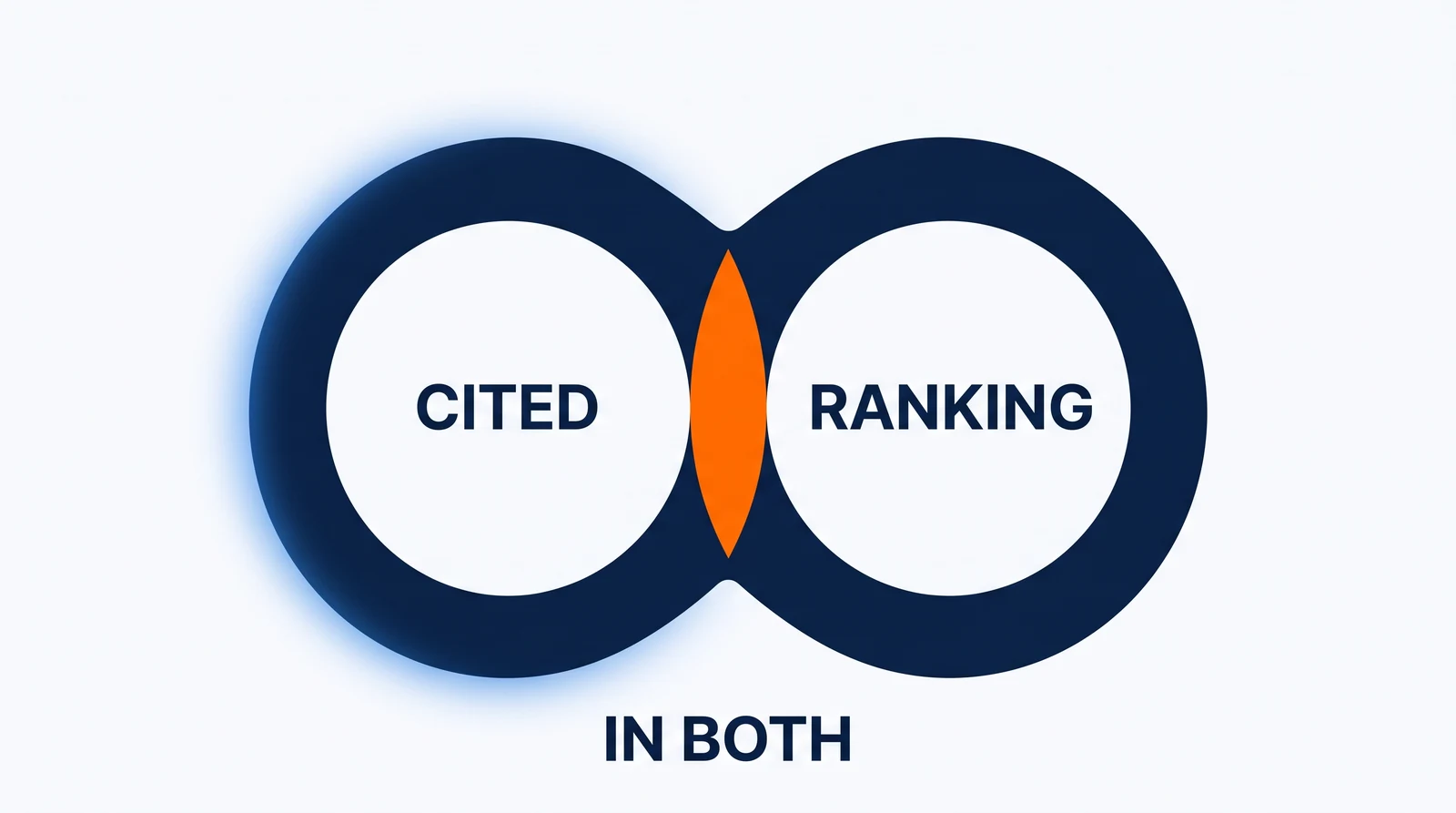
88% of AI Mode citations did not appear in the organic SERP for the exact query, across nearly 40,000 queries on desktop and mobile in the United States and the United Kingdom, in Moz's study of 18 February 2026 — a 12% strict overlap, with about one citation in five from a domain in the top 10 for that query.
Moz wrote its two definitions down: a "strict URL match" is "the exact page appears in both AI Mode citations and Google SERP", and a "site-level match" is "the same domain appears, even if it's a different page". It does not state when the data was collected. Its prose renders the headline a second way too: "only 1 in 10 AI citations match the exact URLs in Google's top 10 organic results."
Overlap with the organic top 10 ran at 14% of URLs and 21.9% of domains in SE Ranking's study of 10,000 keywords, collected on a single day — 20 June 2025 — with every query entered from the United States on non-logged-in accounts.
Different samples, different market scopes, different tools, eight months apart. And the closeness is not a replication, because only one of the two says what its percentage is a percentage of. Moz's 12% is the share of AI Mode citations whose exact page is also in the top 10. SE Ranking calls its figure an "average exact URL overlap" and reports "only 2.5 URLs overlapped per query", against the 12.6 sources the same study found in an average AI Mode answer — two published numbers that do not reduce to 14%, on our reading.
Do AI Mode and AI Overviews cite the same pages?
Published estimates of how far the two surfaces' citations overlap run from 10.7% to 35% of URLs, and the highest of the three is not measuring the same quantity as the other two.
Just 13.7% of citations overlap between AI Overviews and AI Mode, rising to 16.3% across each response's top three, in Ahrefs' study of 15 December 2025 — 540,000 query pairs for the citation and URL analysis, drawn from September 2025 United States data. SE Ranking's June 2025 study puts it at 10.7% of URLs and 16% of domains.
Between 30% and 35% of URLs cited in AI Overviews also appeared in AI Mode, and at domain level 77% of unique domains showed up in only one surface against 23% carrying across both, in Victorious' overlap analysis of over 1,540 queries published 5 September 2025. No collection period and no market are stated on that page, but its direction is: it measured "the percentage of AI Overview citations that also appeared in AI Mode", where SE Ranking reports an average overlap between the two sets. A different quantity is the likeliest reason that answer sits two to three times above the others.
A comparison guide published 8 June 2026 concedes that "the exact percentage moves with methodology — Victorious counted overlap more loosely and landed higher — but every study points the same way". It never says which choices, its summary table is headed "Study (2026)" for three studies dated December 2025, August 2025 and September 2025, and it gives SE Ranking's row as "large-scale crawl" where the study gives 10,000 keywords on one day.
How much does an AI Mode answer cite at all?
Nearly every AI Mode answer carries citations, and three teams found that on three separate samples.
96% of the nearly 40,000 responses Moz analysed included at least one citation, and 91% of them cited ten or more sources. Ahrefs, in its September 2025 United States data, found only 3% of AI Mode responses citing no source at all — the same finding read from the other end. SE Ranking counted the sources directly: 12.6 links per AI Mode answer on average, across 9,734 triggered responses and 122,617 links in total, against 13.3 for AI Overviews, and of those 9,734 responses "none had zero references".
Three teams, three samples, three instruments, and the same answer: an AI Mode response almost always carries citations, and usually carries ten or more. The three rates are not one number — 96% of responses, 97%, and none of 9,734 triggered ones, because SE Ranking counted only the responses that triggered AI Mode at all. The assumption that this surface answers without attribution does not survive contact with any of the three.
How much of this moves between two runs of the same query?
Only 9.2% of the URLs AI Mode cited matched across three runs of the same keyword set on the same day, which is a limit on every figure above. SE Ranking published that alongside its own overlap numbers, concluding that "even the same query run multiple times on the same day often yields different sources".
Ahrefs limits its own headline the same way, in a note on the study page: "this analysis compares single generations of AI Mode and AI Overview responses. Our previous research showed that 45% of AI Overview citations change between generations. This means the citation pools available to each system may overlap more than our single-snapshot comparison suggests."
Both are the publishers' own caveats, dropped by nearly every page repeating the headline figures. It is also why two honest tools can report different numbers for the same brand in the same week — what a visibility figure counts, and what it is measured against.
What does Google itself publish about this?
Google publishes the mechanism behind AI Mode citations and none of the counts. Both surfaces "may use a 'query fan-out' technique — issuing multiple related searches across subtopics and data sources", says Google's documentation for site owners, last updated 10 December 2025, and "AI Mode and AI Overviews may use different models and techniques, so the set of responses and links they show will vary". The same page says there are "no additional requirements to appear in AI Overviews or AI Mode, nor other special optimizations necessary".
We swept the rendered page for anything matching a percentage and the result was an empty list. So the one organisation holding the complete denominator — every AI Mode answer, every citation, in every market — publishes none of the counts, and the eight figures above exist because everyone else measures from outside.
All eight numbers come from five companies selling AI visibility tracking, SEO software or SEO services. That is not a reason to discard the research, but it is a reason to read the sample line before the headline — the same check worth applying to any recommended list, including who wrote it.
Which AI Mode citations figure answers which question
| The figure | Who published it, and when | Sample, period and market | Which question it answers | |---|---|---|---| | 8.4x rise in citation share | Profound, 14 Jul 2026 | Not stated; 15 Apr – 30 Jun; market not stated | Does AI Mode cite Google? | | 17.42% of all citations | SE Ranking, 6 Mar 2026 | 68,313 keywords, 1,321,398 citations; 12 Feb 2026; market not stated | Does AI Mode cite Google? | | 43% of responses | SE Ranking, via SEJ, May 2025 | Not stated in the retelling; United States | AI Overviews, not AI Mode | | 12% strict URL overlap | Moz, 18 Feb 2026 | Nearly 40,000 queries, desktop and mobile; period not stated; US and UK | Is a citation the same as ranking? | | 14% URL, 21.9% domain | SE Ranking, 29 Aug 2025 | 10,000 keywords; 20 Jun 2025; United States | Is a citation the same as ranking? | | 13.7% citation overlap | Ahrefs, 15 Dec 2025 | 540,000 query pairs; Sep 2025; United States | Is AI Mode the same as AI Overviews? | | 77% of domains in one surface | Victorious, 5 Sep 2025 | 1,540 queries; period and market not stated | Is AI Mode the same as AI Overviews? | | 96% of responses cite something | Moz, 18 Feb 2026 | Nearly 40,000 responses; period not stated; US and UK | How much does an answer cite? |
The rows are our own sorting, not the publishers', and they reflect what we think a figure has to carry before it can be set beside another. So before any of these goes into a deck, find its row and check that the figure beside it sits in the same one. Almost every apparent contradiction here is two rows read as one — and a shared row is necessary, not sufficient.
What people actually ask us
What does an AI Mode citation actually look like? In the marketing sense used above, it is a link to a source attached to the answer, and SE Ranking counted where those links sit: 90.8% of citations appear in separate blocks, 8.9% are inline text links, and 0.3% are links leading back into Google's own results page. At domain level a Google-hosted Business Profile, a product knowledge panel and a Google results page all count as a google.com citation. The surface has run in 180 countries in English since mid-2025, while the studies above are almost all United States, one of them United States and United Kingdom.
Which of these studies is right? The question has no answer, because they are not competing. The closest thing to a ranking is how much of the method each published, and by that standard SE Ranking's June 2025 study states the most — sample, single collection date, country, account state, method and a stated limit — while Profound's post states the least. That is a statement about disclosure rather than about the quality of anyone's data, and every one of these teams published more than the pages quoting them did.
How would I check any of this for my own website? With your own data, and with a clear view of its limits. The Generative AI performance report in Search Console is free, it is first-party, and it covers AI Overviews and AI Mode — but what it reports is impressions, by page, country, date and device, with no split between the two surfaces and no count of what was cited. It tells you whether Google's AI features showed your pages; it reproduces none of the figures above. Whether an assistant outside Google cites you is a separate selection, which we have looked at for ChatGPT in one category and against the signals people recommend for it. Whether anyone still clicks once an AI answer appears is a different question again, with its own set of studies that disagree.
Sources
All checked 15 September 2026.
- Profound, Davis McCain, "Google AI Mode's shift to citing itself", 14 July 2026 — https://www.tryprofound.com/blog/google-com-is-now-ai-mode-s-2-cited-domain
- Search Engine Land, Danny Goodwin, "Google is AI Mode's No. 2 most-cited domain: Report", 15 July 2026 — https://searchengineland.com/ai-mode-cites-google-report-482463
- Search Engine Journal, Matt G. Southern, "Google AI Mode Is Citing More Google-Hosted Pages", 20 July 2026 — https://www.searchenginejournal.com/google-is-ai-modes-no-2-cited-domain-data-shows/582941/
- SE Ranking, Yulia Deda, "Is AI Mode Now Dominated by Google's Self-Referencing Links?", 6 March 2026 — https://seranking.com/blog/google-links-in-ai-mode-answers/
- SE Ranking, Yevheniia Khromova and Svitlana Tomko, "AI Mode Research: Sources, Volatility, & Differences between AIO and Organic Search", 29 August 2025 — https://seranking.com/blog/ai-mode-research/
- Ahrefs, Despina Gavoyannis, "Are AI Mode and AI Overviews Just Different Versions of the Same Answer?", 15 December 2025 — https://ahrefs.com/blog/ai-overviews-vs-ai-mode/
- Moz, Chima Mmeje, "Only 12% of AI Mode Citations Match URLs in the Organic SERP", 18 February 2026 — https://moz.com/blog/ai-mode-citations
- Victorious, Jason White, "Do AI Overviews And AI Mode Cite The Same Content?", 5 September 2025 — https://victorious.com/blog/ai-overviews-vs-ai-mode/
- Serpent API, "AI Overviews vs AI Mode Are Two Different Engines", 8 June 2026 — https://apiserpent.com/blog/ai-overviews-vs-ai-mode-citations
- Google Search Central, "AI features and your website", last updated 10 December 2025 — https://developers.google.com/search/docs/appearance/ai-features
- Google Search Console Help, "Generative AI performance report (Search)", last updated 31 August 2026 — https://support.google.com/webmasters/answer/16984139
- LiamVi research: our methods, our samples and our limits — https://liamvi.com/research/