Choosing an AI visibility tool in 2026: how much the recommended lists agree, and what changed when we counted again
In September we counted the recommended lists on a single results page and promised to count again. On 12 October 2026 we did it two ways: we re-opened the same six lists, and we counted the eight lists on a second results page by the same rule. The main finding held on both pages. Most of the products the lists name between them appear on a single list, and two products, Peec AI and Profound, sit on nearly every one. On the same six lists, something did move. On 12 October 2026, Peec AI was the only product on all six of the lists we counted on 14 September, after Zapier dropped Profound from its list.
The second results page answers the other half of our September question, which was who writes these lists. On that page, 5 of the 8 lists were written by a company with a product on its own list, and 4 of those 5 ranked it first. The fifth is the result that contradicts the pattern: Writesonic ranks Profound first and itself second. The pattern is not our discovery: Ryan Doser documented it in September, after checking 22 roundups. What this page adds is the same lists re-opened a month apart, and a second set counted by a published rule.
Our interest belongs here, near the top. We build an AI visibility tool. LiamVi is on none of the 13 list pages we opened, and nothing below compares any product with ours. This is a count of what published lists say. Nothing here ranks, tests or recommends a product, and we have used none of these tools. Treat our interest as a reason to check the count, which every link below lets you do.
A limit shapes everything that follows, so it comes before the findings. The October results page is a different page from September's: only 1 of its 9 results was also in the September set. That makes the two counts two samples. They are never a trend, and nothing here says the market moved. The September count stays on this page as the 14 September baseline. Across six lists we counted 32 products: 2 on all six, 21 on exactly one, and 4 of the 6 lists written by a publisher that put its own product first.
What changed on the six lists we counted in September?
Zapier and Backlinko have changed the products on their lists since we counted them on 14 September 2026.
Frase shows the same ten products in an order we can no longer vouch for, and Profound, Marketer Milk and Analyze AI read exactly as they did.
Zapier's list is the largest change. Its title now reads "The 9 best AI visibility tools in 2026", where on 14 September we read eight. Profound has gone; we searched the page for the name and it no longer appears. Petra Labs and Yext Scout have been added, and OtterlyAI now opens the list. The page dates itself 14 September 2026 and says its most recent update was made in September 2026. That is the day of our capture, so we cannot say whether the update came before or after our read; what we can say is what the page shows now. Profound had been on all six lists in September. The page gives no reason anyone could see for dropping it, and it was not obliged to.
Backlinko's list has grown. We counted six picks on it on 12 October, where we had counted five. Sellm is the new sixth pick, and the page now reads "Last updated on Oct. 08, 2026." An archived copy of the page from 9 September shows the five products we printed, in our order, so this change is verified at both ends. The list still opens with Semrush, and the page still says why: "Backlinko is owned by Semrush." Its author describes testing more than a dozen LLM tracking platforms.
Frase's list names the same ten products we printed, in a different order. Before calling that a move we checked the dates, and they argue against it. Frase's own last update is dated 9 September, five days before our capture, and our September notes record two different orders read from the page on the same day. The uncertainty is in our record, not in anything Frase did. The set of names is identical, so no count changes, and the correction belongs in the section on what our page got wrong.
Profound's list of 18, Marketer Milk's list of 10 and Analyze AI's list of 8 are unchanged: the same picks, in the same order, under the same dates.
We counted 61 entries on the six re-opened lists, resolving to 35 distinct products under the merge rule September used, set out in the next section. Peec AI is the only product on all six, with Profound and Semrush on five each. 24 of the 35 products appear on exactly one list, against 21 of 32 in September. The four publishers that put their own product first in September still do: Frase, Profound, Analyze AI, and Backlinko with its owner's product.
None of these pages announces what changed, and none has to. A list is a living page. Its date tells you when someone last touched it, not what they touched. The useful habit is to note which list you read and when, because a product can leave a recommendation between your visits.
How much do the lists on a second results page agree?
The eight lists on the 12 October results page agree on two products, Peec AI and Profound, out of 39.
Those are the lists Google returned for ai visibility tool 2026 on 12 October 2026, and both products appear on all eight.
Below those two, agreement thins quickly. Semrush and Otterly appear on six of the eight lists, and AthenaHQ, Scrunch and Ahrefs on five. 17 of the 39 products appear on two lists or more. Of the 39 products on those eight lists, 22 appear on exactly one list, and that is the figure worth carrying into your own reading: for more than half the products recommended on this page, a single publisher's judgement is all the page offers.
The method is September's, restated. We took the nine results from a United States capture made on 12 October 2026 and opened every page by hand. Eight carried a list of products. The ninth was a video from Goodie AI, a company whose product appears on Contentpen's list, titled as a comparison of five tools. We count only lists we can read as text on the page, and we could read none on the video's page, so it is not counted either way. Every numbered or headed pick went into our notes in the order its page gives it, and then we tallied how many lists name each product. We counted 91 entries across the eight October lists, resolving to 39 distinct products.
The merge rule is the part to check hardest, because a count of names depends on deciding when two names mean the same product. We counted names as each page writes them and merged spelling variants: Otterly AI, Otterly.AI and OtterlyAI, for example, or LLMrefs and LLMRefs. A vendor's named suite or feature counts under the vendor, so Semrush AI Visibility Toolkit and Semrush One AI Toolkit are both Semrush, and Writesonic GEO is Writesonic. Surfer AI Tracker, on Rankability's list, counts under Surfer, whose own site presents AI tracking as a feature of its platform: "Track how your brand appears in AI tools like ChatGPT." A judgement call deserves naming. SE Visible and SE Ranking's own AI tracker come from the same company, but the vendor names them as two products, and September's count kept them apart, so this count does too. Merge them and the 39 becomes 38; nothing else moves.
Why a different search at all? The tool we use to capture results pages returns its stored copy for a keyword it already holds, so a fresh capture of ai visibility tool itself was not available to us. We captured the nearest search it did not hold, the same words with the year added.
That choice has a cost, and the cost is the reason this page never says the rankings changed. Of the nine pages on the October results page, only Marketer Milk's list is also in the September set. A different month and a different search are mixed together in everything else, and no reader can separate them. The October count is a replication, a second sample counted by the same method, set beside September's. It is not a measure of change.
Set side by side, the samples tell a consistent story:
- 14 September, six lists: 59 entries and 32 products, 21 of them on a single list and 2 on all six (Peec AI and Profound).
- The same six lists, 12 October: 61 entries and 35 products, 24 on a single list and 1 on all six (Peec AI alone).
- The 12 October results page, eight lists: 91 entries and 39 products, 22 on a single list and 2 on all eight (the same two).
That is the finding that held: a short head of products every publisher names, and a long tail that only a single publisher names.
Who wrote the lists on the second results page?
Four of the eight lists on the 12 October results page were written by a company that ranks its own product first.
A fifth, Writesonic, puts its own product second, which makes five of the eight lists the work of a company with a product on its own list.
Contentpen's list of 17 opens with Contentpen. Rankability's list of 22, a list of AI search rank tracking and visibility tools, opens with Rankability. Nightwatch's list of five AI search monitoring tools, written by its founder, opens with Nightwatch. Dageno's list of nine, written by a co-founder, opens with Dageno.
Writesonic's list of 12 is the exception. It ranks Profound first and Writesonic second, and it states its position more plainly than any other page on either results page: "Disclosure: I'm Samanyou Garg, founder and CEO of Writesonic, one of the 12 tools here. I scored every product on the same six criteria and published each criterion score below so you can check my work." A list that publishes its own scores, under a disclosure like that, has given the reader the means to argue with its order. Rankability's page earns credit of the same kind with its own disclosure: "Rankability is our platform, so we're obviously closest to it."
The three lists with no house product lead with somebody else's. Exposure Ninja, an agency that sells AI search services rather than a tracking tool, calls its three picks the best AI search visibility tools, opens with Semrush, and discloses that the page carries referral links. DemandSage's list of 13 brand monitoring tools opens with Semrush too, carries an affiliate disclosure near the top, and places a block promoting a Semrush trial beneath its first pick. Marketer Milk, the only page on both results pages, opens with AI Product Rankings, a free tool its own text says was built by a company called Gauge, and it carries an affiliate disclosure of its own.
Our September count also sorted lists by whether the page says anyone tested the products, and that question splits these eight too. Five of them say someone did: Exposure Ninja, Marketer Milk, Contentpen, Nightwatch and DemandSage. Three give criteria or a scoring scheme without a testing claim: Writesonic, Rankability and Dageno. The difference matters for how you push back. Criteria tell you what a writer values. A testing claim says somebody used the product, which a reader can put to the writer and expect an answer.
No list here is dishonest for any of this. A company that builds in a category often knows it well, and putting your own product at the top of your own blog is what a company blog is for. Nothing here suggests bad faith, and a product's place on a vendor's page says nothing about its quality. What the pattern changes is how much weight an order can carry. On a vendor's page the top slot does two jobs at once, marketing and judgement, and few pages tell you which of the two put a product there.
The same question about who writes a list runs through rankings of agencies as well, and our count of agency lists takes it up on its own results page.
What do the lists say they are judging?
All five lists we read for their criteria include AI engine coverage, and after that they weight different things.
What each list weights most heavily is part of why their orders differ.
On coverage the lists sound alike. Rankability asks whether a tool tracks "ChatGPT, Perplexity, Gemini, Google AI Overviews, Google AI Mode, Claude, Copilot, and Grok". Zapier's first factor is "Tracking visibility across all AI engines", and Profound's list for marketing agencies treats ChatGPT, Claude and Google AI Overviews as the foundation, with the rest depending on where a client's buyers ask.
After coverage, the criteria diverge. Frase's six include prompt-level tracking, competitive benchmarking through share of voice, "Sentiment and context", citation source attribution, and "A path from insight to action", of which its own page says: "This is where most tools stop, and where Frase is built differently." Sentiment turns up in its product summaries too: Frase sums up Writesonic's strength as "brand mention and sentiment tracking". Writesonic gives its heaviest weight to execution, which it defines as how far a product carries work "from detection through prioritization, remediation, approval, delivery, and measurement." Profound's agency list opens its non-negotiables with client and prospect management, meaning per-client workspaces, and puts reporting and integrations among them. Rankability's five criteria include "Repeatability and trend tracking" and fit for agencies and teams, and it warns that "The biggest mistake is choosing a tool only because it shows a visibility score." Zapier adds insights and action items, trends over time, conversation data and citation source detection.
Read fairly, none of this is hidden. A company that builds a monitoring-and-fix workflow will reasonably rank workflow highly, and Frase says so on its own page. But a list's criteria decide its order before any product is scored, so the criterion a list weights most is worth finding first. Then ask whether it is the thing you need. An agency running many clients needs workspaces and reporting. An in-house content team may want the fix in the same platform as the tracking. An analyst may mainly need the monitoring data, the trend over time and the competitor view, and nothing else. Those are different buyers, and a list written for a particular buyer is not wrong for ranking differently from a list written for another.
What do two counts say about reading any one list?
On the lists we counted, at least half of what each list recommends also appears on another list in the set, but most lists also include picks that no other list names.
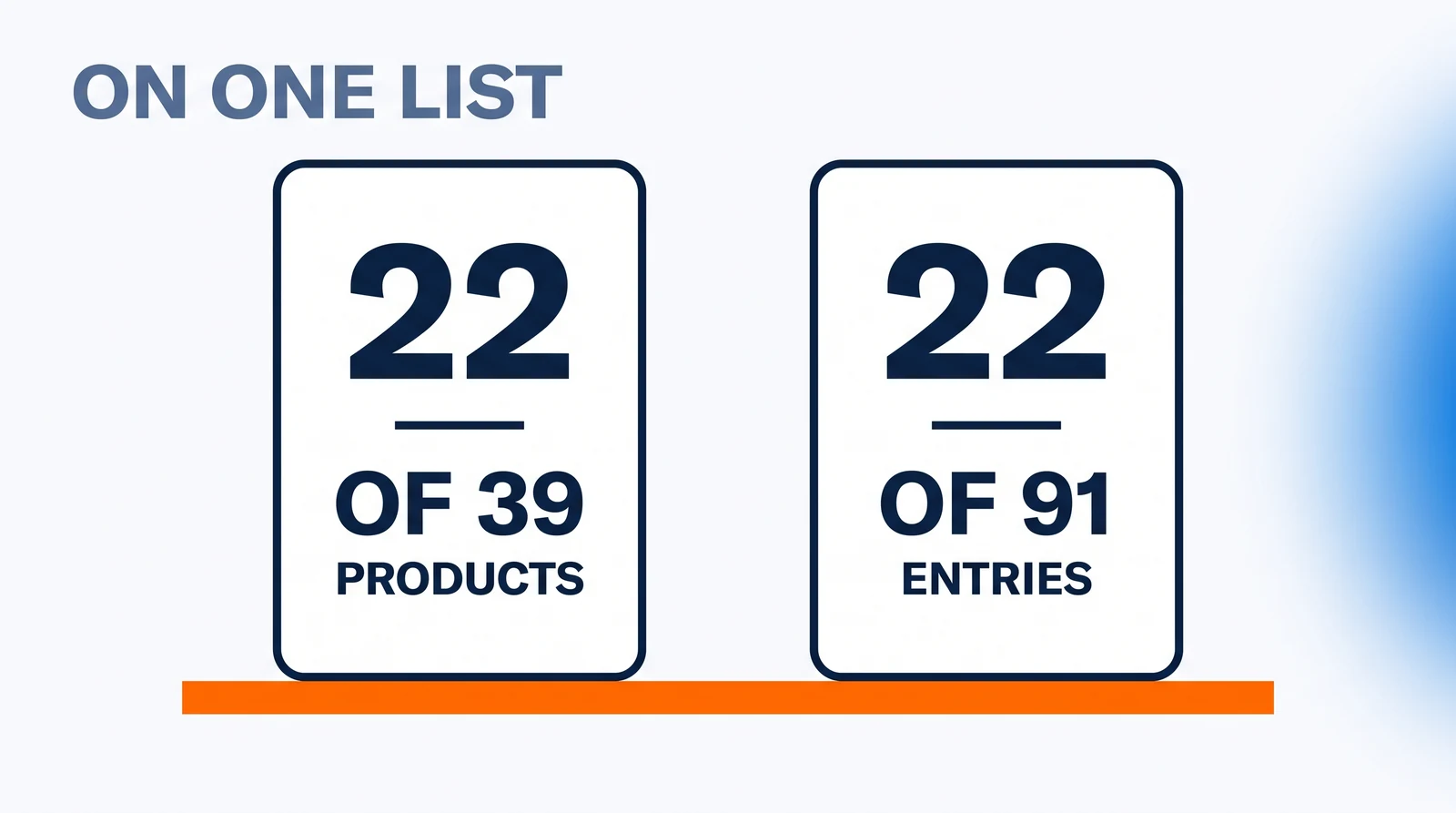
On the October results page, 6 of the 8 lists named at least one product that no other list named, and those single-list picks made up 22 of the 91 entries. September's six lists show the same shape, with single-list picks making up 21 of 59 entries, and so do the same six lists today, at 24 of 61. The long tail of single-list products is real, but it sits inside lists that mostly share their picks. So treat the picks a list shares with others as common ground, and the picks only it makes as a single publisher's view.
Three checks follow from the two counts. They are our view, and we build in this category, so weigh them accordingly:
- Who wrote it. Find the byline and any ownership line before you read the order. On the October page, a reader who skipped that step would have taken four company blogs' top picks as neutral verdicts.
- Whether anyone used the products. A page that says someone tested its picks can be questioned on that claim. A page that gives only criteria is offering a shortlist built on what its writer thinks matters.
- When it last changed. Zapier's list lost a product that had been on all six lists, under a date that matched the day we read it in September. Note the date you read a list, and look again before you buy.
Then open a second list from a publisher that sells nothing in the category, and see which names survive.
That last step has already been done at scale by someone else, and it is worth reading. Ryan Doser's page, published on 1 September 2026 and updated on 9 October, checked 22 roundups and kept the seven written by publishers with no tracker to sell. In his words, "Peec AI is the only tool named in all seven independent roundups." He selected his set; ours is what two searches return. The two samples ask slightly different questions and still put the same product at the top of the agreement count. He also says plainly that he sells a product into this category and left it off his own ranking, and that he earns a commission from a tool on his list. That is the kind of disclosure the lists above mostly lack, and it deserves the credit.
None of this tells you which tool to buy. Which tool fits depends on the AI engines your buyers use, the markets and brands you need to track, how often you need the numbers, and how the tool's reporting fits your workflow. That decision is yours, and no count of ours can make it. If your next question is what the numbers inside a tool actually measure, our analytics page, quoted below, reads the vendors' own documentation on that.
What did our own page get wrong?
Our earlier page on this keyword named three AI visibility products, LiamVi among them, without counting anything.
That page still reads the same way today.
That page still reads: "Three verifiable products track AI visibility today: Semrush's AI Visibility Index, Profound, and LiamVi." Nothing was counted to produce the three, and the sentence carries no date. Across both results pages, LiamVi appears on none of the 13 list pages we opened. The same page prints a pair of rates with no sample size behind them. That breaks our own rule that a rate travels with its denominator. The rule was written two days after the page went live, which explains the sentence and does not make it right.
This page's September version carried two mistakes of its own, and correcting them here is the point of publishing a correction.
We said Zapier and Frase showed no byline. Both show one today: Zapier's list is signed by Maddy Osman and Frase's by Georgina D'Souza. In September, an AI model we asked to review that version of the page reported seeing both bylines; our own three reads of the pages did not find them. Archived copies of both pages from early September exist, and they would settle it, but neither would open for us when we tried. We cannot show our September read was right, so we withdraw the observation rather than defend it.
We printed Frase's list in an order we cannot stand behind. As above, the ten names were right and the count is unaffected; the order was our record's weak point, not Frase's.
What survives both corrections is the count itself: the 32 products, the 2 on all six lists and the 21 on a single list reproduce exactly from the lists we printed.
How can I check my AI visibility for free?
There are two free ways to see where you stand.
Run a vendor's free checker on your brand, or put your buyers' questions to the AI assistants yourself and write down what comes back.
The vendor route is quicker. Ahrefs' free checker promises "No signup required. Results in seconds," and is plain about what you get: "The free tool shows a limited preview (top 5 results per section)." A free tier from the company that sells the paid product is the ordinary shape of a software trial, not a trick. Where the free view stops is set by the seller, so it is a business choice. Treat the free result as a taste of the product's tracking, not the full measurement.
The manual route needs nothing from anybody. Write down five or ten questions your buyers would actually ask, the questions rather than your keywords. Ask each one in Gemini, ChatGPT, Perplexity, Copilot and Claude, and run each as an ordinary Google search that returns an AI Overview, or in AI Mode. Record which brands get a mention and which pages get cited, and keep the two apart: a brand mention means the assistant named you, while a citation means it linked your page. Note every competitor named beside you, and where ChatGPT names a competitor's brand in place of yours, note the page it cited. Then do it again on a different day.
Whatever number either route gives you is a count over prompts somebody picked. In the words of our page on AI visibility analytics: "Change the prompt list and the number changes, with no change at all to your website." Your share of voice can rise or fall with the questions you picked, while your pages stay exactly as they were.
The answers move on their own as well. In our own harvest of citations across 33 keywords, gathered mostly from ChatGPT, asking an assistant the same question on two occasions could bring back a different answer citing different pages. That sample is small and early, and the write-up states its limits. It also explains why a lone free check gives you a reading rather than a verdict. Run the same check a week later. If much has moved, you have learned something about the measurement before paying for it. Whether you need one tool for AI search and another for traditional SEO is a separate question, covered in our page on choosing one tool or two.
What these counts cannot tell you
Counting list mentions cannot tell you whether any AI visibility tool works.
We tested none of these products, and how often a product is listed says nothing about what it does.
Two samples are not a trend. The six lists re-opened a month apart are a real before and after, but only for those six pages. The October results page is a different set of pages, and any difference between it and September's could come from the month, the search or both.
35 and 39 are counts of what lists named, not counts of the market. Tracking products exist that no list on either page mentioned, and the category keeps adding more.
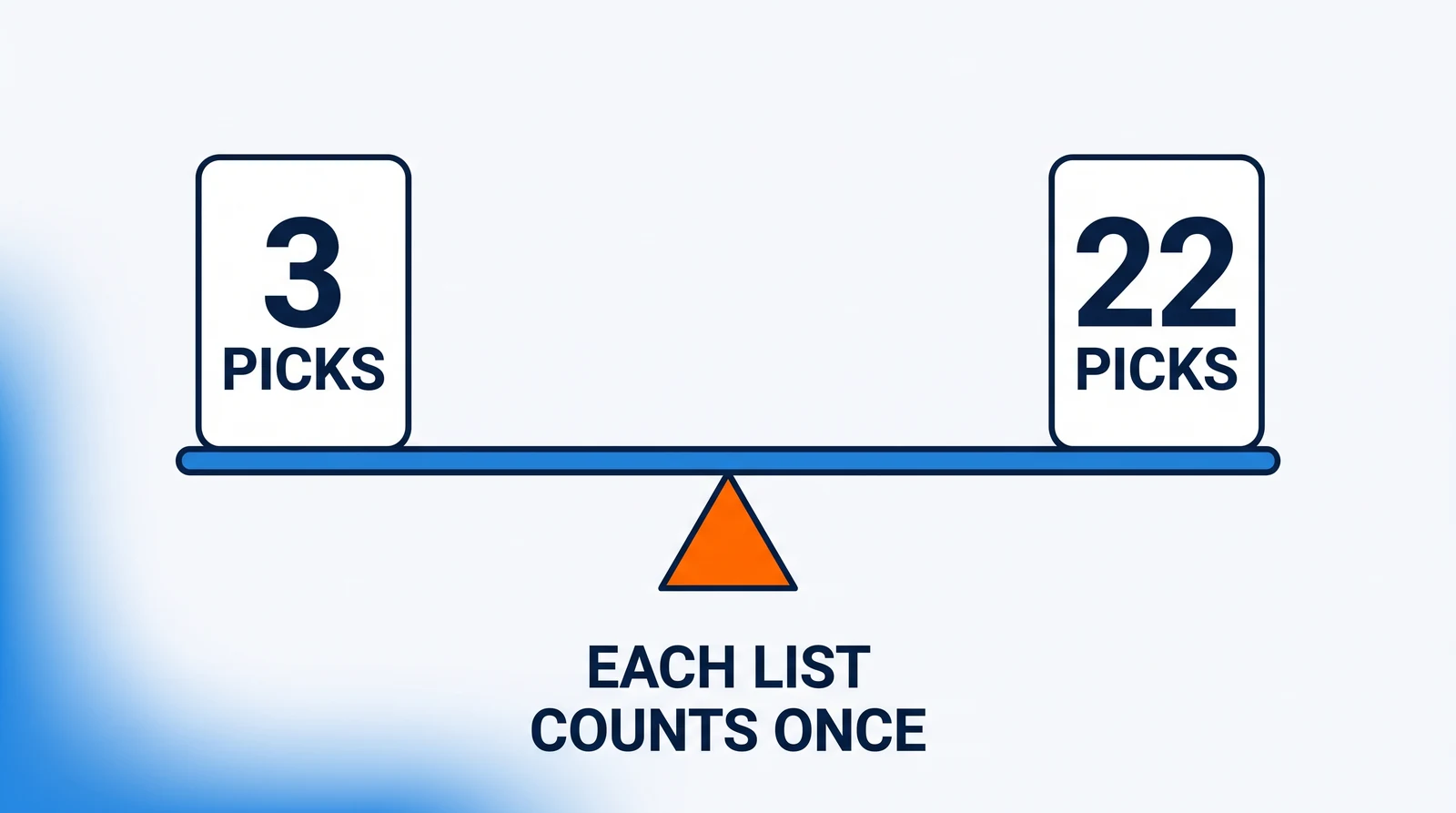
Every list counts once, whatever its length. The October lists run from 3 picks to 22, so a product on all eight had to make Exposure Ninja's shortlist of three as well as Rankability's list of 22. Long lists also supply more of the single-list products: 6 of the October page's 22 come from Rankability's list alone, while the lists of three and five, from Exposure Ninja and Nightwatch, supply none. A count that weighted lists by length or by position would be a different measure, and we kept September's rule so the counts stay comparable.
Another location may be handed different pages. Both captures are United States results; a reader searching from elsewhere could see another set, which would need its own count.
Every absence claim here has a boundary. Saying no list reports how much it agrees with another, or what changed in it since an earlier read, covers the 13 list pages we opened across the two results pages and one dated web search, nothing wider. Finding nothing in one search proves little; Doser's page was on neither results page, and we reached it only by searching.
We have published our own instrument's failure. We tested our own content score against blind quality reviews of nine articles, judged by AI reviewer agents rather than by people, and the score pointed the wrong way: the articles it liked most were the ones the reviewers liked least, a rank correlation of −0.61. That small, early result is written up, with its limits, in our piece on content optimization tools. Hold this count to the same standard: it is an instrument somebody built, and it should be checked.
Our research page does not carry this count yet. That page publishes our samples and limits, and in September we said it would carry this census too. Its last update was on 12 August 2026, and that has not yet happened.
We will count again. The next capture will be counted by the same rule, and we will publish what changed, including anything that contradicts this page.
What people actually ask us
The questions below come from September's People Also Ask box and October's related searches.
The October capture showed no People Also Ask box at all.
What does an AI visibility tool track? The lists disagree far more about which product to pick than about what the category does. Exposure Ninja's page puts it this way: "An AI visibility tool tracks how often, and in what context, AI platforms like ChatGPT, Perplexity and Google's AI Overviews mention, cite or recommend your brand." Its own FAQ names five measures such tools report: a visibility score, mentions, citations, sentiment and position in AI-generated lists. Writesonic's page adds that "Most products monitor prompts, compare competitors, identify cited sources, and calculate share of voice," and draws the line with SEO tools in its FAQ: SEO tools report on search results, keywords, pages and links, while AI visibility tools analyse generated answers and the sources behind them. Every one of those measures is still a count over a prompt list someone chose, which is why the free-check section above matters.
What is the best AI visibility tool? We decline to name one, for reasons this page sets out: none of these tools has been tested by us, we build a competing product of our own, and the lists that do name winners mostly agree on only two products. Peec AI and Profound were on every list on both results pages. That reports what those pages said and is no advice on what to buy.
Are there free AI visibility tools? Yes, in two senses. Several vendors offer free checkers that return a limited preview, and you can run the same kind of check by hand by putting your buyers' questions to the assistants and recording what they name and cite. The free-check section above sets out both, and the limit they share.
Does a product appearing on more lists mean it is better? No. More appearances mean more publishers chose to include it, and that can come from its age, its marketing reach, an affiliate programme or genuine quality, causes no reader can separate from outside. The month between our counts showed another reason for care: a product can leave a list without any note a reader would notice.
Where does your count come from, and can I check it? Two United States captures: the 14 September 2026 results for ai visibility tool, nine pages, and the 12 October 2026 results for ai visibility tool 2026, nine pages, with the September lists re-opened on 12 October. Every page was opened by hand and every pick recorded in page order. The merge rule is above, and every page is linked under Sources. If your re-count disagrees with ours, yours is newer, and you should trust it over ours.
Sources
- Ryan Doser — his ranking built from seven independent roundups — published 1 September 2026, updated 9 October 2026; checked 12 October 2026.
- Ahrefs — free checker — vendor page, no date shown; checked 12 October 2026.
- Surfer — home page — where AI tracking is presented as a feature of the platform; the source for one merge; no date shown; checked 12 October 2026.
- LiamVi — our earlier page on this keyword — corrected in this article; checked 12 October 2026.
- LiamVi — what an analytics number counts — the source of the quoted sentence on prompt lists; checked 12 October 2026.
- LiamVi — checking a platform's data accuracy — run-to-run variance in our 33-keyword harvest, with its limits; checked 12 October 2026.
- LiamVi — content optimization tools — the −0.61 rank correlation across nine articles; checked 12 October 2026.
- LiamVi — one tool or two for AI search and SEO — checked 12 October 2026.
- LiamVi — generative engine optimization companies — checked 12 October 2026.
- LiamVi research — methods, samples and limits — last updated 12 August 2026; checked 12 October 2026.
The six lists we re-opened — counted on 14 September 2026 and re-opened on 12 October 2026; dates are each page's own: - Zapier — its list of nine picks, by Maddy Osman, dated 14 September 2026. - Frase — its ranked list of ten, by Georgina D'Souza, 18 February 2026, updated 9 September 2026. - Profound — its list of 18 for marketing agencies, by Nick Lafferty, 30 January 2026. - Marketer Milk — its list of ten, by Omid Ghiam, 23 December 2025. - Backlinko — its list of six, by Leigh McKenzie, updated 8 October 2026. - Analyze AI — its list of eight, 20 May 2026.
The results page for ai visibility tool 2026 — a United States capture of 12 October 2026, every page opened that day: - Exposure Ninja — its three picks, by Kelly Wilson, updated 29 September 2026. - Marketer Milk — the only page also on September's results page. - Writesonic — its list of 12, by Samanyou Garg, 29 July 2026. - Contentpen — its list of 17, published 5 May 2026, updated 12 October 2026. - Rankability — its list of 22, 2 October 2026. - Goodie AI — a YouTube video — titled 5 AI Search Visibility Tools Compared (2026); no list we could read as text on the page; not counted. - Nightwatch — its list of five, by Aljaž Fajmut, no date shown. - Dageno — its list of nine, updated 28 September 2026. - DemandSage — its list of 13, by Shubham Singh, 13 May 2026.