Content optimization tools in 2026: what they do, and when their scores lie
We build a content optimization tool, and this year we tested the category's core instrument — the content score — against blind quality reviews run by independent reviewer agents. It pointed the wrong way: the drafts our fitted meter rated highest were the ones the reviews rated lowest, at rho −0.61 across the nine articles our meter covered. That result changed how we build scoring, and it is the honest place to start a guide to this category. This piece covers what these tools actually do, which products verifiably exist today, and how to judge one — including ours — using what we measured rather than what the SEO industry asserts.
What does a content optimization tool actually do?
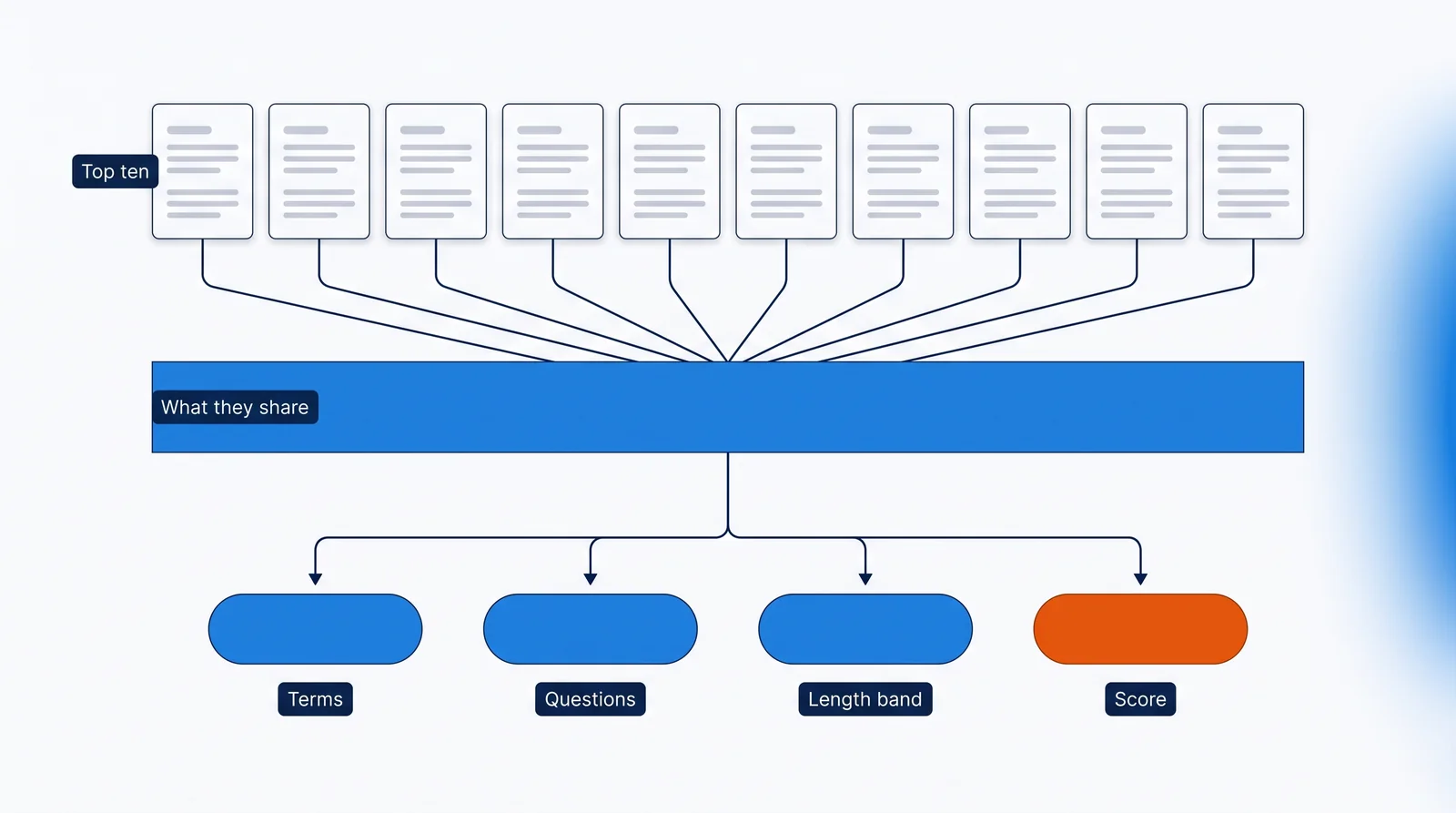
A content optimization tool compares your draft against the pages already ranking on Google for your target keyword and turns the differences into recommendations: terms to use, questions to answer, a length band, and — almost always — a single score. You bring the keyword; the tool fetches the top results and reads what they share. The pitch across the six products we read is the same sentence: create what the winners already created, and the number tells you how close you are.
The standard SEO feature set, in plain language:
- SERP analysis. The tool pulls the top-ranking pages for your keyword and extracts what they have in common — vocabulary, length, structure, headings. This is the feature every other feature is built on.
- Term suggestions. The shared vocabulary becomes a target list: use this term this many times. This is the feature people usually mean by "content optimization".
- Briefs. The same SERP analysis packaged before drafting: a brief listing the topics to cover, the questions to answer, and the competitors to read, handed to whoever will create the draft.
- A live editor. You write, and the meter updates in real time as you use the SEO recommendations. This is the flagship feature almost every vendor leads with.
- Audits. The same analysis run against pages you already published, to find which published pages to improve and which topics to rank for next.
Most of that list sits downstream of keyword research: a keyword research tool (or your rank tracker) picks the target, and the content optimization tool reads the Google SERP for it and turns it into a brief. In that sense these products are research tools first — they read what ranks so you don't have to. Two of the six we checked also sell the step before that. MarketMuse says it "tells you what content to write (and how much)" and offers a plan — "a personalized roadmap showing what to create or update" — and Semrush's Content Toolkit carries a Topic Finder that surfaces ideas "based on your site, audience, and competitors". That is a recommendation about which topics to create, and it runs before the SERP analysis rather than out of it. The meter itself does not tell you what to write about; it tells you what the pages that rank for a chosen keyword look like, and that distinction is exactly where the trouble with the meters begins.
When does a content score lie?
A content score lies when it rewards matching the consensus of the pages that already rank — and that is how most meters in this category, including our first one, are built. The method has an obvious appeal: the ranking pages are the only visible evidence of what Google rewards, so fit a meter to what they share and call the fit a score. We did precisely that. Then we tested it.
We ran blind quality reviews of a small set of articles — one independent reviewer agent per article, judging cold on a seven-dimension scorecard with none of the numbers shown — and compared the judgements against our fitted meter. The correlation came back negative: rho −0.61 across those nine articles, −0.63 for a competitor's meter we benchmarked on its own six, and −0.61 again across all fifteen. The drafts the meter liked most were the ones the reviews ranked lowest: keyword-dense, consensus-shaped, padded to match the length of whatever already ranked. Every draft in that trial sat between 71 and 90 on the meter, so what failed was not the meter's ability to tell bad writing from good — it was its ability to rank good writing against itself.
Two limits ride with that result, and we publish both. The judges were reviewer agents, not people: a human blind read of the same articles is prepared and not yet done. And our editing loop revised each draft until the score cleared 75, so the weaker-scoring drafts received more editorial work than the strong ones — an honest alternative explanation for the direction we found, and the reason we treat the result as grounds to rebuild, not as a law. The sample was small and we say so plainly, but a meter that points the wrong way on a small sample does not earn a bigger one. We rebuilt instead.
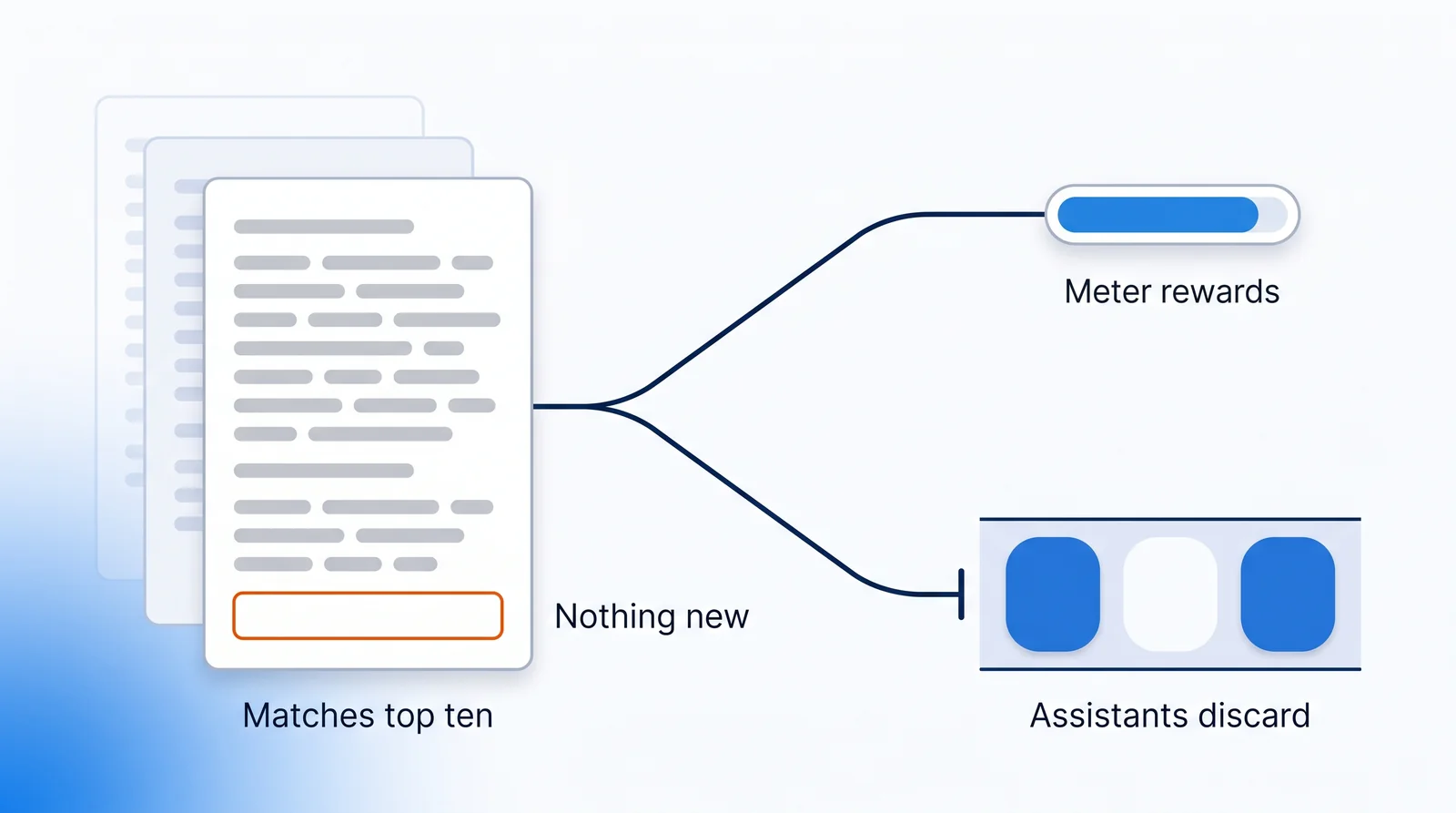
The mechanism is not mysterious. A meter fitted to the ranking consensus rewards you for repeating what Google's top ten already say — and repetition is a behaviour AI assistants discard. Asked to describe its own source selection, ChatGPT told us it often ignores pages that add no new evidence — a self-description, not a controlled measurement, though it matches what we measured. Five articles repeating the same points are not five sources. What we can show is the overlap and not the cause: we observe what cited pages share, and we cannot yet prove that adding those properties causes citation. Our read is that a draft optimized into agreement with everything that ranks is the page an assistant skips.
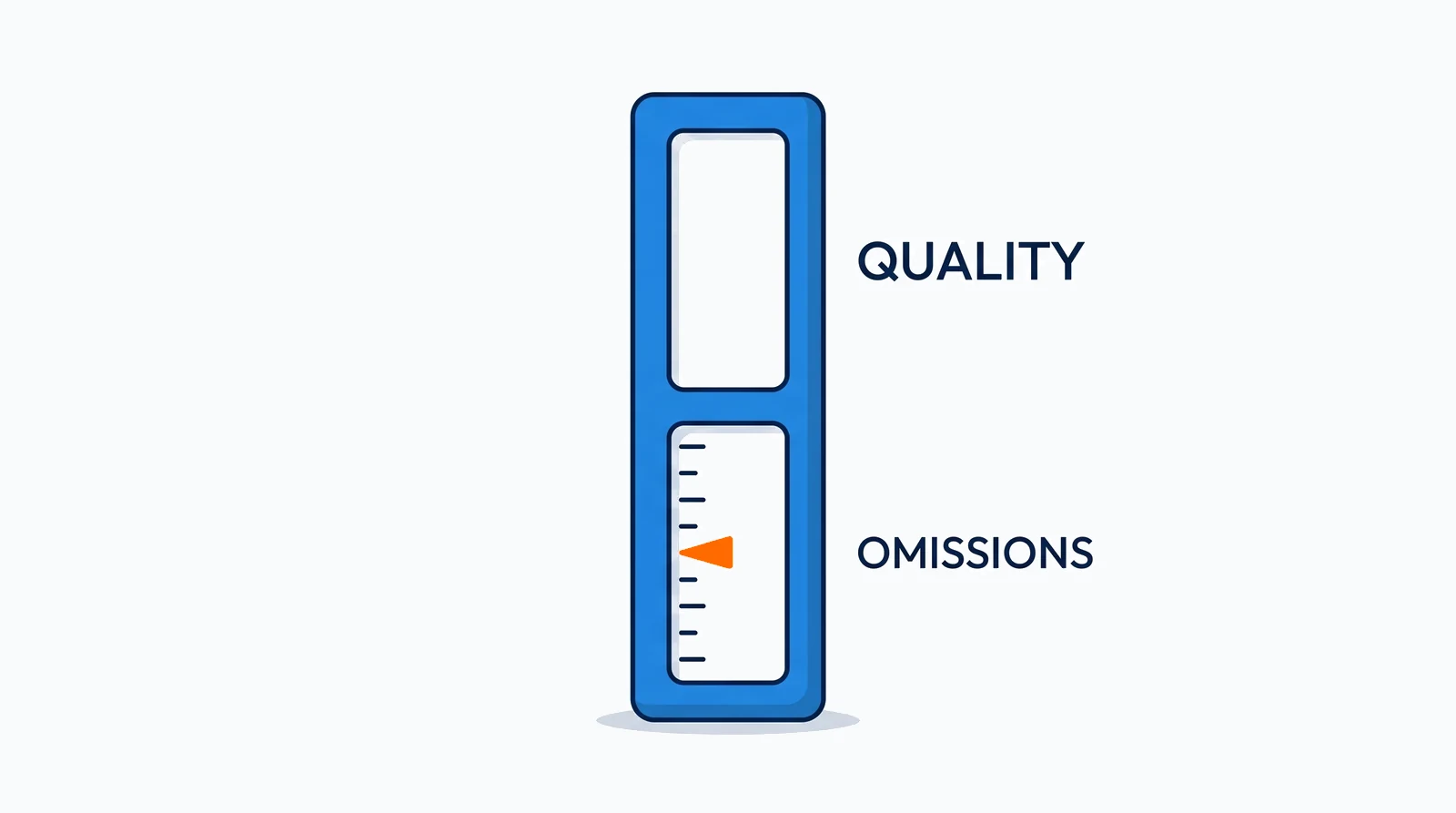
None of this makes the meters useless. In honest use, the meter is good at three jobs: catching omissions (a question searchers ask that your draft never answers, a term the field uses that you never touch), holding a word band so you match the depth of the topic rather than the padding of competitors, and flagging stuffing before a reader smells it. It is a meter, not an editor. It can tell you what is missing and what to improve; it cannot tell you what is good.
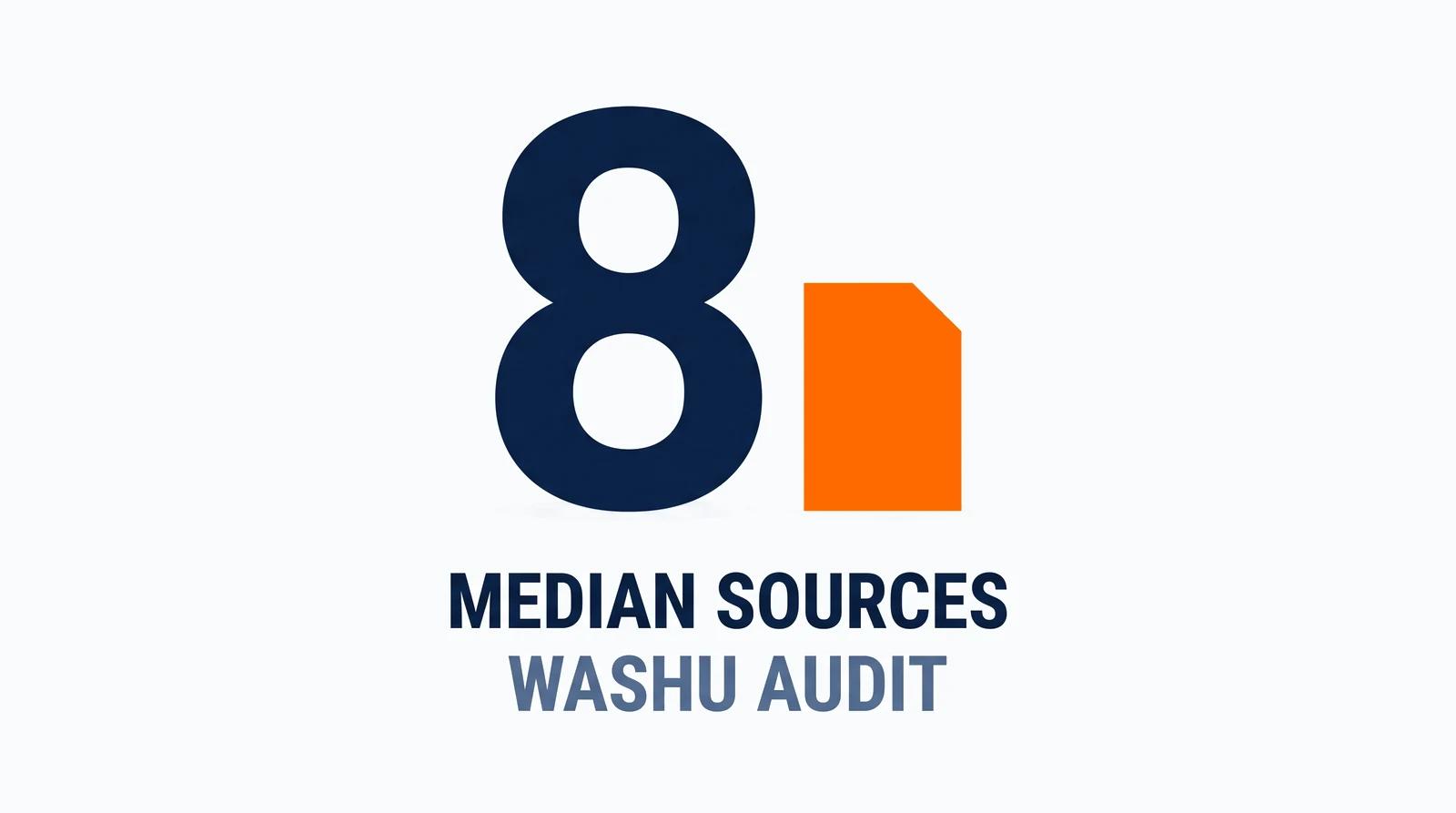
So we rebuilt our scoring around that boundary, and since we sell the result, read this paragraph as our view of what matters rather than a neutral standard. Our checklist is evidence-listed — every item names the measurement behind it, so you can disagree with the meter using its own data. The bands are calibrated on where real winners actually land: the 43 pages ChatGPT cited in our harvest sit at a median of 65 on our citability checklist, not 100, and only 5% of them reach 85. The checklist and its method are published. Real winners land in the 55–84 band; readings above 85 are informational, not better — chasing points past the winners' zone produces the stuffing assistants discard. Stuffing itself we treat as a warning about the writing, never a deduction. A deduction is a penalty you can pay down by stuffing somewhere else, and that teaches exactly the wrong lesson. Every meter we ship is published with its method and limits, including the results that flatter nobody.
Which content optimization tools exist today?
Six SEO products we verified live on 27 August 2026 do this work: Surfer, Clearscope, Frase, MarketMuse, Semrush's Content Toolkit, and Ahrefs' AI Content Helper — plus ours, disclosed below. In each vendor's own words:
- Surfer pairs a Content Editor offering "real-time SEO and AI Search optimization guidelines" with a Content Score it says rests on having "quantified what ranks" — the pitch is "Create Content that Ranks", and it works inside Google Docs through an integration.
- Clearscope sells term suggestions inside an optimization workflow — "write, optimize, track and scale" — now positioned across Google and AI chatbots alike.
- Frase runs the loop from research to rewrite: it "researches, writes, optimizes, publishes, and monitors" pages, splitting SEO ("Rank on Google") from getting cited by AI.
- MarketMuse tells you "what content to write (and how much)" — topic-level planning, competitive gap analysis and an Optimize brief, with its stated emphasis on planning over writing.
- Semrush's Content Toolkit promises "create content with more impact": generate articles from a brief and optimize existing pages, with "real-time SEO and AI visibility recommendations" and ideas to improve visibility in Google and AI search.
- Ahrefs' AI Content Helper grades a draft "against top-ranking pages" to expose "topical coverage gaps" — "create content that gets discovered in search and AI", with its stated emphasis on topics over keyword density.
And the disclosure: we build LiamVi, an optimization tool built around the citation research in this piece. It is early — the product is in early access and you have to request it — so we are not presenting it as a sign-up-today equal of the six shipping products. Judge it with the same questions below, and judge it now rather than later: our methods and samples are already published.
One more thing our tracking data adds. At our 2026-08-03 check, the six domains holding AI citation slots for the query "content optimization tool" were surferseo.com, clearscope.io, frase.io, semrush.com, ahrefs.com and marketmuse.com — the vendors themselves. We hold none. When you ask an assistant to recommend a content optimization tool, the answer is fed largely by the vendors' own pages, ours included if we ever hold one. That is one dated check from a small tracking set, and the category turns over — our weekly research sweeps keep surfacing tools we had not seen the month before — so treat any list, this one included, as a snapshot to verify, not a league table.
How do you choose a content optimization tool?
Ask every vendor questions with measurable answers — a feature list answers none of these. The six below are ours, and we picked them because they are what we built our own tool to answer well — so treat them as a competitor's priorities, not a neutral standard:
- What is the score calibrated on — and where do real winning pages land on it? If the honest answer is "aim for 100", ask what kind of page actually reaches 100. In our data, real winners do not.
- Does each recommendation come with its evidence, or just a number? A term target you cannot trace is an instruction to obey a meter on faith.
- How does it treat stuffing? A warning about the writing respects the reader. A deduction you can offset elsewhere invites you to stuff more quietly.
- Does it separate ranking on Google from being cited by assistants? In our tests those were different games — SEO optimization that moves one often does nothing for the other.
- Does the vendor publish the method and its limits anywhere you can read? Any number without a stated method is an opinion with a progress bar. This applies to us as much as anyone.
- What does weekly use actually cost — and what does the free tier really show? The work is iterative; a price that only supports a monthly check hides the trend you are paying to see.
Do content optimization tools work for AI search?
Mostly not yet — the page-level properties these tools optimize did not separate cited from ignored pages in our research, most of which measured ChatGPT. The findings, each with its limit:
- Question coverage came back null. In our early sample, the pages assistants cited answered searcher questions at nearly the same rate as the pages they ignored. Covering the questions from keyword research makes an article more useful; it did not buy citations.
- Authority came back null. Across our matched keywords, the higher-authority domain won and lost against the smaller one about equally. Small sites hold citation slots next to household names in our sweep data.
- Rank and citation barely overlapped. Only a small minority of the citations in our sample came from pages in Google's top ten. Ranking is position on a results page; citation is presence in an answer — different funnels, and classic SEO optimization only feeds the first. Watching the second funnel is a different job from optimizing for it, and it needs a different kind of product: we wrote separately about what AI visibility tools measure and how to judge one.
- Framing decided retrieval — including for this very topic. In our pre-registered test across five topics, conceptual "what is X" phrasings triggered no source retrieval on the engine we measured, while comparison-shaped phrasings that carried a date triggered it consistently. The topic "content optimization" itself followed the pattern: nothing at all under the conceptual phrasing. Engines differ — some, like Perplexity, cite far more freely — and our data here is small and early; we keep measuring weekly and will publish what changes.
What transfers from classic content optimization: structure still helps. Some assistant citations resolve to a single highlighted sentence inside a page rather than to the page itself, and one article in our harvest was cited four times for four different passages — so self-contained passages give an assistant something to lift. Answering real questions still improves the piece for the human who lands on it. And adding something the ranking pages lack is the behaviour that helps in both places. What does not transfer is the core habit the category trained into everyone: creating pages toward the consensus of the current top ten.
Can you do content optimization free?
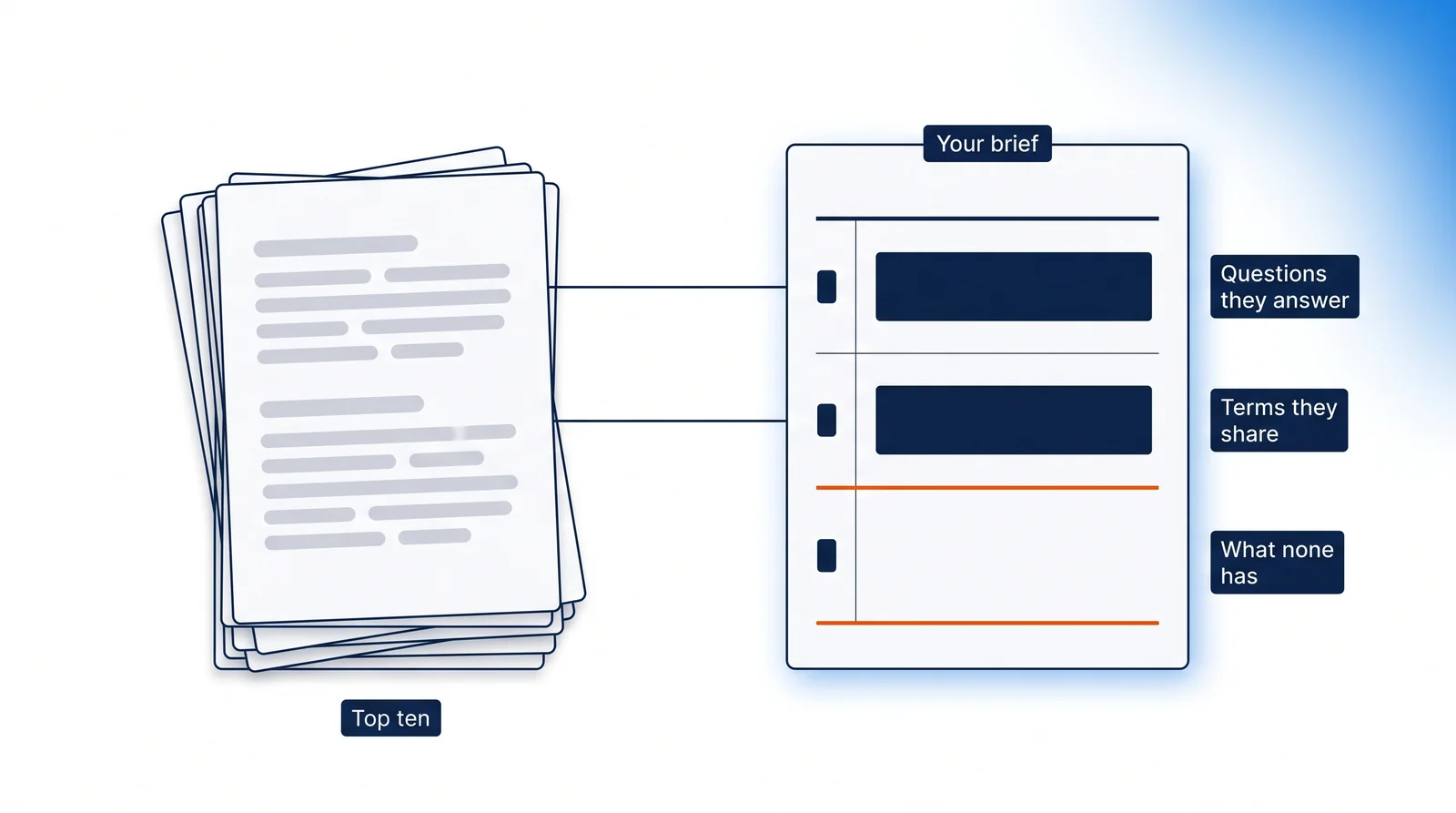
Yes — the manual version costs time instead of money, and it is the same keyword research and SERP analysis the paid SEO tools automate. Run your keyword research, read Google's top ten yourself, and write down three things: the questions they all answer, the term list they share, and what none of them has. That is your brief. A brief you wrote yourself forces the one thing no meter automates: actually reading the winners. Every paid feature above — scale, live feedback, history — automates that idea rather than replacing it, so use the manual method first, pair it with whatever keyword research tool you already use, and buy software when the volume justifies it. Whether a given vendor has a free tier or trial — and what a free plan actually shows — changes too often to summarise honestly, so check the current pages rather than trust a roundup, ours included. "Free SEO optimization tools" sits among the most common related searches for this keyword in the search data we pulled; our read is that free in this category usually means a gated tier of a paid product, or the manual method above.
The discipline that costs nothing is the one this whole piece argues for: use any score as a checklist of omissions, not a target to maximise. Improve what the analysis caught, keep the sentences a human would quote, create the thing the top ten does not have, and stop while the writing is still yours.
Sources
- Surfer — product site, checked 27 August 2026.
- Clearscope — product site, checked 27 August 2026.
- Frase — product site, checked 27 August 2026.
- MarketMuse — product site, checked 27 August 2026.
- Semrush Content Toolkit — product page, checked 27 August 2026. The older `seo-writing-assistant` address now redirects here.
- Ahrefs AI Content Helper — product page, checked 27 August 2026.
- LiamVi — our own site; the product is in early access, checked 27 August 2026.
- Our research — methods, samples and limits — every measurement this article draws on, with the numbers stated precisely and the null results included.