Does location affect AI search results? What a controlled audit of ChatGPT and Gemini found, and how to check your own
Yes: in tests of their APIs, where a question came from changed the sources ChatGPT and Gemini cited and the businesses they recommended. That is the finding of the only controlled audit of both engines that we found, run in October 2026; the two engines use different signals to work out the place. For ChatGPT that result held for questions that depend on place, not for the rest; Gemini moved even on those. The audit is a four-page preprint by Mahe Chen and Nick Koudas of the University of Toronto, submitted on 16 October 2026 and not peer reviewed, and its authors warn that the APIs need not behave like the consumer apps.
The authors asked 300 questions, each twice in every setting so that ordinary run-to-run change could be subtracted: 31,200 answers in all, across the two tests described below. "ChatGPT" in the paper means OpenAI's gpt-5.4-mini through its API with the web search tool; "Gemini" means gemini-3.1-flash-lite with Google Search grounding. Their conclusion is that visibility in generative search "is specific to the user's location".
Our own product tracks the sources AI answers cite, which gives us an interest in this question. We have not measured location ourselves, and every figure below belongs to the people who published it. We reviewed the top-ranking pages for this question, listed at the end: they are local SEO guides and pages, and none cites a measurement of how the asker's place changes an AI answer, including the newest, from 16 October 2026.
How did the audit test location?
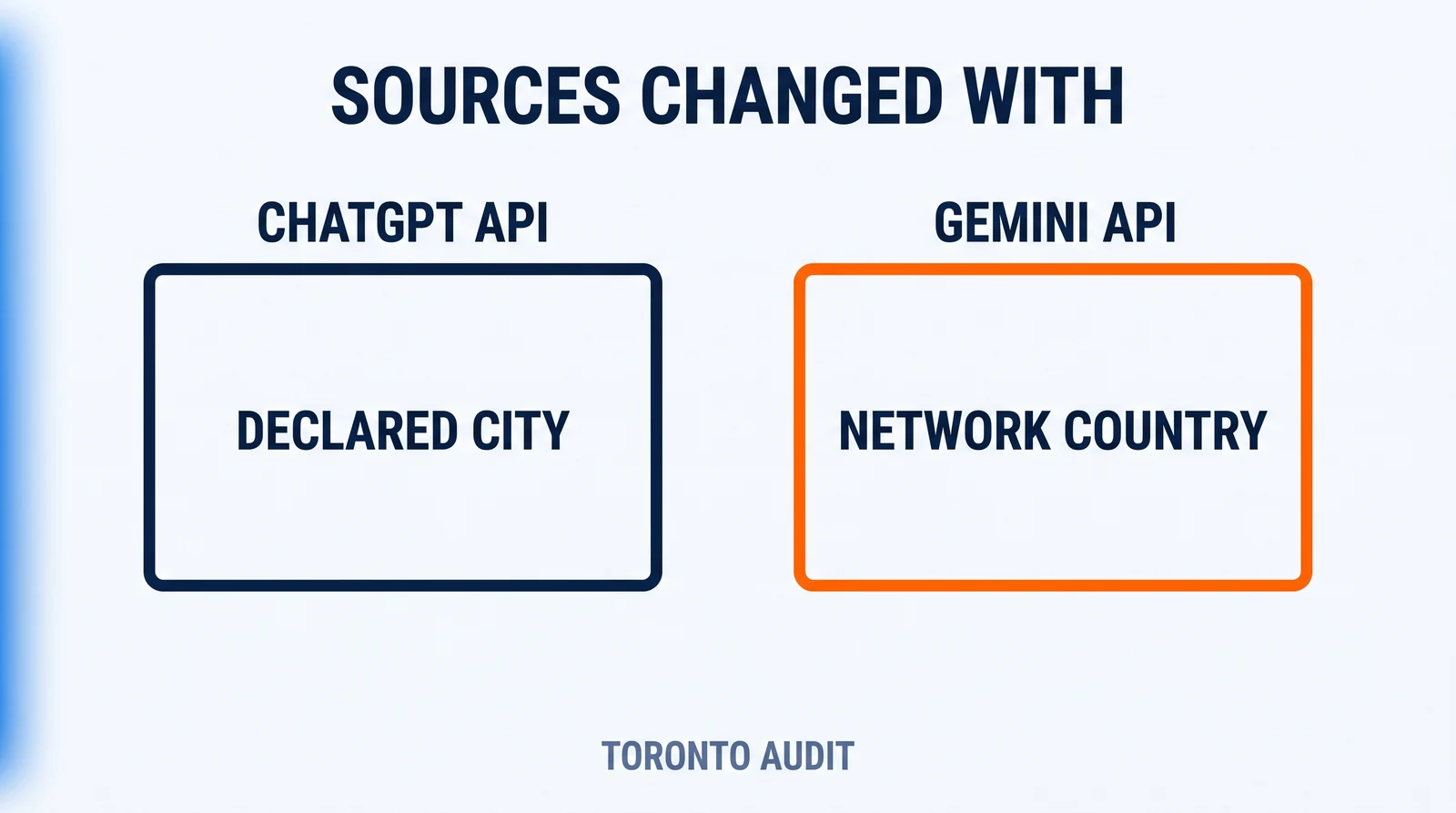
The Toronto audit gave ChatGPT and Gemini a place in two ways, a declared city and a network connection.
The 300 questions cover ten commercial topics, from home services to public services, in three groups of 100. Near-me questions (nearby ones below) ask for something close at hand: "best plumber near me". Place-dependent ones have an answer that depends on where you are, such as prices, laws, providers or weather. Not-local ones do not: "best robot vacuum". None names a place.
The first channel is a declared city. The authors passed a city to OpenAI's web search tool as an approximate user location, which OpenAI's API documentation lets a developer set by country, city, region and timezone: 15 US cities plus London, Toronto, Sydney and Dublin, for 24,000 answers sent from a single network.
The second channel is the network. With no city declared, the requests went out from the authors' connection in Canada, from VPN exits in New York, Los Angeles, London and Sydney, and from Canada again three days later to check for drift: 7,200 answers.
The audit's measure is the localization index. The overlap between two answers is the share of cited domains they have in common out of all the domains either cites (the Jaccard index). For each prompt, the authors took the average overlap between two identical requests and subtracted the average overlap between two settings, then averaged the result over the prompts. So 0 means the setting changed nothing beyond ordinary noise, and the higher the index, the more the setting changed the sources. An index value is a difference in overlap, not a percentage of sources.
Does ChatGPT change its sources with your location?
ChatGPT's sources changed with a declared city and not with the network. That was the result for OpenAI's API in the audit's October 2026 test.
For nearby requests, the sources differed between two US cities by an index of 0.14 and across countries by 0.28. For place-dependent ones the figures were 0.17 and 0.43. For not-local ones they were 0.00 and 0.03: no dependence on the declared city. Between network connections in different countries, the index was 0.00, 0.01 and 0.01, all within noise.
The model wrote the place into every search it ran for nearby requests and into 48% of its searches for place-dependent ones. Its search backend also localized the search result list when the query named no place: for a user declared in Boise, the model cited Oregon State University's extension service on when to plant tomatoes. Distance did not fade it: the index was 0.13 for cities less than 1,000 km apart and 0.14 for cities more than 3,000 km apart.
With no city declared, the model asked for a ZIP code or city on 63% of nearby requests, and when it did look things up it answered for an unspecified user in the United States, from national sources. With a city declared, it cited sources in 64–73% of its answers, against 46% without. The Tallinn study below reports the same US default for the API.
The app is not the API. OpenAI's help page for searching the web with ChatGPT says the app may estimate your rough location from your IP address, that sharing your device's position is optional and off by default, that a VPN may change the place it infers, and that with memory on, saved location information may influence search results, so in the app the network is a signal the audit did not test.
Does Gemini change its sources with your location?
Gemini's sources changed with the country of the network connection, not with a declared city. That was the result for Google's API in the same test.
In a pilot, declared coordinates had no effect. Gemini localized by country, not city: between New York and Los Angeles its index was 0.00, and its queries named the country in 56% of nearby answers but never a city. Across countries, its sources differed by 0.43 for nearby requests and 0.40 for place-dependent ones, and still by 0.23 for requests that do not depend on place. The authors describe Gemini as "changing most of its sources even for questions that do not depend on place".
Asked which store has the cheapest groceries, Gemini named other national chains in each country, such as Aldi, Lidl and Tesco from the UK connection, and mostly the same chains from New York and Los Angeles, Aldi and Walmart first in both. Drift does not explain the country effect: the same Canadian connection three days apart gave 0.03, 0.01 and 0.05.
Google's Gemini Apps Privacy Hub says Gemini Apps use the general area from your IP address or the Home or Work addresses in your Google Account by default, and your device's precise position with your permission, for prompts like "where is the closest coffee shop to me?" Gemini may also receive that precise position from Google Maps, a signal the audit's API test could not see.
The two channels, in short:
- ChatGPT, through the API tested: a declared location, down to the city. The network made no difference.
- Gemini, through the API tested: the network's country. A declared location made no difference.
What changed for the businesses the answers recommended?
The recommended businesses changed with the sources, and for ChatGPT's nearby questions almost completely. Both engines showed it in the audit, through their APIs.
A near-me answer from ChatGPT with a declared city named 4.3 businesses, brands or products on average, as listed by a language model whose extractions a hand check rated fully correct in 29 of 36 cases. Two identical requests shared 23% of those names; two declared cities shared 4%. Across the 15 US cities, 96% of the businesses recommended for nearby requests appeared in only one city. The sources moved the same way: 79% of nearby answers in US cities cited a source naming that city or state, and 92% of those in the other four countries cited a source from that country. Asked for credit unions "in my area", the model named Idaho Central CU, CapEd FCU and Connections CU for Boise, and a different set for New York, Miami and London. Gemini's recommended names moved between network countries even for not-local requests, at an index of 0.07.
The authors' reading is that a local business "becomes visible through pages that the engine finds for place-specific queries, such as local directories, review sites and the sites of local institutions, rather than through national rankings."
Four of the five local SEO and local search pages we reviewed advise a local business on its Google Business Profile or Google Maps presence, and most stress keeping those details complete and consistent. The audit did not test a Google Business Profile or a Maps listing, and it left directories and review sites out of its business counts. It shows that the businesses named move with the place, not which listing moves them; we have not measured that either.
What does this mean for an AI visibility number taken from one place?
An AI visibility number taken from one place describes the answers given in that place. For nearby questions in the audit, it described very little else.
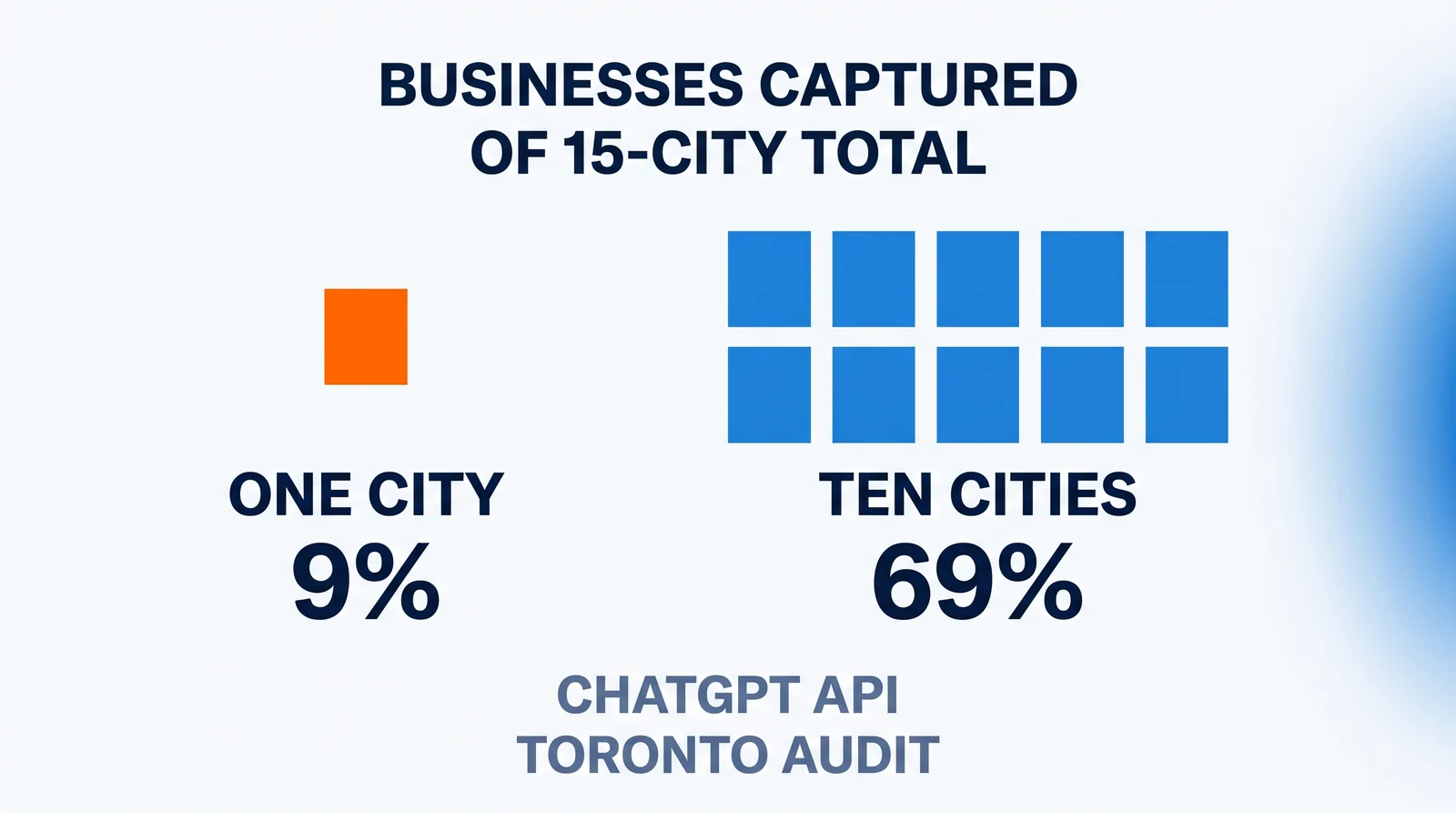
For ChatGPT's nearby requests with a declared city, a request in a US city recommended 8% of the businesses the same request recommended in another city, against 32% when it was repeated in the same city. These two figures count something other than the 23% and 4% above: the share of the businesses recommended in another city that a request also named, across the 15 US cities only, rather than the share of names two answers had in common. Monitoring one city captured 9% of the businesses recommended across all 15 cities, two requests each; five cities captured 36% and ten captured 69%. Even not-local requests, which the place did not affect, gave 19% from a single city and 53% from five, from the variation between repeated requests alone.
A tool that sets only a location parameter, the authors write, "measures ChatGPT for that city but Gemini for the country it runs from". A tracker's reading from a single place is a reading specific to that place and that channel.
Run-to-run variance exists before the place enters at all. The same assistant can cite other sources when asked the same question twice, which is why the twin requests matter. The same lesson holds a level up, where an assistant's share of usage changes with the country counted.
What did other studies find?
Two other studies, both smaller, also saw answers change with the connection a request came from. One tested the ChatGPT web interface, the consumer surface the audit did not.
Dmitrij Żatuchin, affiliated with the Estonian Entrepreneurship University of Applied Sciences and with Rankfor.AI, a company in Tallinn, posted a preprint on 30 August 2026: 234 runs on the logged-out ChatGPT web interface and the OpenAI API over 29–30 August, six identical runs per cell. With the prompt held in Turkish, moving only the exit IP from Istanbul to Berlin moved the suppliers named from Turkish to German ones. Its main finding is that the prompt's language, not the place, decided whether local suppliers appeared at all; its own limits are six runs per cell, a single model and a single prompt per category.
The company cloro, which sells state-level targeting for AI monitoring, published a study on 23 July 2026, updated 15 September: eight near-me prompts on five engines from six US states plus a national baseline, 279 responses. It reports cited sources differing by state, with ChatGPT returning a per-state "map pack" of named businesses; each cell was a single call, a limit the study names, so it cannot separate a state effect from run-to-run change.
The Toronto authors know of no earlier work varying the user's location; the Tallinn preprint varied the exit IP about seven weeks before theirs.
How can you check whether location changes your own AI results?
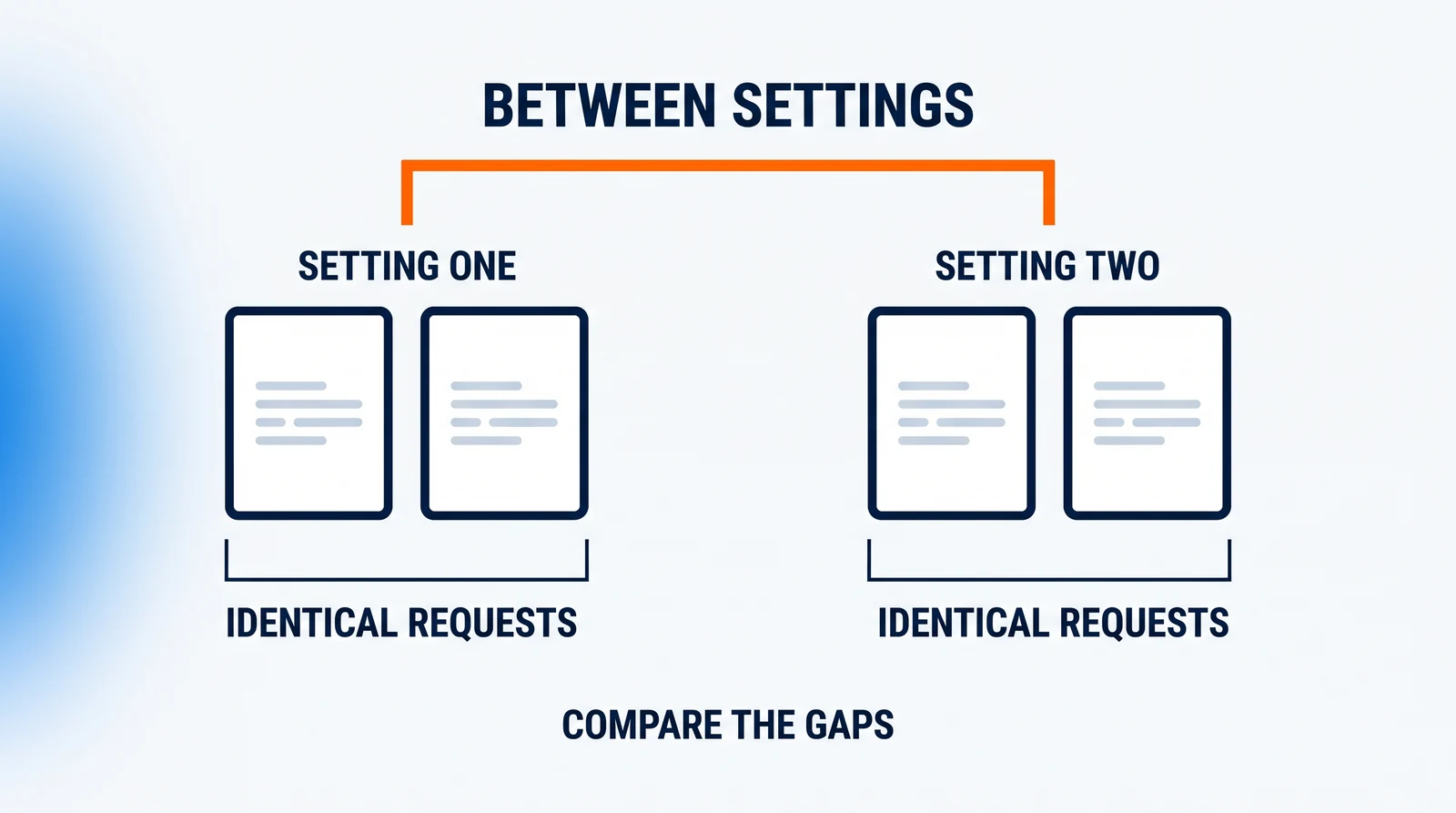
To check whether location changes your own AI results, ask the same question at least twice from each setting that matters, record the sources, and compare the gap between settings with the gap between your identical requests.
- Pick a handful of questions your customers ask, and include at least one that does not depend on place as your control.
- Decide which settings to use. For ChatGPT: the city set in the API's web search tool, or in the app the network you connect from, the device's position and saved memory. For Gemini: the country you connect from, plus in the app the Home or Work address and the device's precise position.
- Send each at least twice per setting, each time in a fresh chat, and record the cited sources and the businesses named.
- Compare. If two settings disagree no more than your identical requests do, you have no sign that the place is moving that answer. If they disagree clearly more, the place is probably moving it, for that prompt, that engine and that day. Two requests per setting give a rough reading, not proof: the Toronto audit averaged its comparisons over 100 questions in each group, and in the Tallinn study ChatGPT's top recommendation changed across six identical runs on four of six prompts. Repeat any setting that stands out before you use the result.
A business in several countries needs the check in each; for ChatGPT, the audit's result says the same of each city. Which places matter is your call. Choosing the place changes what you see, not what your customers are shown.
What the audit cannot tell you
The audit cannot tell you how the consumer apps behave. It tested the APIs, with small models. Its check with the full-size model, 720 answers on 60 prompts at six settings, covered ChatGPT only, which localized at least as strongly. The VPN exits were data-center addresses, and Gemini may localize more finely on home connections. The prompts are the authors' own, in English, and the measurements describe October 2026. The audit did not test Google's AI Overviews or AI Mode, and this page claims nothing about them. The authors say they release their questions, code and answers; a revised paper or a second audit would change this page.
Sources
- Mahe Chen and Nick Koudas, "Location, Location, Generation: Where You Ask Matters for Generative Engine Optimization", arXiv 2610.24081, v1 of 16 October 2026 (checked 29 October 2026) — abstract https://arxiv.org/abs/2610.24081 · full text https://arxiv.org/html/2610.24081v1
- OpenAI, "Web search" (API documentation, section "User location") (checked 29 October 2026) — https://developers.openai.com/api/docs/guides/tools-web-search
- OpenAI Help Center, "Searching the web with ChatGPT" (checked 29 October 2026) — https://help.openai.com/en/articles/9237897-searching-the-web-with-chatgpt
- Google, "Gemini Apps Privacy Hub", last updated 26 October 2026 (checked 29 October 2026) — https://support.google.com/gemini/answer/13594961?hl=en
- Dmitrij Żatuchin, "The Language of the Question Selects the Market: Query Language and Exit IP as Separable Factors in Commercial Recommendations from a Generative Search Interface", arXiv 2608.30052, v1 of 30 August 2026 (checked 29 October 2026) — https://arxiv.org/abs/2608.30052
- cloro, "How AI Answers Change by State: A Data Study", 23 July 2026, updated 15 September 2026 (checked 29 October 2026) — https://cloro.dev/blog/ai-search-results-by-state/
- The top-ranking pages we reviewed for "does location affect ai search results" on 26 October 2026: https://www.searchenginejournal.com/see-google-search-results-different-location/294829/ · https://www.mapranks.com/2025/06/26/google-business-profile-ai-guide-2026/ · https://bullseyestrategy.com/blog/ai-local-search-strategy/ · https://reputation.com/resources/articles/structuring-location-pages-for-ai-clarity-and-discoverability · https://insightarc.com/google-maps-and-ai-visibility/