AI Overviews and click-through rate: the studies disagree, and this is what each one counted
The five studies most often quoted on what an AI Overview does to click-through rate put the fall at anywhere between about 15% and about 61%, and the spread is not a sign that somebody measured badly. It is what happens when five studies count five different things and the results are quoted as though they were one number.
So we opened each at its own source and wrote down what it counted, over what sample, in which country and period, and what it treated as a click — then put them beside each other, which none of the pages ranking for "ai overviews click through rate" in the United States on 15 September 2026 does. Those pages are where the five come from; we read one query on one day, and did not record the device or personalisation state behind them.
We have measured none of this, and no figure in this article is ours — every number below belongs to somebody else and says so. And one figure that appears on several pages could not be found at the source it is attributed to, so we do not repeat it as that company's finding.
How much do AI Overviews reduce click-through rate?
Five published studies give five answers between about 15% and about 61%, and they differ because each one counted something different.
The first counts a share of browsing visits — out of everything a tracked person did, how often they clicked a traditional search result at all. The second counts a position-one rate on matched keyword sets, measured against a forecast rather than against last year. The third counts a blended rate across one agency's client accounts, measured against its own year-ago value. The fourth counts the average change across ten websites' keywords once an AI Overview started appearing on them. The fifth counts one publisher's own tracked keywords.
Those are five denominators answering five questions, so a number from one cannot be compared with a number from another — which is what the pages we read do.
What did Pew Research actually measure?
Google users who met an AI summary clicked a traditional search result in 8% of all visits, against 15% of visits for users who did not, across 68,879 searches made by 900 US adults during March 2025. Pew Research Center published both figures on 22 July 2025, and 12,593 of those searches produced an AI summary.
The 900 adults were recruited from "KnowledgePanel Digital, an online survey panel whose respondents agree to install an app".
Pew also wrote down what it counted as a click. A click was recorded when "the next-visited URL matched any of the links available on the first page of search results or in the first three links cited in a page's AI summary". One more figure sits inside that definition: users who met an AI summary clicked a link in the summary itself in just 1% of all visits.
The limit is Pew's own, stated on the page: the analysis "includes only Google searches", because the researchers could not reliably identify AI summaries on other search engines. A second one is dated: the browsing ran through March 2025, but the search results were collected 7–17 April 2025, and Pew says a summary "may change over time". 8% is a share of visits, not a click-through rate per impression.
Why Ahrefs reports 34.5% and Seer reports 61%
Position-one click-through fell from 5.6% to 3.1% between March 2024 and March 2025 on keywords with no AI Overview on them at all, and the two most-quoted studies differ mainly because one subtracts that background decline and the other does not.
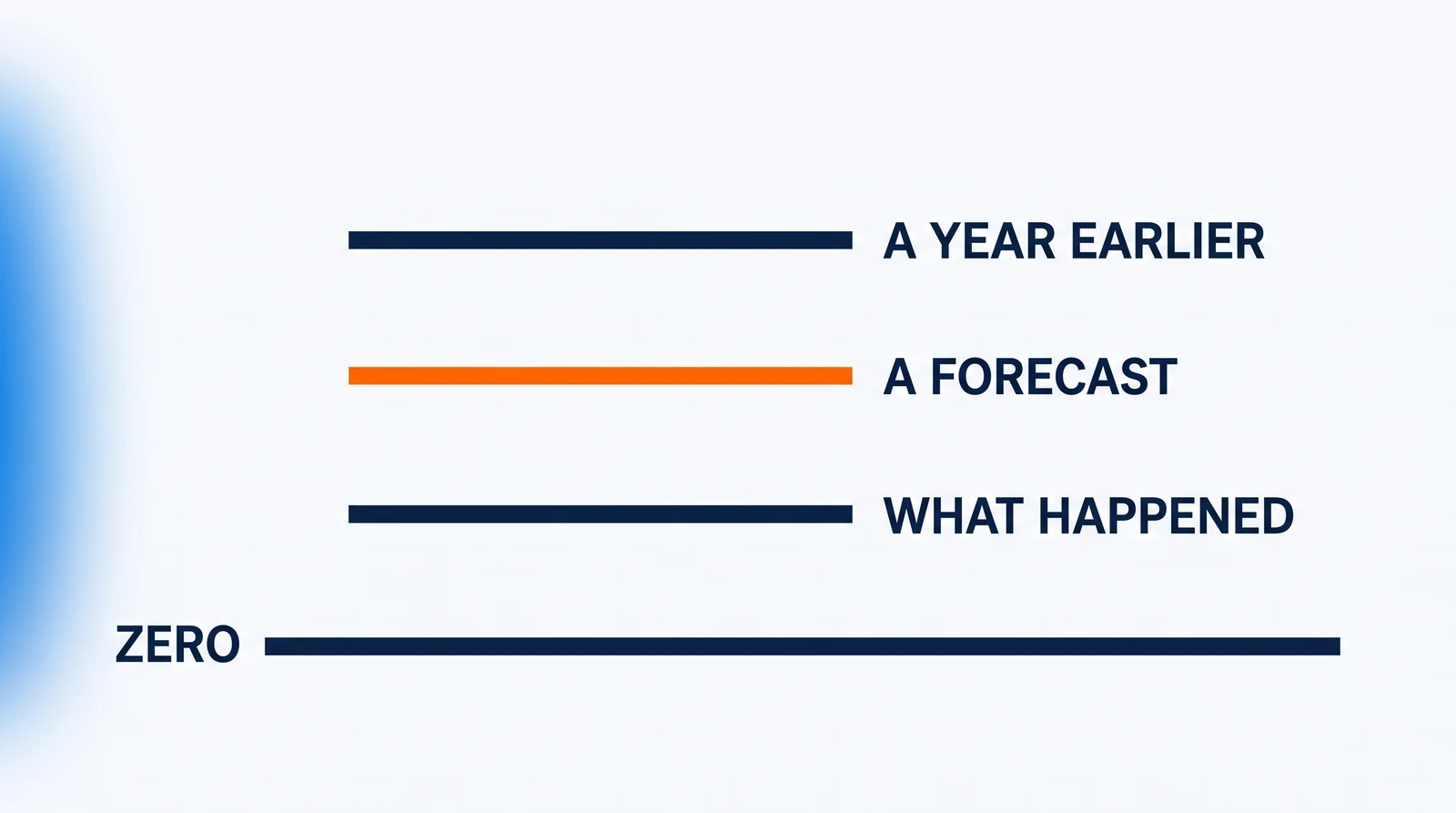
Ahrefs' study of 300,000 keywords, published 17 April 2025 by Ryan Law, compared March 2024, before the US rollout, with March 2025, using 150,000 keywords with an AI Overview present and 150,000 informational keywords with none. The metric is narrow: average position-one click-through rate on desktop, taken from "aggregated GSC data… (sum of clicks/sum of impressions)".
On the keywords that showed an AI Overview, position-one click-through fell from 7.3% to 2.6% — about 64%, and not the number Ahrefs reported. So Ahrefs used the control set above to build a counterfactual: "We can use the drop in CTR for informational keywords to predict the CTR for our sample of AI Overview keywords, assuming AI Overviews had not rolled out. This forecasted CTR is 0.040." The headline is the gap between that forecast and what happened: "the presence of AI Overviews reduces the click-through rate for position 1 by ~34.5% ((0.026-0.040)/0.040)".
Seer Interactive's September 2025 update, published 4 November 2025 by Tracy McDonald, tracked 3,119 search terms across 42 client organisations over 25.1 million organic impressions from June 2024 through September 2025, from Google Search Console and Google Ads. Its rate is blended across all positions, not position one, and it averages one agency's client accounts rather than a keyword database. Organic click-through on the queries that were showing an AI Overview in September 2025 went from 1.76% to 0.61% — the 61% that reaches most readers.
The sentence that rarely travels with it is on the same page: "Even queries WITHOUT AIOs are declining significantly in CTRs, suggesting broader shifts in search behavior beyond just AI Overview presence." Seer puts that decline at 41% over the same period, on queries where no AI Overview appeared at all.
Here is the arithmetic, and it is ours, done on Seer's published figures rather than a finding of Seer's or a measurement of ours. Seer gives its non-overview organic click-through as 2.74% in June 2024 and as both 1.45% for the third quarter of 2025 and 1.62% for September. Apply that decline to the 1.76% baseline the way Ahrefs applied its control, and the expected 2025 rate for AI Overview queries lands at 0.93% or 1.04% depending on which of Seer's two values you use. Against those, the actual 0.61% is a fall of about 35% or about 41%.
The lower of those sits within half a point of Ahrefs' 34.5%, and we are not reading anything into the closeness — two small sets of published numbers, and coincidence is the likeliest explanation. Most of the distance between "34.5%" and "61%" is a choice of baseline, not two measurements of a different effect. What the subtraction cannot show is that the two sets were alike to begin with — they sat at 1.76% and 2.74% in June 2024 — and Seer calls its own work a "retrospective cohort analysis, not a month-by-month correlation study", labelled from September 2025 and applied backwards.
Both of those studies have been re-run since
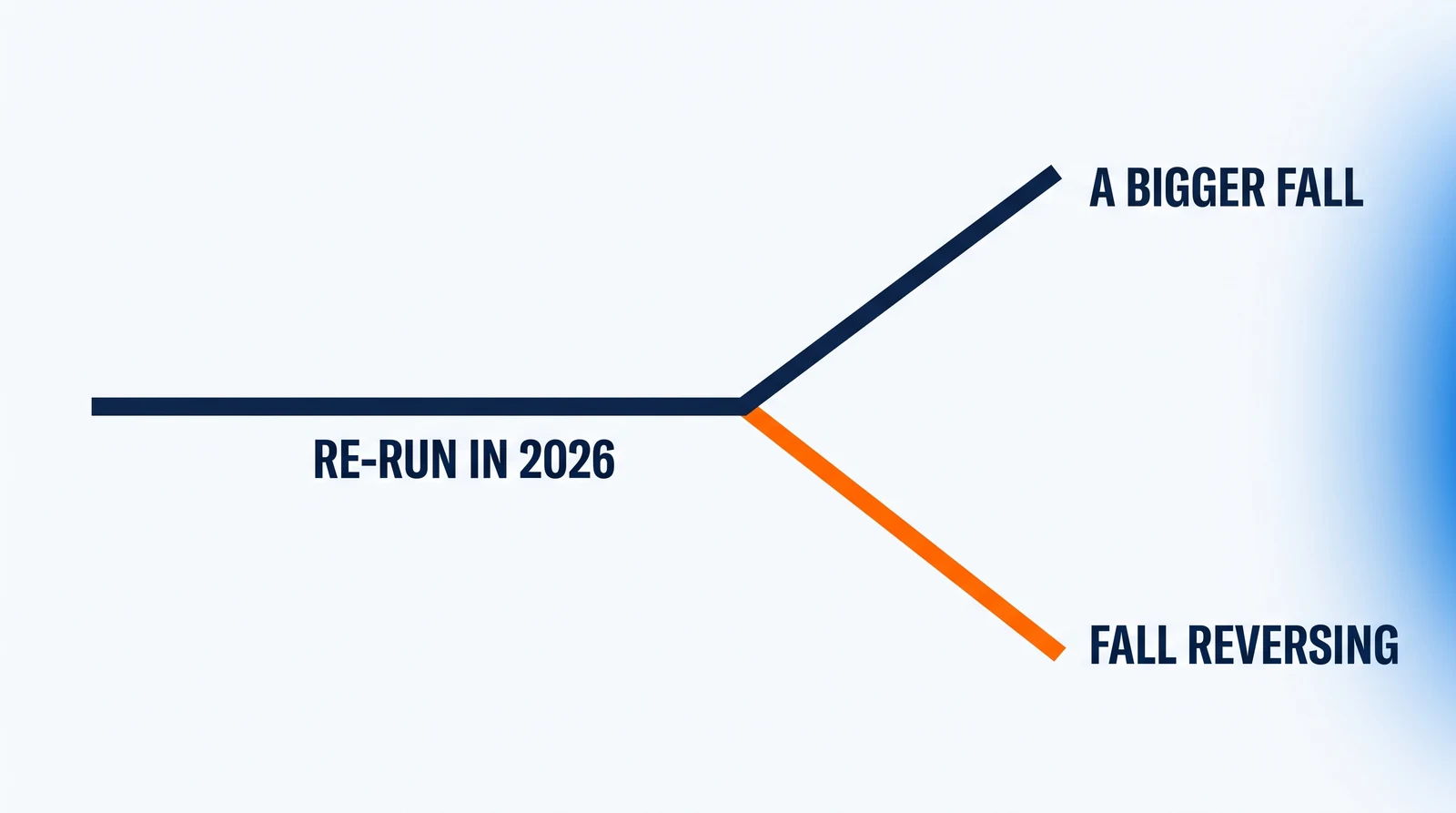
Ahrefs published 58% on 4 February 2026 and Seer's April 2026 update found the fall reversing. Ahrefs re-ran the same method on the same 300,000-keyword split, comparing December 2023 with December 2025: position-one click-through on the overview keywords fell from 7.3% to 1.6%, and against the 3.7% its control set forecasts, "the presence of AI Overviews now reduces the click-through rate for position 1 by ~58%". Seer's update covers 53 brands, 5.47 million tracked queries and 2.43 billion organic impressions across 2025 and the first quarter of 2026, and reports organic click-through on overview queries climbing "from a floor of 1.3% in December 2025 to 2.4% in February 2026", against 3.8% where no overview was shown. Neither states a country, and the five figures this page anatomises are 2025 vintage — a figure's date matters as much as its denominator.
What Amsive's 15.49% counted
The lowest figure in circulation, 15.49%, is an average across 10,000 keywords that triggered an AI Overview, drawn from 700,000 keywords on ten websites in five industries — finance, education, SaaS, healthcare and pets. The study, published 16 April 2025 by Will Guevara at Amsive, puts it as "keywords that now trigger AI Overviews saw a CTR decline of -15.49% on average".
Branded keywords went up 18.68%, and only 4.79% of them triggered an AI Overview at all. Non-branded keywords fell 19.98%, keywords ranking outside the top three fell 27.04%, and keywords triggering both an AI Overview and a featured snippet fell 37.04%, the steepest drop in the study.
The period, the data source, the country and the definition of click-through rate are all unstated, and there is no limits section. That does not make 15.49% wrong; it makes it narrow. Ten websites in five named industries is a real measurement of those ten websites, and quoting it as an industry average asks it to do something the study never claimed.
What it looked like at one publisher
Mail Online's click-through rate at position one fell from about 13% to under 5% on desktop when an AI Overview appeared, and from about 20% to 7% on mobile. Press Gazette reported those figures on 13 May 2025, quoting Carly Steven, the Mail's director of SEO and editorial e-commerce, who called it "a really profound impact on clickthrough rate".
Those are the absolute numbers behind the widely repeated 56.1% on desktop and 48.2% on mobile. The Mail "worked with an SEO software company to look at the impact Google AI Overviews was having on 5,000 of the search keywords which it targets". No period and no data source are stated for that analysis, and no country. It is one website, in news.
A separate example in the same report is often quoted as the study. For "Noor Alfallah news" — about 18,000 US searches — the Mail ranked first and received about 6,000 clicks; after an AI Overview appeared, 100. One query is an illustration, not a rate.
Even as the top link cited inside the AI Overview, Mail Online's click-through rate was still 43.9% lower on desktop and 32.5% lower on mobile.
The figure we could not find at its source
A 20% click-through-rate reduction attributed to Similarweb does not appear on Similarweb's own page on the subject. A widely ranking agency post lists that 20% alongside the Ahrefs, Amsive and Mail Online figures and gives Similarweb as the source.
Similarweb's own page, dated 10 June 2026, does not state it. What it carries is Pew's 8%-versus-15% result, attributed to Pew, and a separate 20%-plus figure that is the share of queries where an AI Overview appears, not a click-through rate. We searched Similarweb's own website for a 20% click-through figure and did not find one.
We do not say how the number got there. The rule is the useful part: a figure travelling under a company's name is not the same as a figure that company published.
One study can also arrive as several percentages without anyone doing anything wrong. One of the longest pages on this query renders Seer's research as "organic CTR plummeted 61% (from 1.76% to 0.61%)" and "paid CTR crashed 68%". Search Engine Roundtable, reporting the same study on 5 November 2025, renders it as "65%" organic when you are not cited, "78%" for paid, "49%" organic when you are cited, "54%" for paid when cited, and "46% drop for organic search and 20% for paid" where no AI Overview appears. Every one is a real cut of the same research, and none is the same claim.
The studies side by side
These are the five as each was published: the samples run from 900 tracked people to 300,000 keywords, and only one states every field a reader needs to use the number.
| Study and date | What it counted | Sample | Period | Country | Positions | What counted as a click | |---|---|---|---|---|---|---| | Pew Research Center, 22 Jul 2025 | Share of browsing visits with any result click | 900 US adults; 68,879 searches; 12,593 with a summary | Mar 2025 (results collected Apr 2025) | United States | All | A next-visited URL matching a first-page link or one of the first three links in the summary | | Ahrefs, 17 Apr 2025 | Position-one CTR against a forecast built from a control set | 300,000 keywords (150,000 with an AI Overview, 150,000 without) | Mar 2024 vs Mar 2025 | Not stated (US rollout referenced) | Position 1, desktop | Search Console clicks ÷ impressions | | Seer Interactive, 4 Nov 2025 | Blended organic CTR against its own year-ago value | 3,119 search terms across 42 client organisations; 25.1M organic impressions | Jun 2024 – Sep 2025 | Not stated | All positions | Search Console clicks ÷ impressions | | Amsive, 16 Apr 2025 | Average CTR change on keywords that trigger an AI Overview | 700,000 keywords across 10 websites in 5 industries; 10,000 triggering | Not stated | Not stated | All, with an outside-top-3 split | Not stated | | Mail Online via Press Gazette, 13 May 2025 | One publisher's CTR with and without an AI Overview | 5,000 keywords the website targets | Not stated | Not stated | Position 1 | Not stated |
Pew's row is the only one where every cell is filled, because Pew wrote its method down. Whatever anyone makes of a 900-person panel, it can be argued with, and that is the standard the other rows could have met.
What Google says, and why it does not settle it
On 6 August 2025 Google said "total organic click volume from Google Search to websites has been relatively stable year-over-year" — an aggregate across all of Search, not a click-through rate on the queries where an AI Overview appears. Liz Reid, VP and Head of Google Search, wrote in that post that average click quality had risen too — "by quality clicks, we mean those where users don't quickly click back" — and that this contrasts with "third-party reports that inaccurately suggest dramatic declines in aggregate traffic — often based on flawed methodologies, isolated examples, or traffic changes that occurred prior to the roll out of AI features in Search".
Both claims can be true at once: total traffic can hold steady while the rate on one kind of query falls, if the number of searches is rising. Neither answers the other, and the post carries no figure, no sample and no period with which to check it. We looked at what it does and does not contain in our piece on zero-click search, and the same question applies to us — we measured none of this, which is why no number of ours appears on this page.
What is a good click-through rate on Google search?
There is no single good click-through rate for Google search: on the keyword set Ahrefs tracked, position one ran at 7.3% in March 2024 and 2.6% in March 2025, while one publisher's first-position rate was about 13% on desktop and about 20% on mobile. A blended rate across one agency's client accounts sat at 1.76% and then 0.61%. Those are three different instruments and none of them is your website. The honest benchmark is your own previous number for the same queries, devices and positions.
So what do you do with an AI Overviews CTR figure?
Four questions separate an AI Overviews click-through figure you can act on from one you cannot: per what, against what baseline, whose sample, and measured when and where. Read those four as our view of what a figure has to carry rather than a neutral standard — we build measurement tools, and that shapes what we look for.
Per what? A rate needs its denominator. Pew's 8% is a share of visits; Ahrefs' 2.6% is clicks divided by impressions at position one. Both are correctly called a click-through rate by somebody, and they are not the same measurement.
Against what baseline? A decline can be measured against the same keywords a year earlier, against a matched control set, or against a forecast of what would have happened anyway. The 34.5% and the raw 64% above come from the same data and differ only in this.
Whose sample? Ten websites, 42 client organisations, 300,000 database keywords and 900 tracked people are four different populations.
When, and where? Most of this work is US. Where a source does not name a country — four of the five above do not — the right thing to write down is "not stated", not "United States".
Then stop looking for a general figure. Search Console reports your impressions and your clicks on your own queries, dated, with no panel in between. Impressions steady while clicks fall is exactly the pattern these studies describe, visible on your own website rather than inferred from someone else's. What that console cannot tell you is whether an AI answer cited you, which is a separate selection from ranking — and if you buy a number for it, what a visibility figure actually counts is worth checking first.
What people actually ask us
How do you optimise for Google AI Overviews? Being cited in the AI Overview helps, and it does not give you the click back. In Seer's data, cited queries ran at 0.70% organic click-through against 0.52% for uncited ones in the third quarter of 2025 — better, and both far below the 1.45% on queries where no AI Overview appeared. Mail Online was still down 43.9% on desktop as the top link inside the overview. So citation is worth having and is not a recovery plan, and anyone promising you the traffic back is promising something none of this evidence supports. If citation is the work you are doing, we have tested which of the popular citation signals have actually been checked by anyone.
How accurate are Google's AI Overviews? We have not measured it, and we will not pass on somebody else's claim about it. None of the studies on this page measured accuracy either — every one measured clicks. A click-through figure tells you nothing about whether the summary above the traditional search results was right.
Does it matter where the figure came from, if they all point the same way? Yes, because the direction is not the decision. All five studies here found click-through falling where an AI Overview appeared, and the 2026 re-runs point in two directions. The magnitude is what budgets are built on, and a 15% fall on ten websites and a 61% fall across 42 client accounts support very different decisions. The same discipline applies to our own numbers: when one of our scores pointed the wrong way, we published that too.
Sources
All checked 15 September 2026.
- Pew Research Center, "Google users are less likely to click on links when an AI summary appears in the results", 22 July 2025 — https://www.pewresearch.org/short-reads/2025/07/22/google-users-are-less-likely-to-click-on-links-when-an-ai-summary-appears-in-the-results/
- Ahrefs, Ryan Law, "AI Overviews Reduce Clicks by 34.5%", 17 April 2025 — https://ahrefs.com/blog/ai-overviews-reduce-clicks/
- Seer Interactive, Tracy McDonald, "AIO Impact on Google CTR: September 2025 Update", 4 November 2025 — https://www.seerinteractive.com/insights/aio-impact-on-google-ctr-september-2025-update
- Amsive, Will Guevara, "Google AI Overviews: New CTR Study Reveals How to Navigate Negative SERP Impact", 16 April 2025 — https://www.amsive.com/insights/seo/google-ai-overviews-new-research-reveals-how-to-navigate-click-drop-off/
- Press Gazette, Charlotte Tobitt, "Google AI Overviews leads to dramatic reduction in click-throughs for Mail Online", 13 May 2025 — https://pressgazette.co.uk/publishers/digital-journalism/google-ai-overviews-leads-to-dramatic-reduction-in-click-throughs-for-mail-online/
- Similarweb, "Zero-Click Marketing: What the 2026 Data Means", 10 June 2026 — https://aisearch.similarweb.com/blog/zero-click-marketing/
- Search Engine Roundtable, Barry Schwartz, "Google AI Overviews CTR Decline", 5 November 2025 — https://www.seroundtable.com/google-ai-overviews-ctr-decline-40374.html
- Dataslayer, "Google AI Overviews: the end of traditional CTR", checked 15 September 2026 — https://www.dataslayer.ai/blog/google-ai-overviews-the-end-of-traditional-ctr-and-how-to-adapt-in-2025
- Passionfruit, "How AI Overviews are affecting click rates on Google", checked 15 September 2026 — https://www.getpassionfruit.com/blog/how-ai-overviews-are-affecting-click-rates-on-google-and-best-practices-to-navigate-through-them
- Ahrefs, Ryan Law, "Update: AI Overviews Reduce Clicks by 58%", 4 February 2026, checked 16 September 2026 — https://ahrefs.com/blog/ai-overviews-reduce-clicks-update/
- Seer Interactive, Tracy McDonald, Hannah Cooley and Marketa Williams, "AIO Impact on Google CTR: 2026 Update", 24 April 2026, checked 16 September 2026 — https://www.seerinteractive.com/insights/aio-impact-on-google-ctr-2026-update
- Google, Liz Reid, "AI in Search is driving more queries and higher quality clicks", 6 August 2025 — https://blog.google/products-and-platforms/products/search/ai-search-driving-more-queries-higher-quality-clicks/
- LiamVi research: our methods, our samples and our limits — https://liamvi.com/research/