Do listicles get cited more by AI: a share of citations is not the chance of being picked
Listicles, the "best X" and "top 10" articles that publishers, agencies and brands put out on the open web, take a large share of what AI assistants such as ChatGPT, Perplexity and Google AI Mode cite in the studies we read. Whether any single one is likelier to be picked than another kind of page is a separate question, and the one study we found that measures it compares formats only among pages already in Google's top 10. This article is for someone who has been handed statistics about the format and is deciding whether to build a content strategy around it. Whether AI tools make up references, or how to credit an AI tool in a student essay, are separate questions; Google's question box for this search asked about them, and they are left alone here. Asked precisely, "more" is a question about a rate: of the lists an assistant could have picked for an answer, what fraction did it pick, set against the same fraction for every other kind of source?
The published figures mostly answer something else. The headline figures on the results Google returned run from 16.6% to 63%, and each is a share: of the citations a study counted, the fraction that pointed at a listicle. A share says nothing about the chance of being picked until it sits beside a second number, the share those articles make up among all the sources that could have been cited, and none of the studies we opened publishes it. What the evidence does support is narrower and still useful: the format's share is largest by far on questions that ask for the best of something.
We have measured nothing about content formats ourselves, and no figure below is ours. Every number belongs to the publisher named beside it and carries its sample. We read the eight results of a Google search for this question, run from the United States on 23 September 2026, and opened seven of them (a Reddit thread refused our request, and nothing here is quoted from it), then opened the studies behind the figures they repeat on the same day, along with one study that none of them cites. On 24 September we added a second that none of them cites, because it measures what the others do not.
Do listicles get cited more by AI?
Listicles come first by share of citations in every study we opened that compares formats (in Qvery's case, among the sources it could sort by title). The one study we found that measures the chance of being picked by format, a test of four assistants on 125 keywords, finds lists in Google's top 10 for "best X" questions cited by at least one of the four only about half the time.
The two measures sound alike and answer different questions. A share asks: of everything the assistant cited, how much was a listicle? A rate asks: of the lists the assistant could have used, what fraction did it use, and is that more than for other kinds of source? A large share can sit beside an ordinary rate. If most of the sources that answer a question are lists, they will collect most of the citations for that question even if the assistant has no preference for the format at all.
Masset's writing guide shows the gap on the results page itself. The guide, by Masset's chief executive Benjamin Ard and dated 4 June 2026, asks in its FAQ "Do listicles really get cited more by AI search?" and answers "Yes", on the strength of an analysis in which "63% pointed to listicle pages". That is a question about the chance of being cited, answered with a share.
How much does the question asked change the share?
The kind of question moves the share more than any other choice these studies made, from 5.36% to 40.86% of citations within a single study. Wix Studio's AI Search Lab published that study on 23 March 2026, written by Tom Wells, who describes himself as "a GEO researcher" at Peec AI, whose AI search analytics platform produced the data: 75,000 AI answers and the 1,056,727 citations in them, from ChatGPT, Google AI Mode and Perplexity, on prompts kept non-branded and sorted into four intents across five industries. Wix does not say when the answers were collected or for which location.
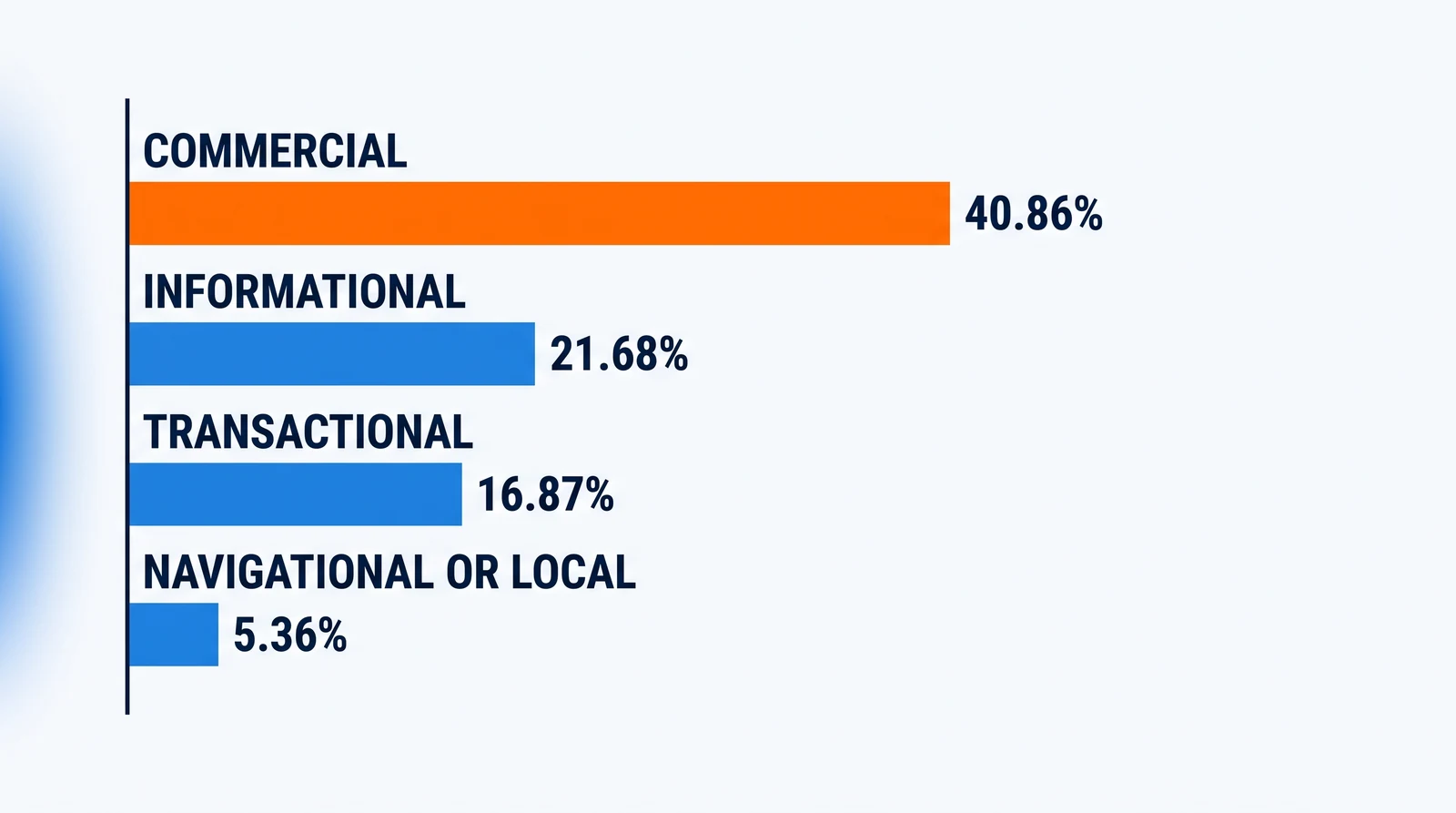
Listicles took 21.88% of all the citations in the Wix study. They took 40.86% on commercial prompts, where someone is "comparing options, reading reviews, or looking for recommendations before making a decision". They took 21.68% on informational prompts, 16.87% on transactional prompts and 5.36% on navigational or local prompts. The same kind of article, in the same study, moves between 5.36% and 40.86% with nothing changed but the question.
Two details in the Wix study are easy to misread. Wix labels the informational figure "on par with average", and the average it means, by our check of its other figures, is their own share across all intents, 21.88%, not their share of the web, so the phrase does not supply the missing second number. The study's headline card reads "40% of commercial queries cite listicles", while the table it summarises counts citations, not queries.
"Best X" blog lists made up 43.8% of all the page types ChatGPT cited in Glen Allsopp's study for Ahrefs, published on 4 December 2025, which analysed ChatGPT's responses to 750 "top-of-the-funnel prompts in three categories: software, products, and agency recommendations", such as "best crm software for enterprise", drawing on 26,283 source URLs. Every prompt in that set asked for a recommendation, and a recommendation is the kind of question lists are written to answer, so we read the 43.8% as the same effect at full strength. Seer Interactive says the same of its own data: the industries where lists were cited most also had the most "awareness prompts such as 'What are the best…' — which historically drive higher listicle rates".
A listicle share is partly a measure of how many list-shaped questions somebody chose to ask.
Which citations were counted?
The citations behind three of the largest figures, 63%, 45.8% and 35.6%, are three different totals: each assistant's most-cited URLs, the sources whose titles could be classified, and everything cited. Each figure describes its own total, and none describes the others'.
Listicles took 63% of nearly 400 million citations in a study Evertune published under its research name on a Search Engine Land page marked as sponsored content on 19 May 2026. Evertune, which sells an AI marketing platform that tracks "hundreds of brands across 250 categories", took the 6,000 most-cited URLs for each of six AI surfaces (ChatGPT, Copilot, Gemini, Google AI Mode, Google AI Overviews and Perplexity) over March and April, about 25,000 unique URLs in all. That pool was chosen for being cited: only sources already among each assistant's most-cited got in. Of those URLs, in Evertune's words, "half were listicles", and they drew 63% of what those URLs collected. The 63% describes the head of the distribution and cannot say how often one outside it gets picked; Masset's guide carries the figure without the pool.
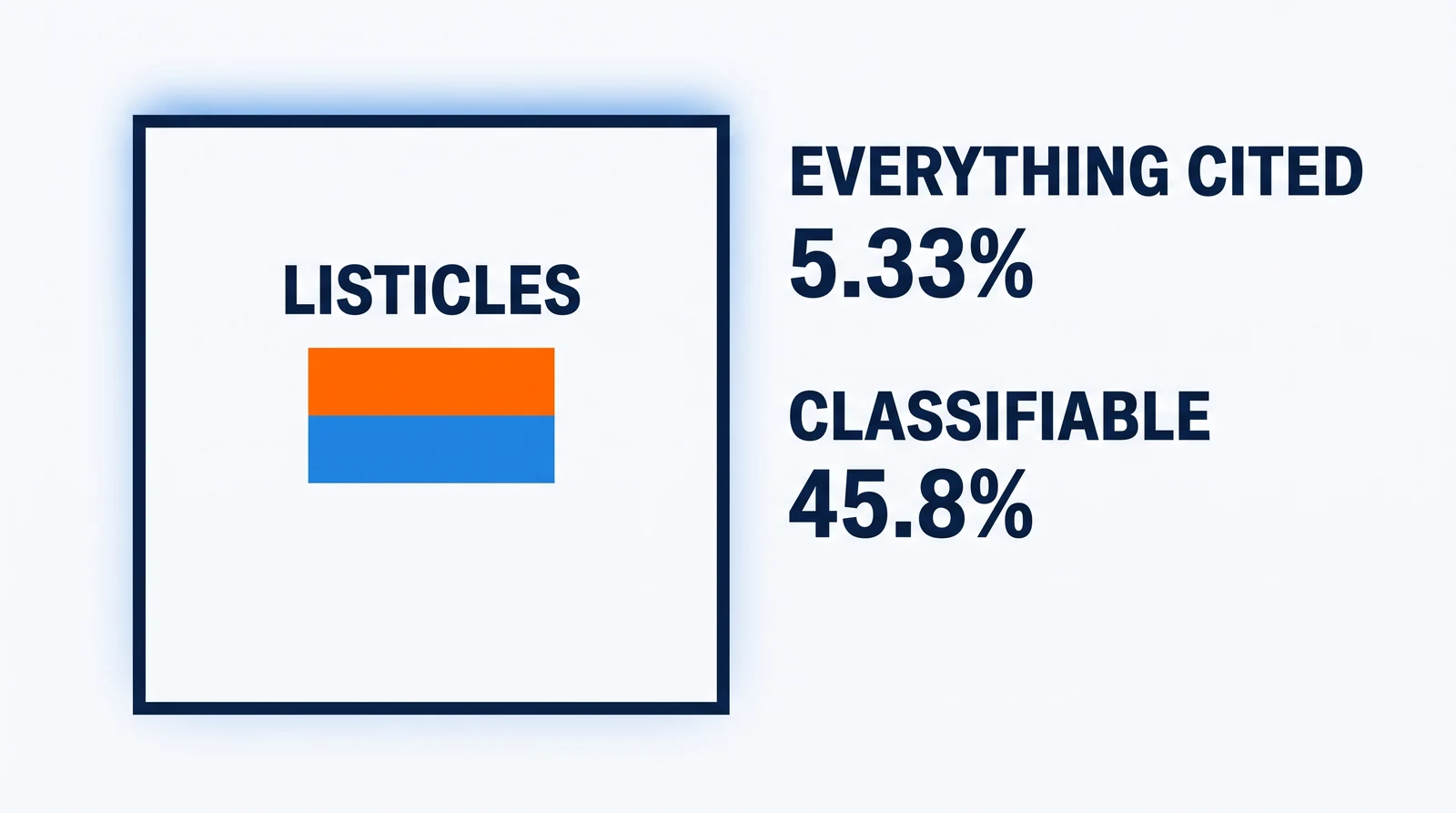
Listicles were 45.8% of the classifiable citations, and 5.33% of everything cited, in Vlad Shvets' blog post for Qvery, published on 29 March 2026. Qvery, which sells AI-search citation tracking through its AI Engine Researcher, sorted what ChatGPT and Google AI Mode cited in its data by title pattern and states the limit at the top: only "Roughly 12% of all citations match known patterns", and "Everything in this post refers to that classifiable 12%, which represents hundreds of thousands of individual citations." Both numbers are Qvery's own, and they answer different questions: the first asks how many of the sources whose titles could be sorted were lists, the second how many of everything cited were. Qvery does not state over what period the data was gathered.
Listicles took 35.6% of more than 200 million citations in Lantern's February 2026 AI Citation Content Visibility Report, described on Lantern's blog on 16 March 2026 as "collected directly from ChatGPT, Perplexity, Gemini, and Claude" across "all query types". Lantern, which sells AI-search software, does not say how it classified sources or which questions were asked. Bradlee Bartlett's guide carries the same 35.6% under the label "Comparative listicles".
Published rankings of the most-cited websites raise the same problem for domains. Here the three totals are the most-cited sources, the sortable titles and everything cited: three pools, three answers.
What counted as a listicle?
A listicle meant a different thing in each of the four studies that state a method: a word in the URL for Seer, a title pattern for Qvery, sorting by hand and by model for Ahrefs, and a URL pattern for The HOTH. The definition moves the number as well. Seer counted "any URL containing 'best' or 'top'" as a listicle. Qvery sorted titles into six types, with reviews next after lists at 19.4% of the classifiable set. Ahrefs categorised first-party mentions, a brand's own pages, by hand, and more than 10,000 third-party URLs with help from OpenAI's GPT-5 model before checking the groups. The HOTH used a URL pattern and names the cost itself: a comparison article whose address lacks one of its words "gets missed", and a page with "guide" in the slug "gets counted even if it isn't a roundup". Wix, Lantern and Evertune do not say how they classified a source.
A URL rule counts a review with "best" in its address as a list and misses a numbered list whose address says something else. Two studies using different rules are not counting the same set of sources, so their shares cannot be lined up as if they were.
Does the assistant change the share?
Listicles took 46.8% of Perplexity's citations and 33.1% of ChatGPT's in Lantern's February 2026 report of more than 200 million citations from four AI engines, ChatGPT, Perplexity, Gemini and Claude. Lantern calls the first "the highest listicle citation rate" and the second "the lowest listicle rate", although both are shares. Listicles made up 8.62% of everything ChatGPT cited in Qvery's ChatGPT and Google AI Mode data, against 2.50% for Google AI Mode, figures that count every source, classifiable or not. Lists made up between 40% and 65% of each assistant's 6,000 most-cited URLs over March and April in Evertune's study, lowest for Copilot and highest for Gemini.
The orderings do not line up. Perplexity leads in Lantern's report and Gemini in Evertune's, one counting citations across four AI engines and the other the most-cited URLs across six. A single figure for "AI" hides all of this, and a figure quoted without its assistant can be far off for the one you care about.
Is the listicle share falling?
ChatGPT's listicle share fell from 17.8% in November 2025 to 15.5% in January 2026 in Seer Interactive's tracking, the only trend on the subject we found. Nick Haigler's analysis for Seer, published on 25 February 2026, covered more than 2 million ChatGPT citations on a fixed set of prompts tracked from November 2025 through February 2026, counting "any URL containing 'best' or 'top'" as a listicle; they made up 16.6% of those citations over three and a half months. By month, it read 17.8% in November, 17.2% in December, 15.5% in January and 16.7% in February, a partial month.
Seer's headline 30% decline is a fall in the count of listicle citations, not in their share. The count went from 160,000 in December to 111,000 in January, while all ChatGPT citations in the same set fell from 931,000 to 719,000, a drop of 22.7%. Because all citations fell as well, the share moved only from 17.2% to 15.5%. Seer is candid about the time span: "While this stat only represents a month, there are other signs indicating a larger shift." It also reports that on the same prompts, listicles in Google's AI Overviews were "trending up or staying flat", and it names "SEO listicle publishers" among the sources losing the most ground.
The only published trend we found covers one assistant, one prompt set and three and a half months.
What would it take to know whether a listicle is likelier to be picked?
Measuring the chance that a listicle is picked takes the pool: every source the assistant could have used for each question, sorted by format, and the fraction of each format it actually picked. In practice that means the sources gathered for each question, each labelled by format, with the cited ones marked. A pool of what the assistant retrieved still answers a narrower question than it seems: how often a list is picked once it has been found. Whether being a list helps a page get found in the first place is an earlier stage, and a study confined to retrieved sources would miss any effect there.
The design exists: ChatGPT ended up citing about half of the dozens of URLs it retrieved for each query in Louise Linehan and Xibeijia Guan's study for Ahrefs, published on 15 April 2026, which compared what ChatGPT retrieved with what it used across 1.4 million prompts. Reddit results, retrieved through their own channel, had a citation rate of 1.93% in the same study, a rate for one kind of source. The study does not split the comparison by format, so it gives a rate for Reddit and none for lists. The same study warns that comparing cited and uncited sources "without accounting for where those URLs came from risks mistaking quirks of the data for real patterns."
Three of the publishers on the results page come close to that comparison, and each deserves the credit. Lantern, in the same report, writes that comparison content wins citations out of proportion to what is published, since it represents "a much smaller share of published content": the right comparison, made in words, with no figure beside it, and about comparison pages rather than lists. Evertune reports the share of URLs as well as of citations, inside a pool chosen for being cited. Bradlee Bartlett, in a guide first published on 31 March 2026 and updated on 8 July 2026, names the distinction outright: "citation rate (how often an article gets cited when it appears) versus citation share (percentage of all citations)". He applies it to articles; nobody on the results page applies it to lists.
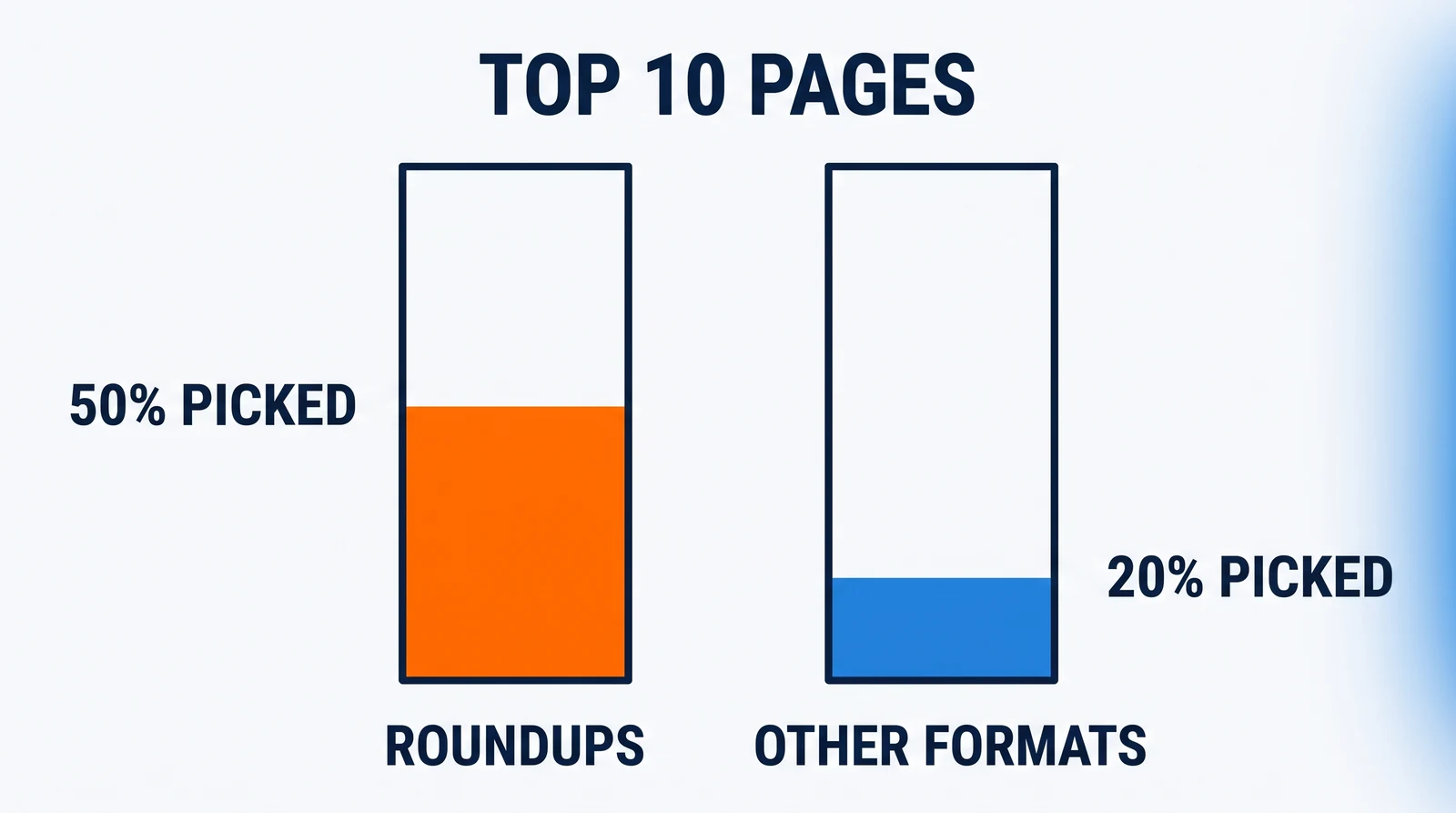
One study off the results page does, for the part of the pool that can be seen. Irina Saprykina's 125-keyword study, published on her site Datairi on 4 September 2026, took Google's top 40 results for each keyword in the United States and recorded which of those pages ChatGPT, Claude, Gemini and Perplexity each drew on, with every page labelled by content type. In Saprykina's two deeper runs, 64 software keywords and 36 shopping keywords, top-10 roundups on "best X" questions were cited by at least one of the four assistants only about 47% to 48% of the time, while definition and validation questions drew on their top-10 pages 85% to 90% of the time. In Saprykina's shopping run, on "best X" questions, roundups in Google's top 10 were picked 50% of the time against 20% for top-10 pages in other formats. She draws the distinction this article draws: "any single top-10 listicle still gets cited only about half the time."
Saprykina's pool is Google's ranked pages, not everything an assistant could have found: in her software run, 56% of all citations went to pages outside Google's top 40. She leaves Reddit, YouTube and Wikipedia out of the analysis, does not say how many of her keywords asked for the best of something, and first reached ChatGPT through the gpt-4o model in the API rather than the app, a limit she states herself. Her September re-run on current models, on 100 of the same queries, still found pages matching the question ahead, 87% against 77% with all question types pooled, and she treats that as directional.
We think the honest position is narrower than either side's headline. Inside Google's top 10, one study found lists ahead of other pages on questions that ask for the best of something, in its shopping run, and even there half of them went uncited. Beyond that pool, the claim that listicles are more likely to be cited is still an inference from shares, and the shares are equally consistent with assistants that simply meet a lot of lists.
What is the strongest evidence that listicles do win?
The HOTH's four-brand study makes the best case on the results page for lists on list-shaped questions: a brand's own domain drew 1.3% of citing responses on "best" questions against 69.6% on questions naming the brand. Rachel Hernandez's analysis for The HOTH, published on 8 September 2026, pulled "ChatGPT citation data for four brands" from Ahrefs Brand Radar for the United States in August 2026, taking the top 30 to 50 cited pages in each bucket; the 69.6% is of 1,929 citing responses and the 1.3% of 2,838. In that "best" bucket, 85.6% of all citations landed on roundup- or comparison-shaped URLs. The study keeps the brands, the assistant and the month the same and changes the question, but a different question brings a different set of possible sources, so it describes what got cited rather than holding a pool still. It is still a share, of the most-cited sources, for four brands, and The HOTH calls it "a directional read, not a census". The HOTH also says plainly that it sells listicle placements, and that this gap is the reason.
Among the listicles in the 1,000 most-cited URLs in the Wix study's professional services industry, third-party ones took 80.9% of the citations, and self-promotional ones, where a brand ranked itself first among its competitors, took 19.1%. Wix chose that industry because, in its words, it is where "the listicle citation rate is the highest", and that rate is itself a share.
Qvery's own analysis tempers its headline. Under the heading "Listicles Win on Volume, Not Position", Qvery reports that in the same classifiable ChatGPT and Google AI Mode data, lists averaged position 14.36 in a citation list (median 13.0), against 5.65 for reference sources such as Wikipedia.
Dhaval Bhatt, in a LinkedIn post from June 2026, reads Ahrefs' 43.8% another way: "the 43.8% is a measurement of the corpus we built, a lagging indicator of human SEO behavior, not a signal that listicles answer the question best." That is an argument rather than a measurement. It fits the shares, and so does a preference; neither has been tested against the other.
On list-shaped questions, lists lead what gets cited in every study that separated those questions out. Read as shares, that fits both an assistant that prefers lists and a pool that is mostly lists; the one rate we found, in the section above, leans toward a preference inside Google's top 10 and says nothing beyond it.
Should you write more listicles?
No published figure can settle whether to write more listicles, because none of them measured what happens to a source when it becomes a list. Qvery's post asks the question directly, "Should You Actually Publish More Listicles?", and answers "Yes. But not the way you think." What the evidence does show is narrower: in The HOTH's four-brand ChatGPT study, the sources cited on questions containing "best" were mostly roundup-shaped, and a brand's own domain was cited in 1.3% of those citing responses.
We have nothing of our own to add on formats. Our published reading of AI citations in one category counted which domains held them, not what kind of page the cited sources were, and our research page publishes nothing on formats. Who wrote the recommended lists on one results page is a separate question, which we looked at for AI visibility tools.
Several of the publishers above sell something connected to their findings, from citation tracking to paid placements to SEO software, and we build citation-measurement software ourselves. Weigh every figure here, and our reading of them, with that in mind. Whether a list serves the people you want to reach is a judgement about your readers that no share of citations can make for you.
Other questions about listicles and AI citations
Two further questions about the format and AI citations come from the ranking articles' own headings and FAQs. Google's question box for this search asked about AI and academic citations instead, which this article does not cover.
Does AI cite listicles more than product pages?
By share of citations, listicles lead product pages overall and trail them on transactional questions in Wix Studio's study of 75,000 answers from ChatGPT, Google AI Mode and Perplexity: 21.88% against 13.66% of all citations, but 16.87% against 24.88% on transactional prompts. Neither comparison says which is likelier to be picked, because the study does not report how many of each were available to cite.
Why would an AI assistant cite a list?
The ranking articles offer three explanations for why AI assistants cite lists so often, and none tests its own. Bartlett and Lantern point to structure: each item in a list is a self-contained unit an assistant can lift. Seer and The HOTH point to the question: a request for the best of something is answered from sources that already rank options. Dhaval Bhatt points to the web the models learned from, full of lists. All three may be partly right, and no study on the results page separates them.
What to look for in the next listicle statistic
The next figure you meet about lists in AI answers will almost certainly be a share, and it may be a sound one. Look for the number that belongs beside it: how many of the sources the assistant could have chosen were listicles to begin with, or better, how often each kind of source was picked when it was available. With either, you have a rate and a real comparison with other formats. Without them, you have a description of what got cited, and that description says as much about the questions somebody asked as about the format.
One study we found reports that rate by format, for pages already in Google's top 10. When one reports it for everything an assistant could have cited, it will tell you more than every share in this article.
Sources
All URLs checked 23 September 2026 and re-checked live on 24 September 2026.
- Wix Studio AI Search Lab (Tom Wells, Peec AI), The content types most cited by LLMs, 23 March 2026 — 75,000 AI answers, 1,056,727 citations, ChatGPT / Google AI Mode / Perplexity, non-branded prompts in four intents; no collection period, location or classification method stated — https://www.wix.com/studio/ai-search-lab/research/content-types-most-cited-by-llms
- Evertune Research, AI search loves listicles: What 25,000 URLs reveal about citations, Search Engine Land (sponsored content), 19 May 2026 — the 6,000 most-cited URLs per model across six AI surfaces, March and April; about 25,000 unique URLs; nearly 400 million citations — https://searchengineland.com/ai-search-loves-listicles-what-25000-urls-reveal-about-citations-477682
- Qvery (Vlad Shvets), Listicles Are the Most Cited Content Type in AI Search, 29 March 2026 — ChatGPT and Google AI Mode citations sorted by title pattern; the classifiable share is roughly 12% of all citations; no period stated — https://qvery.ai/blog/listicles-most-cited-content-type-ai-search
- Ahrefs (Glen Allsopp), Do Self-Promotional "Best" Lists Boost ChatGPT Visibility? Study of 26,283 Source URLs, 4 December 2025 — 750 recommendation prompts in three categories, ChatGPT — https://ahrefs.com/blog/best-lists-research/
- Ahrefs (Louise Linehan and Xibeijia Guan), Why ChatGPT Cites One Page Over Another (Study of 1.4M Prompts), 15 April 2026 — retrieved versus cited URLs on ChatGPT; no split by format — https://ahrefs.com/blog/why-chatgpt-cites-pages/
- Seer Interactive (Nick Haigler), The Listicle Window Is Closing in AI Search: 30% Decline MoM, 25 February 2026 — more than 2 million ChatGPT citations, a fixed prompt set, November 2025 to February 2026, any URL containing "best" or "top" counted as a listicle — https://www.seerinteractive.com/insights/the-listicle-window-is-closing-in-ai-search-30-decline-mom
- Lantern, The Content Format That Wins AI Citations, 16 March 2026 — its February 2026 report of more than 200 million citations from ChatGPT, Perplexity, Gemini and Claude; no classification method or question set stated — https://www.asklantern.com/blogs/the-content-format-that-wins-ai-citations
- The HOTH (Rachel Hernandez), Why AI Cites Listicles More Than It Cites You, 8 September 2026 — Ahrefs Brand Radar, four brands, ChatGPT, United States, August 2026, the top 30 to 50 cited pages per bucket — https://www.thehoth.com/blog/ai-cites-listicles/
- Bradlee Bartlett, What Content Formats Get Cited Most Often by AI?, 31 March 2026, updated 8 July 2026 — carries Lantern's 35.6% and names citation rate versus citation share — https://www.bradleebartlett.com/blog/what-content-formats-get-cited-by-ai
- Masset (Benjamin Ard), How to Write a Listicle AI Will Actually Cite, 4 June 2026 — carries Evertune's 63% without its pool — https://www.getmasset.com/resources/blog/write-a-listicle-ai-will-cite
- Datairi (Irina Saprykina), How AI Chooses Sites to Cite: A 125-Keyword Study, 4 September 2026 — Google's top 40 results for 125 keywords, United States, desktop; pages cited and not cited by ChatGPT, Claude, Gemini and Perplexity compared by content type; Reddit, YouTube and Wikipedia excluded; ChatGPT first reached through gpt-4o in the API; the number of "best X" keywords is not stated — https://datairi.com/blog/how-ai-chooses-what-to-cite/
- Dhaval Bhatt, LinkedIn post on Ahrefs' 43.8%, June 2026 — an argument that the figure reflects the web the models learned from — https://www.linkedin.com/posts/dhavalbhatt_438-of-ai-citations-are-listicles-heres-activity-7473417982497701889-pALN
- LiamVi, What does ChatGPT cite in 2026 — our reading of which domains held citations in one category; it does not classify formats — https://liamvi.com/blog/what-does-chatgpt-cite-in-2026
- LiamVi, Choosing an AI visibility tool in 2026 — who wrote the recommended lists on one results page — https://liamvi.com/blog/ai-visibility-tool
- LiamVi research — our citation work, its samples and its limits; it publishes no measurement of formats — https://liamvi.com/research/