

Does content syndication help AI citations: the same word names three different practices
"Content syndication" is sold under one name for three different things. In lead generation, it means placing a gated asset on other companies' networks: LeadSpot, which sells this service, defines it as "the distribution of gated content such as whitepapers, case studies, or guides across third-party publisher networks, research portals, and opt-in newsletters", and a reader who downloads the file becomes a lead. In republishing, it means a brand's own articles appearing in full on other sites, the way Stacker's Connect product "syndicates brands' editorial content to thousands of publishers on the Stacker Newswire". In news, it means a publisher's article run by a portal such as MSN or Yahoo, and a press release carried by a wire service and then by those portals. Each number you will meet on this question answers one of the three, and the word alone does not tell you which.
A word on where we stand before the reading. We make software that records which pages AI answers cite, so the way anyone judges a route into those answers bears on our own business. We have not measured syndication in any of its three senses, and no number on this page is ours: each belongs to the company or researcher named beside it. We read the eight results Google showed a searcher in the United States for this question when the list was captured on 28 September 2026, five of which we could open in full; the studies their figures come from; Google's own documentation on syndicated versions; and what five further searches turned up. Everything was opened on 29 September 2026.
Set side by side, the three meanings have been measured very unevenly. The republishing meaning has been measured mostly by the company that sells it, and its figures count citations of the copies. The news meaning has one broad dataset covering a single week, plus a few independent tests of which version gets cited. For the lead-generation meaning, the pages we read offer an argument and a proposed test, and no measurement.
Which kind of syndication is the question about?
Lead generation, republishing and news syndication all go by the same name, and they reach an AI answer by different routes, if they reach it at all.
Lead-generation syndication is a B2B marketing channel before it is anything else. LeadSpot, a B2B lead generation agency by its own description, sets out the exchange plainly: "When a reader downloads the content, their contact information is captured as a lead and delivered to the sponsoring company." Its whitepaper on the subject gives the practice's history in a line: "Historically, syndication was usually justified as demand gen: borrow someone else's audience to create leads." Copy.ai, on 4 July 2025, gave the same purpose: "to connect with niche audiences for quality lead generation". What an assistant could read is whatever sits in the open, such as the listing, the landing page or the summary, since the asset itself sits behind a form. LeadSpot says its "syndication abstracts are built to be AEO-friendly from day one" (AEO being the trade's name for optimizing for AI answers), which is a claim about those summaries. The outcome this channel is bought for is leads from a target audience, and a citation is a different outcome.
Republishing is the practice behind the 1,428% that Stacker published for a client in August. A brand writes a story and other sites publish it in full, each version living on a third-party domain under that site's name. Stacker runs this at the scale of a newswire; an author who reposts their own article on LinkedIn or Medium does the same thing by hand.
News syndication moves a publisher's article onto a portal such as MSN or Yahoo, which runs it as one of its own pages; press releases travel the same way, from a wire service to the portals that carry wire stories.
Two of the pages ranking for this question read it the other way round. DemandScience, in a post from 2023 updated in November 2024, explains how ChatGPT can help a marketer run syndication campaigns by drafting outlines and headlines, and Copy.ai describes AI tools that automate the distribution. Neither page uses the word citation. They answer how AI can help with syndication, which is a fair question; it is not this one.
What does Stacker's 1,428% for CreditNinja count?
The 1,428% that Stacker reports for its client CreditNinja is a count that includes the copies of CreditNinja's stories on other publishers' sites, measured by Stacker for its own client.
The case study, published by Stacker's Madeline Stone on 4 August 2026, says CreditNinja, an online lender, "distributes three stories a month through Stacker's Connect product" and has done so since December 2025, having chosen Stacker partly for "its network of high-authority sites". Its headline is "an overall Citation Lift of 1,428%". Stacker defines Citation Lift as "the increase in AI citations that a brand gains as a result of earned media distribution", and says it "calculates this by comparing a brand's total presence with the number of citations the brand earned across Stacker's network." The best-performing story, on why so many people, high earners included, live paycheck to paycheck, carries an estimated lift of 7,200% after being picked up by more than 300 publishers.
The case does not print the prompts behind these numbers, the platforms, the dates of measurement or the counts the percentages were taken from. Stacker's GEO Reporting page describes what its product tracks: 30 prompts per story across six platforms (ChatGPT, Perplexity, Google AI Overviews, Google AI Mode, Gemini and Claude) for four weeks after syndication, with "Brand citations and network citations tracked separately". The case does not say its figures came from that product.
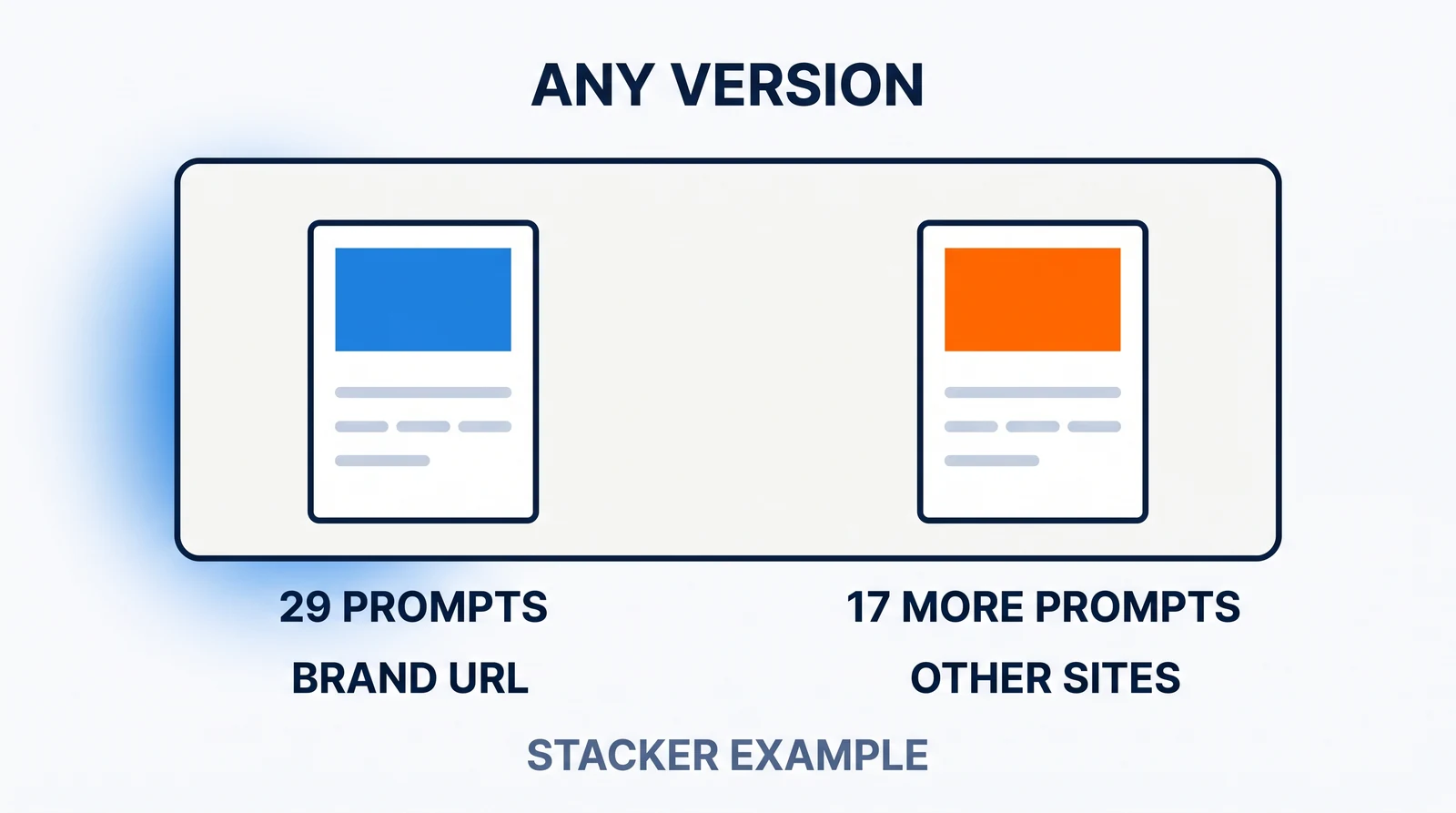
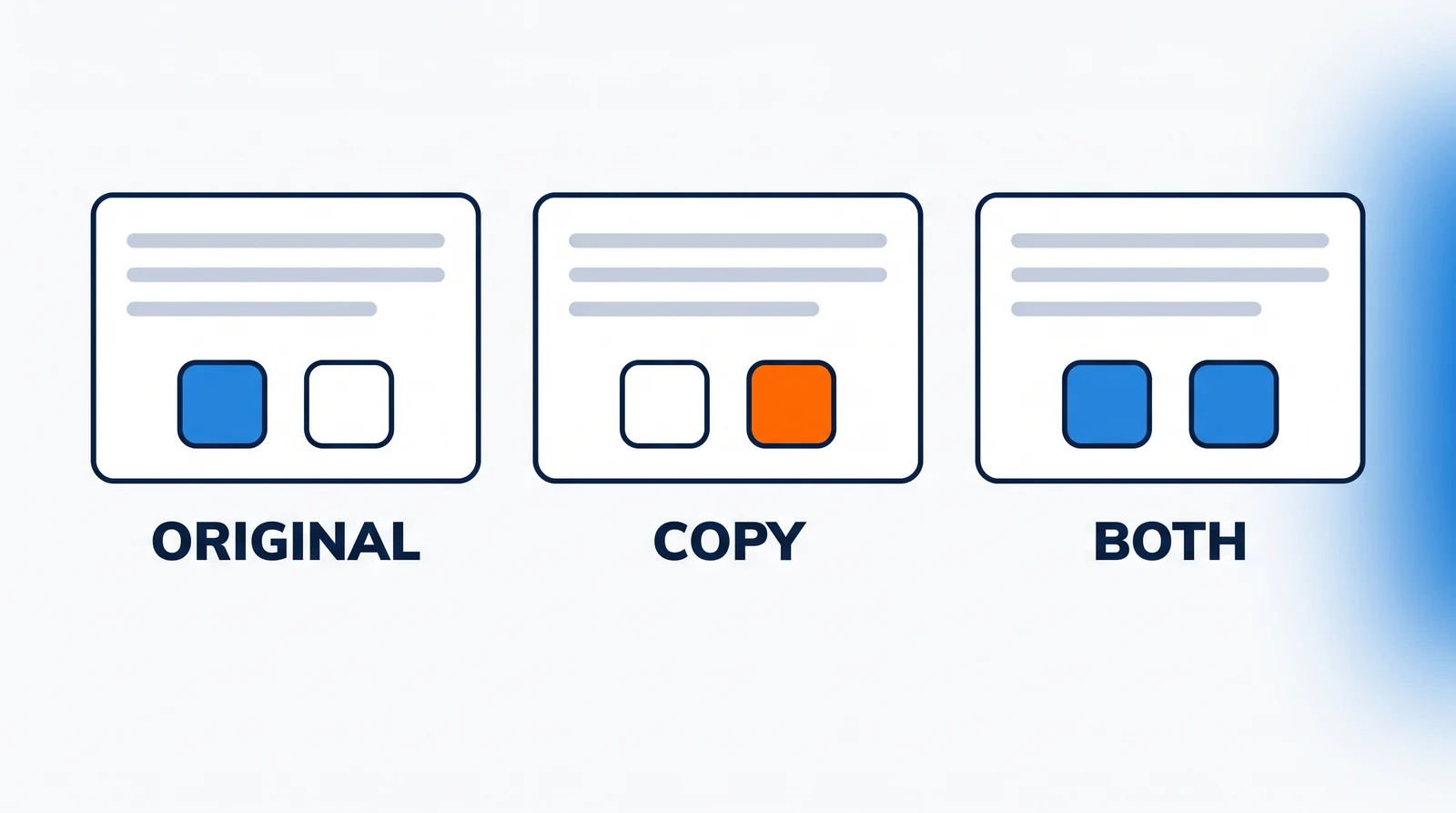
Stacker's method is set out most fully in its first study, which its chief executive, Noah Greenberg, published on 9 December 2025 with the AI visibility platform Scrunch. Eight stories were "republished in full across hundreds of 3rd party publishers, with canonical tag pointing back to the original version". A custom GPT agent wrote the prompts, and the study "evaluated 944 prompt–platform combinations across five leading LLMs". Each answer was sorted as citing the brand's page alone, a republished version alone, or both. Answers citing any version came to 34%, against 8% that cited the brand's page alone, which Stacker reports as a 325% lift. The study states its own limit: it was "an early, directional exploration", limited "to eight stories, five platforms, and citations". Greenberg's LinkedIn post of 6 November 2025 shows the unit in one example: the brand's own URL was cited in 29 of the sample prompts, and "the distributed versions of the story were cited in an additional 17 prompts."
In our reading, that is what Citation Lift measures: how many more answers cite some version of a story once it exists on multiple domains, compared with the answers that cite the brand's own page. It is a comparison with a base, and the smaller the base, the larger the percentage; Stacker's March 2026 method page notes that its network "carried the most weight for brands with the smallest existing AI footprint." Stacker's two method write-ups both describe counts taken after distribution: the first study sorted one set of answers into those three kinds, and the March study, in Stacker's words, "took a post-distribution snapshot" and measured the two levels "at the same point in time". Neither describes asking the same prompts before the stories were republished, so neither says how many copy-only answers would have cited the brand's own page had the copies never existed. We are not questioning Stacker's arithmetic, but with no counts printed, the CreditNinja case cannot be checked either way. What does not follow is a reading of 1,428% as a rise in citations of CreditNinja's own pages, because the counted citations include the versions on other sites.
The counter-case deserves its full weight. In the first study, the answers that cited only a republished version were answers in which the brand's own page was not cited: those versions carried the stories somewhere the brands' pages had not reached. If what you want is for an answer to rest on your story, wherever it is hosted, a cited copy may be exactly the result you were after, and nothing on this page shows otherwise.
Stacker's larger study of March 2026, which our reading of the earned-media figures quotes for its median lift of 239% from 87 stories by 30 clients, measured on 8 AI platforms, counted the same two levels: "any citations to the brand's own domain and story-specific citations from publisher sources within the Stacker network."
How often do AI answers cite syndicated news copies?
Syndicated news pieces drew 6.2% of the news citations, and 0.9% of all 4 million citations, in the one broad dataset we found: BuzzStream's week of data from 27 January 2026.
BuzzStream's report, by Vince Nero, published on 9 March 2026 and updated on 8 April, ran 3,600 prompts across 10 industries through ChatGPT, Google AI Mode, Google AI Overviews and Gemini, and collected the citations with XOFU, a monitoring tool from Citation Labs. News publications made up 14.09% of those citations. To find the syndicated pieces, BuzzStream looked at "clear syndication networks (MSN, Yahoo)" and flagged, then checked by hand, every news page whose author did not match its publication. It is plain about the method's weak point: "This methodology isn't foolproof". That candour deserves credit, because a republished page that carries no sign of being one will be missed. The report looks at news because, in its own words, "BuzzStream's user base is primarily news-focused", and Search Engine Journal, reporting the study on 16 March, added that BuzzStream sells outreach and digital PR tools and named the single week and the large-brand focus as limits. Press releases carried on those same networks were rarer still, at 0.32% of news citations, which Search Engine Journal reported under the headline AI Search Barely Cites Syndicated News Or Press Releases.
The 6.2% tells you how the cited news in that week split between first publications and syndicated versions. It does not say what syndicating did to a publisher's chance of being cited, or whether a portal's version took a citation the publisher's page would otherwise have won. It is a share of what was cited, not a rate at which syndicated pages get picked.
The same report holds the counter-case. BuzzStream's own example of a syndicated citation is Google AI Mode answering "Is Tesla Energy more expensive than Fluence?" with a Zacks Equity Research article from its syndicated version on Yahoo Finance, and yahoo.com sits first in BuzzStream's table of the news domains cited most. The table does not say how many of Yahoo's citations were syndicated. A small share of a large dataset is still a lot of answers: 0.9% of 4 million is, by our arithmetic, about 36,000 citations resting on a syndicated piece rather than the first publication.
When an answer cites a copy, whose page gets the credit?
The credit for a cited story goes sometimes to the original article and sometimes to its syndicated copy, according to two independent tests by people who do not sell syndication. They found assistants citing one, the other, or both.
The Tow Center for Digital Journalism, in a test of eight AI search tools published on 6 March 2025, found chatbots directing its researchers "to syndicated versions of articles on platforms like Yahoo News or AOL rather than the original sources". Its sharpest example: "while USA Today blocks ChatGPT's crawler, the chatbot still cited a version of its article that was republished by Yahoo News." The Tow Center names the cost in one line: "This tendency deprives the original sources of proper attribution and potential referral traffic."
Glenn Gabe, an SEO consultant, tested nine publishers that syndicate to Yahoo or MSN and checked ChatGPT, Perplexity, Claude, Gemini and Google's AI Overviews, publishing his findings on 16 September 2025. His summary: "Sometimes the original url ranked in AI search, sometimes the syndicated content on third-party sites like Yahoo or MSN ranked, and sometimes they both ranked." Canonical tags helped some publishers but were "not always foolproof", and Yahoo showed up far more often than MSN. His own recommendation to publishers was to have their syndicated pages kept out of the index, and we report it as his view.
This fits the shape our reading of the websites AI models cite most describes: the domains at the top of those lists mostly publish other people's work, and a portal running syndicated stories is a domain of that kind. For the republishing and news meanings, the result cuts both ways. A republished version can carry a story into an answer the first publication never reaches, and it can be cited where that page is not. Neither test compared the same questions with no copy in existence, so neither shows a copy taking a citation the first publication would otherwise have won.
What does Google say happens to a syndicated copy?
Google tells syndication partners to keep their versions out of its index rather than rely on a canonical tag, and on its own AI features a page kept out of the index cannot be cited.
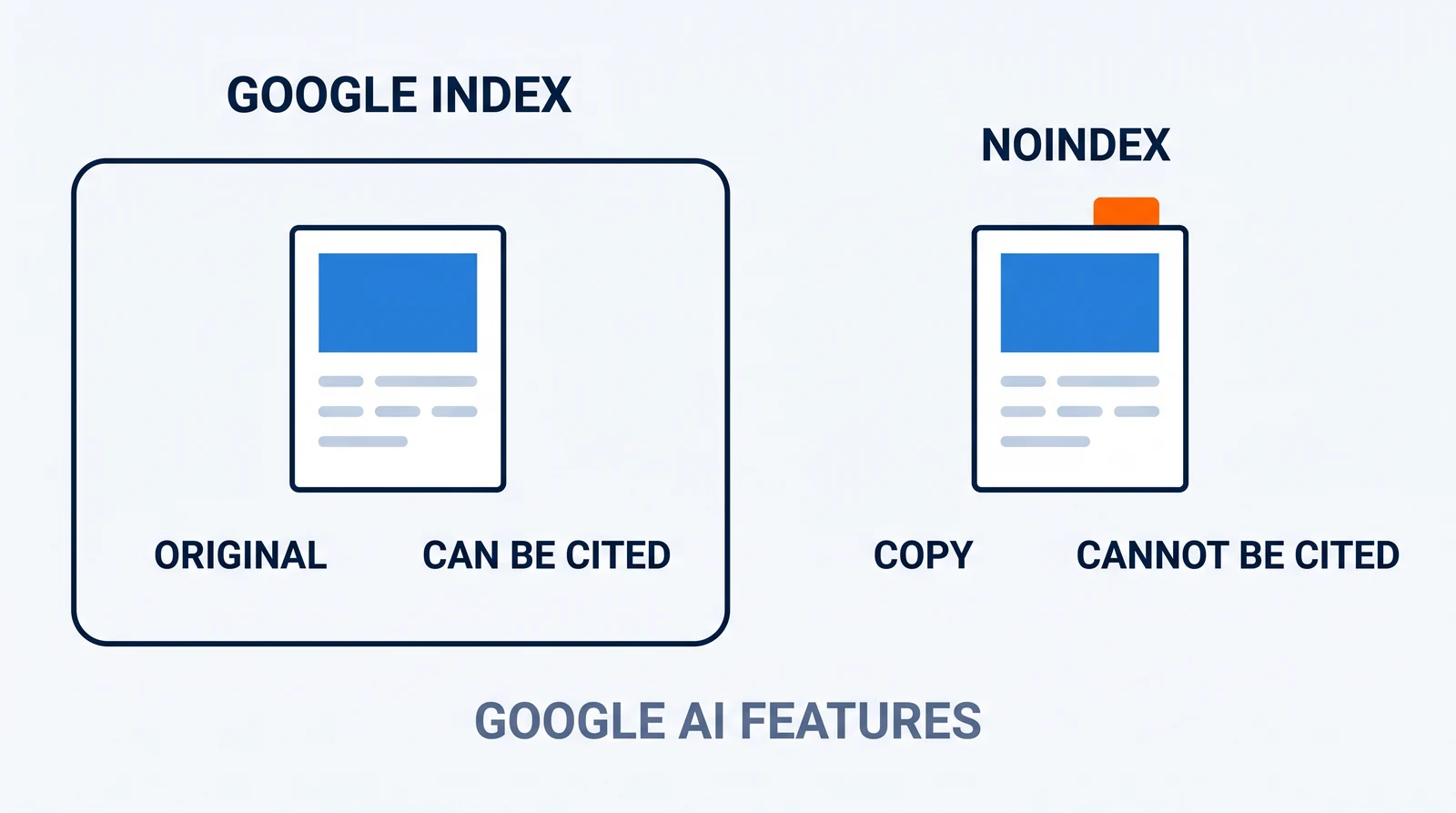
Google's canonicalization troubleshooting page, last updated on 21 August 2026, says: "The canonical link element is not recommended for those who want to avoid duplication by syndication partners, because the pages are often very different. The most effective solution is for partners to block indexing of your content." Its Google News help page on article duplication names the tags: a partner adds a noindex robots tag addressed to Googlebot-News to keep its version out of Google News, or addressed to Googlebot to keep it out of Google Search as well.
What that means for citations sits on a third page. Google's guide to AI features and your website says "There are no additional requirements to appear in AI Overviews or AI Mode", and that "to be eligible to be shown as a supporting link in AI Overviews or AI Mode, a page must be indexed and eligible to be shown in Google Search with a snippet". Read together, on Google's two AI features a syndicated version whose partner blocks indexing as Google recommends is not eligible to be cited, while the publisher's own page stays eligible. A version left in the index can be cited, which is what Gabe saw.
The advice sellers give does not all match Google's. Stacker's first study says its republished stories carried a canonical tag pointing back to the brand's page. Amicited, which sells AI-citation monitoring, advised in Content Syndication Strategy for AI Visibility, on 3 January 2026, to "always include a canonical tag pointing back to your original article", so that "authority and citations flow back to your primary source". Copy.ai puts it this way: "To avoid duplicate content issues, use canonical tags or no-index tags to signal the original source." Google's own page is the one that says the canonical element is not the recommended tool for syndication, and which instruction a partner follows is worth knowing before an agreement is signed.
We found no comparable documentation from OpenAI, Anthropic or Perplexity on how their assistants treat a syndicated page in what we read; for those assistants, the tests above are what there is.
The link a republished story carries back to the brand is often counted as a benefit of its own, a backlink in SEO terms. BuzzStream notes that in digital PR "some even count syndicated links as unique links for their clients". Whether links do anything for what assistants cite is a separate argument, and the published correlations on it each measure a different outcome, as we set out in our reading of the backlink studies.
Has anyone measured syndication for lead generation?
No measurement of lead-generation syndication against AI citations turned up in what we read, which covered the results page for this question and five searches beyond it on 29 September 2026; what we found was an argument and a proposed test.
The argument is LeadSpot's whitepaper of 6 March 2026, Content Syndication Is Steroids for AI Visibility. It reasons that each extra publisher site holding a version of your insight is one more chance for an engine to retrieve it, and it is candid about what kind of claim that is: "This is an inference grounded in how retrieval works and how buyer trust is formed." It also concedes a point a seller could have left out: "Yes, companies can and do earn citations from strong owned content alone." And it describes how to test its own thesis: measure a set of priority prompts, syndicate a cluster of content, then measure again over the same window. We have not found the results of such a test published.
The whitepaper also uses the word more broadly than LeadSpot's service page does, as "republishing, co‑publishing, excerpting, or adapting original research". Even within one company, then, syndication moves between the gated download and republishing. The lead-generation version reaches an answer, if it does, through the open summaries and landing pages, not through the asset behind the form, and the audience it is built for is the B2B buyers who fill in that form.
None of this shows that lead-generation syndication fails to produce citations. It shows the question is open, and that the leads this channel is sold on are a separate outcome from citations.
What people actually ask us
Is content syndication still effective?
Content syndication can be effective, but at different things depending on its kind. The lead-generation kind is sold on leads, which its sellers measure themselves and which are outside this page, while the republishing kind, as Stacker measures it for its own clients, adds citations of republished versions of your articles. For citations of your own pages, nothing we read shows a gain, and both the Tow Center and Glenn Gabe saw syndicated versions cited instead of the first publication.
Does a syndicated version take citations from the original?
In some answers a syndicated version is cited in place of the original article, though no test we read measured whether the original would otherwise have been cited. The Tow Center found ChatGPT citing a Yahoo News version of a USA Today article instead of the newspaper's own page, and Gabe found the original, the syndicated page or both cited depending on the assistant. In BuzzStream's week of data, syndicated pieces accounted for 6.2% of news citations. On Google's side, a partner blocking indexing of its version is the documented way to keep that version out of Google's AI answers.
How do you get your content cited by AI?
No one can promise that AI assistants will cite your content, and we do not. Google's stated requirement for AI Overviews and AI Mode is only that a page be indexed and eligible to show with a snippet. The other assistants publish less about how they choose, and nothing we read shows a specific way to improve how often a page is cited. Syndication in any of its three senses changes where versions of your content live, and the evidence above shows that it can add citations to copies, and that a copy can be cited where your page is not.
What the decision rests on
Whether to syndicate for AI citations is your decision, and it turns on three things. First, which of the three practices is on offer, since a lead-generation program, a republishing network and a wire package reach an answer by different routes. Second, whose page you want an answer to cite: your own, or any version that carries your story. A cited copy counts for the second and not for the first. Third, what the partner does about indexing: on Google's AI features a version kept out of the index cannot be cited, and one left in can be, sometimes where your page is not. Those three are our reading of what the evidence above bears on, not a neutral checklist.
When syndication is sold for AI visibility, it is fair to ask of any figure what it counts and against what base, and that includes any figure we publish. We have not measured syndication, and we would rather say so than guess. If we do measure it, we will publish what comes back, including a null.
Sources
- LeadSpot, B2B Lead Generation Agency (service definitions, undated homepage) — https://lead-spot.net/ — checked 29 September 2026
- LeadSpot, Why Is Content Syndication Steroids for AI Visibility? How Multi-Publisher Distribution Increases AI Citations, 6 March 2026 — https://lead-spot.net/research/content-syndication-is-steroids-for-ai-visibility-how-multi-publisher-distribution-increases-ai-citations/ — checked 29 September 2026
- Copy.ai, Best Practices for B2B Content Syndication with AI, 4 July 2025 — https://www.copy.ai/blog/best-practices-for-b2b-content-syndication — checked 29 September 2026
- DemandScience, How ChatGPT Can Help with Content Syndication, 23 March 2023, updated 20 November 2024 — https://demandscience.com/resources/blog/chatgpt-content-syndication/ — checked 29 September 2026
- Madeline Stone, Stacker, How CreditNinja Grew AI Citations by 1,428% Through Content Syndication, 4 August 2026 — https://stacker.com/blog/how-creditninja-grew-ai-citations-through-content-syndication — checked 29 September 2026
- Stacker, GEO Reporting (product page, undated) — https://stacker.com/brands/geo-reporting — checked 29 September 2026
- Noah Greenberg, Stacker, How Earned Media Distribution Expands AI Visibility: A First Look at "Citation Lift", 9 December 2025 — https://stacker.com/blog/how-earned-media-distribution-expands-ai-visibility-first-look-at-citation-lift — checked 29 September 2026
- Noah Greenberg, LinkedIn post, How does distributing content to 3rd parties impact AI search results?, 6 November 2025 — https://www.linkedin.com/posts/noahg_how-does-distributing-content-to-3rd-parties-activity-7392203284070952966-F2Jk — checked 29 September 2026
- Stacker, the March 2026 study's method page, 16 March 2026 — https://stacker.com/blog/latest-research-on-expanding-brand-visibility-across-llms — checked 29 September 2026
- Stacker, New Stacker Research: Earned Media Distribution Triples AI Search Visibility, Delivers 239% Median Lift in Brand Citations — GlobeNewswire release of 16 March 2026, read on Yahoo Finance — https://finance.yahoo.com/news/stacker-research-earned-media-distribution-131500850.html — checked 29 September 2026
- Vince Nero, BuzzStream, The Role of News Publications in AI Citations [New Data], 9 March 2026, updated 8 April 2026 — https://www.buzzstream.com/blog/news-publications-ai-citations/ — checked 29 September 2026
- Matt G. Southern, Search Engine Journal, AI Search Barely Cites Syndicated News Or Press Releases, 16 March 2026 — https://www.searchenginejournal.com/ai-search-barely-cites-syndicated-news-or-press-releases/569854/ — checked 29 September 2026
- Klaudia Jaźwińska and Aisvarya Chandrasekar, Tow Center for Digital Journalism, Columbia Journalism Review, AI Search Has a Citation Problem, 6 March 2025 — https://www.cjr.org/tow_center/we-compared-eight-ai-search-engines-theyre-all-bad-at-citing-news.php — checked 29 September 2026
- Glenn Gabe, G-Squared Interactive, AI Search and Syndicated Content, 16 September 2025 — https://www.gsqi.com/marketing-blog/ai-search-and-syndicated-content/ — checked 29 September 2026
- Google Search Central, Fix Canonicalization Issues (canonicalization troubleshooting), last updated 21 August 2026 — https://developers.google.com/search/docs/crawling-indexing/canonicalization-troubleshooting — checked 29 September 2026
- Google News Publisher Center Help, Avoid article duplication in Google News (undated) — https://support.google.com/news/publisher-center/answer/9606800 — checked 29 September 2026
- Google Search Central, AI features and your website, last updated 10 December 2025 — https://developers.google.com/search/docs/appearance/ai-features — checked 29 September 2026
- Amicited, Content Syndication Strategy for AI Visibility, 3 January 2026 — https://www.amicited.com/blog/content-syndication-strategy-ai-visibility/ — checked 29 September 2026