Does a Wikipedia page help AI visibility: training data and live search treat an article differently
A Wikipedia page can get into an AI answer by two routes. The first is training: its text is collected into the data a model learns from, and anything the model later says because of it arrives with no source attached and only as of the date that text was gathered. The second is a web search at the time of the question: an assistant decides the query needs the web, retrieves pages, and may cite the article it finds. The pages that rank for this question make their case from the first route and back it with citation figures from the second. Those figures describe the encyclopedia as a whole domain across every topic, not one company's article about itself. Whether a page helps your company therefore depends on which route the answers you care about take, and the numbers usually quoted measure neither route for a single company. None of this shows that an entry is useless: a well-sourced one may well be read and cited when someone asks about the company.
Where we sit, so you can weigh it: our own product logs the sources that AI assistants cite, which puts any question about AI search visibility close to our business. We have measured nothing about encyclopedia entries, for companies or for any other subject. Every quotation and figure below is credited, in its sentence, to whoever published it.
The reading draws on the pages Google ranked for this question in a US search on 28 September 2026, the encyclopedia's own rules, OpenAI's documentation, and research papers in which model makers listed their training data, all read on 29 September 2026.
What happens when a Wikipedia article becomes training data?
Wikipedia made up 3% of GPT-3's training mix, and text used that way shapes a model's answers with no citation attached. The ranking pages lean on this route first: The Mather Group, a digital agency whose services include online reputation and Wikipedia work, writes that the encyclopedia "is part of nearly every LLM training set, including The Pile", and that "we know it shapes how Google AI Overviews, ChatGPT, and other LLMs describe your brand". Lumino, a consultancy in the same line of work, makes the same case in Want a Wikipedia Article to Boost Your AI Search Visibility? Read This First.: "AI models are trained on it heavily".
Where model makers have published their data, the record bears them out. GPT-3's training mix gave the encyclopedia 3 billion tokens, a 3% weight, sampled about 3.4 times over. OpenAI's 2020 paper explains that it sampled "datasets we view as higher-quality" more often than their size alone would give. LLaMA took 4.5% of its training sample from dumps of the encyclopedia collected between June and August 2022, in 20 languages, as Meta's 2023 paper sets out. The Pile, the open dataset The Mather Group names, includes the English-language encyclopedia too.
A model learns from a snapshot, so a company article written after the June–August 2022 dumps is not in that part of LLaMA's data, and a paragraph added to any article after a snapshot can reach a model only if its maker trains one on newer text. OpenAI's 2023 GPT-4 technical report said only that the model was trained on publicly available and licensed data and gave no further details of its dataset construction, so from outside, nobody can check which version of a company's article a model like that saw.
A model answering from its training shows no link, so no citation count can see this route, and every citation figure you will meet on this subject describes the other one.
When does an assistant search, find the article and cite it?
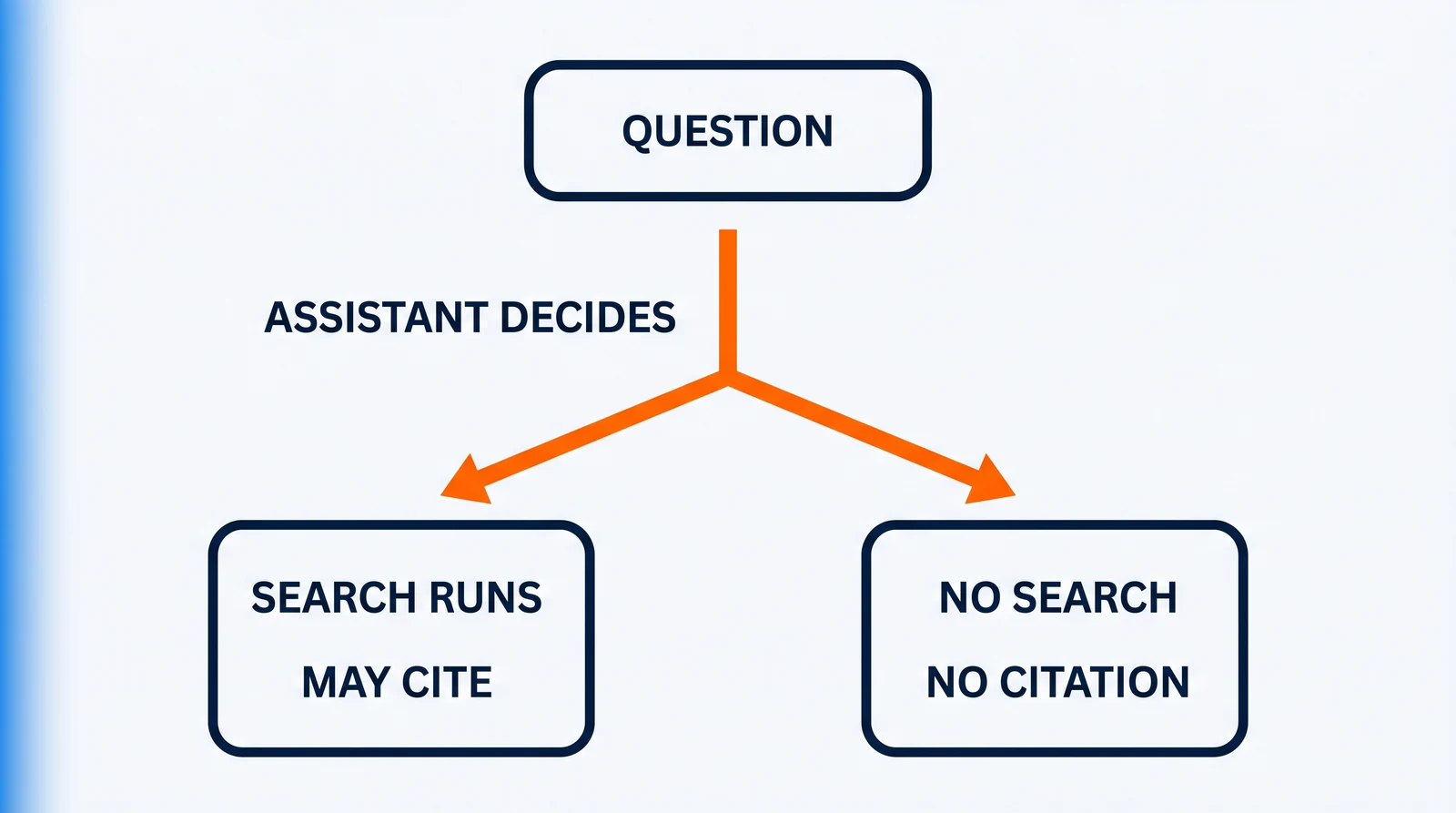
ChatGPT cites an encyclopedia entry only when it runs a web search, a step OpenAI's help page on ChatGPT search, updated in August 2026, leaves to the assistant unless the user asks for one. The page says "ChatGPT may search the web automatically when your question would benefit from current information" and adds that "Responses that use web search may include citations." The 2024 launch post described the choice as searching "based on what you ask", with a manual option alongside. Search does not always mean the live web: for eligible ChatGPT workspaces, such as certain Enterprise and Edu ones, OpenAI documents an offline web search setting that uses "OpenAI's indexed and cached web content instead of using live web search at the time of each request", so the search still runs when the question is asked, over pages stored earlier. A query that sets off no search produces no citation for anyone, and in our own small sample we recorded exactly that on some of the queries we ran.
OpenAI runs GPTBot for training and OAI-SearchBot for search, and its crawler documentation treats the two as separate settings, though it is written about every website rather than about the encyclopedia. GPTBot collects "content that may be used in training our generative AI foundation models", while "OAI-SearchBot is for search", used "to surface websites in search results in ChatGPT's search features". "Each setting is independent of the others," the page adds, so a site can take part in one route and stay out of the other.
We have not measured how often a query about a company by name sets off a search. That decides which of the two routes answers a query about you, and you can check part of it by hand: ask the assistants your buyers use and see whether the answer carries sources, remembering that one without them may still have come from a search.
What do the Wikipedia citation figures on these pages describe?
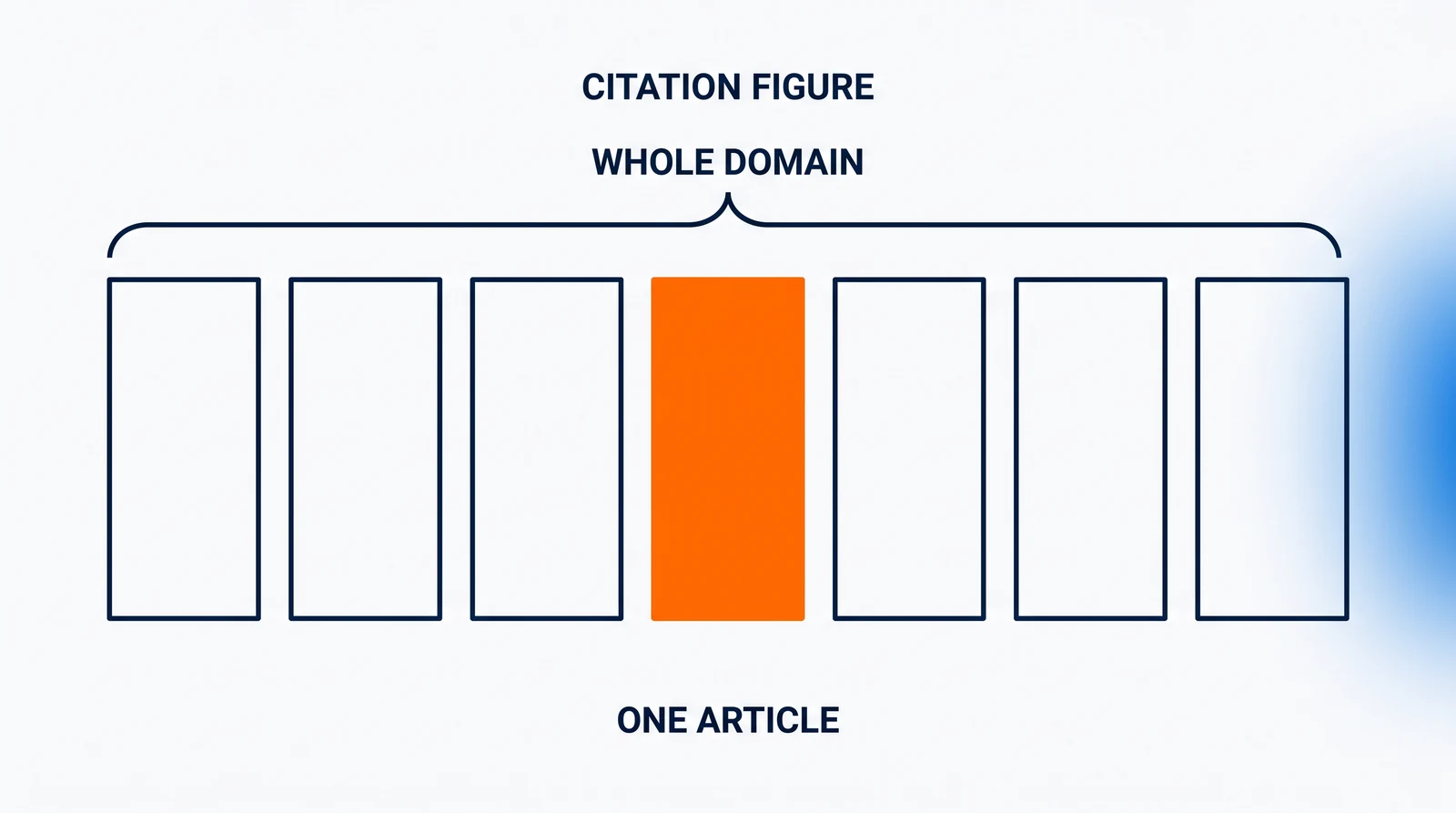
Every Wikipedia citation figure on the ranking pages we read on 29 September 2026 counts the encyclopedia as one domain across all the queries in a study, not one company's article. IN2communications, a marketing agency, calls the site "the third most cited domain" in its guide How to Create a Business Wikipedia Page to Improve AI Search Visibility, where it names ChatGPT, Google AI Mode and Perplexity, links the ranking to a Semrush study, and concludes that "if your business has a Wikipedia page, you are more likely to show up in AI-generated answers". The same guide says the encyclopedia "is seen as a third-party reference" and that a well-maintained page "can strengthen your credibility", and The Mather Group calls it "one of the most frequently cited sources across all AI systems". A domain's count is summed over every query in a study, whatever it was about, so the step from the site's standing to one company's article is the part a reader has to test.
What the published domain shares measure, and why they differ from one index to the next, is set out in our reading of the most-cited-website indexes; none of those figures is repeated here.
Semrush took weekly snapshots from 14 July to 12 October 2025 (Semrush). Its report found that "In September 2025, ChatGPT suddenly began citing Reddit and Wikipedia—two of its most frequent sources—far less frequently", and that ChatGPT "had the sharpest adjustment among top citation sources". The explanation Semrush discusses is what it calls a "widely discussed theory": Google "removed its num=100 search parameter in mid-September", limiting how far tools could see past the first page of results, and ChatGPT may have relied on those deeper results. Semrush's own head of organic and AI visibility doubts it is "the root cause", or at least the only one, and points to an attempt by ChatGPT to avoid "over-citing on certain websites". Nothing in its report ties the September 2025 fall to the articles themselves, which is how the search route looks from outside: the count moves with the machinery that finds and picks pages.
A share of citations is also a different quantity from the chance that one particular page is picked, a gap we worked through for listicles.
How do visibility tools judge a Wikipedia article?
Adobe's Brand Visibility product, in documentation last updated on 6 August 2026, analyses a company's entry on five features of the article itself: references, sections, content length, images and infobox completeness. Its Wikipedia Analysis page opens: "Your company's Wikipedia page is one of the most influential sources AI systems use when generating responses about your brand." The feature compares that page with competitors' to find "the gaps that matter most for LLM citability", with recommendations such as "Add references to reach industry standard". Adobe's FAQ says "Improving your Wikipedia page increases the likelihood of being cited by ChatGPT (Free and Paid), Google AI Overview, Google AI Mode, Perplexity, Microsoft Copilot, and Gemini", and calls the encyclopedia "one of the most trusted sources in LLM training data and real-time retrieval", naming both routes in one sentence.
The same documentation points users back to the encyclopedia's rules. Edits "must be made directly on Wikipedia following their editorial guidelines", and an article flagged for tone should get a look at "Wikipedia's neutral point of view policy before making changes." The feature "requires an existing Wikipedia article"; for a brand without one, Adobe writes that "creating a Wikipedia page that meets Wikipedia's notability guidelines is a foundational GEO step worth prioritizing before other optimizations." Adobe's five features describe the entry, while the route a given answer takes depends on the query and the assistant, which is outside what an analysis of the text itself sets out to measure.
Writers beyond this results page draw the line between the routes directly. Dean Garland's guide of 9 August 2026 sets parametric memory apart from live retrieval for brands in general, and pages from Lyra (22 July 2026) and ZipTie (15 April 2026) describe the encyclopedia reaching answers through both training and retrieval. None of the three reports a measurement of what a company's own article does.
What do Wikipedia's own rules decide first?
A company gets an article on the encyclopedia only if independent, reliable sources have covered it in depth, under a notability guideline last edited on 21 September 2026. The notability guideline for organizations and companies says an organization "is generally considered notable if it has been the subject of significant coverage in reliable, independent secondary sources", that "No company or organization is considered inherently notable", and that "only a small percentage of the world's organizations meet the requirements for a Wikipedia article". The same guideline lists what does not count toward notability: "press releases, press kits, or similar public relations materials", along with coverage based on them. On money it is blunt: "Only unpaid sources count." Lumino's summary of the consequence is plain: "This is why many companies simply don't qualify immediately." IN2communications, whose guide walks through a submission, puts the same test in its own words: "The more solid your citations, the more likely your page will pass editorial review."
The company's own staff are strongly discouraged from editing it directly: the conflict-of-interest guideline, last edited on 16 September 2026, opens: "Do not edit Wikipedia in your own interests, or in the interests of your external relationships." It says "COI editing is strongly discouraged on Wikipedia", that such editors "can propose changes on article talk pages instead", and that new articles should go through the Articles for Creation process rather than being published directly. It adds that "The kind of paid editing of most concern to the community involves using Wikipedia for public relations and marketing purposes." Wikimedia's rule on paid contributions has been in force since 7 June 2023. Anyone paid for a contribution must "disclose each and any employer, client, intended beneficiary and affiliation".
What the article will say is set by the neutral point of view policy, which holds that "Articles must not take sides, but should explain the sides, fairly and without editorial bias." Lumino, which sells such services itself, spells out what that means for a brand: "A Wikipedia article isn't a marketing asset. It's a public, crowd-edited reference page you can't control," and "If the sources are mixed, critical, or controversial, that's what the article will reflect." The Mather Group advises readers to "Evaluate page creation thoughtfully" and notes that the encyclopedia "strongly discourages anyone writing about themselves." Lumino's and The Mather Group's warnings both hold, and both come from firms whose business includes this work.
The notability and conflict-of-interest rules come before any question about AI: they decide whether an article can exist, that its content will come from coverage the company did not write, and that any change the company wants is proposed in the open, where the volunteer community of editors decides.
So does a Wikipedia page help AI visibility for your company?
A Wikipedia page can help a company's AI visibility through training, through search or both, and the encyclopedia's notability guideline decides first whether the company can have one. These three checks are ours, and they lean toward what our own software counts; treat them as a starting point, not a standard:
- When an assistant answers a query about your company, does the answer cite web pages? One that does used a search. One that does not may still have used one, since OpenAI says responses that use web search "may include citations", not that they always do; whatever a model says from its training carries no source, and no citation report will show it.
- When someone quotes a citation figure for the site to you, does it describe the whole domain or one article? The figures we read on these pages describe the domain.
- Does the company clear the notability bar on coverage in reliable sources it neither wrote nor paid for? The guideline's own summary is that "If no independent, third-party, reliable sources can be found on a topic, then Wikipedia should not have an article on it."
What we read reflects 28 and 29 September 2026. OpenAI can change when ChatGPT searches, and a model trained later may learn from a different snapshot, so both routes can shift without notice. If someone publishes a measurement of what companies' own articles do in AI answers, this reading will change with it. Whether to pursue an entry is your decision, and the notability and conflict-of-interest rules will weigh on it more than any citation share.
Sources
- The Mather Group, Why Wikipedia is the Hidden Lever for AI and LLM Search Results, 7 October 2025, updated 3 April 2026 (checked 29 September 2026) — https://themathergroupllc.com/why-wikipedia-is-the-hidden-lever-for-ai-and-llm-search-results/
- Lumino, Want a Wikipedia Article to Boost Your AI Search Visibility? Read This First., 28 January 2026 (checked 29 September 2026) — https://www.luminodigital.com/blog/wikipedia-article-to-boost-ai-search-visibility
- IN2communications, How to Create a Business Wikipedia Page to Improve AI Search Visibility, 27 July 2026 (checked 29 September 2026) — https://in2communications.com/how-to-create-business-wikipedia-page/
- Adobe, Brand Visibility documentation, Wikipedia Analysis, last updated 6 August 2026 (checked 29 September 2026) — https://experienceleague.adobe.com/en/docs/brand-visibility/using/dashboards/opportunities/wikipedia-analysis
- Brown et al. (OpenAI), Language Models are Few-Shot Learners, 2020, Table 2.2 (checked 29 September 2026) — https://arxiv.org/abs/2005.14165
- Touvron et al. (Meta), LLaMA: Open and Efficient Foundation Language Models, 2023 (checked 29 September 2026) — https://arxiv.org/abs/2302.13971
- Gao et al., The Pile: An 800GB Dataset of Diverse Text for Language Modeling, 2020 (checked 29 September 2026) — https://arxiv.org/abs/2101.00027
- OpenAI, GPT-4 Technical Report, 2023 (checked 29 September 2026) — https://arxiv.org/abs/2303.08774
- OpenAI Help Center, ChatGPT search, updated August 2026 (checked 29 September 2026) — https://help.openai.com/en/articles/9237897-chatgpt-search
- OpenAI Help Center, Offline web search for ChatGPT workspaces (checked 29 September 2026) — https://help.openai.com/en/articles/20001203-offline-web-search-for-chatgpt-workspaces
- OpenAI, Introducing ChatGPT search, 31 October 2024 (checked 29 September 2026) — https://openai.com/index/introducing-chatgpt-search/
- OpenAI, Overview of OpenAI crawlers (checked 29 September 2026) — https://developers.openai.com/api/docs/bots
- Semrush, Most cited domains in AI, 10 November 2025 (checked 29 September 2026) — https://www.semrush.com/blog/most-cited-domains-ai/
- Dean Garland, How to Tell if an AI Assistant is Citing You From Training Data or Live Retrieval, 9 August 2026 (checked 29 September 2026) — https://www.deangarland.com/insights/ai-citation-training-data-vs-live-retrieval/
- Lyra, Wikipedia AI citations, 22 July 2026 (checked 29 September 2026) — https://www.trylyra.ai/blog/wikipedia-ai-citations/
- ZipTie, How Wikipedia-Like Sources Shape AI Answers, 15 April 2026, updated 15 September 2026 (checked 29 September 2026) — https://ziptie.dev/blog/how-wikipedia-like-sources-shape-ai-answers/
- Wikipedia, Notability (organizations and companies), last edited 21 September 2026 (checked 29 September 2026) — https://en.wikipedia.org/wiki/Wikipedia:Notability_%28organizations_and_companies%29
- Wikipedia, Conflict of interest, last edited 16 September 2026 (checked 29 September 2026) — https://en.wikipedia.org/wiki/Wikipedia:Conflict_of_interest
- Wikimedia Foundation, Terms of Use, in effect since 7 June 2023 (checked 29 September 2026) — https://foundation.wikimedia.org/wiki/Policy:Terms_of_Use
- Wikipedia, Neutral point of view, last edited 20 August 2026 (checked 29 September 2026) — https://en.wikipedia.org/wiki/Wikipedia:Neutral_point_of_view