Does schema markup affect AI citations: the evidence comes from pages AI was already citing
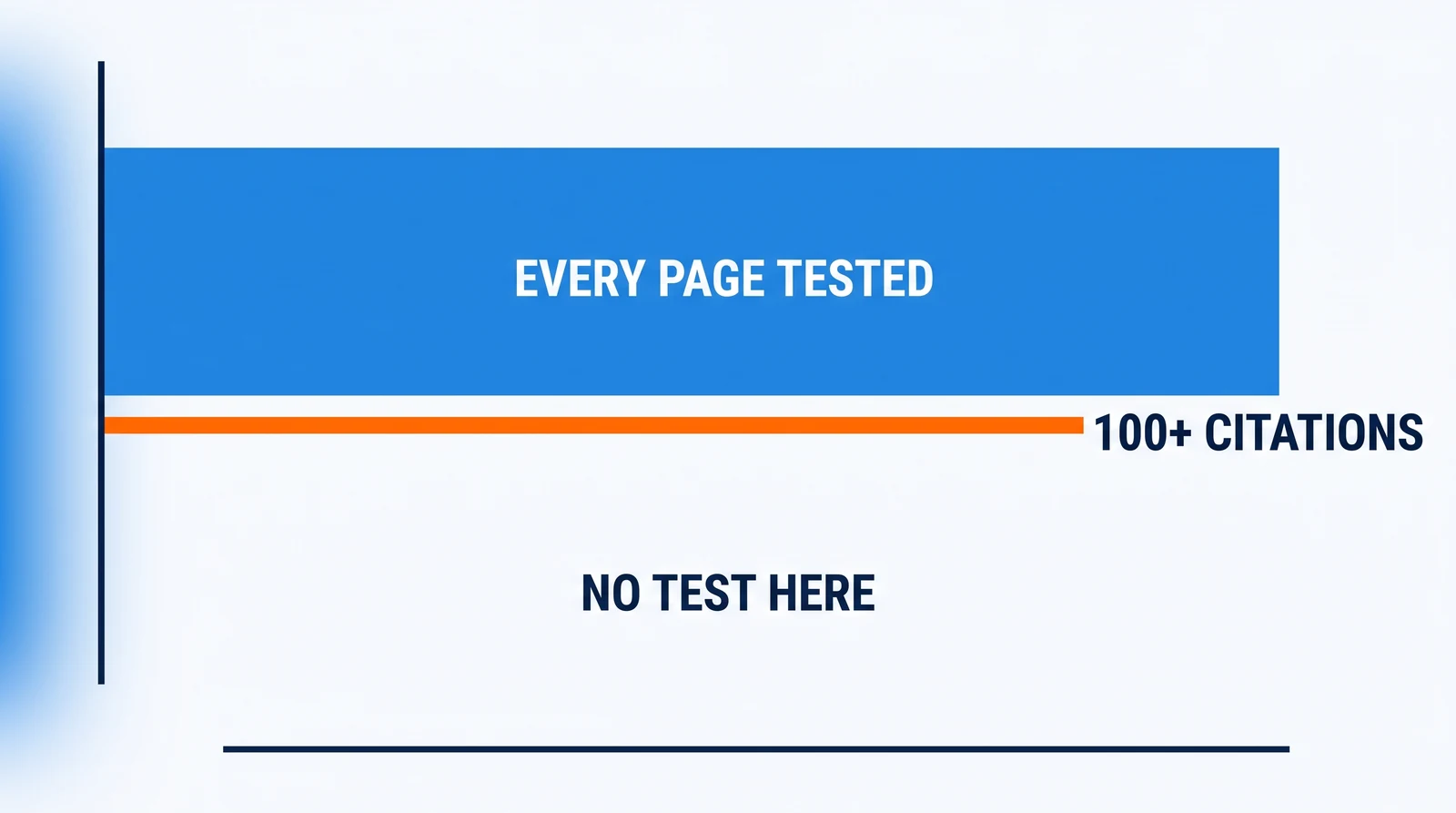
Every page in the largest controlled test of schema markup and AI citations we could find was carrying more than a hundred AI Overview citations before a line of JSON-LD went on it. That is the sample behind the finding you have probably been handed, and the people who ran the test wrote it down: "we studied pages that were already being cited heavily by AI. Every page in the dataset had 100+ AI Overview citations in February 2025, before any schema was added." It sits in a caveat box near the end of the Ahrefs study published on 11 May 2026, and they draw the consequence themselves — "If a page is already getting picked up, our data suggests that adding schema isn't going to push it higher. But for pages that aren't being seen by AI systems at all, schema markup might still play a role in helping them get crawled, parsed, or indexed in the first place."
We went looking for that boundary on the other pages answering this question and found it on none of them. The most careful of those write-ups reprints the page count, all three platform figures and the six-million-URL correlation, and says nothing whatever about who was in the sample.
A second thing is missing, and it is stranger. On most assistants it is not established that the annotations are read at all. Two separate experiments put facts inside structured data that appeared nowhere else on the page, asked the assistants about them, and got nothing back either time. If the code never reaches the model, a citation test cannot separate this does not help from this was never seen — and those are different answers to your question.
One clarification before the evidence. This page is about your own pages being quoted as sources inside AI answers. Readers arrive at this question in two very different states. The other one — how to reference an assistant's output in academic work — has its own page here, how to get citations from ChatGPT. Nothing below concerns reference formats or academic practice.
Does schema markup affect AI citations?
Whether it affects anything depends on whether AI is citing the page already, and the published evidence only covers one of those two cases. On pages cited heavily before the change, adding JSON-LD produced no meaningful movement: 1,885 treated pages against 4,000 matched controls, across three AI surfaces, in the Ahrefs intervention study. On pages nobody is citing, no published test we could find has run — that study "can't speak to that directly", in its authors' words. And on most assistants anyone has checked, the code was not read during a live fetch at all, which puts a question mark over what the citation tests were measuring.
We have written about this subject once before, as one of eight signals in a published playbook, and that piece carries both primary studies in full with their samples, the author's own correction and the one statistically significant exception. For the two studies laid out against the advice they test, read what has actually been tested about getting cited by ChatGPT. This article is about what that page does not carry: which pages the evidence came from, and whether the code ever reached the AI systems doing the citing.
We hold no measurement of our own here. We have not run this test, and nothing below is ours.
Which pages were in the study everyone is quoting?
Every page in the 1,885-page dataset had 100+ AI Overview citations in February 2025, before any schema was added — that is how the study describes its own sample, and it is the fact that decides who the finding applies to. Ahrefs describe those pages as "already inside the consideration set, being crawled and surfaced by LLMs"; the volumes in the hundreds they report elsewhere belong to most of the sample during the measurement window, not to every page before treatment. Each of them acquired JSON-LD at some point across the eight months from August 2025 to March 2026; each was matched against three control pages from other domains at similar prior citation levels, 4,000 controls in all; and citations were counted in the 30 days either side of each page's change, on Google AI Overviews, Google AI Mode and ChatGPT. The comparison group is what makes the work worth reading, because it does the job a before-and-after count cannot do alone.
Treated pages moved −4.6% on AI Overviews, +2.4% on AI Mode and +2.2% on ChatGPT against their matched controls, in the difference-in-differences test the study trusts most. The AI Mode and ChatGPT results are "statistically indistinguishable from zero". The AI Overviews decline is small but statistically significant. The verdict they publish on all three: "Adding schema produced no major uplift in citations on any platform."
That decline works out at "an average loss of around 12 daily citations per page, in a sample where most pages were getting hundreds" — roughly twelve a day against a baseline in the hundreds. Treated pages and control pages were both falling before the change. The cause is not claimed: the list of open questions ends "The small AI Overview decline is real but unexplained."
A page already inside that consideration set has cleared every hurdle between a web page and an AI answer: crawled, indexed, and inside the set of sources the system considers. What the study measures is what structured data does to a page in that position. That is a real question, well answered. It is not the question a practitioner with an uncited page is asking.
All schema types in the 1,885-page study were pooled into a single result: "We pooled all schema types together. Article, FAQ, Product, HowTo, Organization." The other stated limits are a 30-day measurement window, JSON-LD only — not Microdata or RDFa — and code sitting in the HTML, not injected by JavaScript — a distinction the study says AI crawlers appear to treat differently. One format, all types at once, one month, on pages inside the consideration set.
The page ranking ninth for this query — in one United States results capture taken on 18 September 2026 — is Authority Tech's write-up of 15 May 2026, the most careful derivative on that results page. It reports the 1,885 pages, the three platform figures, the "roughly 12 fewer daily citations per page" and the six-million-URL correlation. Read it end to end and there is no sentence about which pages were in the sample, no inclusion threshold and no baseline citation level. That is not dishonesty — it is the ordinary compression that happens when a finding travels. What got compressed out is the part that decides whether the finding is about you.
Can the assistants read the markup at all?
A price placed only inside JSON-LD was returned by none of the five AI systems asked to read the page it was on. searchVIU built a page for a fictional product, published the results on 2 December 2025, and put eight product variants on it with each price in a different place: visible HTML, JavaScript-rendered, JSON-LD only, JSON-LD injected by JavaScript, hidden Microdata, visible Microdata, hidden RDFa, and visible RDFa. They then asked ChatGPT, Claude, Gemini, Perplexity and Google AI Mode the same question five times each, on 30 October 2025.
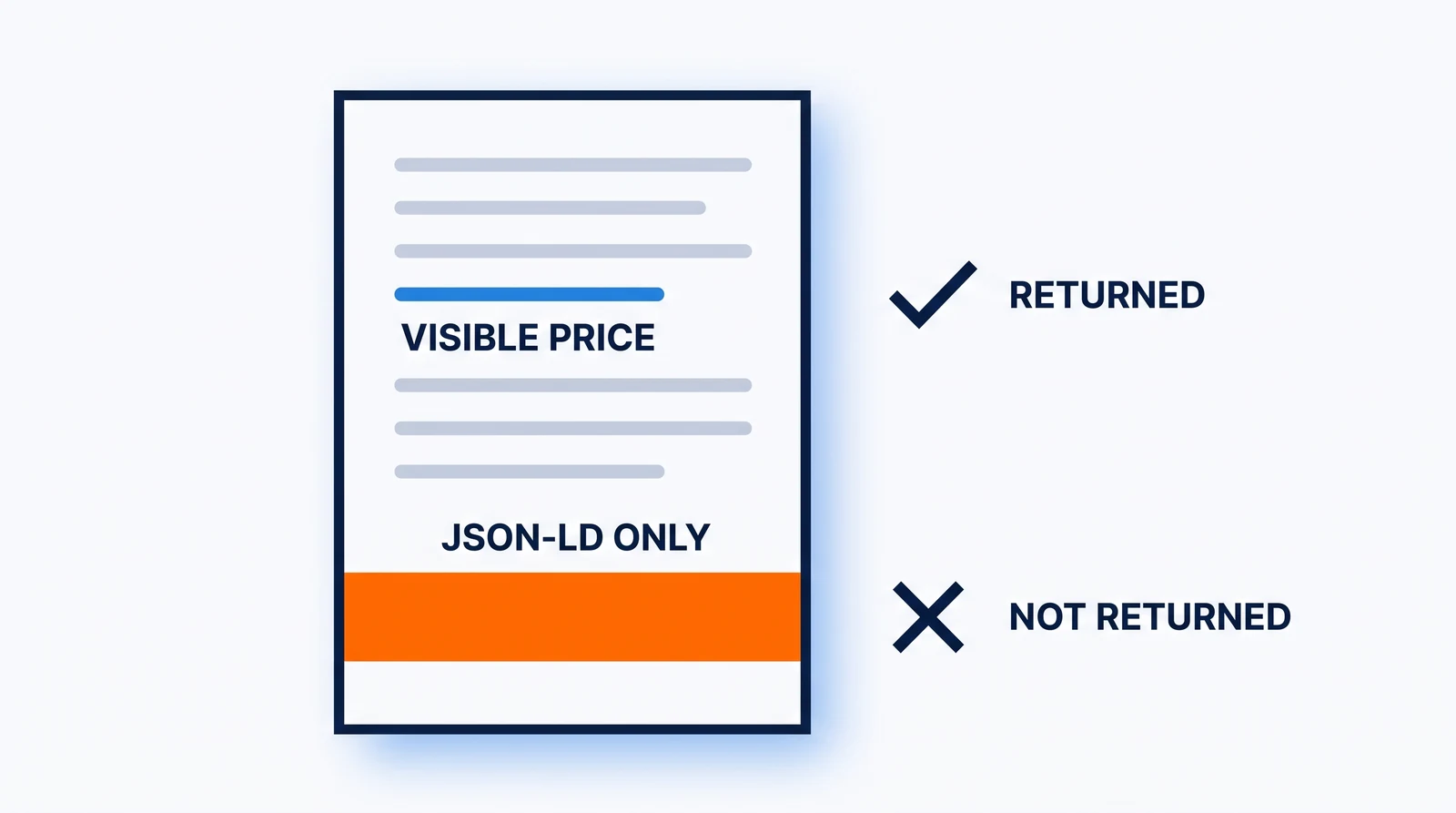
"JSON-LD Schema Markup is NOT extracted by ANY system during direct fetch – even when the information is nowhere else visible on the page" is how the write-up puts it. The hidden Microdata price and the hidden RDFa price went the same way. What the systems did find was the text a person can see. Gemini returned 4 of the 8 prices and ChatGPT 3 of 8; Google AI Mode returned 2 of 8 once the page was indexed, and Perplexity 1 of 8. Claude returned none of the eight prices at all, while naming all seven products correctly.
The experiment tests the direct-fetch phase and nothing else, and it says so twice on its own page: "Our tests primarily show Phase 4 (Direct Fetch). Schema Markup could very well be used in Phases 1-3 – especially by Google AI Overviews and Bing Copilot, which have access to search indexes." That makes it evidence about what happens when an assistant fetches your page live, and not about what a search index stored from that page months ago. The whole sample is one purpose-built page, eight tests and five systems, built by a company that sells SEO monitoring software.
Six of seven AI platforms could not return the code when asked for it directly. That result opens a controlled experiment Otterly.AI published on 23 March 2026, run on Otterly's own website: five types — FAQ, Organization, SoftwareApplication, Review snippet and Article/BlogPosting — added across the site on 7 December 2025, with brand coverage tracked across 319 prompts in the United States market from 1 November 2025 into March 2026 and competitors tracked over the same window as a control. The limit is the first thing their write-up states, not the last: "This is not an industry-wide study, it is a controlled experiment run on a single SaaS brand's web presence, across a defined set of pages and a specific 3 month window."
The breakdown is worth more than the six. Each platform was asked, in as many words, "Fetch me the Schema Markup code from this page: [URL]". Gemini returned the correct JSON-LD. Claude replied that there was none on the page. ChatGPT could not detect any in the source it could reach. Perplexity's fetch was blocked by the server. Copilot reached the readable text but not the raw HTML. Google AI Mode returned a list of types including a Service schema that had never been implemented, and Otterly draw the conclusion themselves: "A platform that confidently returns wrong structured data is not reading schema. It is generating text that sounds like schema." Google AI Overviews returned no fetch result at all, because it does not answer that way. Two of those six are a different kind of failure from the other four, and a summary that reports six of seven without the breakdown drops the interesting part.
An answer placed inside FAQ markup, and nowhere else on the site or anywhere on the web, was used by none of the AI search platforms Otterly asked. The fact was how many of their employees live in Portugal, and the result is flat: "None of the AI Search platforms used Schema Markup in an attempt to answer this question." That held even when a prompt pointed at the specific page.
A mechanism is offered on the same page, asserted and not measured: HTML-to-Markdown and extraction pipelines used in AI search workflows "either ignore or destroy `<script>` tags entirely or treat them as low‑value content", so the JSON-LD inside them is "often removed before the model ever sees the page." That is a plausible account of the results above, not a demonstration of them.
The visibility half of the same experiment discards its own best number in public. Brand coverage across those 319 prompts rose from roughly 27% in November to about 49% by mid-March, with a +6% lift in the weeks after 7 December, and that lift is ruled out by the people who found it, because every competitor they tracked moved as much or more without touching their own pages: "the December lift was algorithmic, not schema-driven." Ruling out your own best number, on your own company's blog, is not the usual thing, and it is why the rest of this experiment is worth quoting.
We did not go hunting for the first of those two experiments. Ahrefs named searchVIU themselves, in the same caveat that carries the population boundary, and summarised it in one line — "Spoiler: none of them did." The company whose study is used to settle this question has already published the finding that complicates it.
Why "never read" and "does not help" are not the same finding
A null result on something the system never saw is a narrower result than it looks. An intervention study measures the effect of a change; if the change never reaches the model, what it measures is the effect of something the model did not read. That still answers the practical question — structured data did not move citations on those pages in that window — but it does not show that a machine-readable description of a page is worthless, and it says nothing about a system that does read one.
The limits belong in the same breath. The retrieval evidence is two experiments, one on a purpose-built page and one on a single company's website, both run by vendors who sell in this market. Neither watched a server log; both inferred what the AI systems could see from what those systems returned. Inferring a system's inputs from its outputs is weaker evidence than a crawl record and much stronger than an assistant's account of its own behaviour, which is not evidence at all. And searchVIU's caveat stands: indexing is not the phase they tested, and Google's AI features run on the same index as ordinary search. A tool reading your page directly and an assistant answering from an index are doing two different jobs, a distinction we set out in what an AI visibility tool can actually read on your page.
A second reading of this evidence is already published, and it belongs to someone else. Across six million URLs, AI-cited pages were "almost three times more likely to have JSON-LD than non-cited pages", and 53% of cited pages carry it — the correlation the Ahrefs study opened with before setting out to test it. The gap has an explanation in the same write-up: sites that add structured data "tend to also invest in technical SEO, publish authoritative content, build links, maintain their pages, and rank well in regular search." Authority Tech put the reconciliation in one line, and the line is theirs: "Pages with schema markup get cited more often — not because of the markup, but because those pages belong to authoritative, well-maintained sites doing everything else right." We are pointing at it because it is right and because the page that wrote it should get the credit.
Our own work points the same way about page-level signals in general, and not about this one. Every property of a whole page we put to the test came back unable to tell a cited page from an ignored one in our harvest, while the one selection we could physically observe was made at the level of a sentence. The sample and the limits sit on our research page, with the longer version in the four strategies we tested. Different signal, different test. We have not measured this one and we are not going to imply that we have.
What Google says you actually need
No additional markup is required to appear in Google's AI features, and Google's documentation says so twice. The AI features and your website page, last updated 10 December 2025, puts it this way: "There are no additional requirements to appear in AI Overviews or AI Mode, nor other special optimizations necessary." And in its best-practices list: "You don't need to create new machine readable files, AI text files, or markup to appear in these features. There's also no special schema.org structured data that you need to add."
The other half of that page is usually dropped. Structured data is still on Google's list of SEO fundamentals that "continue to be worthwhile", as the entry "Making sure your structured data matches the visible text on the page." Not required for the AI features; still worth maintaining for the reasons it always was. And the documentation sets its own ceiling on all of it: "Indexing and serving isn't guaranteed."
Scope that carefully. This is Google describing Google's own AI Overviews and AI Mode. It says nothing about ChatGPT, Perplexity, Claude or Copilot, each of which retrieves differently, as the fetch results above show. Anyone deciding about structured data should see the platform's own answer next to the independent tests. We read that same documentation against what a GEO agency can actually sell you.
The figures on this subject that carry no population
The most quoted number on this results page has no study behind it. Averi's implementation guide of 30 December 2025 opens by promising to show you "how schema markup increases AI citation rates by 30%+" and repeats it as "up to 30% higher visibility in AI overviews". We read the page in full and extracted its outbound links: it points at Google's structured-data documentation and one vendor benchmark, and it names no study, no sample and no population for that 30%. Beside it sits "GPT-5's accuracy improves from 16% to 54% when content relies on structured data … that's a 300% improvement in response accuracy", also without a source — and 16% to 54% is a rise of 38 percentage points, a multiple of about 3.4. A separate claim on the same page, that language models grounded in a knowledge graph reach "300% higher accuracy", does carry a link, to a vendor's own benchmark.
A knowledge graph is a structured store of entities and the relationships between them, which a model can be pointed at as a data source; markup on your page is a set of labels an indexing system may or may not collect. Those are different objects and the difference is worth holding on to. Whether an AI system recognises your organisation as an entity at all is the adjacent question readers fold into this one most often, and no test here answers it. Nor did we find one anywhere: entity clarity was one of two items with no published test behind it in either direction when we audited an eight-signal playbook against the evidence.
Evertune's explainer of 6 November 2025 rests its positive case on one sentence with no link, no date and no sample behind it: "BrightEdge research demonstrated that schema markup improved brand presence in Google's AI Overviews, noting higher citation rates on pages with robust schema markup." To its credit the same page asks in its own heading whether the investment is worth it "when evidence remains mixed", and notes that models may strip the tags during tokenization — the retrieval finding above, arriving from the other direction.
Another page on that same results list cites no study at all and is franker than most about what it is doing. The HOTH's guide of 4 June 2026 tells you "Schema does not buy you a citation… It changes the probability that an AI system can confidently pull your content into an answer". Every outbound link on that page is a schema.org vocabulary page, a validator, a rich results test or a plugin — not one is a study. The argument is a reasonable one. It is simply not measured, and the page does not pretend otherwise.
Apply the same question to everyone here, ourselves included: Ahrefs, Otterly, Evertune, Averi and searchVIU all sell software in this category, and so do we. A commercial interest does not make a number wrong: the study we think is the strongest work on this question comes from a tool vendor. It does mean the sample and the method are the first things to read, whoever published them.
The test nobody has run
Nobody has published a test of what structured data does for a page that AI is not citing. The question a practitioner actually arrives with is exactly that one, and the study we judge the most careful of these says as much twice over — once in the caveat about its own sample, and once in the protocol it offers for running a smaller version yourself. Anyone running that protocol is told to pick test pages "ideally pages already getting some AI citations, so you have a baseline", because "pages with zero citations make it harder to tell whether schema did nothing, or whether the page just wasn't going to get cited either way."
That is a fair account of why the experiment is hard, and it is also why the gap persists: the pages where an effect would matter most are the pages on which an effect is hardest to detect. The intervention study went where the signal was measurable; nobody has yet gone where the question is.
The state of the evidence today, in one line each. The null belongs to pages AI was citing already. The fetch failures belong to direct retrieval on most assistants. The uncited page — the one whoever is reading this probably owns — has been tested by nobody.
So should you add it?
Structured data is worth keeping for the job it demonstrably does in ordinary search, and not worth buying as an AI-citation lever for pages AI is citing already. It has a documented job that none of this evidence touches: a rich result — the review stars and the price Google can draw from a page into an ordinary search listing — plus a place on Google's own list of fundamentals worth maintaining. That job has been shrinking, and not because of anything above: Google's documentation changelog records the FAQ rich result deprecated from 7 May 2026 and its documentation removed on 15 June 2026, after being restricted to authoritative government and health sites in 2023 — so that rich result is now gone for everybody, which is a separate question from whether an AI platform reads the tags. Nothing here is a reason to take the rest off. The single negative signal in all of it is a 4.6% decline in AI Overview citations, on 1,885 already-cited pages whose control group was falling alongside them, and the people who measured it say they cannot explain it.
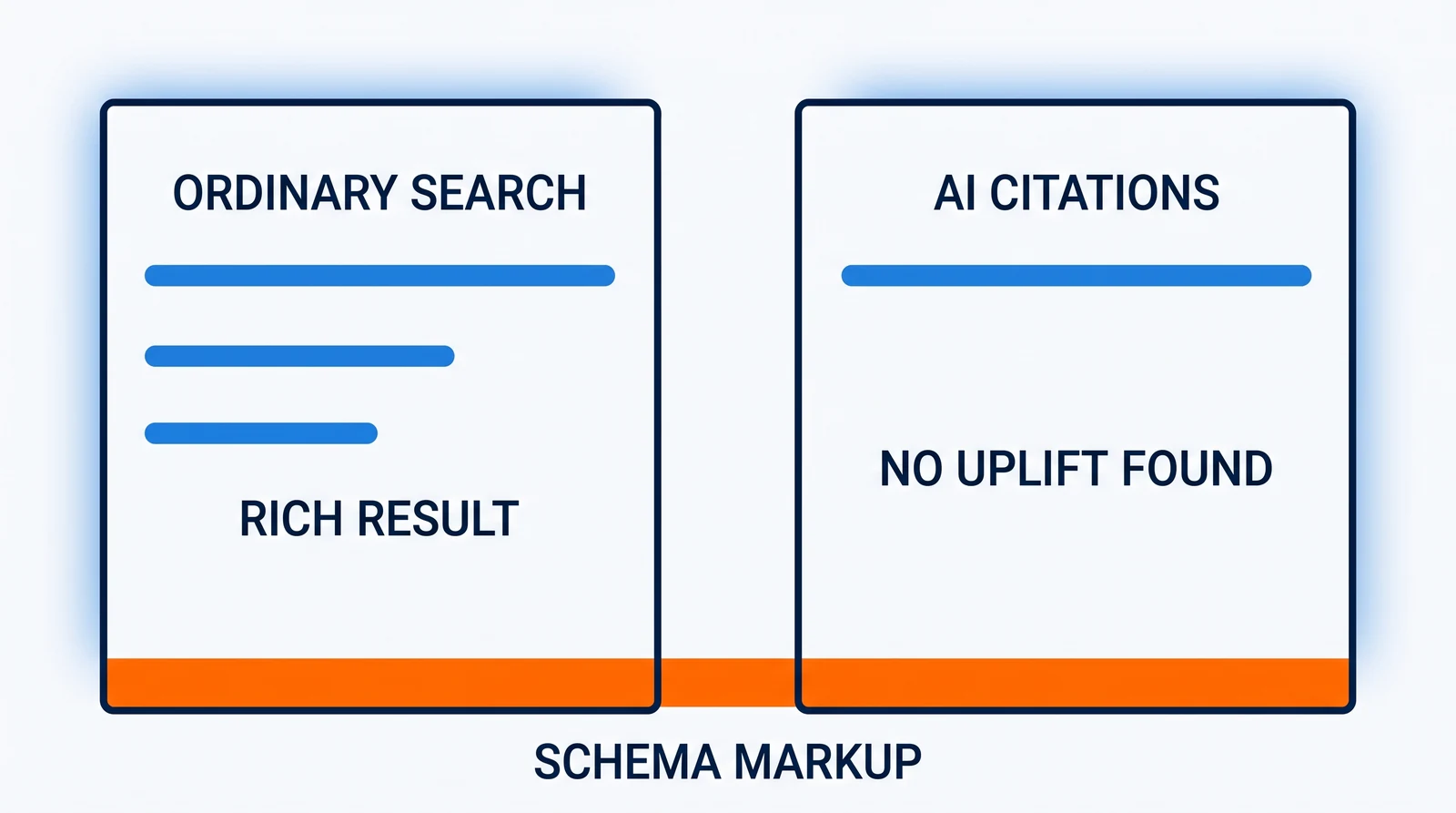
On pages that are already visible, the matched-control study says the tags do not move the citation number, and most assistants were not reading them during a live fetch anyway. Otterly reach the same place from the other direction: whatever value they could trace ran through ordinary search performance, not through direct consumption by AI platforms.
If your pages are not being cited at all, none of this is about you yet — and the cheaper first check is not a technical audit. It is whether an assistant searches the web for your question in the first place, because a question it answers from memory has no citation slot for anyone to win. What happened when we varied how a question was framed, and watched retrieval switch on and off, is on our research page with its sample. The same question runs at two other signals — do backlinks matter for AI search and does content freshness affect AI citations — and, with the signal questions set aside, at who holds the citations anyway.
The decision belongs to you and your own site. We can tell you what was measured, on which pages and by whom. We cannot tell you whether a sprint of developer time is better spent on tags than on the thing the tags were standing in for.
What people actually ask us
These four answers draw only on the sources listed at the end, each of which was opened and read on 18 September 2026; where the evidence does not reach the question, the answer says so rather than filling the gap.
Can schema markup hurt my website? No published evidence supports removing it. The only negative result anywhere in this material is a 4.6% fall in AI Overview citations on 1,885 treated pages against matched controls — about twelve fewer a day in a sample where most pages were getting hundreds, and where both groups were already declining — and the people who measured it say plainly they cannot pin it on the change. That is a long way from evidence of harm. The tags continue to do their ordinary job in search regardless.
How do I increase AI citations? None of the tests on this page found a lever, and the page promising a 30% uplift names no study behind it. The measured work on citation supports something narrower and less satisfying: the question has to be one an assistant actually searches for, and what gets quoted is usually a specific, self-contained sentence rather than a whole page. Each of those findings carries its sample and its limits on our research page, and the eight-signal audit in what has actually been tested shows how little of the standard advice has a test behind it in either direction.
Is SEO still relevant for generative AI search? Google's own answer is yes, and it is the clearest line in their documentation: the AI features carry "no additional requirements" beyond the existing fundamentals, and that list is the familiar one — crawlable, internally linked, important content available as text, structured data matching the visible page. Scope it to Google, though. That documentation covers AI Overviews and AI Mode; it is not a statement about how ChatGPT or Perplexity retrieve.
Do some types matter more than others? One published finding points that way and it deserves stating precisely. In a preprint dated 22 February 2026, Kurt Fischman reports that pages carrying Product or Review markup with concrete populated attributes were cited more often than pages carrying generic types, at p = .012, while presence in general came back null across the same dataset. The preprint is open access, and we set it out with its full sample and its author's own correction in the eight-signal audit. It is a preprint's finding, it is one correlational study, and it is not a recommendation from us. Ahrefs pooled every type together and list type-by-type analysis as an open question.
Sources
- Ahrefs — We tracked 1,885 pages adding schema. AI citations barely moved. — the intervention study: 1,885 pages adding JSON-LD between August 2025 and March 2026 against 4,000 matched controls, the three platform figures, the population caveat, the six-million-URL correlation and the authors' own open questions. Published 11 May 2026; verified 18 September 2026.
- searchVIU — Schema markup and AI in 2025: what ChatGPT, Claude, Perplexity and Gemini really see — eight tests on one purpose-built page across five AI systems, and the authors' own statement that they tested the direct-fetch phase only. Published 2 December 2025; verified 18 September 2026.
- Otterly.AI — Schema markup's real impact on AI search — a single-brand controlled experiment: 319 prompts in the US market, 7 December 2025 to 7 March 2026, seven platforms, the direct-fetch test and the FAQ-only information test. Published 23 March 2026; verified 18 September 2026.
- Authority Tech — the Ahrefs schema study, summarised — the derivative write-up quoted here, and the source of the correlation-versus-causation line credited above. Published 15 May 2026; verified 18 September 2026.
- Averi — Schema markup for AI citations: the technical implementation guide — the "30%+" and "16% to 54%" claims quoted above. Published 30 December 2025, updated 2 January 2026; verified 18 September 2026.
- Evertune — Schema vs no schema: does structured data matter for AI search? — the BrightEdge sentence and the "evidence remains mixed" question. Published 6 November 2025; verified 18 September 2026.
- The HOTH — Schema markup and AI citations: which tags actually affect whether you get pulled — the careful unmeasured case. Published 4 June 2026; verified 18 September 2026.
- Google Search Central — AI features and your website — no additional requirements and no special schema.org structured data for AI Overviews or AI Mode, and structured data among the SEO fundamentals. Last updated 10 December 2025; verified 18 September 2026.
- Google Search Central — documentation updates changelog — the FAQ rich result's deprecation: "This feature will no longer appear in Google Search starting May 7, 2026" (entry of 8 May 2026) and the removal of its documentation on 15 June 2026. The earlier restriction to "well-known, authoritative government and health websites" is in the Search Central blog post of 8 August 2023. Changelog last updated 16 September 2026; both verified 18 September 2026.
- Kurt Fischman — Does schema markup predict AI citation? — the correlational preprint: 730 AI citations, 75 queries, 1,006 pages, Google's top ten as the control population, and the Product/Review exception. Record dated 22 February 2026; verified 18 September 2026.
- LiamVi — Research: our methods, samples and limits — the page-level nulls, the passage-level evidence and the framing ladder, each with its sample. Verified 18 September 2026.
- LiamVi — How to get cited by ChatGPT in 2026 — the eight-signal audit, and both primary schema studies in full with their samples. Verified 18 September 2026.
- LiamVi — Generative engine optimization strategies for AI visibility — the four tested strategies and Google's mythbusting list. Verified 18 September 2026.
- LiamVi — What a GEO agency can actually sell you — the same documentation read against an agency's differentiators. Verified 18 September 2026.
- LiamVi — AI tools with the best generative engine optimization features — what a tool can read on your page, and what it infers. Verified 18 September 2026.
- LiamVi — How to get citations from ChatGPT — citing ChatGPT as a source, in academic formats. Verified 18 September 2026.
- LiamVi — Do backlinks matter for AI search — the same question at another signal. Publishes 22 September 2026.
- LiamVi — Does content freshness affect AI citations — the same question at another signal. Publishes 24 September 2026.
- LiamVi — Most cited websites by AI models — who holds the citations once the signal questions are set aside. Publishes 26 September 2026.