AI search optimization agencies in 2026: what they can change, what they cannot, and how to check
An AI search optimization agency sells you presence inside AI-generated answers — the ones ChatGPT, Google's AI Overviews and AI Mode, Perplexity and Gemini return in place of a list of links. A good deal of that work is real, and there is now official guidance on optimizing for generative AI features that any agency should be able to point to. One assumption sits underneath almost every pitch, though, and nobody tests it in front of you: that for your topics, an assistant goes looking for sources at all. We measure what AI assistants cite, and on 12 of the 33 keywords in our early harvest nobody was cited at all — no page won, at any quality level. Our read is that no search happened for those questions; what we measured is that there was nothing to win. This is what we would check before signing an AI search optimization agency, and how to run most of those checks yourself this week.
What does an AI search optimization agency actually do?
An AI search optimization agency works to get your pages named or quoted inside AI answers, usually bundling four things: an AI search visibility audit of where you appear today, content work, technical SEO, and tracking across the AI search surfaces. The deliverables look like a traditional SEO retainer because, in large part, that is what they are.
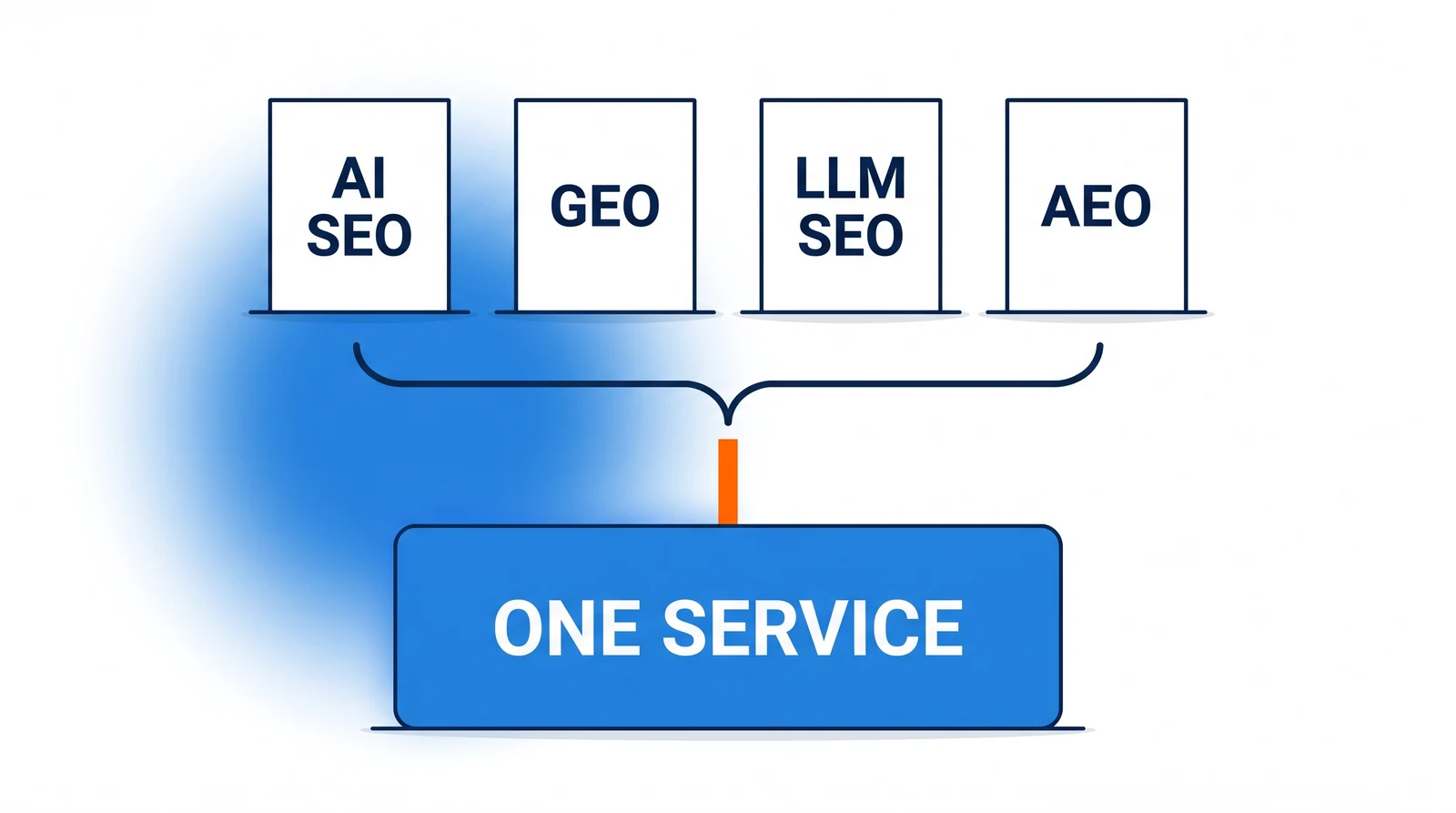
The labels multiply faster than the work does. "AEO" stands for "answer engine optimization" and "GEO" for "generative engine optimization", and both describe work aimed at improving visibility in AI search experiences — after which the same guidance adds that "from Google Search's perspective, optimizing for generative AI search is optimizing for the search experience, and thus still SEO." An AI SEO agency, a GEO agency, an LLM SEO company and an answer engine optimization consultancy are, in 2026, mostly one service wearing different names: the AEO version and the GEO version are running the traditional SEO playbook with a new section at the front of the deck. The label tells you very little. What the agency measures tells you nearly everything.
The answer engines themselves are worth naming accurately, because one AI search engine does not behave like the next. AI Overviews and AI Mode may use different models and techniques, so the links they show can vary between them; AI Mode is aimed at queries needing "further exploration, reasoning, or complex comparisons". Perplexity answers with "citations and links to original sources" on each response. Gemini shows a Sources button when sources are available. A single blended AI visibility score across all of them hides which answer engine you are actually losing.
Is AI search optimization different from traditional SEO?
Some of it is traditional SEO under a new name and some of it genuinely is not, and the platform documentation settles which is which more cheaply than any agency will. There are "no additional requirements to appear in AI Overviews or AI Mode, nor other special optimizations necessary": to be shown as a supporting link, a page must be indexed and eligible to appear with a snippet, and there are no extra technical requirements beyond that.
The myths get named directly in the same documentation: you do not need new machine-readable files, AI text files, markup or Markdown; there is no requirement to break content into tiny pieces for AI to understand it; structured data is not required for generative AI search, and there is no special schema markup to add. If a GEO agency's differentiator is a proprietary AI markup file, the platform it is aimed at says the file does nothing.
So the technical half of an AI search optimization strategy is largely traditional SEO done properly — the same crawlability, indexing and snippet eligibility a traditional SEO agency has been selling for a decade, and what earns a page traditional search visibility earns it the technical half here too. What genuinely differs is selection, not crawling, and that is where our own measurements bite. Across a 33-keyword harvest, mostly on ChatGPT, 9 of the 73 pages the assistant cited also ranked in Google's top ten — seven citations in eight came from outside the first page of search results. The two sets barely overlap. In a matched, within-keyword test, higher-authority domains won and lost against smaller ones in close to equal measure: nothing we could detect. Both results come from a small, early corpus skewed toward a few related industries, which is why we re-run them weekly and will publish what changes. They matter to a buying decision anyway, because "we will build your authority and your rankings, and the citations follow" is the most common thing an agency will tell you, and it is the part our data supports least.
What can an AI search optimization agency not do for you?
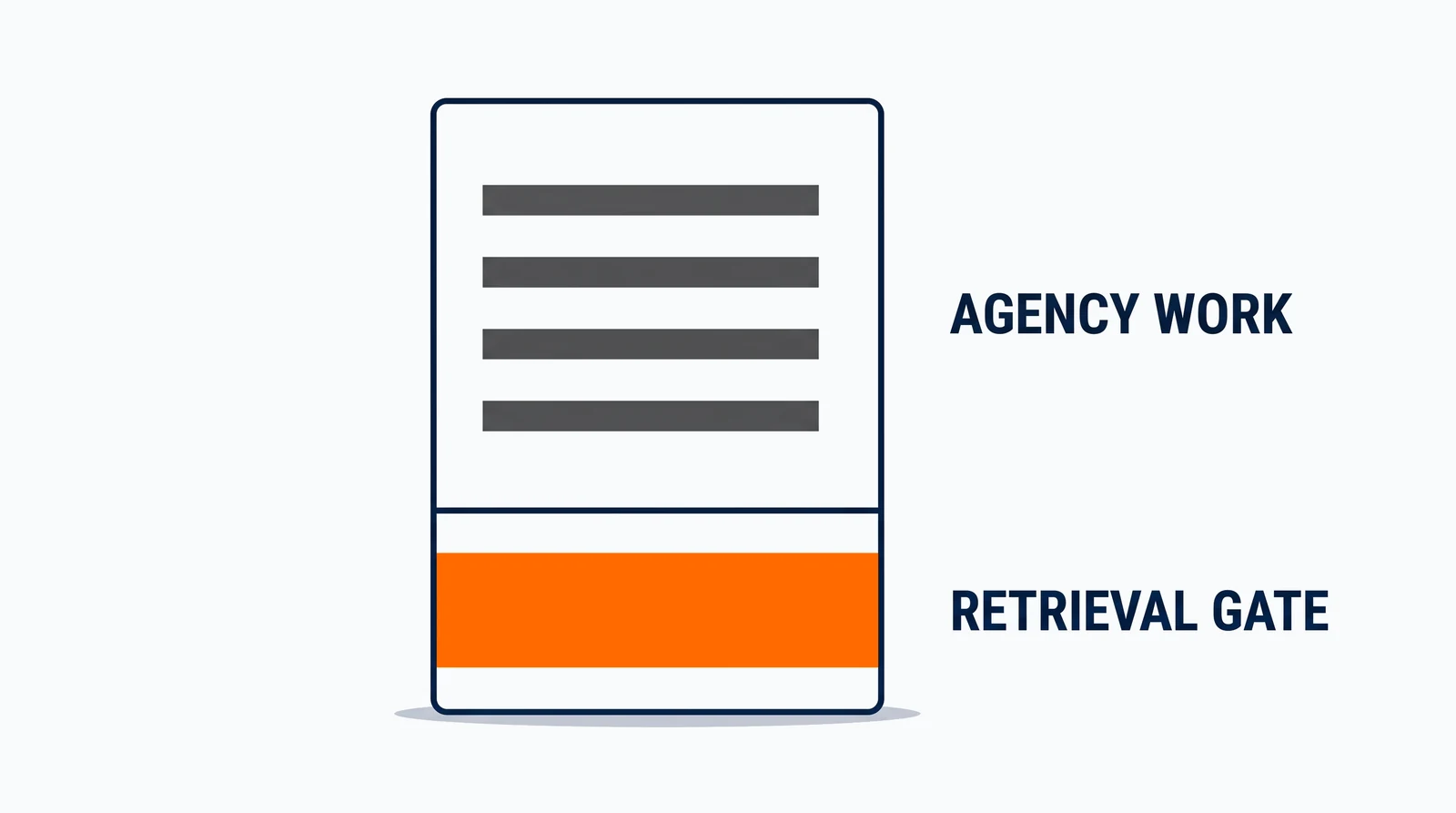
No agency can win you a citation on a question the assistant never searches for. That is the hard limit on this entire market, it is decided before your page is considered, and it is not a metaphor — the platforms document it.
Google's own grounding product works this way and publishes the mechanics: Agent Search assigns a prediction score to the prompt, a value between 0 and 1 for whether the prompt would benefit from grounding in current web information, compared against a threshold that defaults to 0.7. Below the line, the model still answers — just not from the web. The published worked examples score "Write a poem about peonies" at 0.13 and "Who won the latest F1 grand prix?" at 0.97. That documentation covers a developer grounding API that Google has since deprecated and closed to new requests, and it is not a spec sheet for the consumer products you are buying visibility in; no platform publishes a threshold for those, and anyone quoting you 0.7 for ChatGPT is inventing it. What it does establish is that a retrieval gate is a real, tunable thing, and that the score belongs to the question rather than to your page.
The consumer surfaces say the same in plainer words. ChatGPT "will choose to search the web based on what you ask". AI Overviews are shown only when Google's systems judge them additive to classic search, "and as such, often don't trigger". Gemini does not attach sources to every response — when the Sources button is absent, no links were provided at all.
Then there is what that looks like across a real keyword set. On 12 of the 33 keywords in our early harvest, no page was cited by anyone — not a competitor, not a large publisher, nobody. That much we measured. Why it happened we can only read, not show: our read is that the question never crossed a retrieval gate and the assistant answered from what it already knew, because an absent citation cannot tell you from the outside whether a search ran at all. Either way there is no citation to win on those topics, so no amount of content, authority or retainer wins one. The harvest is small and early, its method and its limits are on our research page, and this particular breakdown is not published there yet; we keep measuring weekly and will publish what changes. The direction has held every time we have looked, and it is the first question we would put to an agency: what happens if my topics turn out to be in that group? An agency that has never considered it will sell you twelve months of content aimed at an answer box that does not exist.
What actually moves it, then?
Two things move it: how the question is framed, which is decided before anything is written, and whether your pages carry sentences worth lifting.
Framing comes first. In a small pre-registered test — the prediction written down before the run — we held the topic constant and varied only the shape of the query. None of the conceptual "what is X" framings triggered source retrieval; the dated, comparison-shaped and recommendation-shaped framings did. Engines differ, and our replication on a second engine rests on very few queries, so treat this as a direction rather than a law. Holding the topic constant and changing only the shape of the question moved retrieval from nothing to consistent in that test, while the pages themselves never changed. Choosing which questions to compete on is therefore a decision made before commissioning, and it is the cheapest thing on this list to get right.
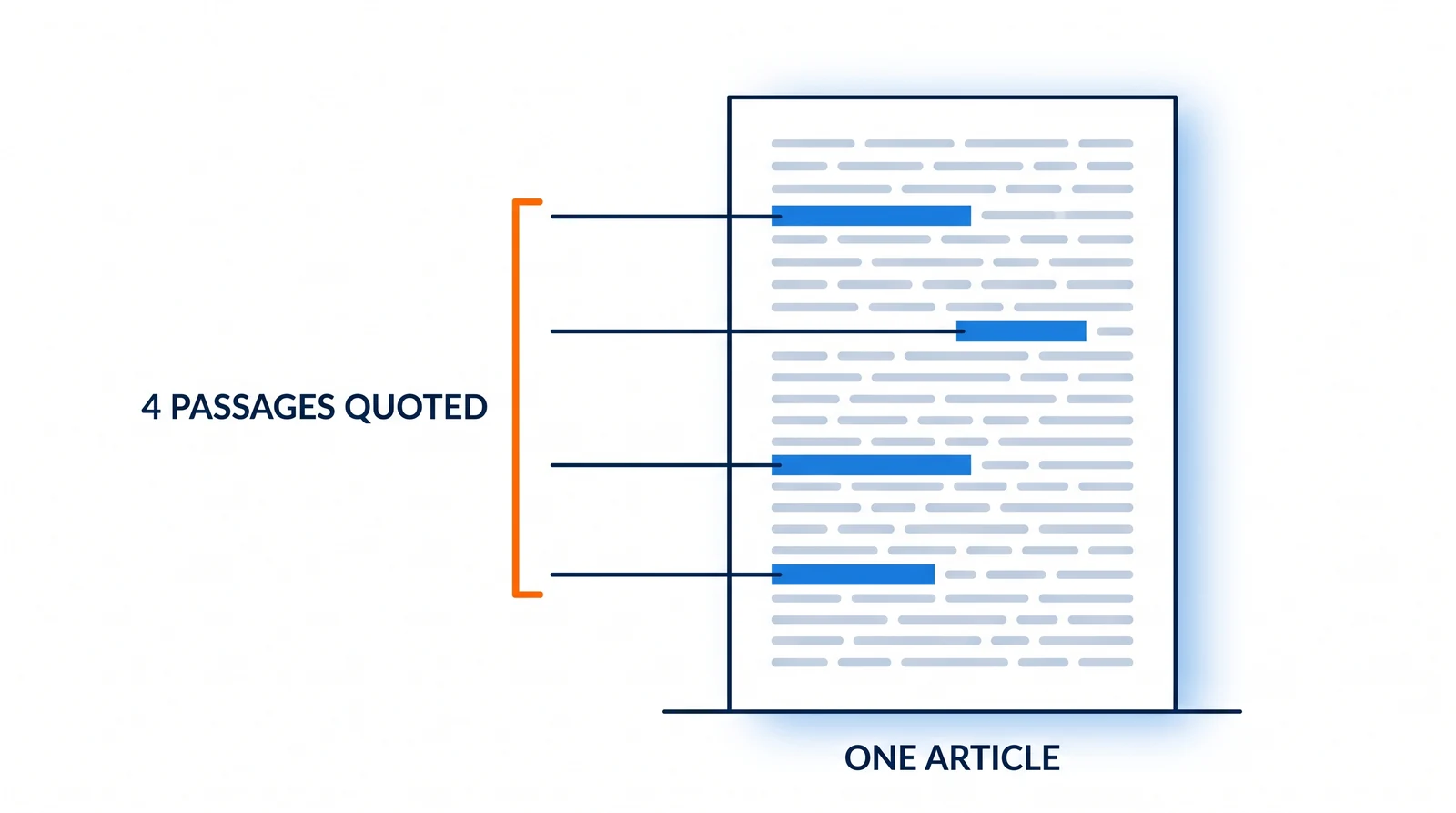
Then passages, not pages. Some assistant citations link to a single highlighted sentence inside a page rather than to the page itself. We recorded these as text-fragment links on Gemini, with one article quoted four separate times from four different passages in it. That is an observation rather than an inference, and it changes what a deliverable should look like: a self-contained sentence carrying a figure and a named thing can be lifted; a paragraph that only makes sense in context cannot.
And say something the other pages do not. In our testing, ChatGPT's own account of its selection behaviour was that it ignores pages adding no new evidence — several articles repeating the same points are not several independent sources. A model's self-report is weak evidence on its own, and we treat this one as load-bearing only because it predicted results we had already measured blind. It has an uncomfortable implication for the standard content retainer: a page assembled from the consensus of everything already ranking is, by that description, the kind of page that gets skipped.
What should you ask an AI search optimization agency before signing?
The questions worth asking are the ones with measurable answers, and there are about seven of them. Ask for the measurement, not the deliverable count. These seven are ours, and we build software in this market — so read them as our view of what matters, not a neutral standard. The third-party guidance cited below applies to us exactly as it applies to any AI search optimization agency.
- What happens if my topics draw no citations at all? The answer you want involves checking before commissioning. "We would write more" is the answer that should worry you.
- Do you track citations, or only brand mentions? A mention is your name in a sentence; a citation is a source relationship with a link. Reporting that cannot separate them cannot tell you what to fix.
- Can you show me who holds the answers in my category today? Naming the incumbents is a measurement. Describing the visibility opportunity is a brochure.
- Is your reporting reproducible by me? You should be able to run a version of the check yourself and land in roughly the same place.
- Which crawler should I allow? An agency that answers "GPTBot" for ChatGPT search visibility has named the wrong one, and the documentation is a page long.
- What exactly do you guarantee? "No one can guarantee a #1 ranking on Google", and an SEO who guarantees you first place is one to walk away from. That guidance is about rankings; no platform publishes an equivalent promise about AI citations either, and given the retrieval gate above, a guaranteed citation is a guarantee about someone else's classifier.
- Does your advice cite the platform's own documentation? The published buyer's guidance asks exactly this of AEO and GEO services — whether an answer engine optimization strategy aligns with the official guidance on optimizing for generative AI features, and whether the agency cites that documentation as supporting evidence rather than asserting it.
Two more worth holding on to from the same source: Google does not evaluate third-party services, so a claim of being Google-approved is the claim itself and nothing more; and third-party tools have no access to internal ranking data, which caps what any of them — ours included — can honestly promise. If an agency asks for Search Console access to run an audit, grant read access at that stage, not write access.
How do you check any of this yourself?
Every check in this section is free, and three of the four take an afternoon, which is the point: an AI visibility audit you can reproduce is worth more to you than one you have to take on trust. Open the assistant your buyers use, ask your category's real questions with web search switched on, and read the source list. If links appear, note who holds them — those are the pages an agency would have to displace. If no links appear on any phrasing you try, you have learned the most valuable thing on this page before spending anything. How to read what ChatGPT cites, and in what format is the longer version of that check.
Three more checks worth doing in the same sitting:
- Your robots.txt. OAI-SearchBot controls whether you appear in ChatGPT's search answers, GPTBot controls whether your content may be used to train the models, and the two settings are independent of each other. Blocking GPTBot therefore does not remove you from ChatGPT's search citations — in our own sample, sites blocking GPTBot were cited anyway. If you want to appear, OAI-SearchBot is the one to allow.
- Your Search Console setting. A site must be included in Search generative AI features in Search Console to be eligible for display in those features. That is a site-level control, separate from the snippet-eligibility requirements above, which is how "no additional requirements" and "must be included" can both be true at once. The control is rolling out to a subset of site owners and set to include by default on every property, so most readers have nothing to change here and some will not see the setting yet. Either way it is a setting you own, not a service you buy.
- The vendor's own numbers. Ask for the method behind any figure, then check one. Being able to check is the point; a number without a method is an opinion in a dashboard, ours included.
Should you hire an agency, build in-house, or buy software?
Establish whether assistants search for your topics at all, then decide who does the work — the sequence matters more than the choice. If your category turns out to be one where retrieval rarely fires, the honest answer may be that AI visibility is not a channel to invest in this year, and no agency, tool or in-house hire changes that. If retrieval does fire, the scarce ingredient is usually not writing capacity. It is someone who knows something specific and true that nobody else in your category has published, and that person almost always already works for you. If buying software is on the table, compare what each one actually measures rather than what it calls the number — what an AI visibility tool measures, and how to judge one sets out that comparison. Beyond that, the choice depends on budget, in-house capacity and how much of the measurement you want to own — facts about your business that we do not have, and will not pretend to.
What people actually ask us
These four questions reach us more often than any others from people about to sign with an agency, and they come to us directly rather than from a search result page: this query returns no People Also Ask panel at all, which is its own small finding about how unsettled the category still is.
Is an LLM SEO company a real thing, or a rebrand? Mostly a rebrand of a real job. The work — technical fixes, content, measuring who gets cited — genuinely exists, and optimizing for generative AI now appears among the services agencies legitimately provide. But the naming has run well ahead of any settled discipline: an AI SEO agency, an AEO consultancy and a generative engine optimization shop are describing the same engagement, and the platform's own position is that all of it is still SEO. Judge the measurement, not the noun.
Are AI search optimization agency reviews worth anything? They are worth something for service quality — responsiveness, reporting, whether deadlines held — and very little for effectiveness, because almost nobody publishes what they measured or how. A review saying "our AI visibility improved" without naming the surface, the queries and the method is a testimonial, not evidence.
What do AI search optimization services usually include? Typically an AI visibility audit of where you currently appear, content production or rewriting, technical SEO work, and reporting on mentions and citations across ChatGPT, AI Overviews, AI Mode, Perplexity and Gemini. The variable worth interrogating is the reporting: whether it covers each answer engine separately, whether it separates citations from mentions, and whether you could reproduce it.
Can an agency guarantee AI citations? No, and the guarantee is the clearest signal to walk away. A citation requires the assistant to look for sources at all, and on 12 of the 33 keywords in our early harvest nobody was cited — not the incumbent, not anyone — so there was no citation for the work to win. Nobody can promise an outcome they do not control, and an agency offering one is telling you what it does not measure.
Sources
- Optimizing your website for generative AI features on Google Search — the AEO and GEO vocabulary, "still SEO", the mythbusting list, and the Search Console eligibility condition; last updated 10 July 2026, checked 27 August 2026.
- AI features and your website — no additional requirements or special optimizations; AI Overviews "often don't trigger"; how AI Overviews and AI Mode differ; last updated 10 December 2025, checked 27 August 2026.
- Do you need an SEO? — no guaranteed #1 ranking; the questions to ask about AEO and GEO advice; Search Console read access; last updated 5 June 2026, checked 27 August 2026.
- Guidance on using third-party SEO tools, services, and advice — Google does not evaluate third-party services, and third-party tools have no access to internal ranking data; last updated 5 June 2026, checked 27 August 2026.
- Generate grounded answers with RAG — Agent Search — the prediction score, the 0.7 default threshold and the scored examples, for a developer grounding API Google has deprecated and closed to new requests; last updated 26 August 2026, checked 27 August 2026.
- Search generative AI control — Search Console Help — the control is rolling out to a subset of website owners, and inclusion is the default for all properties; undated, checked 27 August 2026.
- Introducing ChatGPT search — OpenAI — "based on what you ask"; links to sources; page dated 31 October 2024 with updates to February 2025, checked 27 August 2026.
- Overview of OpenAI crawlers — OAI-SearchBot versus GPTBot, and that the settings are independent; checked 27 August 2026.
- What is Perplexity? — answers backed by citations and links to original sources; undated vendor documentation, checked 27 August 2026.
- View related sources from Gemini Apps — the Sources button, and that not all responses include sources; undated, checked 27 August 2026.
- Our research — methods, samples and limits — the framing test, the authority null, the passage-level citation observation and the redundancy finding, with their samples and what they do not establish; checked 27 August 2026.