Does content freshness affect AI citations: nobody has measured what happens when you update a page
Somebody has just been told that AI assistants only cite content from the past thirteen weeks, and is costing out a quarter of refresh work on the strength of it. Research by Lily Ray and the team at Amsive is the source given for it on the pages we opened: roughly half of what AI search surfaces cite is less than thirteen weeks old.
Here is the figure they were not given. URLs cited by ChatGPT, Perplexity, Copilot and Gemini average 1,064 days old — close to three years — against the 1,432 days Ahrefs reports for organic Google results, a figure its own table attaches to a different surface, across an extraction of 16.975 million cited URLs Ahrefs published on 28 July 2025.
Thirteen weeks, or three years. Both figures come from people doing serious work, and a reader who meets them in the same week is entitled to think one of them must be wrong. Neither is. The reason why is arithmetic you can check in a minute.
What neither figure can do is answer the question in the title. We opened the nine pages ranking for it on 17 September 2026 and traced every number on them back as far as it goes. No published test of what happens when a page is updated turned up — not one study that held a set of pages still, refreshed half of them, and counted the citations afterwards. The closest published experiment changes stated dates on benchmark passages, not on live pages, and the next section comes to it. That is a report of what looking found, not a proof that no such study exists anywhere. Point us at one and we will say so here.
No figure in this article is ours. This desk has run no freshness test at all — our published research carries no measurement of content age — and nothing below is a LiamVi number.
Does content freshness affect AI citations?
No published study we found has held a group of pages still, refreshed half of them, and counted the AI citations before and after. That is the experiment the question needs, and nobody has run it in public. Every dataset quoted under this question describes pages that were already cited. The distinction sounds like pedantry and it is the whole cost of the quarter somebody is about to spend.
What the evidence does establish is narrower and worth having. In every dataset we opened for this question, the pages AI assistants cite are more current than the pages Google ranks organically for the same queries. That holds at the mean, it holds at the median, and it holds across four assistants and two product categories.
An observation that cited pages skew newer is not a measurement of what changes when you update one. Those are separate claims and only the first has evidence behind it. A page refreshed last month might be cited because it is current, or because the kind of page people update monthly — a pricing table, a release note, a comparison that has to move — is the kind of page an AI system reaches for anyway. Which of those is true matters, because only the first is something a budget can buy, and nothing in these datasets separates them.
A precedent for reading a correlational signal is worth a paragraph here, because it cuts the other way. Domain authority is the other page-level signal in AI search with published tests behind it, and our own matched pairs split 11 to 10 in favour of the higher-authority page — a null, published against our own expectation, in our audit of an eight-signal AI-citation checklist. Authority looked like a decisive factor in correlational data and did not survive being tested directly. Whether link counts do any better has its own body of correlational work and its own article, in do backlinks matter for AI search.
One freshness signal — recency — has had a direct test, and not on web pages: seven large language models reranking passages from the TREC Deep Learning 2021 and 2022 collections, with artificial publication dates prepended. Fresh dates moved individual passages by as many as 95 rank positions and reversed the models' preference between equally relevant passages by up to 25% on average (arXiv 2509.11353, submitted 14 September 2025). No page was refreshed and no citation counted, so it leaves the title's question open, and Gander, quoted below, cites it. The refresh itself remains untested, in either direction.
We made the same point about the largest freshness dataset on that page: it "does not hold a page constant and vary its stated dates, so it cannot tell you what happens when you update yours, and it is not a measurement of a penalty". The finding here is not that verdict repeated. It is that every other number now circulating about content freshness carries the same limit, and that two of them look like they contradict each other when they do not.
How can half of AI citations be under three months old when the average is nearly three years?
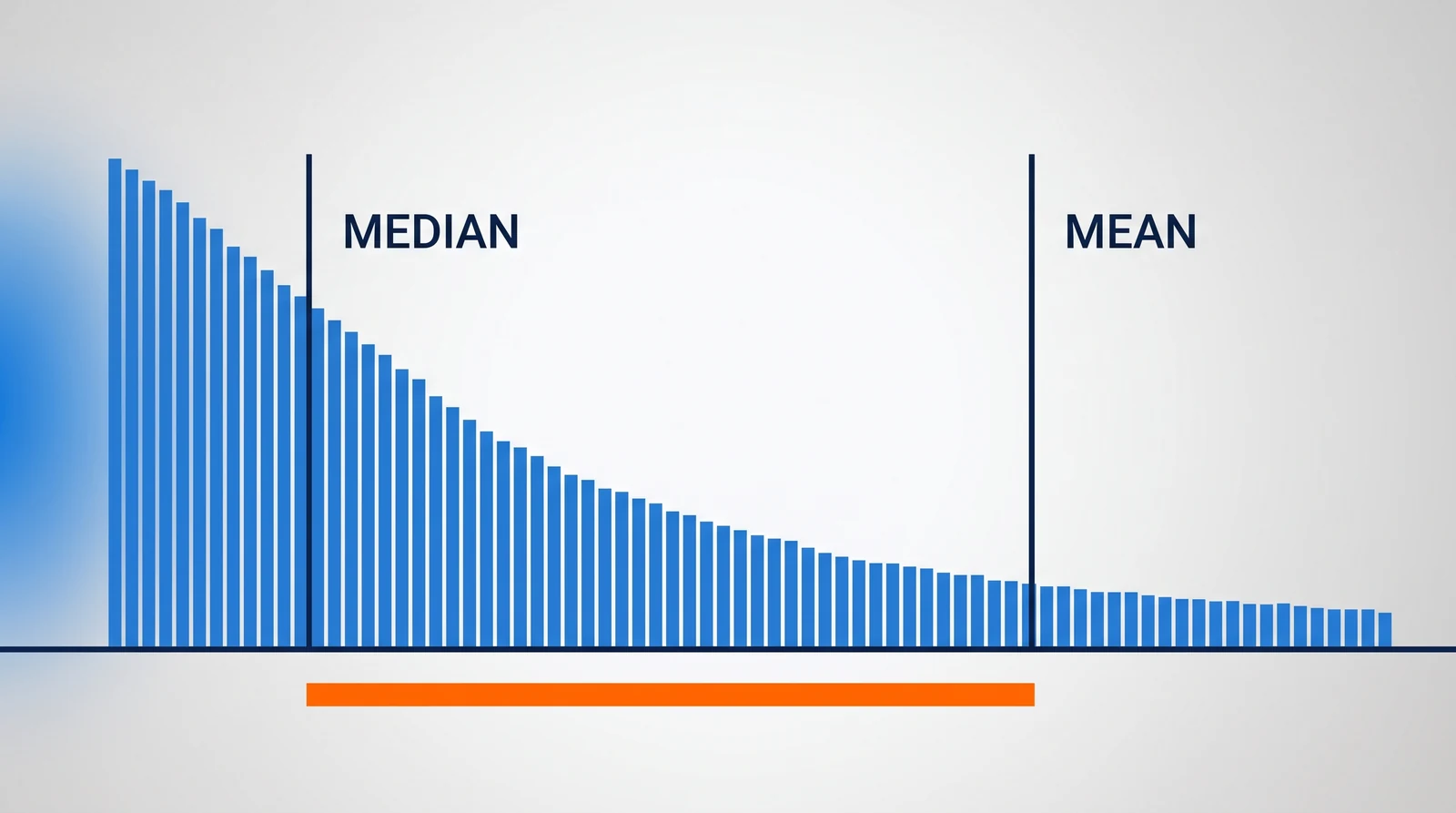
Amsive's thirteen weeks is a median and Ahrefs' 1,064 days is a mean. Those are two different statistics, and the gap between them is the ordinary signature of a long tail. Thirteen weeks is the point where half the pool of AI citations sits on either side; it never claimed to be an average.
Somebody measured that median directly. The University of Toronto preprint Navigating the Shift reports median ages of 62.3 days for Claude 4.5 Sonnet, 79.8 days for GPT-4o, 90.4 days for Perplexity Sonar Pro and 130.4 days for Google on consumer-electronics questions, and 148.0, 162.2, 216.6 and 492.9 days on automotive ones. The answer engines return newer cited material than Google at the median in both categories, and the gap widens in automotive. That is arXiv 2601.16858, by Mahe Chen, Xiaoxuan Wang, Kaiwen Chen and Nick Koudas of the Department of Computer Science, University of Toronto, submitted 23 January 2026 and last revised 16 May 2026, over 100 curated ranking-style queries per category. It is a preprint, not a peer-reviewed journal article, and that is how it should be quoted.
Now set the two beside each other. A median around ninety days and a mean of 1,064 days are not rival estimates of one quantity; they are what a distribution with a long tail produces — a large mass of recent pages, and a minority ageing enough to drag the average up. If one pool of pages has half its members under about ninety days and a mean of 1,064 days, the other half must average roughly two thousand days, or five and a half years. The published mean and the medians are compatible with a population shaped like that. They are not two readings of one pool, and this article does not treat them as one.
The limit belongs here, not at the bottom of the page, because it is large. These are three separate studies, on different platforms, over different periods, with different query sets, and they cannot be combined into one distribution. The medians are computed only over cited URLs whose publication date could be extracted, which runs from 42.6% to 93.0% by engine and category. The study that publishes the mean publishes no median at all: its only distribution language is that most cited URLs are "relatively close in age", with no percentiles and no graph of the spread. Nobody has published a distribution like it. A mean and a median from the same kind of population routinely sit this far apart, and treating either as evidence against the other is a mistake a reader can stop making today.
The biggest dataset measures how old cited pages are
Ahrefs extracted 16.975 million cited URLs through its Brand Radar product and compared their ages against organic results. That is by a wide margin the largest dataset we found on this question, and its own sentence is exact: "the average age of URLs cited by AI assistants is 1064 days, compared to 1432 days for URLs in organic SERPs—25.7% 'fresher'."
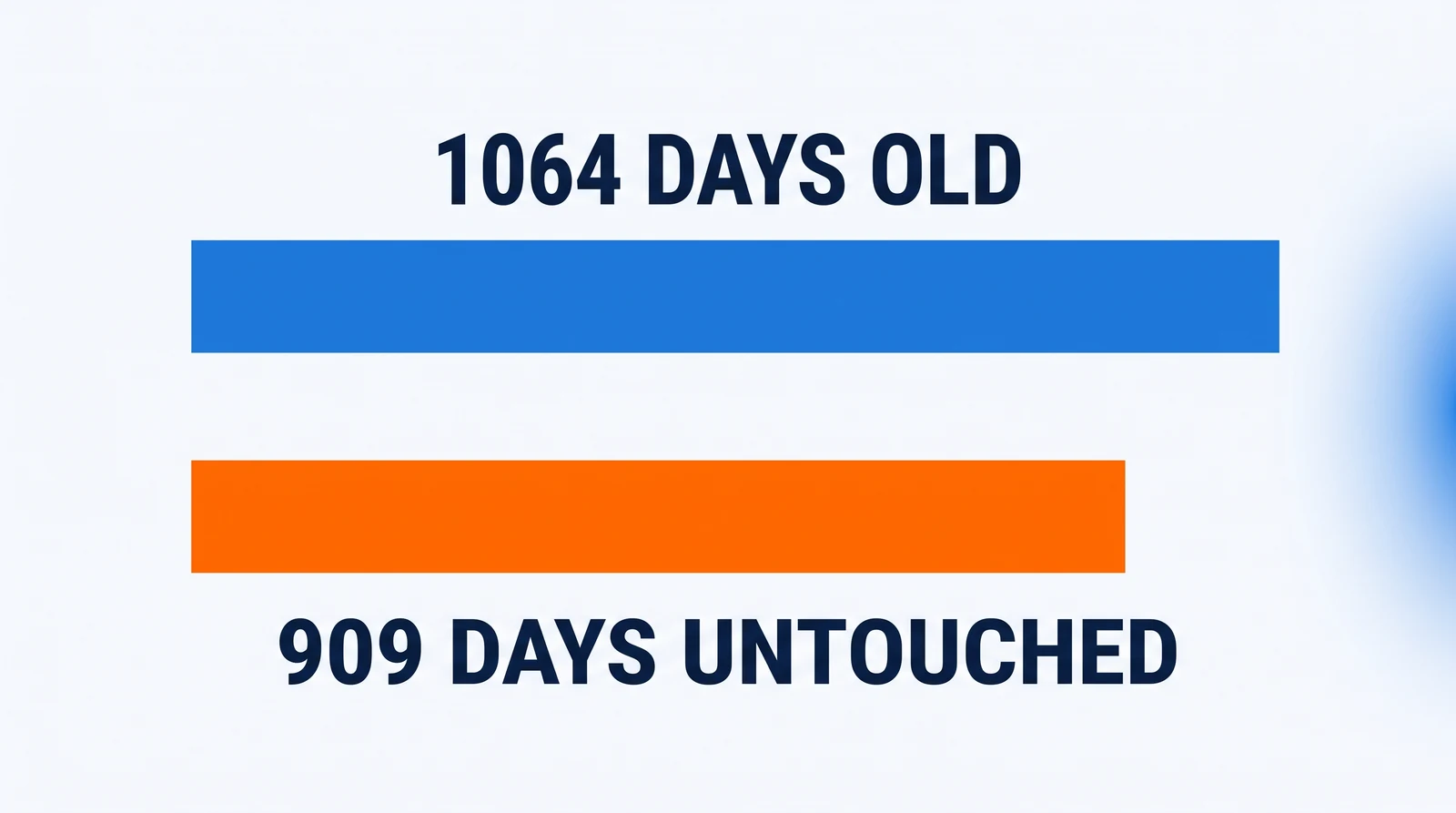
The extraction ran across ChatGPT, Perplexity, Gemini, Copilot, AI Overviews and organic Google results. The 1,064-day average is reported across four of them — ChatGPT, Perplexity, Copilot and Gemini — and works out at 2.9 years. The 1,432-day comparison is carried two ways on that page. Its table gives 1,416 days since publication for the row labelled Organic SERP, and 1,432 for the row labelled Google AIO (top 3); a sentence further down attaches the same 1,432 days to Google's top three AI Overview citations. The 25.7% follows from 1,432; from 1,416 it is 24.9%.
The half of that study nobody quotes is the half about updating. In the same Ahrefs analysis of 16.975 million cited URLs, cited pages average 909 days since their last update against 1,047 days for the organic results — about two and a half years without anyone touching them. None of the nine pages ranking for this question carries that pair, and it is the figure closest to what a content refresh actually changes. Reading any published citation figure starts with the same three questions we set out in what ChatGPT cites — measured where, over what set, on what date.
Ahrefs is more careful than its summarisers. The study says that "the average age of cited ages is still 2.9 years. Like traditional search, AI assistants still prefer citing long-lived content," and it puts the result among many factors instead of above them: content freshness is one influence on visibility in AI search among several, and low-quality, irrelevant content updated every day will not lift visibility in AI search by itself. That is a quality caveat as much as a recency caveat, and neither travels with the number.
Those figures are not new to this site. We first wrote about the study in our audit of an eight-signal AI-citation checklist, where it was one of four signals with a published test behind it and the only one whose test ran the way the checklist claimed. The last-update pair, 909 against 1,047 days, is new here.
Try tracing one of these numbers yourself
Both of the most-quoted freshness figures lose their owner and their sample within two clicks of their source. Follow them yourself.
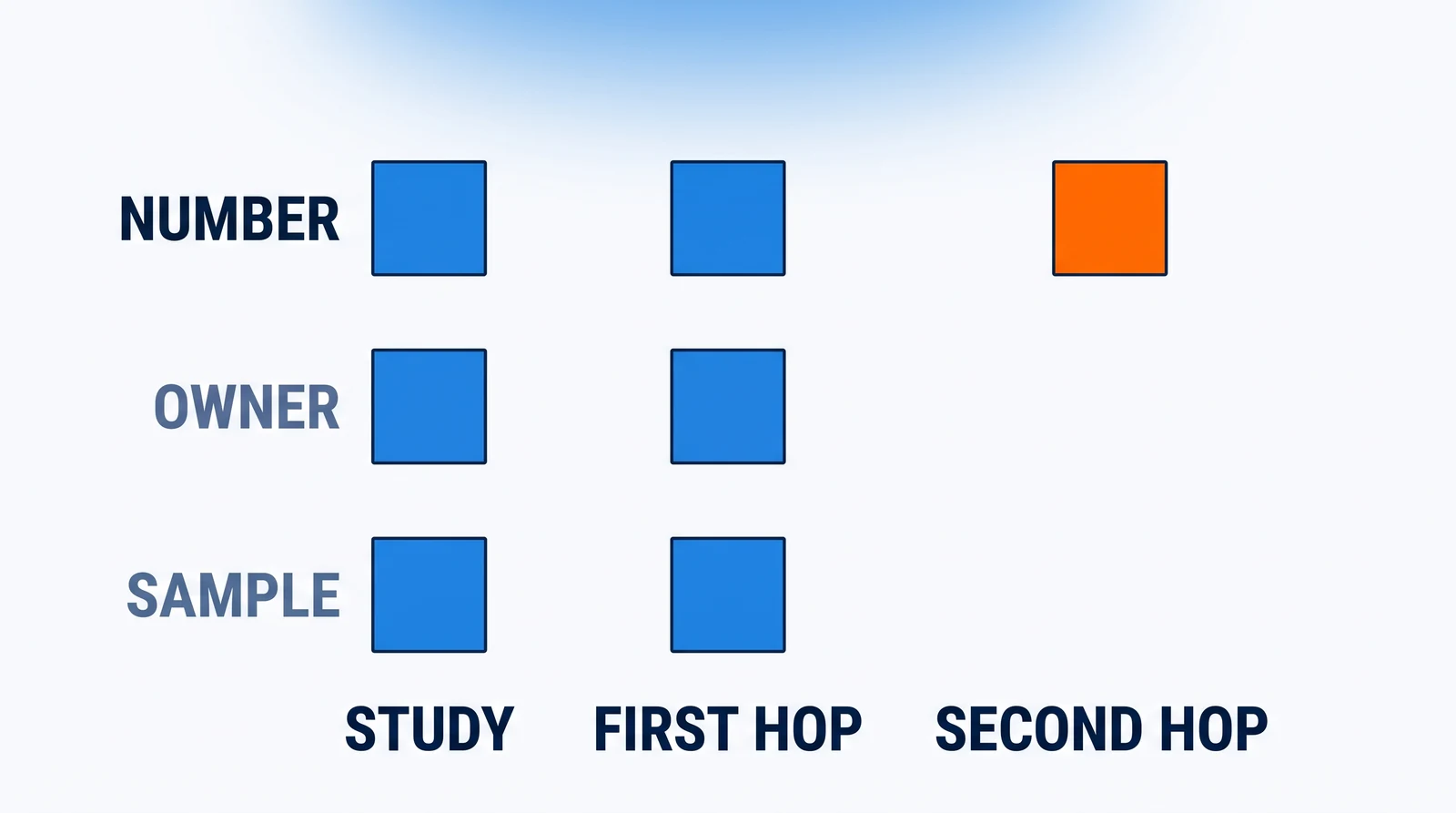
Start with 25.7%. The page ranking third for this question is a LinkedIn post, and it reports that content cited by AI assistants runs 25.7% fresher than what ranks organically on Google, attributing the finding to new research from NoGood. No sample travels with it. Open NoGood's page of 2 September 2026 and the figure is there, credited to Ahrefs by name with the sample printed beside it — a study of 16.975 million cited URLs from Ahrefs' own Brand Radar dataset. The owner and the sample survive the first hop of that chain and disappear on the second. NoGood is the careful party here, not the careless one. It does get something wrong: it dates the Ahrefs study "earlier in 2026", when the study came out on 28 July 2025.
Now try 3.2×. Authority Tech's page, published 27 May 2026 and updated 2 September 2026, reports that content under thirty days old "earns an estimated 3.2x more AI citations than older pages" and links Loamly. Loamly's page of 20 February 2026 states it without the hedge — "content under 30 days old gets 3.2x more AI citations than older content" — and credits the analysis to Kevin Indig, who it says examined 1.2 million AI citations and found content age among the strongest predictors of whether AI platforms cite a source. The URL Loamly links that attribution to, `kevin-indig.com/the-1m-ai-citation-study/`, returned HTTP 404 on two requests we made on 17 September 2026, once through a fetching tool and once directly.
A broken URL is a broken URL and not a charge against anybody. Sites move; links rot. The practical consequence is the point: the sample behind the most-quoted ratio on the first page of results for this question cannot be checked by a reader today.
What the two chains have in common is worth carrying away. The number survives every hop. The owner and the sample do not.
The page that comes closest gets it wrong
Authority Tech's page is the only one of the nine ranking pages that sets two freshness statistics side by side. That deserves saying before the correction, because everyone else reports a single study or none. Its opening paragraph runs both through a single sentence: "Roughly half of all AI-cited content is less than 13 weeks old, and content under 30 days old earns an estimated 3.2x more AI citations than older pages." That sentence carries a share of a citation pool and a ratio of citation counts, which are two different kinds of quantity from two different sources, and it carries no sample for either.
Two sentences later it adds a third. Gander measured content age against visibility in AI search over 23,973 fan-out queries and 194,077 unique URLs, on ChatGPT, Google AI Overviews, Gemini and Perplexity in the first quarter of 2026. Of those URLs, 17.4% carried a year in the URL path, which is the study's stated freshness proxy, and the age figures are computed among those dated URLs. Its own sentences are "Content has a 1-year half-life in AI search" and "Each year of age reduces a page's visibility by roughly 40-60%." Authority Tech renders that as a page losing "roughly 50% of its AI citation potential within 12 months of publication, all else being equal", then writes: "But the steepest drop-off happens much earlier. Content published within the last 13 weeks accounts for approximately half of all AI-cited sources." The word "but" is doing work it cannot do. A decay rate for a given page over time and the age composition of a whole citation pool are different curves, and neither sharpens the other. Gander's page of 7 April 2026 is more disciplined than the summary of it: it names that sample where Authority Tech does not.
The one study that ran a model on its own data
SE Ranking brought original data to this question and no other page ranking for it did: 2,328,533 pages from 295,485 unique domains across twenty niches, with citation counts calculated over more than 500,000 prompts, fitted with an XGBoost regression model and read through SHAP analysis, which ranks how much each factor contributes. Its freshness result, published on 15 December 2025, is that "pages updated within the last two months average 5.0 citations, compared to 3.9 for those untouched for over two years." The study's own disclaimer belongs beside that pair: citation counts run from one into the thousands, so it applies a logarithmic transformation, and the values it quotes are transformed instead of raw. 5.0 against 3.9 is not two raw averages.
That is the closest thing in print to the test a practitioner wants, and it is still not that test. A regression across 2,328,533 pages that already exist in whatever state their owners left them is an observation, not an experiment. Nobody refreshed a page and watched what happened next. Pages touched in the past two months differ from pages untouched for two years in every way a page can differ — what they are about, who maintains them, how much traffic justifies the maintenance — and a model fitted to observational data cannot hold those still. The study also covers Google's AI Mode alone, which is a single surface among the several the other figures here describe. It is separate research from the AI Mode citation studies we have looked at elsewhere.
Where the thirteen-week figure actually comes from
Amsive's thirteen-week figure reaches the web through conference talks instead of a published dataset, as far as we can establish. Salespeak's page of 9 March 2026, sixth in the ranking, puts "50% of the content cited in AI search responses" under thirteen weeks old and credits Lily Ray and the team at Amsive, who it says analysed which URLs actually get surfaced in answers generated by an LLM. It prints no sample, no query count and no method. NoGood describes the same work as research on AI citation age presented across multiple 2026 industry talks. We looked for a standalone Amsive report carrying the figure and did not find one.
That is a limit on the figure, not a charge against its author. A finding presented at a conference can be perfectly sound. It simply cannot be checked by a reader, which matters when it is the number being used to justify a budget.
The page carrying it also contradicts itself two paragraphs down: "half of all AI citations come from content less than 11 months old. The other half? Even fresher, dominated by content published in the last three months." If half the pool is under eleven months, the other half is older, not fresher — and eleven months is not thirteen weeks. This is what happens to a figure with no published method behind it. There is nothing to check the retelling against.
One name needs separating while we are here. Amsive is also cited in this field for a click-through-rate figure, which is a different measurement from the content-age one above. Same firm, two objects, and they are not interchangeable.
So should you refresh the page?
Refreshing a page has not been shown to get it cited by an AI assistant. The study that would settle the question has not been published, which means nobody quoting these statistics at you can show it either. What the evidence does support is worth stating exactly.
Across the datasets above, the pages AI assistants cite are more current than the pages Google ranks organically for the same queries: at the mean, at the median, and across four assistants. Those cited pages are still ageing. Across Ahrefs' 16.975 million cited URLs, cited pages average 1,064 days since publication and about 909 days since their last content refresh. Newer than the organic results, in other words, and nowhere near new.
The test that would settle it is not exotic. Take a set of comparable pages, refresh half of them substantively, leave the rest alone, and count citations on both groups before and after. Anyone with a large content estate could run it in a quarter. Until somebody does, every recommendation about refresh cadence — including the ones handing you a number of weeks — is a reading of correlational data with the causal claim added by whoever retold it.
A smaller version costs nothing and you can run it this week. Put your ten most valuable queries to an assistant with search switched on, then read the publication and update dates on every source it returns. Do the same for your own pages on those subjects. You will not get a causal answer, but you will find out whether the pages winning your queries are three weeks old or three years old, which is more than any figure above can tell you about your own market.
Whether a content refresh matters enough to be worth your quarter depends on your pages, your market and what the work would displace, and we know none of those. What changes once you know which signals are untested is not whether you update your content, but how much certainty you are buying when you do. If a page is genuinely outdated, refreshing it matters for the reader who lands on it, and that argument needs no citation study at all.
Our interest in all of this is worth stating plainly. LiamVi sells AI-citation measurement, so a reader who starts interrogating published statistics is a reader who is good for us — which is a reason to hold this article to the same standard, and to apply every question above to anything we publish.
What people actually ask us
Four questions arrive with content freshness and AI citations often enough to answer here.
Is SEO still relevant with AI? On this evidence, yes — and freshness is a good illustration of why the two jobs are not the same. SEO freshness is about signalling recency to a ranking system: dates in structured markup, a visible updated timestamp, internal links from pages a crawler visits often, a sitemap that reports the change. The studies above measure something else entirely, which is the age of the pages an AI assistant actually cited. The two overlap without being the same object: a page can carry every freshness signal in the SEO playbook and still sit among the 1,064-day-old URLs in the Ahrefs dataset. Where classical SEO and AI citation genuinely diverge is worked through in what carried over from search engine optimization.
How accurate are AI citations? Accurate about what they are is the first question to ask. Every figure in this article counts something slightly different — a mean publication age, a median by assistant, a share of a pool, a ratio of citation counts, a decay rate — and none of them measures whether the assistant quoted the page correctly. There is a further wrinkle on the measurement side. Put one question to one assistant on two occasions and the sources attached to the answer can differ, which is why two honest tools sampling the same surface publish different numbers — the reason is worked through in what a citation dashboard actually counts. Prevalence figures move for a related reason, and what percentage of searches have AI Overviews takes that apart separately.
How often should I update a page? Nobody has published a cadence we would repeat, and the ones in circulation — every three months, every six — are not derived from any dataset above. The honest version: update a page when it is wrong, when the thing it describes has moved, or when you would be embarrassed to have a reader land on it. Evergreen material can sit for a year and stay accurate; a pricing table cannot sit for a month. If a content update also earns an AI citation, that is a bonus nobody has yet demonstrated you can plan for. How the page was produced in the first place is a separate argument, and we made ours in AI-generated content and SEO.
I meant citing ChatGPT in an essay. Different subject, and we have written it up separately in how to get citations from ChatGPT, which covers citing ChatGPT itself in APA, MLA or Chicago style.
Sources
- Ahrefs, "Do AI assistants prefer to cite fresh content?", 28 July 2025 — https://ahrefs.com/blog/do-ai-assistants-prefer-to-cite-fresh-content (checked 17 September 2026)
- Mahe Chen, Xiaoxuan Wang, Kaiwen Chen and Nick Koudas, University of Toronto, "Navigating the Shift: A Comparative Analysis of Web Search and Generative AI Response Generation", arXiv 2601.16858, submitted 23 January 2026, revised 16 May 2026 — a preprint, not a peer-reviewed journal article — https://arxiv.org/abs/2601.16858 (checked 17 September 2026)
- Hanpei Fang, Sijie Tao, Nuo Chen, Kai-Xin Chang and Tetsuya Sakai, "Do Large Language Models Favor Recent Content? A Study on Recency Bias in LLM-Based Reranking", arXiv 2509.11353, submitted 14 September 2025 — https://arxiv.org/abs/2509.11353 (checked 18 September 2026)
- SE Ranking, "How to optimize for AI Mode", 15 December 2025 — https://seranking.com/blog/how-to-optimize-for-ai-mode/ (checked 17 September 2026)
- NoGood, "The Impact of Content Freshness on AI Citations", 2 September 2026 — https://nogood.io/blog/content-freshness-ai-citations/ (checked 17 September 2026)
- Authority Tech, "Content Freshness in 2026", published 27 May 2026, updated 2 September 2026 — https://authoritytech.io/blog/content-freshness-seo-ai-2026 (checked 17 September 2026)
- Loamly, "The Content Freshness Tax", 20 February 2026 — https://loamly.ai/blog/content-freshness-tax-why-old-content-invisible-to-ai (checked 17 September 2026)
- Kevin Indig, "The 1M AI citation study" — the URL Loamly cites for the 3.2× figure — https://www.kevin-indig.com/the-1m-ai-citation-study/ — returned HTTP 404 on two attempts, 17 September 2026
- Gander, "The 1-Year Half-Life", 7 April 2026 — https://takeagander.ai/resources/gander-blog/how-content-freshness-drives-visibility-in-ai-search (checked 17 September 2026)
- Salespeak, "Content Freshness and AI Search", 9 March 2026 — https://salespeak.ai/aeo-news/content-freshness-ai-search/ (checked 17 September 2026)
- Mark Shropshire, LinkedIn post on content freshness and AI citations — no sample stated in the post — https://www.linkedin.com/posts/markshropshire_the-impact-of-content-freshness-on-ai-citations-activity-7501665232738500609-4OOR (checked 17 September 2026)
- SEOptimer, "Content freshness", 31 July 2026 — https://www.seoptimer.com/blog/content-freshness/ (checked 17 September 2026)
- Writesonic, "How content freshness affects AI citations", 21 May 2026 — https://writesonic.com/blog/how-content-freshness-affects-ai-citations (checked 17 September 2026)
- The HOTH, "Content freshness", 29 January 2026 — https://www.thehoth.com/blog/content-freshness-seo/ (checked 17 September 2026)
- LSEO, "The impact of content freshness on AI citation stability" — no date on the page; its case examples carry no sample — https://lseo.com/join-lseo/the-impact-of-content-freshness-on-ai-citation-stability/ (checked 17 September 2026)
- Wryve AI, "How content freshness affects AI citations in 2026", 14 June 2026 — https://wryveai.com/how-content-freshness-affects-ai-citations-in-2026/ (checked 17 September 2026)
- LiamVi research — our methods, samples and limits — https://liamvi.com/research/ (checked 17 September 2026)