Do tables help AI citations: the figure you keep meeting traces to a page without it
The figure we met most often on this question is 2.5x. Content with tables, the claim goes, is cited by AI assistants two and a half times more than content without them. On 23 September 2026 we followed every link on that figure's trail, and the trail ends at a statistics page that does not contain it. The subject here is tables on your own web pages, and whether AI systems such as ChatGPT and Perplexity quote those pages as sources in their answers. How to cite an AI tool in an essay or a paper is a separate matter, and nothing below addresses it.
The list the figure most likely came from carried it in a version dated two weeks before Onely's post, so the figure probably did not start with Onely. What is missing is anything behind the line itself: a study, a sample, a comparison. A missing source is not evidence that the format fails to help, and it is not an accusation. Statistics roundups get rebuilt, as this one was, and a source label can link to the wrong address.
Other figures on the subject do have an owner you can open, and each one measures something narrower than the claim it usually travels with. We have measured nothing about this format ourselves, and no figure here is ours; each belongs to the publication named beside it.
Where does the 2.5x figure come from?
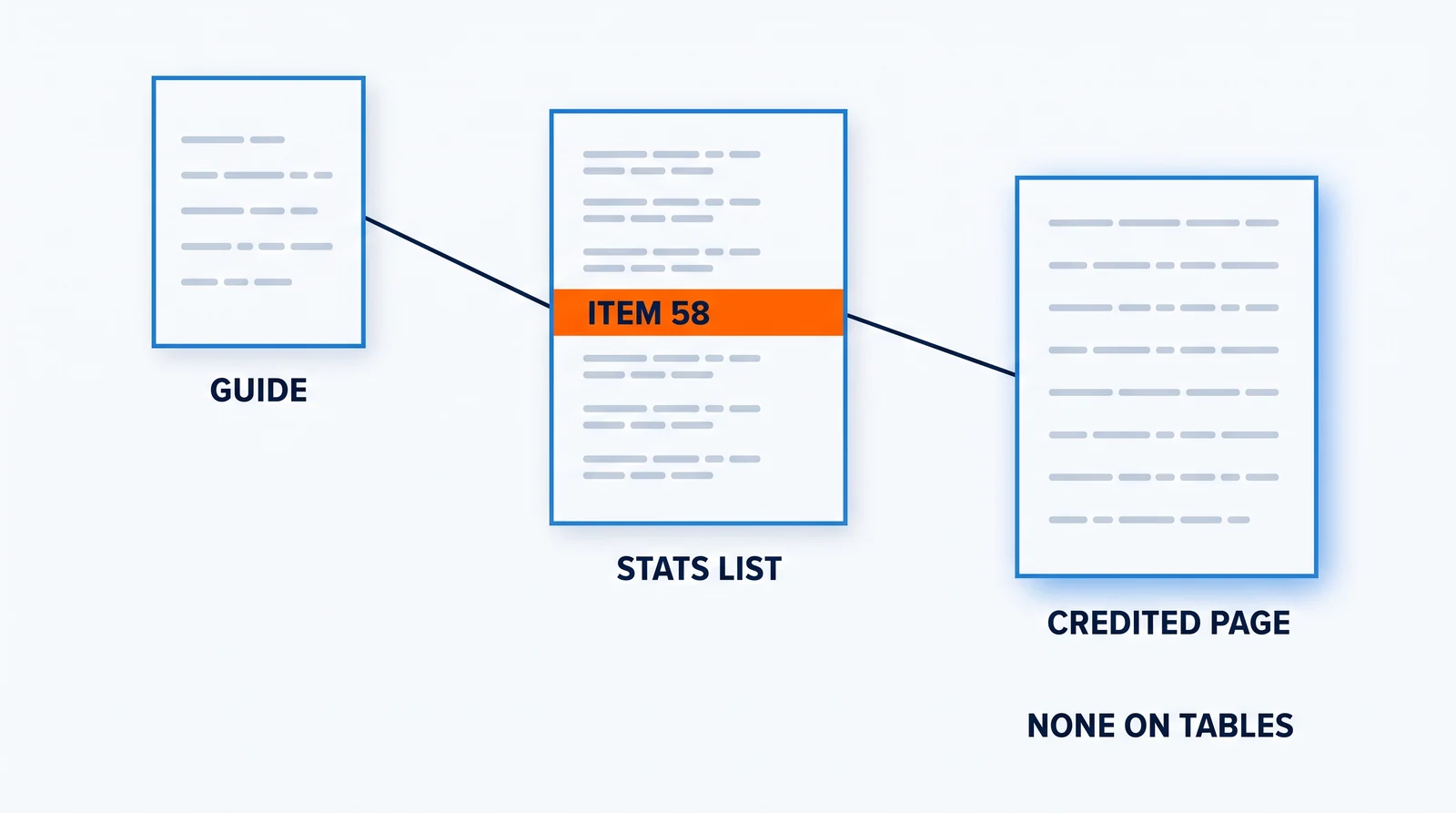
The earliest source we found for the 2.5x is a line in a statistics list, and the source that line names holds no statistic about tables. The trail runs through Onely, nobori and Ahrefs.
Onely's guide to LLM-friendly content was written by Bartosz Góralewicz for the SEO agency and published on 2 December 2025. The guide's first tip reads: "Content with tables and structured data gets cited 2.5x more often than unstructured content." Onely's sentence carries no link. The guide's own FAQ shortens it to "Content with tables gets cited 2.5x more often." The Onely guide gives no source for the 2.5x anywhere in its text.
The only link in that part of the guide sits on the sentence before, on the words "50% of top AI citations". The link leads to a list of AI search visibility statistics published by nobori.ai, a company that sells AI visibility tracking.
The nobori list of 2025 survives in the Internet Archive's capture of 10 December 2025. The list was dated 18 November 2025 and ran to 90 data points. The introduction promised that "Each statistic includes source and methodology." Item 58 reads "Content with tables & structured data gets cited 2.5x more often". Item 58's credit is "Data structure impact, 2025": a label naming no study, no author and no sample, set as a link to one address.
The label links to Ahrefs' collection of AI SEO statistics, written by Despina Gavoyannis for the SEO software company and updated on 10 November 2025. We read the Ahrefs collection in three versions. The capture of 17 December 2025 shows the version updated on 10 November 2025, which was current when the nobori list was dated. An earlier capture, from 10 September 2025, carries 81 statistics. The December version and the live version, read on 23 September 2026, each list 90 statistics, with a source link beside every one. None of the 90 is about tables, and the word does not appear in the text. Ahrefs makes no claim about the figure; its collection is simply where the label points.
The 2.5x trail therefore ends where a measurement ought to be, and there is nothing there to read. Checking the figure would take the pages compared, the engines asked and the dates of the test, and none of the sites on the trail gives any of them.
Was the figure ever on the page Onely linked?
The list Onely linked did carry the 2.5x: its version dated 18 November 2025, two weeks before Onely's post, shows it as item 58 in the archive capture taken eight days after the post. Item 58 was still there in the capture of 10 April 2026, when the list carried a date of 13 March 2026. The same address now serves a different list. Read on 23 September 2026, nobori's current version is a 2026 collection of 98 data points dated 15 April 2026, with no 2.5x and no statistic about tables.
Replacing last year's roundup with this year's is ordinary, and nothing here faults anyone for it. Onely's sentence matches item 58 almost word for word, so the nobori list is the likely origin of the wording. A reader who clicks Onely's link today, though, lands on a list that never mentions the figure. The only way back to item 58 is an archive copy, and item 58 leads on to Ahrefs' collection, which is silent on the subject.
The 2.5x may come from analysis that was never published, or the label may have been meant to link somewhere else. We cannot tell which from what is published, and we have not asked either company.
How the claim changed as it was repeated
The 2.5x claim grew more specific the further it travelled from nobori's original line, with nothing new arriving to support it.
The nobori line covered "tables & structured data", and Onely's sentence set "tables and structured data" against "unstructured content". Arun Nagarathanam's guide on aruntastic, published on 19 December 2025 and updated on 3 February 2026, repeats the figure in its summary, a heading, its body, a grid and its FAQ. One version reads "Content with tables receives 2.5x higher citation rates than unstructured comparison text." No source sits beside the figure on aruntastic; the guide links AirOps and Onely, but for other statistics. Structured data has dropped out, and comparison has come in.
Zach Chmael's guide for Averi was published on 10 February 2026, and it goes further: "Semantic HTML tables increase AI citation rates by approximately 2.5x compared to the same information in paragraph form, according to research compiled by Onely." Averi's version describes a like-for-like test of one set of facts in both formats, and no source earlier in the chain describes such a test.
The original nobori line also joined two different things. A table is structure a reader can see, while structured data usually means schema markup, labels in the code that a reader never sees, and what the evidence shows about markup is a separate question.
We think the pattern is worth recognising: a figure that grows more precise each time it is repeated, with nothing new behind it, reads as stronger evidence the more often you meet it.
Which table figures can you trace to an owner?
Four published figures on formatting for AI answers have an owner you can open, and each one measures something narrower than the general claim it is quoted for. We found three of them listed together, without links, in subscribepr's formatting guide, dated 11 July 2026, and opened every primary source ourselves.
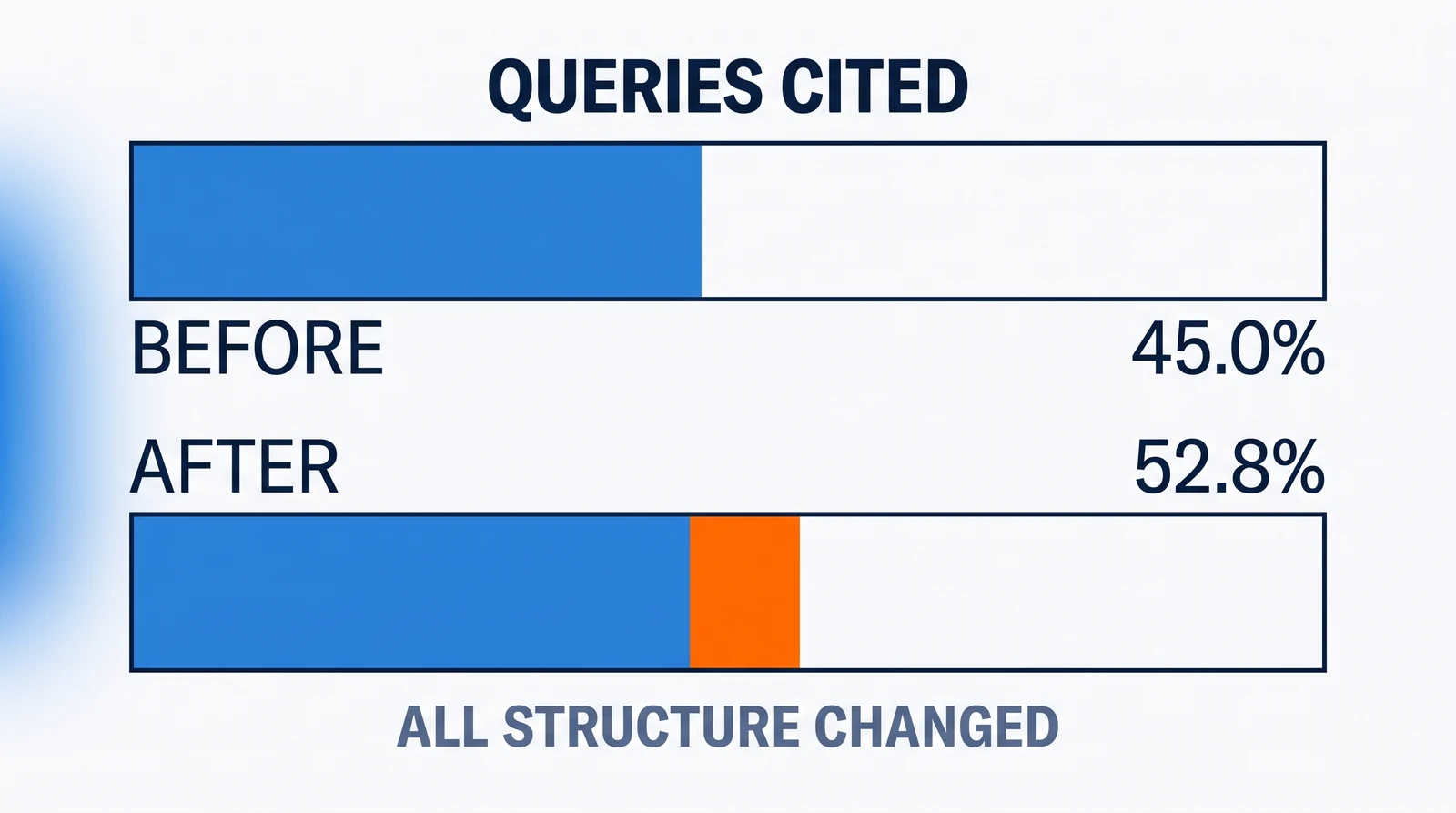
- The Tokyo and Tsukuba preprint. The preprint was submitted to arXiv on 31 March 2026 by Junwei Yu, Mufeng Yang, Yepeng Ding and Hiroyuki Sato. The paper lists the authors' affiliations as the University of Tokyo, the University of Tsukuba, Hiroshima University and the National Institute of Informatics. GEO-SFE, their framework, applies generative engine optimization (GEO) to structure. The test restructured 200 benchmark articles and ran them against 377 queries on six engines — Google SGE, Bing Chat, Perplexity AI, Phind, ChatGPT and Claude — for 2,400 test cases. The paper does not say when or how the engines were queried, and it names Bing Chat, which Microsoft renamed Copilot in November 2023, over two years before the paper was submitted. The restructured versions were cited on 52.8% of queries across the six engines, against 45.0% before. The rise is 17.3% in relative terms, or 7.8 percentage points. Headings, chunking and emphasis changed together, and tables are one element of the middle level, which produced 39.7% of the gain in the authors' own breakdown. The 17.3% measures structure as a whole.
- AirOps' report on commercial content in AI search. Oshen Davidson's study for AirOps, published on 1 April 2026, covers 217,508 pages that ChatGPT retrieved for 7,500 commercial prompts, comparing the pages it cited with the ones it passed over. In that sample, comparison pages carrying three tables were cited 25.7% more often for prompts comparing named products. The report words the same result as "a 25.7% higher citation likelihood". The result covers ChatGPT only, commercial prompts only and pages already retrieved. AirOps' figure is an association across observed pages, not a test on any one page.
- Presenc AI's note on structured content. Presenc AI's research note is by its CTO, Ramanath, was last updated in May 2026, and tracks ChatGPT, Gemini, Claude and Perplexity. The note reports "an estimated 70 percent more citations on comparison and data queries than prose-only pages covering the same information, based on Presenc AI tracking across 2,100 brand-query pairs". Presenc sells AI visibility tracking, and its method is a single paragraph that says of its own numbers: "Lift estimates are directional." Presenc's candour is useful; the note does not say how pages carrying the same information were matched.
- The Digital Bloom's 2025 report. Vlad Kuriatnyk's 2025 report for The Digital Bloom was published on 14 December 2025. The report states "47% higher AI citation rates for comparison tables using proper `<thead>` and descriptive columns." The Digital Bloom's line carries no sample, no control group and no named study. It can be traced to its publisher but not checked as a measurement.
The AirOps, Presenc and Digital Bloom figures all concern pages or queries built for comparison, and the preprint restructures whole articles. None isolates a table on an ordinary explanatory page, and none of them is the 2.5x. All four owned figures report a rise, none a fall, which is a fact about these figures and not a finding about your pages. The subscribepr guide deserves credit for naming the studies behind its figures, which no page on the 2.5x trail did. The retelling still adds baselines the primaries do not state: "equivalent pages without them" for AirOps, and "unstructured versions of the same content" for The Digital Bloom.
Why would a table matter to an AI assistant at all?
The case for the format rests on one reason: a grid labels every value with its row and its column, so an AI system can extract a single value without rebuilding the sentence around it. Onely's guide puts the case in five words: "Tables provide explicit data relationships." On the practitioner pages we read, that reason is argued rather than measured. The preprint comes closest: its authors write that "Structured formats (lists, tables) demonstrate 43% higher extraction accuracy than equivalent prose in our experiments". The line measures extraction, not citation, and lists and tables as one group, with no sample stated beside it. We think the reason is plausible — a language model reading a row has less to parse than one reading a paragraph that carries the same facts — but no one we read has measured it against what assistants cite.
Our own evidence touches this subject in one place. The one selection we have seen directly happens at the level of a passage — a single article in our harvest was quoted in four places, each a different passage, the evidence behind the chunk-level row of our eight-signal audit. We have not tested whether a self-contained row is picked ahead of a self-contained sentence.
For AI Overviews and AI Mode, Google says "There's no requirement to break your content into tiny pieces for AI to better understand it" in its guide to generative AI features in Search, a line we have read against the tactics we tested. The guide covers Google Search only, not how other AI systems such as ChatGPT or Perplexity choose what to quote.
When does a table serve the reader?
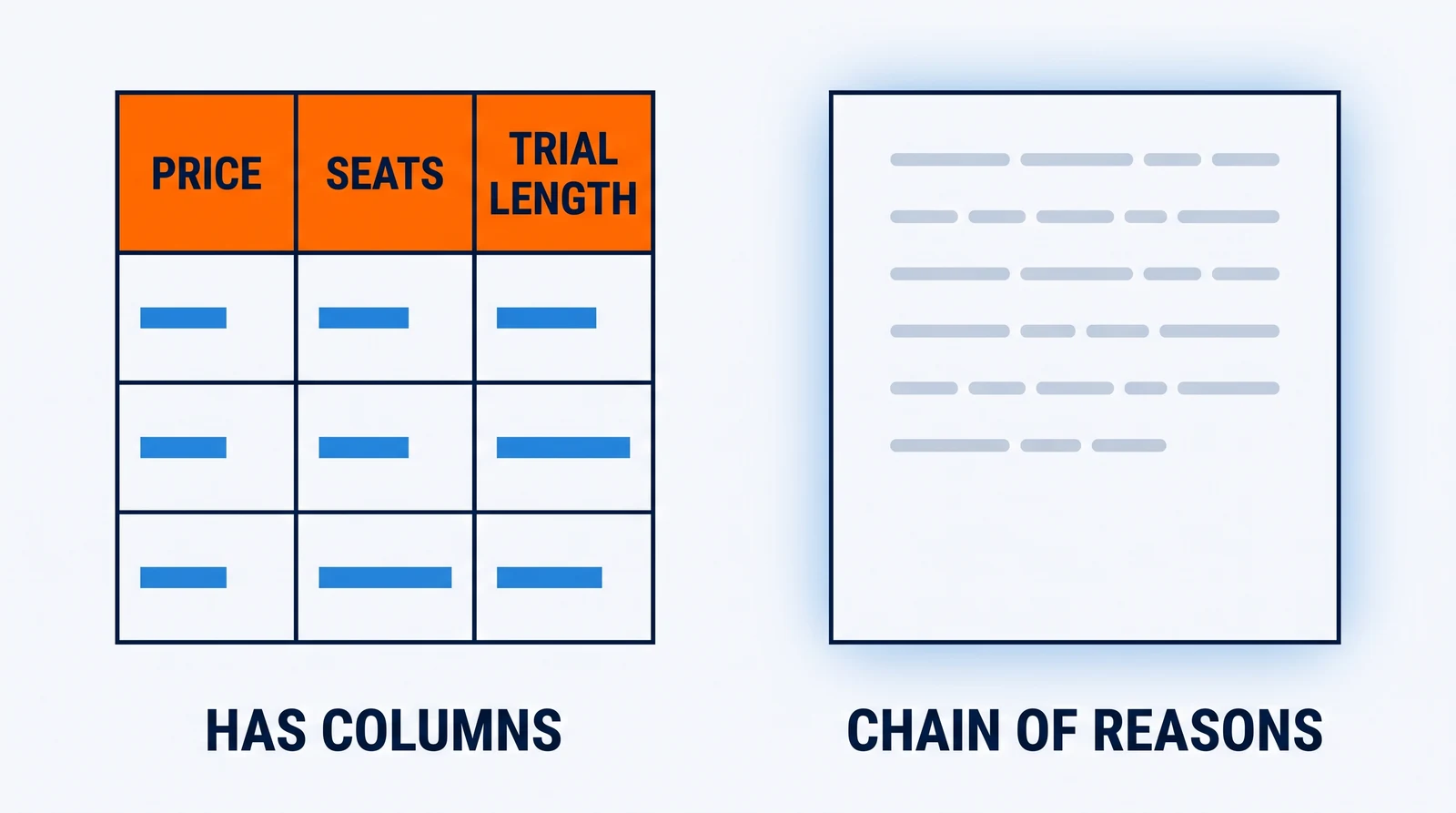
A table serves the reader when the material already has rows and columns: prices by plan, specifications by model, the same few questions put to several options. Our rough test: if the same attributes repeat across several items — price, seats, trial length — the material has columns; if each sentence depends on the one before it, it does not. Material of that kind is also what the AirOps, Presenc and Digital Bloom figures describe. When the material is an argument, a chain of reasons or an explanation, a grid cuts it into cells the reader has to put back together. Nothing in the evidence above shows an assistant prefers that.
Before you use a multiplier to plan a rebuild, open its source and look for what was compared, on which engines, and across how many pages or queries — our checklist, not an industry standard. The 2.5x cannot pass that test today. The figures that come closest are narrower than the claims usually made with them: one engine and commercial prompts, a company's own tracking, a benchmark.
Whether your material has the shape of a grid is something you can see on your own pages, and a statistic cannot see it for you. The judgement is yours.
We sell software that tracks AI citations, so a reader who checks sources before acting suits us. Hold this piece to the same standard, and open every link in it.
Related questions
Google's People Also Ask box for this search, in a single capture for the United States on 23 September 2026, supplied the first of these questions; the rest of that box concerned citing AI in academic writing. The other two questions are ours.
How to improve AI citations?
Only one of the formatting figures we found describes changing pages and measuring the result, and it covers pages already in contention. The preprint's restructured benchmark articles were cited on more queries, but the authors changed headings, chunking and emphasis at once, so the paper cannot say what a grid alone adds. AirOps studied pages ChatGPT had already retrieved, an association and not a test. Whether an AI system goes looking for sources on your question at all comes before any of that, and no formatting choice answers it.
Is it worth turning paragraphs into tables?
Turning paragraphs into tables makes sense only where a paragraph was already a grid written out as sentences, such as three plans and their prices. The published evidence concerns comparison pages and whole-article structure. None of it tested what happens when you convert explanatory prose wholesale, and none of it measured what a reader loses when you do.
Where does the 2.5x statistic come from?
The 2.5x statistic traces back, as far as any link on its trail goes, to item 58 of an AI search visibility statistics list that nobori.ai dated 18 November 2025 and has since replaced. Onely's post of 2 December 2025 echoes that item almost word for word. The nobori list credited it to a label linking Ahrefs' collection of AI SEO statistics. Ahrefs' collection, in every version we could read, contains no statistic on the subject.
Sources
- Onely — LLM-Friendly Content: 12 Tips to Get Cited in AI Answers — Bartosz Góralewicz; the 2.5x sentence, the FAQ line and the neighbouring link to nobori.ai. Published 2 December 2025; checked 23 September 2026, and against the Internet Archive's capture of 3 December 2025.
- nobori.ai — AI Search Visibility Statistics — the 2026 version, dated 15 April 2026, checked 23 September 2026; the 2025 version with item 58 read on the Internet Archive's captures of 10 December 2025 and 10 April 2026.
- Ahrefs — 90+ AI SEO Statistics for 2025 (Fresh and Original Data) — Despina Gavoyannis; updated 10 November 2025; checked 23 September 2026, and on the Internet Archive's captures of 17 December 2025 and 10 September 2025.
- aruntastic — Lists, Tables, and Structured Data: What AI Prefers — Arun Nagarathanam. Published 19 December 2025, updated 3 February 2026; checked 23 September 2026.
- Averi — LLM‑Optimized Content Structures: Tables, FAQs & Snippets — Zach Chmael. Published 10 February 2026; checked 23 September 2026.
- subscribepr — How to format tables so AI engines cite them (2026) — dated 11 July 2026; checked 23 September 2026.
- Yu, Yang, Ding and Sato — Structural Feature Engineering for Generative Engine Optimization: How Content Structure Shapes Citation Behavior — arXiv preprint 2603.29979; the extraction-accuracy line quoted from its HTML version. Submitted 31 March 2026; checked 23 September 2026.
- AirOps — From Retrieved to Cited: How Commercial Content Earns Citations in AI Search — Oshen Davidson. Published 1 April 2026; checked 23 September 2026.
- Presenc AI — Does Table and Structured Content Improve AI Citations? — Ramanath. Last updated May 2026; checked 23 September 2026.
- The Digital Bloom — 2025 AI Citation & LLM Visibility Report — Vlad Kuriatnyk. Published 14 December 2025; checked 23 September 2026.
- Google Search Central — Optimizing your website for generative AI features on Google Search — the "chunking" line and its scope (AI Overviews and AI Mode). Last updated 10 July 2026; checked 23 September 2026.
- Microsoft — Microsoft Ignite 2023: AI transformation and the technology driving change — Frank X. Shaw; the line renaming Bing Chat as Copilot. Published 15 November 2023; checked 24 September 2026.
- LiamVi — Research: our methods, samples and limits — the passage evidence and its sample; it carries no measurement of tables. Last updated 12 August 2026; checked 23 September 2026.