Do FAQ sections help AI citations: most numbers you meet measure the markup, not the section
An FAQ section does two jobs at once. It answers a handful of questions, and it sets them out in a fixed format. We have measured only the first of those jobs, and the result was null. Across our 33-keyword harvest (276 ranking pages and 73 that ChatGPT cited for the same queries, in three related industries, mostly on ChatGPT), the cited pages answered 58.8% of the questions in Google's People Also Ask box and the ignored ones 58.2%. That was a test of whether a page answered those questions anywhere on it, not of whether it had an FAQ section. The method and the sample are on our research page, and we first published the result on 10 August, in our guide to AI visibility tools; it is small and early, and it is not new here.
The format is the half still open. The two published measurements of the section itself that we found are both SE Ranking's, one for ChatGPT and one for Google's AI Mode, and their raw averages point in opposite directions. Most of the numbers the ranking pages repeat measure something else: code added for machines to read, rather than the text a reader sees. A figure about code and a figure about visible text are different claims, and the difference decides what any number on this subject can tell you.
Our null is the measurement this article is built on, and it is small; every figure that is not ours is named with whoever published it. We read the eight pages Google showed for this search from the United States on 24 September 2026. Six opened for us, and the other two are quoted nowhere. We also read the studies behind the figures those six repeat, and a second SE Ranking study that none of them cites, all on the same day.
Does answering the questions people search for get a page cited?
In our 33-keyword harvest, the cited pages and the ignored ones answered almost the same share of the People Also Ask questions, on ChatGPT for the most part. For each keyword we recorded what ChatGPT cited and what ranked on Google for the same query and was passed over, then compared how many of the box's questions each group answered. Holding the keyword constant is what makes that comparison worth running, and it returned 58.8% against 58.2%.
Our research write-up prints the two rates but not the number of questions behind them, and it should; until it does, the percentages carry the harvest's sample but not their own denominator. The same test counted answers wherever they sat — in a paragraph, a list or a block of questions — so it cannot say if moving the same answers into a Q&A block changes anything. Answering the questions and using the format are separate tests, and we have run only the first. Question coverage is a property of the whole page, while the one selection we could observe directly was made at the level of a single passage — which, we think, is one reason a count at that level did not separate the two groups.
We had expected answering these questions to earn AI citations, and it did not; we stopped claiming that it does, and our research page records the change beside the result.
Our harvest is 33 keywords in three related industries, mostly ChatGPT, one harvest at one moment; other assistants behave differently, and one of them may reward what this one did not. We keep measuring, the set grows every week, and when the result moves we will publish the change.
A check comes before this one: do the questions in a People Also Ask box belong to the reader of your keyword at all? That is a separate test we have written up, and it is worth running before you write answers to any of them.
Has anyone measured the FAQ section itself?
SE Ranking has measured the visible FAQ section twice, in the only two published studies of it we found: once for ChatGPT, with a result that points two ways, and once for Google's AI Mode. Pages from 129,000 domains, 216,524 of them across 20 niches, with citation counts taken from a parsed set of 100,000 ChatGPT prompts, make up SE Ranking's ChatGPT study, published on 24 November 2025, written by Yulia Deda, reviewed by Svitlana Tomko and analysed with an XGBoost regression read through SHAP values. To find the format, the study "analyzed the text for patterns that indicate these sections", flagging headings such as "FAQ," "Frequently Asked Questions," "Q&A," "Questions and Answers," "Common Questions," and "Popular Questions." That is the text a reader sees, not the code.
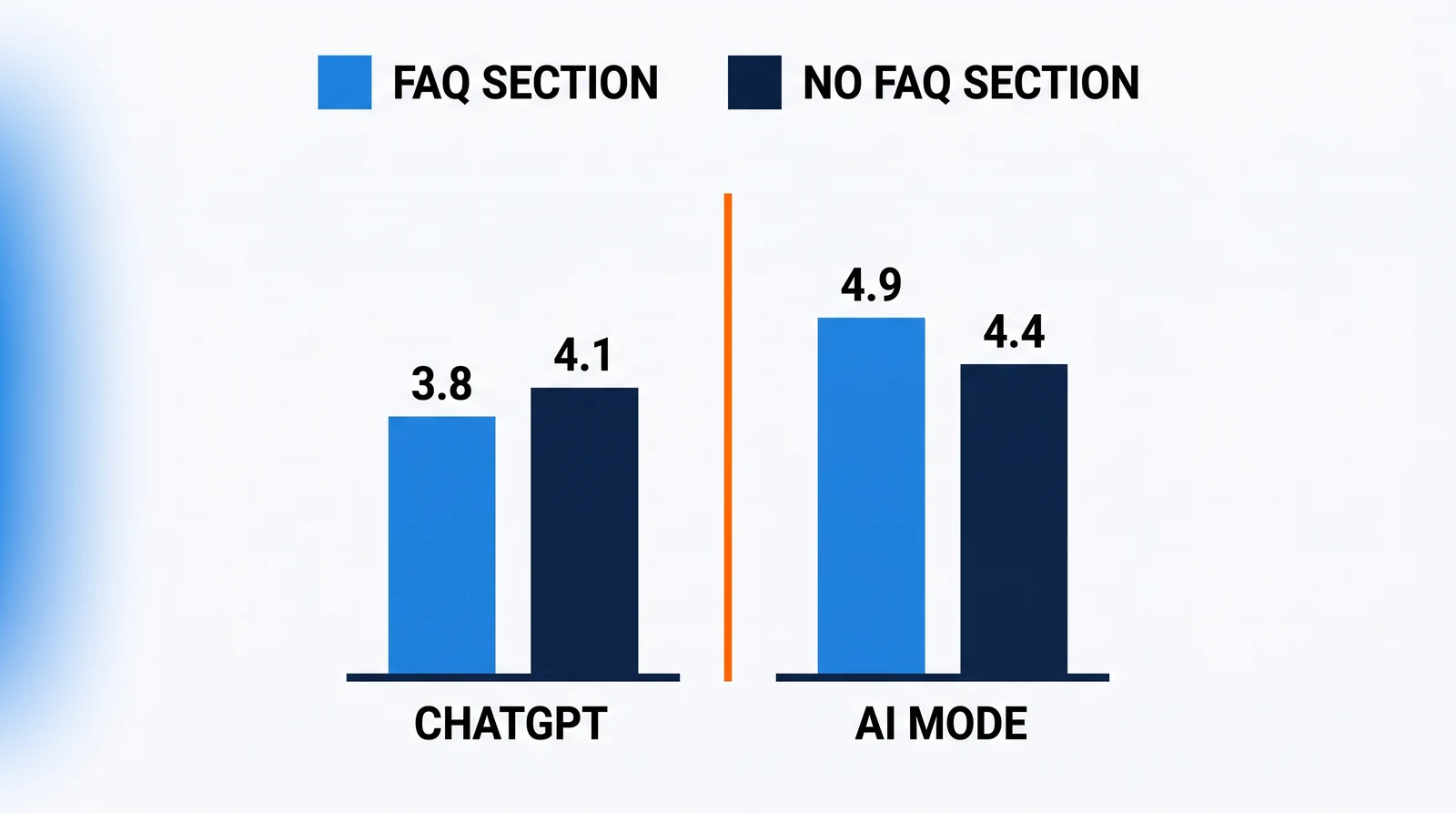
Pages with an FAQ section averaged 3.8 ChatGPT citations and those without one 4.1, across all 216,524 in SE Ranking's ChatGPT study, so the raw averages put the format behind.
SE Ranking's regression model reads the format the other way: "the model views the absence of FAQ sections as a negative signal", the study says, and it explains the raw gap by where the section tends to sit: often on "smaller or simpler pages", support documents and product pages among them, which earn fewer citations anyway. "They're just context-dependent," it concludes. Its key takeaways go further and say the format "nearly doubles your chances of being cited by ChatGPT". No figure appears beside that line anywhere in the study, by our reading; the body's own numbers are the 3.8 and the 4.1. A few paragraphs later the same study is careful in the other direction: "adding a FAQ section alone won't dramatically increase citations." That model was fitted to the number of citations each domain receives in ChatGPT, and SHAP values measure each feature's contribution to the model's predictions, so this is how the model weighs the format across domains, not an estimate of what adding a section would do to a single page.
SE Ranking's ChatGPT study gives no collection period and no ChatGPT version — Search Engine Journal's write-up of the study notes the same gap — and it does not say whether pages ChatGPT never cited are in the set at all. A regression describes pages as they already are, and this one covers one assistant.
The split that would test SE Ranking's own explanation is not in the study. If the raw gap comes from support documents and product pages, the check is the same comparison run within each type — articles against articles, support documents against support documents — and the study does not publish its figures that way. We think a section figure split by page type is the most useful number SE Ranking could add.
Pages with an FAQ section in their main content averaged 4.9 citations in Google's AI Mode and those without one 4.4, across the 2,328,533 pages of SE Ranking's second study, published on 15 December 2025 by the same author and reviewer. It found the section by the same headings, drew them from 295,485 domains in 20 niches, and fitted the same kind of model to the citations each domain received over more than 500,000 prompts; it gives no collection period. SE Ranking says the format can "help you increase AI Mode citations", and the limits that apply to its ChatGPT study apply here too. None of the six ranking pages we could read mentions this study.
SE Ranking is a competitor of ours, and these two studies are the most careful work on the subject that we found. The ChatGPT study says itself that "alternative perspectives and analyses may also be valid", which is the right way to hold a result like this.
Averi's guide is the only one of those six to print the 3.8 and the 4.1. Averi cites them as "one study", straight after its own case for the format, and adds that "predictive models still viewed the absence of an FAQ section as a negative signal". Averi printed a number that cuts against its own advice, and that deserves the credit.
We think SE Ranking's two studies leave the question open rather than answered. Each raw gap is small, the two point opposite ways on two surfaces, and in the ChatGPT study the gap is tangled up with where the format tends to appear, exactly the situation in which a model and a raw average can disagree.
Is FAQ schema the same thing as an FAQ section?
FAQ schema and an FAQ section are different things: the schema is code that labels questions and answers for machines, and the section is what readers see. Most figures quoted on the pages we read measure the code.
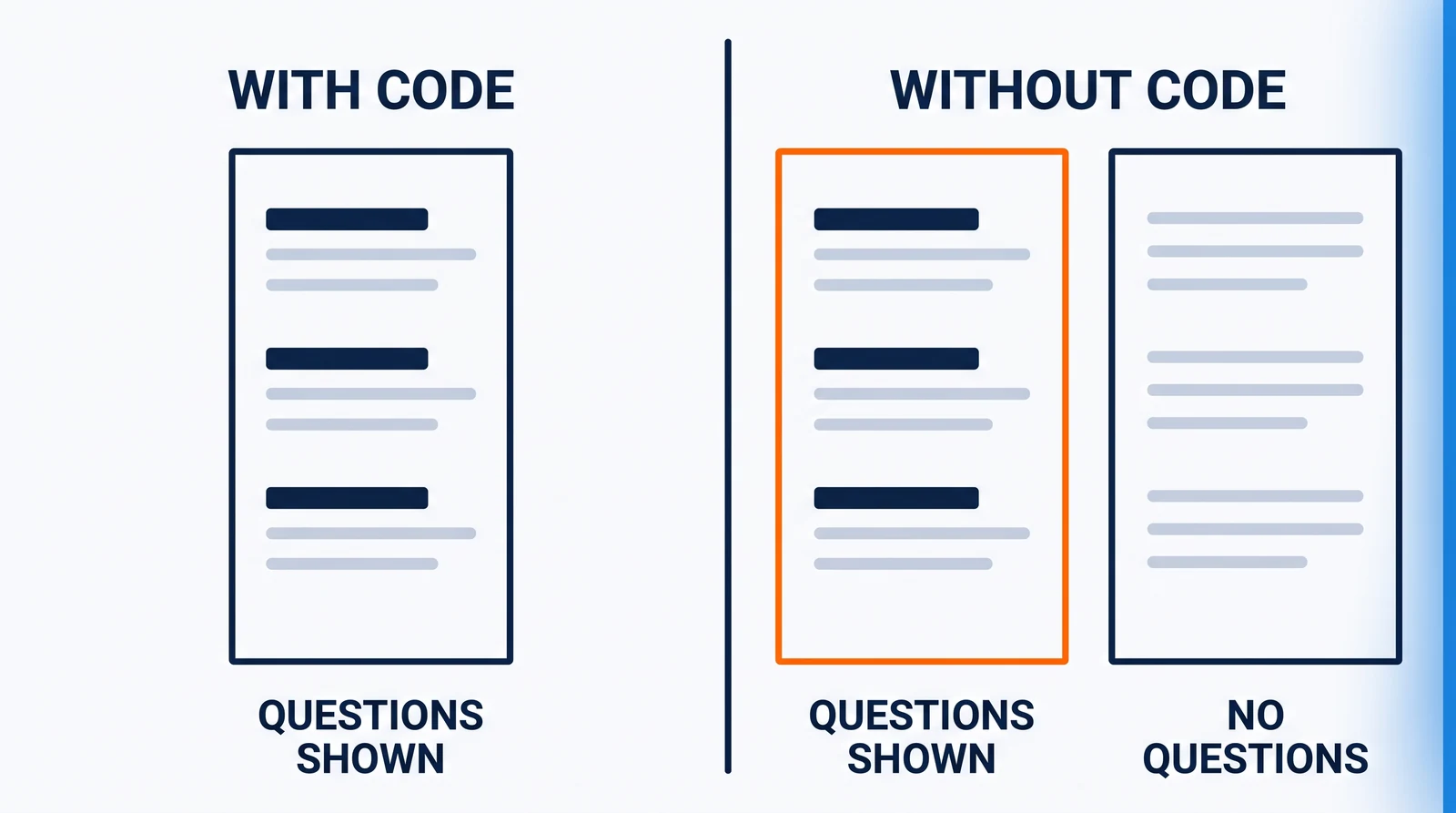
The code and the visible questions usually travel together, and that is the difficulty. Google's own guidelines for structured data say "Don't mark up content that is not visible to readers of the page." The guides we read give the same instruction in their own words: Frase says "FAQ schema requires corresponding visible FAQ content on your page", HubSpot that "FAQPage schema should only mark up question-and-answer pairs users can see", and mqlmagnet that the visible section and the code "have to match word for word." Advice that pairs the two by design is the reason a comparison of pages with and without the code cannot tell you what the section does: one that follows it shows its questions to readers either way, and one with visible questions and no code sits in the "without" group.
The largest multiple attached to this code in the guides we could read is the hardest to trace. Pages with FAQ schema had an AI Overview citation rate of 13.6% against 4.2% for those with no structured data — a multiple of 3.2 — as SGA Index reports it and as Frase's guide repeats it (Shegun Otulana, updated on 1 September 2026). SGA Index's post, dated 5 April 2026, describes 500,000 URLs tracked in Google AI Overviews from October 2025 to March 2026, and credits the work to "Princeton University Department of Computer Science + Moz Research", "Published at: WWW 2026 (The Web Conference)". SGA Index's post gives no link to the study, no authors, no title and no definition of that citation rate. We read the conference's published lists of accepted papers on 24 September 2026 and did not find it. The SGA Index site offers its own schema generator. So the figure travels here as SGA Index reports it: Google AI Overviews only, and the code only.
Frase's guide states that multiple a second way, against "pages without FAQ structured data" — a different comparison group from those with no structured data at all. To its credit, the same guide concedes that "comprehensive citation rate studies are still emerging".
Averi's 28% has changed shape on its way to you. Averi's guide, by Zach Chmael, published on 30 December 2025 and updated on 8 April 2026, says "Pages using FAQPage schema see 28% higher citation rates than those without." The link on that sentence goes to a Superprompt article by Hamp Oldshue, dated 12 August 2025, whose line reads "Proper Article and FAQ schema increases citations by 28%" — one item in a checklist resting on "analysis of 400+ websites from January-August 2025", with no method given for that line. The article refused our connections on 24 September; we read the Internet Archive's copy of 25 April 2026. Between Superprompt's checklist and Averi's guide, two kinds of code became one.
Pages carrying FAQ schema averaged 3.6 ChatGPT citations and those without it 4.2, in SE Ranking's ChatGPT study — the one markup comparison we found that points the other way. ZipTie's guide, by Ishtiaque Ahmed and updated on 15 September 2026, puts that result beside its own list of positives and says of the positives that "most come from industry blogs and vendor analyses rather than large-scale controlled studies". ZipTie's line is a fair one, and few of the other guides we read write it.
Three single-page sites, each built for a different keyword, made up the controlled test both guides cite: Search Engine Land's experiment, by Molly Nogami and Ben Tannenbaum, published on 23 September 2025. Only the one with well-implemented code appeared in an AI Overview, and the one with none was not indexed. Its authors called the result "Promising, but inconclusive". It is three pages, and we read it in the Internet Archive's copy of 1 September 2026, because the live version refused us.
We think the 3.2x and the 3.6 against 4.2 are less at odds than they look. The positive one is Google AI Overviews and the negative one is ChatGPT; they come from different samples, both are correlations, and neither separates the code from the section. SE Ranking's AI Mode study adds a third surface and a third answer: for FAQ schema markup it "didn't see any meaningful impact on AI Mode citations", and it prints no averages for that line. None of them covers Perplexity or Gemini. Whether the assistants read this code at all, and what the controlled evidence on adding it shows, is the subject of our piece on schema markup and AI citations.
Why do the ranking pages recommend FAQ sections?
The ranking pages' case for FAQ sections is extraction, and in every one we read it is asserted rather than measured. A question with a short answer under it looks easy for an assistant to lift.
mqlmagnet's guide, by Harold Bell, published on 27 April 2026 and updated on 31 July, states that "AI engines extract from FAQ sections at substantially higher rates than from prose-format article bodies". mqlmagnet's guide names no study behind that sentence and links none. Its other support is experience: "Every B2B content team I have worked with has seen citation rates increase after deploying FAQ sections with FAQPage schema." mqlmagnet's line is an agency describing its own clients: worth hearing, and not a count.
Digital Hothouse, an agency in New Zealand and the UK, wrote on 27 April 2026 that FAQs "make your content easier for AI systems to interpret". Digital Hothouse gives no figure. HubSpot's guide to answer engine optimization, by Kenny Lee and dated 4 August 2026, puts the argument most precisely: "If a passage cannot be cleanly extracted, it is less likely to be cited." It names a check a site can run on itself, suggesting its own tool can "evaluate whether FAQ sections actually contribute to citation frequency". HubSpot sells that tool; the check is still the right one.
Here the argument meets our evidence, and the two agree. Assistants can select a passage rather than a page: in our harvest, some citations led straight to one highlighted sentence, which makes passage selection the one item on an eight-signal playbook our evidence supports. A single article in that harvest drew four separate citations, each to a different passage. A self-contained answer under a clear question matches the spans we have seen quoted. That is the premise of the advice these guides give, and it holds up.
The step that follows is untested: nobody we read has tested whether the same answer is cited more often inside an FAQ section than in ordinary prose, and we have not tested it either.
The case for the format deserves its full weight: the extraction argument may be right, SE Ranking's ChatGPT model leans toward the section, and its AI Mode averages do too. The format can serve people rather than machines too, though even that is argued rather than measured, and the guides disagree about it: Averi opens with "While most humans skim past FAQ sections, AI systems absolutely devour them", while mqlmagnet says it gives "quick answers to readers who skim". One says readers skip it; the other says skimmers are who it is for. Nothing we read shows that FAQ sections do not help.
Read every publisher here with its interests in view, ours included. Frase, SE Ranking, ZipTie, HubSpot and Averi, whose guides and studies on AI search are all quoted here, sell tools or services tied to this advice, the SGA Index site promotes its own generator for the code, mqlmagnet and Digital Hothouse sell this work to clients, and we build software in this category too.
Why do our own articles end with questions?
Many of our own articles end with a section headed "What people actually ask us", so this evidence applies to us too. We use it for readers who skim, and for questions that deserve one self-contained paragraph each, written so that each answer makes sense to someone who reads nothing else in the article.
Pages with question-style titles and headings averaged 3.4 citations against 4.3 for plain ones in SE Ranking's raw ChatGPT averages; in its AI Mode study, question-phrased titles or H1s averaged 4.6 against 4.5. Our headings are written as questions. The same caveats apply as to the figures above: raw averages, one surface each, and no collection period stated.
We have not measured what our own question sections do for citations, and the evidence above does not settle it for us. What would tell us is the fair test described at the end of this article, run on our own articles; we have not run it, and we would rather say so than let a format we use shape a conclusion about it.
Other questions about FAQ sections and AI
Three more questions have answers on the pages we read, each taken from the People Also Ask box Google returned for this query on 24 September 2026 or from those guides' own question headings. Of the box's four questions, one is answered below, one — about the code — is dealt with above, and two are left alone: one asks how to improve AI citations in general, and the other asks what to do when an AI provides citations.
How should FAQ answers be written for AI?
Answers written for AI should stand on their own, because that part has evidence behind it; the word counts you are given are preferences, because the guides disagree and none of them cites a test. The advice runs from 40 to 60 words (Averi, Digital Hothouse) through 40 to 80 (mqlmagnet) to 50 to 300 (ZipTie), with 100 to 200 words in the best-performing group SGA Index reports — from the study we could not find. What the passage evidence supports is narrower: an answer that still makes sense when lifted out on its own, with the specific name, date or figure inside it.
How many questions should an FAQ section have?
No guide we read links a test behind the number of questions it recommends, and the recommendations disagree. Recommendations run from three to five questions (ZipTie) to eight to twelve (mqlmagnet), with three to seven as the best group in SGA Index's account, "about 1.4x" for fewer than three and "2.1x" above ten, from the same unlinked study. Our view, and it is only a view: you need as many questions as your readers actually ask.
Where should an FAQ section go on the page?
FAQ placement is untested in every guide we read, and the advice splits between the top and the bottom. mqlmagnet's own answer puts it "Near the bottom of the article, immediately before the closing call to action"; ZipTie says to place visible FAQ content "in the top half of the page"; Digital Hothouse says to display it "near the top or clearly signposted". None of the three shows a comparison behind its answer. Place it where your readers look for it, and if you want to know what placement does to your own citations, that is a test you would have to run.
Deciding whether your page needs one
Whether your page needs an FAQ section comes down to its readers, because nobody we found has measured what adding the format does to its chances of being cited, in either direction.
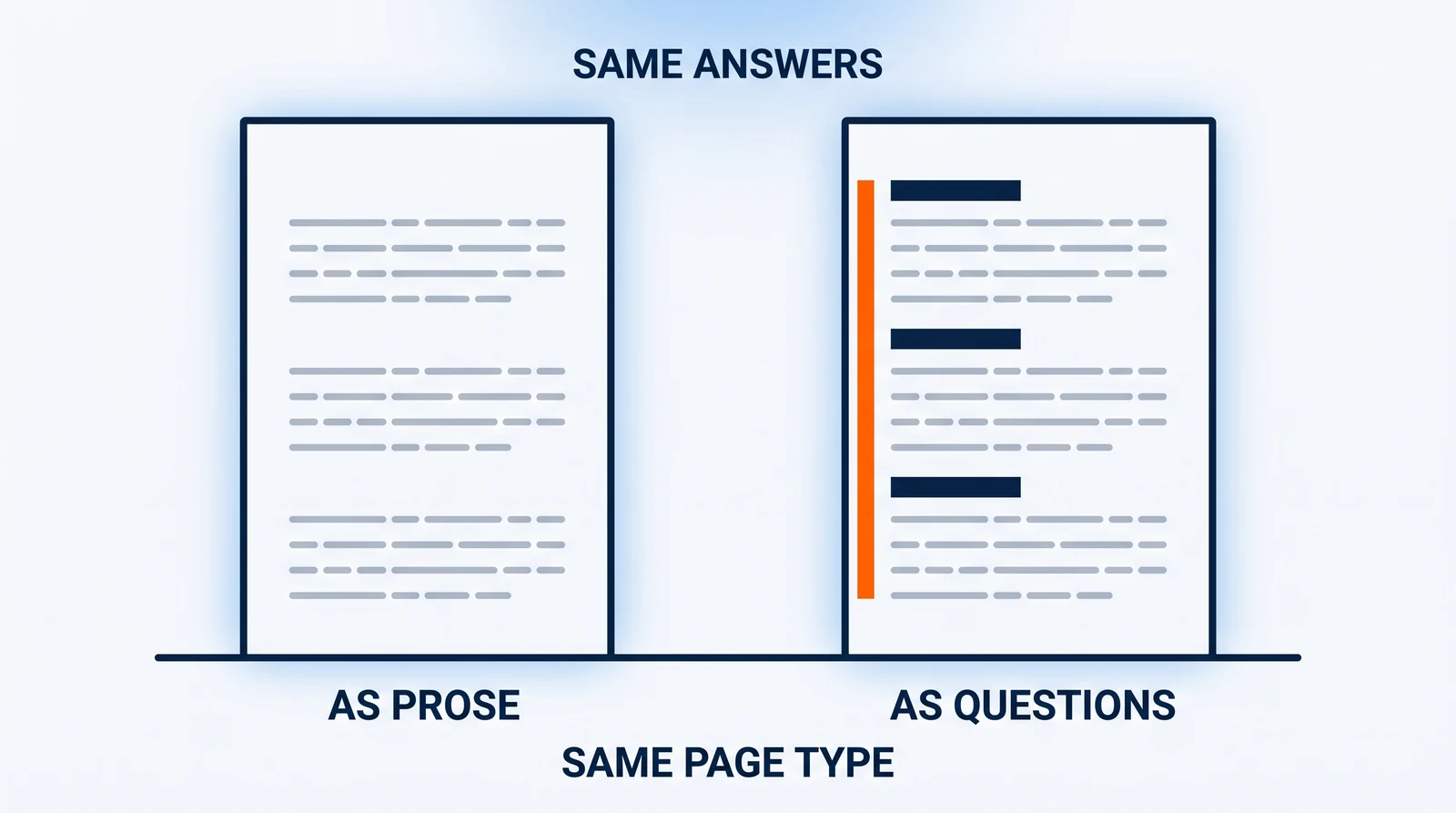
A fair test is easy to describe: take the same answers, word for word, on the same kind of page, set them once as prose and once as a question block, and check across several assistants over several weeks which version gets cited. That type has to be held steady, because that is SE Ranking's own explanation for the raw gap in its ChatGPT study, and the assistants have to vary, because the figures we have cover ChatGPT, Google AI Overviews and Google's AI Mode, and they do not agree. We found no published test run that way. On your own site, the practical version is the check HubSpot names: note in your own citation data which of your pages are cited before you change one, and look again afterwards. A before-and-after on one page shows what happened to it, not why, because anything else that changed over the same weeks moves the result too, so repeat the check and compare it with pages you left alone.
An FAQ section is a reader's tool first. If your readers arrive with the same few follow-up questions, answering each in a paragraph that stands on its own serves them, and it matches the shape of the passages we have seen quoted. If a section exists only to hold phrases, it serves nobody.
The citation case can wait for a test. The reader in front of you cannot.
Sources
All URLs below were checked on 24 September 2026.
- SE Ranking, How to optimize for ChatGPT: LLMs.txt doesn't matter but brand mentions on Quora and Reddit do, Yulia Deda (reviewed by Svitlana Tomko), 24 November 2025 — the visible FAQ section (3.8 against 4.1 citations; the model's reading of its absence) and FAQ schema (3.6 against 4.2); 129,000 domains, 216,524 pages, 20 niches, 100,000 prompts, ChatGPT only; model fitted to citations per domain; no collection period stated — https://seranking.com/blog/how-to-optimize-for-chatgpt/
- SE Ranking, How to Optimize for AI Mode: Google Visibility Matters 3x More Than Content, Yulia Deda (reviewed by Svitlana Tomko), 15 December 2025 — the visible FAQ section in Google's AI Mode (4.9 against 4.4 citations), question-phrased titles or H1s (4.6 against 4.5) and FAQ schema markup (no meaningful impact, no averages given); 2,328,533 pages, 295,485 domains, 20 niches, more than 500,000 prompts, model fitted to citations per domain; no collection period stated — https://seranking.com/blog/how-to-optimize-for-ai-mode/
- Search Engine Journal, New Data Reveals The Top 20 Factors Influencing ChatGPT Citations, Matt G. Southern, 26 November 2025 — a news write-up of the SE Ranking study, noting that it does not specify a ChatGPT version or timeframe — https://www.searchenginejournal.com/new-data-top-factors-influencing-chatgpt-citations/561954/
- Averi, FAQ Optimization for AI Search: Getting Your Answers Cited, Zach Chmael, 30 December 2025, updated 8 April 2026 — the 28% line (the code), the 3.8 against 4.1 line (the section, as "one study") and its line on how humans read FAQ sections — https://www.averi.ai/how-to/faq-optimization-for-ai-search-getting-your-answers-cited
- Superprompt, AI Traffic Surges 527% in 2025: How to Get Your Site Cited by ChatGPT, Claude & Perplexity (Data from 400+ Sites), Hamp Oldshue, 12 August 2025 — "Proper Article and FAQ schema increases citations by 28%" (the code, two kinds together); no method for that line; the live page refused connections, read in the Internet Archive's copy of 25 April 2026 — https://web.archive.org/web/20260425175921/https://superprompt.com/blog/ai-traffic-up-527-percent-how-to-get-cited-by-chatgpt-claude-perplexity-2025
- Frase, Are FAQs and FAQ Schemas Important to AI Search, GEO and AEO?, Shegun Otulana, 17 November 2025, updated 1 September 2026 — the 3.2x (the code, Google AI Overviews), credited to SGA Index, and its line on visible FAQ content — https://www.frase.io/blog/faq-schema-ai-search-geo-aeo
- SGA Index, New Study: Sites with Structured Data Get 3x More Citations in AI Overviews, 5 April 2026 — 500,000 URLs in Google AI Overviews, October 2025 to March 2026, credited to Princeton and Moz with no link, authors or title — https://sgaindex.com/news/ai-overview3-3517d27c
- ZipTie, FAQ Schema for AI Answers: Does It Actually Get You Cited by AI?, Ishtiaque Ahmed, 6 March 2026, updated 15 September 2026 — SE Ranking's 3.6 against 4.2 beside its positives, its note on where the positives come from, and its placement advice — https://ziptie.ai/blog/faq-schema-for-ai-answers/
- Search Engine Land, Schema and AI Overviews: Does structured data improve visibility?, Molly Nogami and Ben Tannenbaum, 23 September 2025 — three single-page sites, one AI Overview appearance, "Promising, but inconclusive"; the live page refused us, read in the Internet Archive's copy of 1 September 2026 — https://web.archive.org/web/20260901031455/https://searchengineland.com/schema-ai-overviews-structured-data-visibility-462353
- Google Search Central, General Structured Data Guidelines, last updated 10 July 2026 — "Don't mark up content that is not visible to readers of the page." — https://developers.google.com/search/docs/appearance/structured-data/sd-policies
- mqlmagnet, How to Write FAQ Sections That Rank and Get Cited by AI, Harold Bell, 27 April 2026, updated 31 July 2026 — the extraction claim with no study named, its line on readers who skim, and its placement advice — https://www.mqlmagnet.com/post/faq-section
- Digital Hothouse, What's the Best Way to Structure FAQ Sections for AI Engines?, 27 April 2026 — the extractability argument, no figure, and its placement advice — https://www.digitalhothouse.co.nz/blog/whats-the-best-way-to-structure-faq-sections-for-ai-engines/
- HubSpot, FAQs for AEO: How to structure answers that rank in answer engines, Kenny Lee, 4 August 2026 — the extraction argument, the check it names, and its line on marking up only what users can see — https://blog.hubspot.com/marketing/faqs-for-aeo
- LiamVi, Research: our methods, samples and limits, last updated 12 August 2026 — the People Also Ask null, the harvest's sample and the passage evidence — https://liamvi.com/research/
- LiamVi, The best AI visibility tools in 2026: what they measure, and how to judge one, 10 August 2026 — the null's first publication — https://liamvi.com/blog/best-ai-visibility-tool
- LiamVi, People Also Ask in an SEO strategy: read the questions against the results before you write, 15 September 2026 — whether a box's questions belong to your keyword's reader — https://liamvi.com/blog/people-also-ask-seo-strategy
- LiamVi, How to get cited by ChatGPT in 2026: eight signals, and what has actually been tested, 14 September 2026 — passage selection, the one signal our evidence supports — https://liamvi.com/blog/how-to-get-cited-by-chatgpt-in-2026
- LiamVi, Does schema markup affect AI citations: the evidence comes from pages AI was already citing, publishes 27 September 2026 — whether assistants read the code, and the evidence on adding it — https://liamvi.com/blog/does-schema-markup-affect-ai-citations