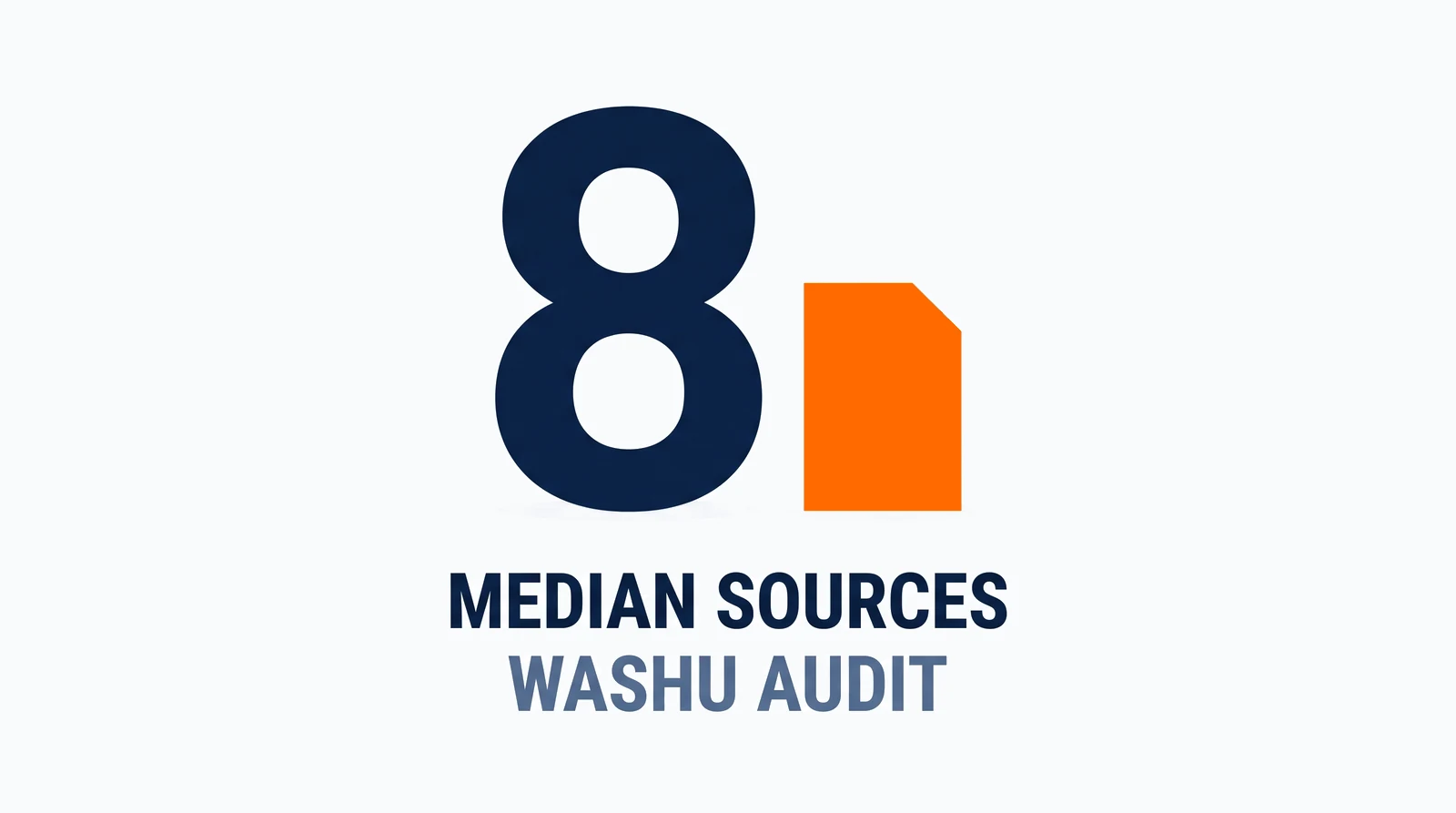
Gartner's search volume prediction: the year arrived, the baseline never did
On 19 February 2024, Gartner put a year and a number on the move from lists of links to AI answers: "By 2026, traditional search engine volume will drop 25%, with search marketing losing market share to AI chatbots and other virtual agents." That sentence is still published on the firm's newsroom, and the year it named has arrived. Apart from a corrected spelling of "February" in its dateline, the release reads today exactly as it read on the day it went out.
What it never said is which volume, measured from what starting number, and counted by whom. Without those three things, the question most readers now bring to it — did it come true? — has no public answer. Two pages published in April 2026 answer it anyway, in opposite directions, and neither shows a count of the thing the forecast said would fall. This page reads the forecast in its own year, against what has been published since, and sets out what it would take to grade it.
Two limits come first, because they apply to everything that follows. We have measured nothing about search volume, and no figure below is ours; each one belongs to the company or publication named beside it. And the firm's clients can read a longer report behind the release, which we cannot — it may define what the public version does not. When we checked on 24 September 2026 for a follow-up from the firm that restates, defines or grades the figure, we found none; the related research it has published since is covered at the end.
What did Gartner predict in 2024?
Gartner predicted on 19 February 2024 that "traditional search engine volume" would fall 25% by 2026, with AI chatbots and other virtual agents taking over the questions people used to type. The forecast is credited to Alan Antin, a Vice President Analyst at the firm, in a press release datelined Stamford, Connecticut, and his explanation runs to two sentences: "Generative AI (GenAI) solutions are becoming substitute answer engines, replacing user queries that previously may have been executed in traditional search engines. This will force companies to rethink their marketing channels strategy as GenAI becomes more embedded across all aspects of the enterprise."
The release is short and written for tech marketers. It opens with Antin's line that "Organic and paid search are vital channels for tech marketers", spends its second half on content quality and on watermarking AI-generated material, and promotes the firm's conference held that March in Grapevine, Texas. Its fuller research sits in a client-only report, "Predicts 2024: How GenAI Will Reshape Tech Marketing", which the public cannot read.
The headline and the body do not say quite the same thing. The headline reads "Search Engine Volume Will Drop 25%"; the word traditional appears only in the body, and that difference matters more than it looks.
The public text has not moved in the thirty-one months since. The Internet Archive's capture from the day of release, its capture of 19 September 2026 and the live page on 23 September 2026 carry the same body, character for character. The one difference is the dateline: the release-day version spelled the month "Feburary".
What is the 25% a percentage of?
Gartner's February 2024 release names no unit for its 25%: not queries, sessions, users or advertising spend. The same sentence carries a second measure, search marketing "losing market share" to AI chatbots, and defines that one no better; no geography is stated either. Each possible unit would move differently: a person can ask more often while fewer people use the engine at all, and advertising budgets can rise or fall without a single question changing.
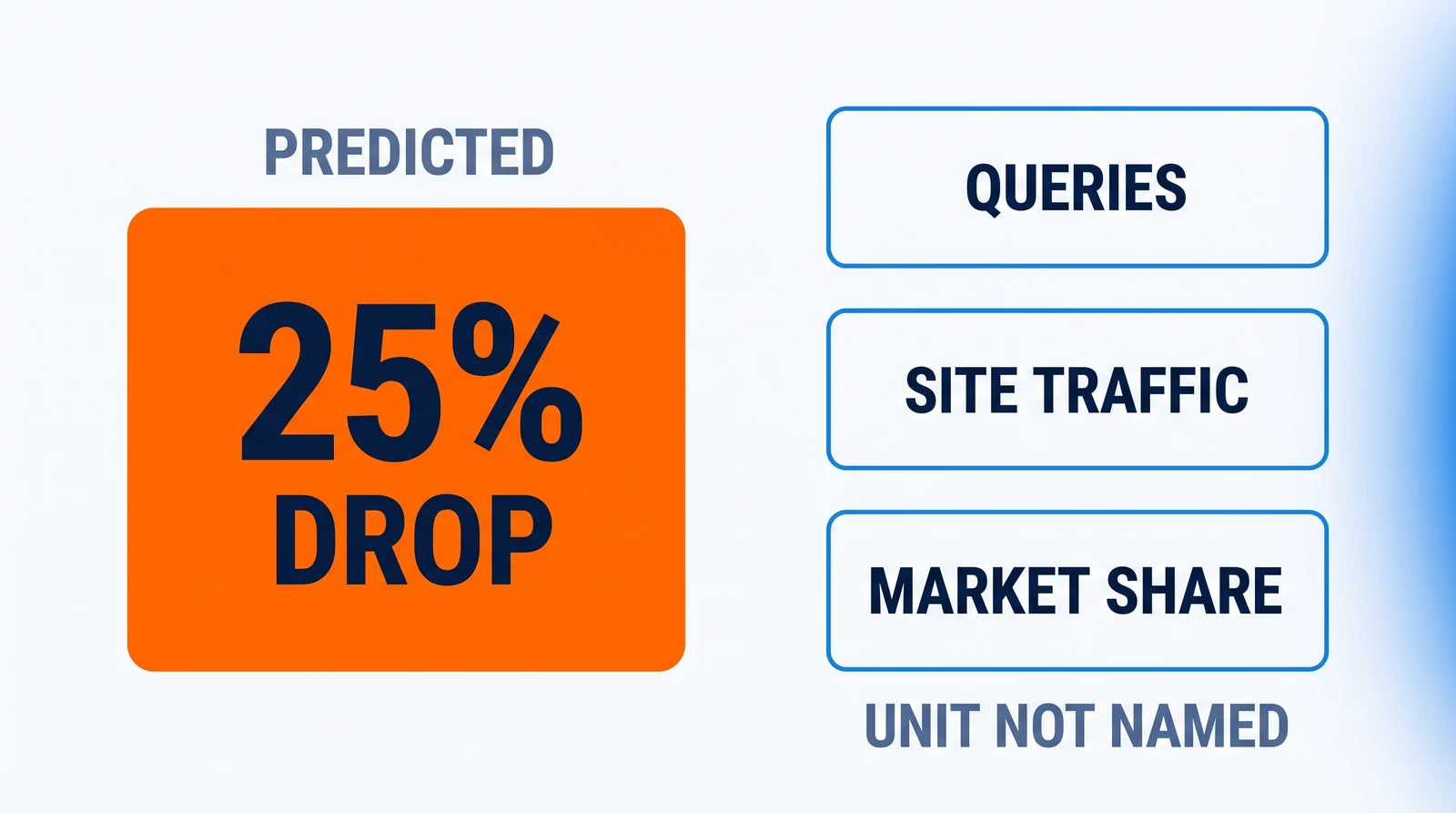
The gap is not pedantry, because the pages repeating the forecast fill it in differently. Search Engine Journal's critique of 15 March 2024, by Roger Montti, calls it a 25% drop in "search market share" in its first paragraph and "a 25% decrease in traditional search query volume" under its fourth reason. A 2026 review by futurefactors is headlined as a drop in "search traffic". Emarketed's explainer of 24 February 2026 restates the forecast's sentence without linking the release. A decline in queries, a decline in traffic sent to websites and a loss of market share are three different tests, and a forecast can pass one while failing another.
A share and a volume are not the same kind of number: one is a slice of a total, the other is the total. How much a published share depends on what was counted is a question of its own.
What was the drop measured against?
Gartner's release gives no starting figure for its 25%, and the only total we found the forecaster voicing on the record belongs to a third party he did not name. The firm does not do that counting itself, by Antin's own account to Alex Kantrowitz of Big Technology on 15 March 2024, a month after the release: "We don’t do the calculations of how many searches there are, so this is coming third party, but over 8 billion searches happen per day."
Three things about that sentence need saying together. The third party is not named. In the part of the interview a non-subscriber can read, Antin does not say the 25% is measured against that figure; the rest of the conversation is for paid subscribers, and we have read only the free part. And the figure appears nowhere in the release, so a reader of the release had no way to know it existed.
The reasoning in the free part is a scenario, not a count. Antin starts from ChatGPT's adoption, "the fastest ever to 100 million monthly users" in his words, and from what people already do with it: "Some people are using ChatGPT, Claude, and other chatbots to answer questions like you would with search." He then points to the "over 1.5 billion Apple iPhones" that one software rollout could turn toward an answer engine without anyone downloading anything. That is a reasonable argument for the direction of a shift. It is not a measurement of how far anything would fall, or from where.
Did Gartner's search volume prediction come true?
Nothing published that we could find sets a 2026 count of search volume against a starting count, so the prediction's 25% cannot be checked from outside — and the two 2026 verdicts we found on it disagree.
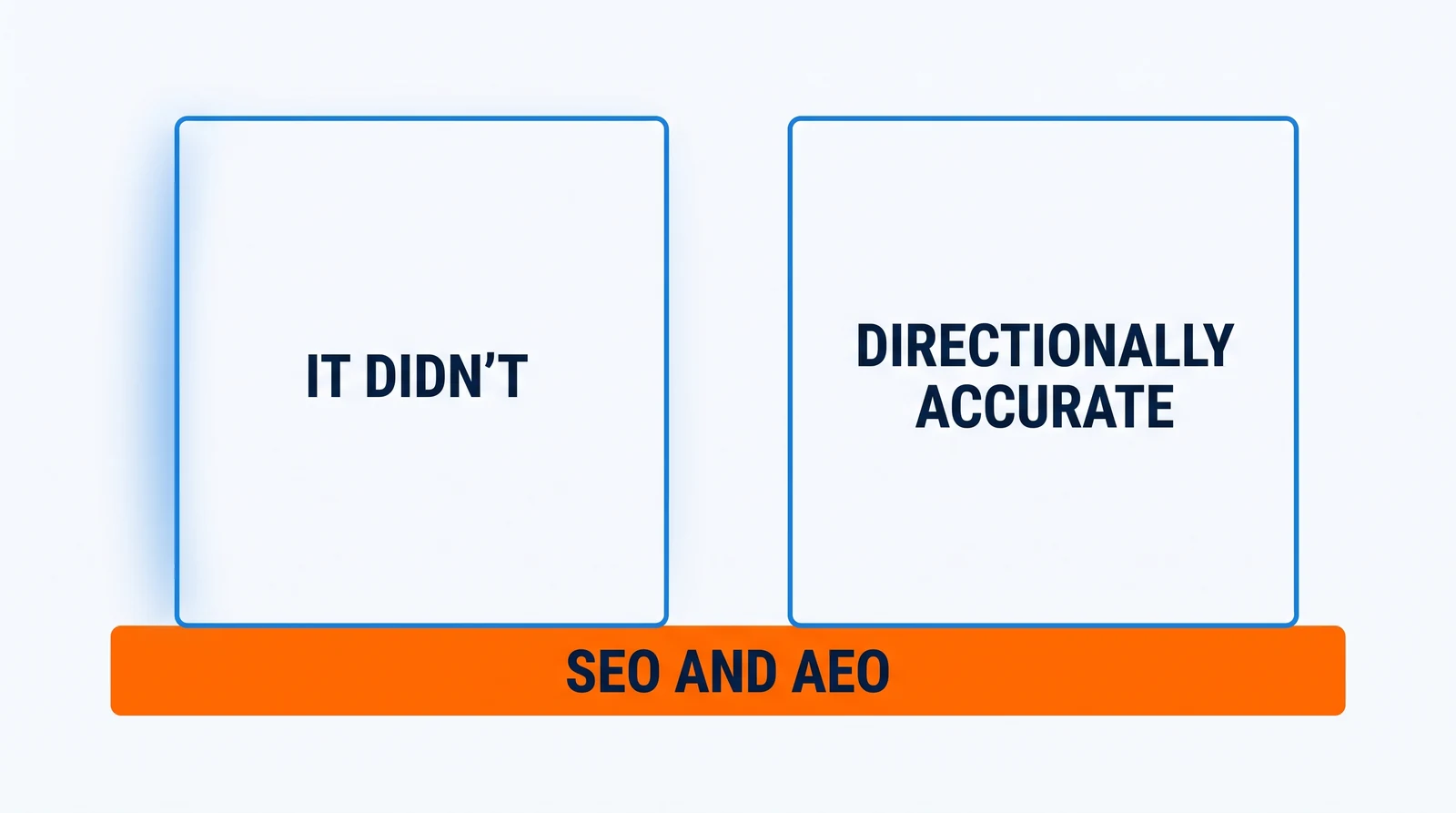
futurefactors' verdict rests on a count of users and a market share, not on a count of what the forecast said would fall. Hina Mian's review for futurefactors was published on 3 April 2026, updated on 3 June, and runs under the title "Gartner Said Search Would Drop 25% in 2026. It Didn't." Its evidence is that "ChatGPT hit 883 million monthly active users, and AI chatbots collectively process billions of queries every month", and that Google "still commands over 90% of the search market". The billions-of-queries half carries no source on the page. Its conclusion, "Traditional search volume hasn’t dropped 25%", comes without a volume figure. Its reference list names "Statista and SimilarWeb (April 2026)" without a link to either.
helpguides' opposite verdict cites no external source at all. Its content strategy article, dated 17 April 2026, says the forecast "has proven directionally accurate" and that "the data confirms the direction was right". Every link on the page points back to helpguides' own site. The page dates the forecast to "late 2024"; the release is datelined February 2024.
Both verdicts end on the same advice. futurefactors tells marketers to "invest in both SEO and AEO (Answer Engine Optimization) to stay competitive"; helpguides writes that "The correct strategic position is not "SEO or AEO" but "SEO and AEO."" Two pages that disagree about whether the forecast came true agree on what to do about it, which we read as a sign that the 25% is doing less work in either argument than its headline suggests.
Neither page is arguing in bad faith, and each may be right about part of what it describes: futurefactors itself grants that "Gartner identified a real shift, but mispredicted its magnitude and mechanism", and helpguides may be right that some kinds of question moved to AI assistants. The gap is in the forecast's own sentence, which gave them nothing to measure against, and in the verdicts, which did not bring a count of their own.
What do Google and Apple say about their own counts?
Google, which holds the counts for its own engine, has published directions and one lower-bound total since 2025, and Apple has described a one-month fall in Safari's queries, but neither has published a count that could grade the forecast. Google's 2026 statements, made through its parent company Alphabet, treat AI answers as part of Google Search. Those are one engine's counts; the forecast named no engine, and Google's figures cannot stand in for everything its 25% might cover.
Google's own total, from internal data as of January 2025, is "more than 5 trillion searches on Google annually", stated in a post about advertising on 3 March 2025. That is a floor, for one year, with no earlier figure on the same basis beside it in that post.
Queries from Safari fell in April 2025 for the first time in more than 20 years, by Apple's own account in court on 7 May 2025. Eddy Cue, Apple's senior vice president of services, testified: "For the first time ever in over 20—I think we’ve been at this for 22 years—last month, our search volume actually went down." He added: "it’s because people are using ChatGPT. They’re using Perplexity." That testimony reaches us through Fortune's report of 8 May 2025, which quotes MLex's report of it. Google answered the same day: "We continue to see overall query growth in Search. That includes an increase in total queries coming from Apple’s devices and platforms." Neither company published a number. In Fortune's account, what fell was iPhone users' use of Google's search feature in Safari, Apple's browser: the engine the forecast's word traditional most plainly covers. It covers one browser and one month, gives no figure, and Google read its own data the other way the same day.
Alphabet described Google Search queries as at "an all-time high" in Sundar Pichai's remarks of 29 April 2026. In his remarks of 22 July 2026, Alphabet's chief executive credited AI Mode, "just like AI Overviews", with "an incremental increase in Search queries overall". Neither statement carries a figure.
Average searches per searcher on Google rose 21.64% from 2023 to 2024 on Datos' US panel of active desktop devices, in research SparkToro published with Datos on 11 March 2025. That is the one outside count we found inside the forecast's window. It is per searcher, on desktop, in one country, for 2024 alone. The page now carries its own warning that it "may be out of date".
None of these is the forecast's baseline, because the release named none, and they count different things over different dates. Their directions are not blank, though. Google's statements that give a direction all describe growth, as does the one outside count, and Cue's one-month fall is the only statement we found running the other way. If a question answered by AI Mode counts as a search, Google's own account weighs against a broad 25% fall on Google. If it does not, Google's statements cannot say, because they do not separate the two: the 2026 ones present the AI features as part of the product, "Our AI-powered features are driving increased Search usage", in Pichai's July words. Either way, we are not reading them as a verdict.
Where did "traditional search" go?
The line between traditional search and AI answers moved inside Google itself after February 2024, when AI Overviews went above the links and AI Mode was built into Google's own product. Those AI search features now sit on the same results page as the list the forecast called traditional. When the forecast was made, a traditional search engine had an obvious meaning: you typed a query and got a list of links. Google's 2026 statements now describe those AI features as driving its usage, alongside everything else.

Search Engine Journal's Roger Montti named the risk on 15 March 2024. The fourth of his seven reasons for doubt was that the forecast "assumes that traditional search engines will remain the same", when "search engines evolve not just on a yearly basis but on a month to month basis." Google's own product did change in exactly that way, and whatever one makes of his other six reasons, we think that one has held up.
The consequence is practical. Even a complete count of Google's queries in 2026 would not grade the forecast until someone drew a line between a query answered with links and one answered by an AI summary, and the forecast never drew it. A question answered inside AI Mode could be scored as a traditional search that survived or as a question lost to an answer engine; the release does not say which, and every answer to "did it come true?" quietly depends on it. The same holds for a question typed into a social media app — futurefactors notes that customers are "increasingly starting their search journeys on TikTok, Instagram, and YouTube" — and the forecast does not say whether those count.
How often an AI Overview appears is a separate measurement again, and the published AI Overview rates are percentages of several different things, from tracked keywords to results pages, none of them a total.
What a forecast needs before anyone can grade it
A percentage forecast can be graded cleanly when three things are clear: what is counted, the starting point it is measured from, and a later count made the same way to set against it. The first two have to come from the forecast itself, as a starting figure or a dated public series anyone can look up, because a reviewer who supplies them is grading a forecast of their own. The third can come from anyone, though a forecast that names where it will come from spares everyone the argument. Queries, visits, people and money are all reasonable things to count; a forecast that picks one can be checked by anyone willing to read the source, and a forecast that picks none can be argued about indefinitely, which is what has happened to this one. Those three are our test, not an industry standard, and we have an interest in it: we build measurement tools, and a reader who asks every forecast for its starting number suits that business. Weigh the test with that in mind.
The February 2024 release supplies neither of the first two, so no later count can be set against it. Its December 2023 forecast about organic traffic, covered below, at least named the survey it leaned on; this one named nothing. That does not make its direction wrong. It makes its number impossible to check from outside, which for a figure repeated this widely is a problem of its own.
What you do with that is your decision as a marketer or a founder; the 25% cannot make it for you. The numbers you can check are closer to home — your own visits and your own clicks, dated — and clicks are a different question from volume. The next time a forecast like this one lands in a deck, look in the forecast itself for what it counts and where it starts. If those are missing, you are holding a direction, not a measurement.
Related questions
The three questions below come from the related suggestions Google listed for this topic in one United States capture on 23 September 2026.
Is this the same as Gartner's 50% organic traffic forecast? No: that is a separate forecast. Gartner published it on 14 December 2023, predicting that brands' organic traffic would fall by half or more by 2028. Its release reads: "By 2028, brands’ organic search traffic will decrease by 50% or more as consumers embrace generative AI-powered search." It counts a different thing, organic traffic from search to brands' sites, over a longer horizon. It also names the survey behind it: 299 consumers asked in August 2023, 79% of whom expected to use AI-enhanced search within the next year. That survey measured what respondents expected to do, not what traffic did; but it is named, which the support for the February 2024 forecast is not.
Has Gartner updated or graded the 2024 prediction? Not publicly, as far as we could find on 24 September 2026. The release is unchanged apart from the spelling of its dateline, and a check of Gartner's newsroom and the open web turned up no restatement, definition or review of the figure by the firm. It has published related research since. A release of 20 January 2026, on a survey of 377 US consumers conducted in June and July 2025, said generative AI tools "are far from replacing traditional channels". Its summary of a marketing conference on 9 June 2026 said its research shows "customers are increasingly using LLMs alongside traditional search", LLMs being the language models behind AI chatbots. Neither mentions the 25% or gives a volume figure, but both describe AI tools used alongside the engines rather than in place of them, a different emphasis from the 2024 release's "substitute answer engines". The client report behind the 2024 release may say more; we could not read it.
If search volume falls, does that make SEO pointless? A forecast about volume cannot answer that, because the question is where the traffic ends up, not how often anyone asks. It is better answered from Google's own documentation, which the "Is SEO dead now with AI?" section of this site's SEO guide does.
Sources
- Gartner — Gartner Predicts Search Engine Volume Will Drop 25% by 2026, Due to AI Chatbots and Other Virtual Agents — the forecast, the analyst and the client report it points to. Press release, Stamford, 19 February 2024; checked 23 September 2026 on Gartner's page and on the Internet Archive's captures of 19 February 2024 and 19 September 2026.
- Gartner — Gartner Predicts 50% of Consumers Will Significantly Limit Their Interactions with Social Media by 2025 — the 2028 organic-traffic forecast and the 299-consumer survey. Press release, Stamford, 14 December 2023; checked 23 September 2026.
- Gartner — Gartner Survey Finds Only One-Third of Consumers Say GenAI Rivals Search Engines; Marketers Must Optimize for Both AI-Driven and Traditional Search — the survey of 377 US consumers, June and July 2025. Press release, Stamford, 20 January 2026; read on the Internet Archive's capture of 20 June 2026 because Gartner's page returned an access error to us; checked 24 September 2026.
- Gartner — Gartner Marketing Symposium/Xpo: Day 2 Highlights — Matt Moorut's session on language models and search marketing. Press release, Denver, 9 June 2026; read on the Internet Archive's capture of 9 June 2026 because Gartner's page returned an access error to us; checked 24 September 2026.
- Big Technology — Will Search Engine Traffic Really Drop 25% by 2026, As Gartner Predicts? — Alex Kantrowitz's interview with Alan Antin; the free portion only. Published 15 March 2024; checked 23 September 2026.
- Search Engine Journal — 7 Reasons To Be Skeptical of 25% Search Drop by 2026 — Roger Montti's critique. Published 15 March 2024; checked 23 September 2026.
- Emarketed — Gartner Predicts 25% Search Volume Drop by 2026: What It Means for Your Business — Matt Ramage. Published 24 February 2026; checked 23 September 2026.
- futurefactors — Gartner Predicted a 25% Drop in Search Traffic by 2026: Here's What Actually Happened — Hina Mian. Published 3 April 2026, updated 3 June 2026; checked 23 September 2026.
- helpguides — How Gartner's Search Volume Drop Prediction Affects Content Strategy — dated 17 April 2026; checked 23 September 2026.
- Google — AI, personalization and the future of shopping — Vidhya Srinivasan; "more than 5 trillion searches on Google annually", Google internal data, January 2025. Published 3 March 2025; checked 23 September 2026.
- Google — Google's statement on May 7 press reports about Search traffic — published 7 May 2025; checked 23 September 2026.
- Fortune — Apple's Eddy Cue: Safari searches are down for first time in 22 years — Sasha Rogelberg, quoting MLex's report of the testimony. Published 8 May 2025; checked 23 September 2026.
- Alphabet earnings call, Q1 2026: Sundar Pichai's remarks — published 29 April 2026; checked 23 September 2026.
- Alphabet earnings call, Q2 2026: Sundar Pichai's remarks — published 22 July 2026; checked 23 September 2026.
- SparkToro — New Research: Google Search Grew 20%+ in 2024 — Rand Fishkin, with Datos data: average searches per searcher, US desktop panel, 2023 against 2024. Published 11 March 2025; read on the Internet Archive's capture of 17 September 2026 because the live page returned a bot check; checked 23 September 2026.
- LiamVi — Research: our methods, samples and limits — what we have measured; it carries no measurement of search volume. Checked 23 September 2026.