How many B2B buyers use AI to research vendors: the answer depends on the question buyers were asked
The answer you will meet most often is Forrester's: "Nearly all business buyers (94%) report using AI during their buying process," from a survey of nearly 18,000 global business buyers that the firm ran in 2025 and published in January 2026. That counts people who used AI somewhere in a purchase, which is wider than researching vendors with it. Other sources, most of them asking narrower questions of other groups, put the share at 51% (G2, of 1,076 software decision makers), 66% (Semrush, of 519 US professionals who use AI at work; Magenta Associates, of UK decision-makers) or 73% (a paid press release). So the question has several honest answers, and each belongs with the question that produced it. None of this means the surveys disagree about the direction: every survey among them points to most B2B buyers using these tools somewhere in buying, and if that is all you need to know, any of those surveys will do. The 73% sits outside that count, because its release credits it to an analysis of citations rather than to a poll.
Before the numbers, you should know where we stand. The software we build records which sources AI assistants cite, so a marketer who believes vendor research now happens inside chatbots is someone we could sell to. We have polled no one and hold no measurement of B2B buying, and every percentage on this page belongs to the organisation named beside it.
We began with the nine results Google showed for this question in a United States search on 28 September 2026. For each number those pages repeat, we then looked for the owner's own release or report and read that.
Which year is Forrester's 94% from?
Forrester's 94% comes from the study it names its Buyers' Journey Survey, 2025, published in January 2026. In a post on 22 January 2026, Forrester's John Buten wrote that "While the proportion of buyers using AI only grew five percentage points, to 94%, twice as many buyers in Forrester's Buyers' Journey Survey, 2025, named generative AI or conversational search as a more meaningful or important source of information than any other source, far outpacing vendor websites, product experts, and sales." The 89% it grew from was the share the firm had announced a year earlier.
The document built on that study is The State Of Business Buying, 2026, open to clients only. Vice president Barbara Winters described it on 21 January 2026 as "based on Forrester's Buyers' Journey Survey of nearly 18,000 global business buyers from last year".
Two of the ranking pages date the number differently, and both describe the same study. Machine Relations, on 24 March 2026, calls it "Forrester's 2026 Buyers' Journey Survey" and says usage grew "from 89% in 2025 to 94% in 2026". Geisheker, in a page last updated on 24 September 2026, credits the same 94% to the 2025 edition. One page uses the study's name, the other the publication year, and a poll fielded in one year and published in the next makes that easy to do.
The wording travels less well than the year. The firm's public posts say respondents "report using AI during their buying process". Machine Relations' version, that they "used AI during their most recent purchase", and the three use cases it attributes to the same study (55% comparing vendors, 54% researching products, 47% building business cases) do not appear on the Forrester pages we could open; they may be in the client document, which we have not read.
Two more details from those posts belong with the 94%. Buten says 61% of business buyers use private tools their organisation provides, so much of this use happens inside company systems rather than on public chatbots. And Winters writes that while "AI-powered search tools offer speed and efficiency, they can create mistrust by delivering incomplete or unreliable information", and that "Buyers compensate by seeking validation from trusted sources: peers, product experts, industry analysts, and others within their buying networks."
Is 94% the share of buyers who research vendors with AI?
Forrester's 94% counts business buyers who report using AI somewhere in their buying process, a wider thing than vendor research, and 6sense's separate 2025 study also reports 94%. The 2025 Buyer Experience Report from 6sense, built on nearly 4,000 responses from North America, APAC and EMEA, says "94% of buyers report using LLMs during their buying process to do things like analyze sentiment in customer reviews and process information." The number is the same; the study, the sample and the wording are not.
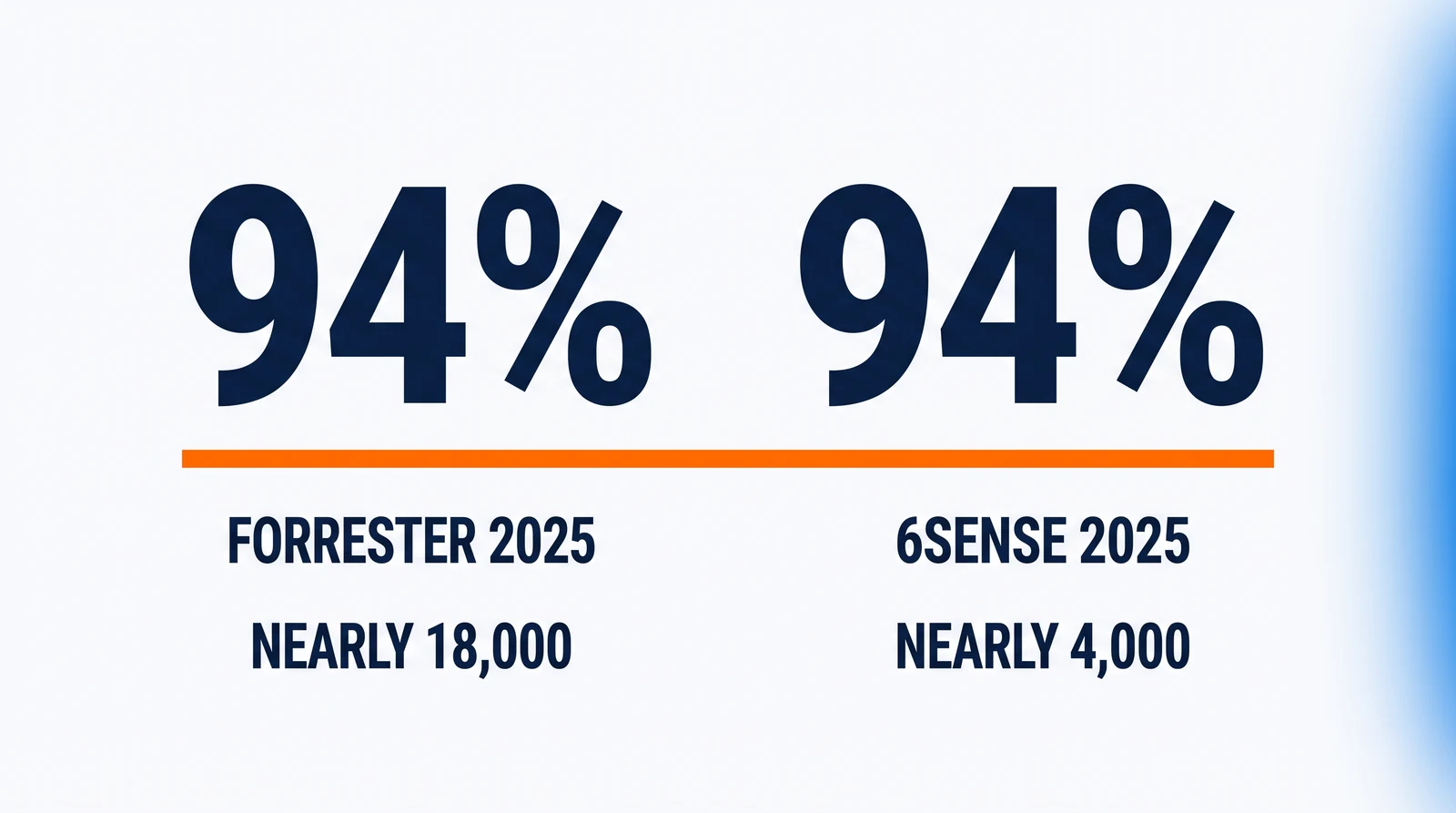
The top result for this question, Geisheker's page, carries both, Forrester's among its key facts and 6sense's further down. A reader skimming it could take one 94% for the other, and nothing in the numbers themselves would warn them.
6sense also describes the kind of purchase its 94% sits inside. Across purchases of physical goods, services and software, the median purchase cost in its data fell between $200,000 and $300,000, and 6sense found that LLM use "does not appear to be diminishing reliance on vendor interactions": respondents had an average of 16 interactions per person with the seller they chose. Its data also shows how early the list of sellers forms: "In 85% of cases — rising to 95% in 2025 — buyers ultimately purchase from one of the four vendors on their Day One shortlist." First contact with sellers came about 61% of the way through the journey in 2025, against about 69% in 2024, by 6sense's count.
Even an owner's headline can drift from its data. 6sense's blog post of 18 November 2025 is titled "94% of B2B Buyers Use AI for Research", while the study's own sentence is about using LLMs during the buying process.
How many start their vendor research in a chatbot?
Half of B2B software buyers in G2's March 2026 poll, 51% of 1,076 decision makers, start their software research in an AI chatbot more often than with Google. G2's release of 15 April 2026, for its study The Answer Economy: How AI Search Is Rewiring B2B Software Buying, puts it this way: "Half (51%) of B2B software buyers now begin their software research with an AI chatbot more often than with Google, up from 29% in April 2025." The respondents were decision makers responsible for, or influencing, purchase decisions, across North America, EMEA and APAC.
Two details decide what that 51% can carry. It is about software, and G2, which runs a software review and data business, asked about software research. And it compares habits: the same release words the finding as beginning "in an AI chatbot rather than a traditional search engine", but starting in a chatbot more often than with Google is not the same as never using Google. In the same poll, 71% said they rely on chatbots for software research, ChatGPT was the main one at 63%, and G2 writes that buyers return to chatbots "at every stage of their journey". The top use was comparing vendor strengths and weaknesses, at 41%.
G2 also reports the closest thing in any of these studies to what chatbot research does to a list of sellers: "Sixty-nine percent of buyers indicated they chose a different software vendor than they initially planned based on AI chatbot guidance." That is a self-report of a change of mind, not a record of which vendors the chatbots named.
Semrush found a start-then-check pattern as well. Among the 519 people in its study who use these tools for work, "41% now start with AI and validate via search", and 75% still use Google or other search engines as part of their research.
How many use AI specifically to research vendors or suppliers?
Semrush and Magenta Associates both put the share at 66%, among two different groups: US professionals who use AI at work, and UK decision-makers. Semrush's survey, published on 8 July 2026, reached 643 US B2B professionals in March and April 2026; 622 valid responses remained after a quality check, and 519 of those said they use such tools for work. Semrush states its base plainly: "All findings below are based on those 519 respondents." Its headline finding is that "66% regularly use AI specifically to research products, vendors, or solutions for their job."
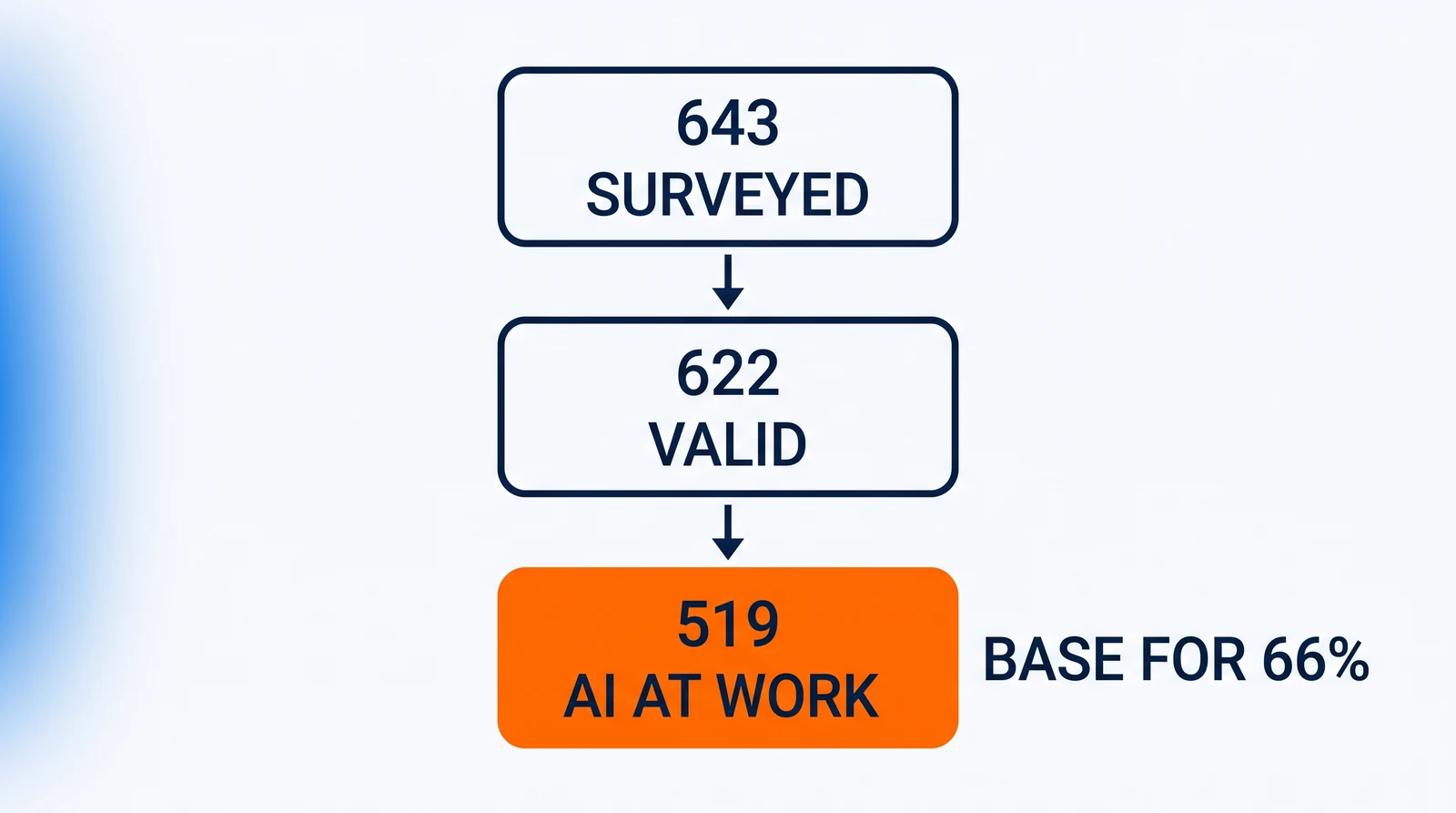
That base belongs with the percentage. On our own calculation from those counts, 66% of 519 is about 343 people, or roughly 55% of the 622 who gave valid answers. Both come from Semrush's data; the difference is only which group the share is taken of, and anyone quoting it as a share of all B2B professionals should know it is 66% of those who already use it at work. In the same study, 61% of those using it for vendor research compare vendors directly, and 92% say AI has shaped their vendor shortlist.
The other 66% comes from the UK. Magenta Associates, a PR agency, published in November 2025 a Search Forward report finding that "Two-thirds (66%) of UK decision-makers already use AI tools such as ChatGPT, Copilot and Perplexity to research and evaluate suppliers." The document does not state its sample size; AI Magazine reported on 3 December 2025 that the study surveyed 300 UK business leaders, and its one line on method describes "a survey of UK marketing professionals". In the same study, "90% of users say they trust AI-generated recommendations", and after discovering a new supplier this way, 79% visited the supplier's website.
The population moves the share as much as the question does. Magenta found that 85% of 25-to-34-year-olds used these tools for supplier research, against 23% of 55-to-64-year-olds.
Where does the 73% come from?
Loganix, an SEO and link-building firm, published the 73% in a paid press release that attributes it to an analysis of AI citations. Loganix's release, dated 3 April 2026, runs on Yahoo Finance under the label "This is a paid press release," and reads: "73% of B2B buyers now use AI tools like ChatGPT and Perplexity in their research process, according to a March 2026 analysis of 680 million citations by Averi." The release presents itself as a synthesis of six published studies, describes Loganix as providing "AI visibility measurement and optimization services", and says "Loganix did not conduct primary data collection for this analysis", which is a fair thing to state plainly.
A count of citations records what AI assistants cited. It does not record what people did, and the release does not explain how an analysis of 680 million citations arrived at a share of buyers. We could not find Averi's own document, so the number reaches us only through the release.
It changes again as it travels. A LinkedIn post on the same results page restates it as the share of B2B buyers who "use AI to research before they contact any business", a timing the release does not state.
Which figure fits the question you are being asked?
Forrester's and 6sense's 94% answer whether buyers use AI anywhere in a purchase, G2's 51% answers where software research starts, and the two 66% figures answer whether people research vendors or suppliers with these tools. Read the grouping below as ours, not a standard:
- Used somewhere in a purchase: Forrester, 94% of nearly 18,000 global business buyers (Buyers' Journey Survey, 2025); 6sense, 94% using LLMs among nearly 4,000 respondents in North America, APAC and EMEA (2025 edition).
- Research started in a chatbot more often than with Google: G2, 51% of 1,076 software decision makers across three regions, polled in March 2026.
- Used regularly to research vendors: Semrush, 66% of the 519 US professionals in its March–April 2026 study who use such tools for work.
- Used to research and evaluate suppliers: Magenta Associates, 66% of UK decision-makers (November 2025; 300 surveyed, as AI Magazine reported).
- The 73%: a paid release's synthesis, attributed to a citation analysis whose own document we could not find.
Every one of the five surveys in that list may be right about what it asked, and all five point the same way. If the decision in front of you rests on whether most B2B buyers now use these tools somewhere in buying, any of the five answers yes; the 73% is left out, for the reason its own section gives. If it rests on whether they build a vendor shortlist inside a chatbot before they visit your website, none of these numbers settles it on its own.
What can a survey of buyers not tell you?
A survey of B2B buyers records what respondents say they did, not what their tools showed them or which vendors those tools named. Each survey percentage above is a self-report counted by the organisation that asked, which is a real measurement of what people say and not a record of their research sessions. The 73% is not one of them: its release credits it to an analysis of citations instead.
Every owner of these numbers also sells something to the marketers who want this answer: a research and advisory firm, a software review site, an SEO software company, a PR agency, a link-building firm and a revenue marketing platform. So do we. That is not a reason to doubt any of them; it is a reason to read the question and the base before the headline, which Semrush's method note and Loganix's own disclaimer make possible.
The neighbouring numbers measure other things again. A forecast of how much people will search is a different kind of measurement from a poll of buyers, as our reading of Gartner's search volume prediction sets out. The share of people using each assistant is not a count of purchasers either, and the published AI search market share figures change with what they count.
The decision about what to do with any of this is yours. The number worth quoting is the one whose question matches the decision you are making; if it arrives without its question, its people and its year, ask for them before building a budget on it. These are the studies we read on 28 September 2026. Forrester and 6sense run theirs every year, G2 has published two waves eleven months apart, and the numbers will move.
Sources
- Forrester, "The State Of Business Buying: Risk-Averse Buyers Demand Proof, Not Promises", Barbara Winters, 21 January 2026: https://www.forrester.com/blogs/state-of-business-buying-2026/ (checked 28 September 2026)
- Forrester, "B2B Buyers Make Zero-Click Buying Number One", John Buten, 22 January 2026: https://www.forrester.com/blogs/b2b_buyers_make_zero_click_buying_number_one/ (checked 28 September 2026)
- 6sense, "The B2B Buyer Experience Report for 2025", 2025 edition: https://6sense.com/science-of-b2b/buyer-experience-report-2025/ (checked 28 September 2026)
- 6sense, "94% of B2B Buyers Use AI for Research", 18 November 2025: https://6sense.com/blog/94-of-b2b-buyers-use-ai-for-research-heres-why-your-demand-gen-team-doesnt-need-to-panic/ (checked 28 September 2026)
- G2, "New G2 Research: Half of B2B Software Buyers Now Start Their Research With AI Chatbots", PR Newswire, 15 April 2026: https://www.prnewswire.com/news-releases/new-g2-research-half-of-b2b-software-buyers-now-start-their-research-with-ai-chatbots-302742807.html (checked 28 September 2026)
- Semrush, "How AI tools shape the B2B buying process: A survey of 600+ US business professionals", 8 July 2026: https://www.semrush.com/blog/how-ai-shapes-b2b-buying/ (checked 28 September 2026)
- Magenta Associates, "Search Forward: How AI is reshaping the B2B buyer journey", November 2025: https://www.magentaassociates.co/wp-content/uploads/2025/11/How-AI-is-shaping-the-B2B-buyer-journey_Magenta-Associates.pdf (checked 28 September 2026)
- AI Magazine, "The New Supply Chain Battle: AI Discoverability", 3 December 2025: https://aimagazine.com/news/the-new-supply-chain-battle-ai-discoverability (checked 28 September 2026)
- Loganix, "73% of B2B Buyers Use AI Tools in Purchase Research, Multi-Source Analysis Finds", paid press release via Yahoo Finance, 3 April 2026: https://finance.yahoo.com/sectors/technology/articles/73-b2b-buyers-ai-tools-231200431.html (checked 28 September 2026)
- Machine Relations, "94% of B2B Buyers Use AI for Vendor Research", 24 March 2026: https://machinerelations.ai/research/b2b-ai-vendor-research-2026 (checked 28 September 2026)
- The Geisheker Group, "How AI Has Changed the B2B Buying Process in 2026", updated 24 September 2026: https://www.geisheker.com/how-ai-changed-b2b-buying-process/ (checked 28 September 2026)
- LinkedIn post restating the 73%, 22 April 2026: https://www.linkedin.com/posts/bringperformance_73-of-b2b-buyers-now-use-ai-to-research-activity-7452510769419563008--OJ3 (checked 28 September 2026)