How do AI assistants recommend products? What their own shopping documentation says
By OpenAI's own account, ChatGPT shows a product when it judges it relevant to what you asked, weighing structured data from merchants and other providers, what the model would already say before it searches, and the company's own policies. Once a shopper clicks an item, ChatGPT ranks the shops selling it on availability, price, quality and whether the shop makes or mainly sells it. Before acting on advice about AI recommendations, the AI assistants' own documents are the first place to look. OpenAI's help page says what goes into a product recommendation and which parts of the result are generated rather than verified. Perplexity and Microsoft publish shorter lists of what they weigh, and Google, in what we read, names relevance. None of them says what earns a recommendation, beyond better chances for merchants who share their data, and the OpenAI text has already changed this year.
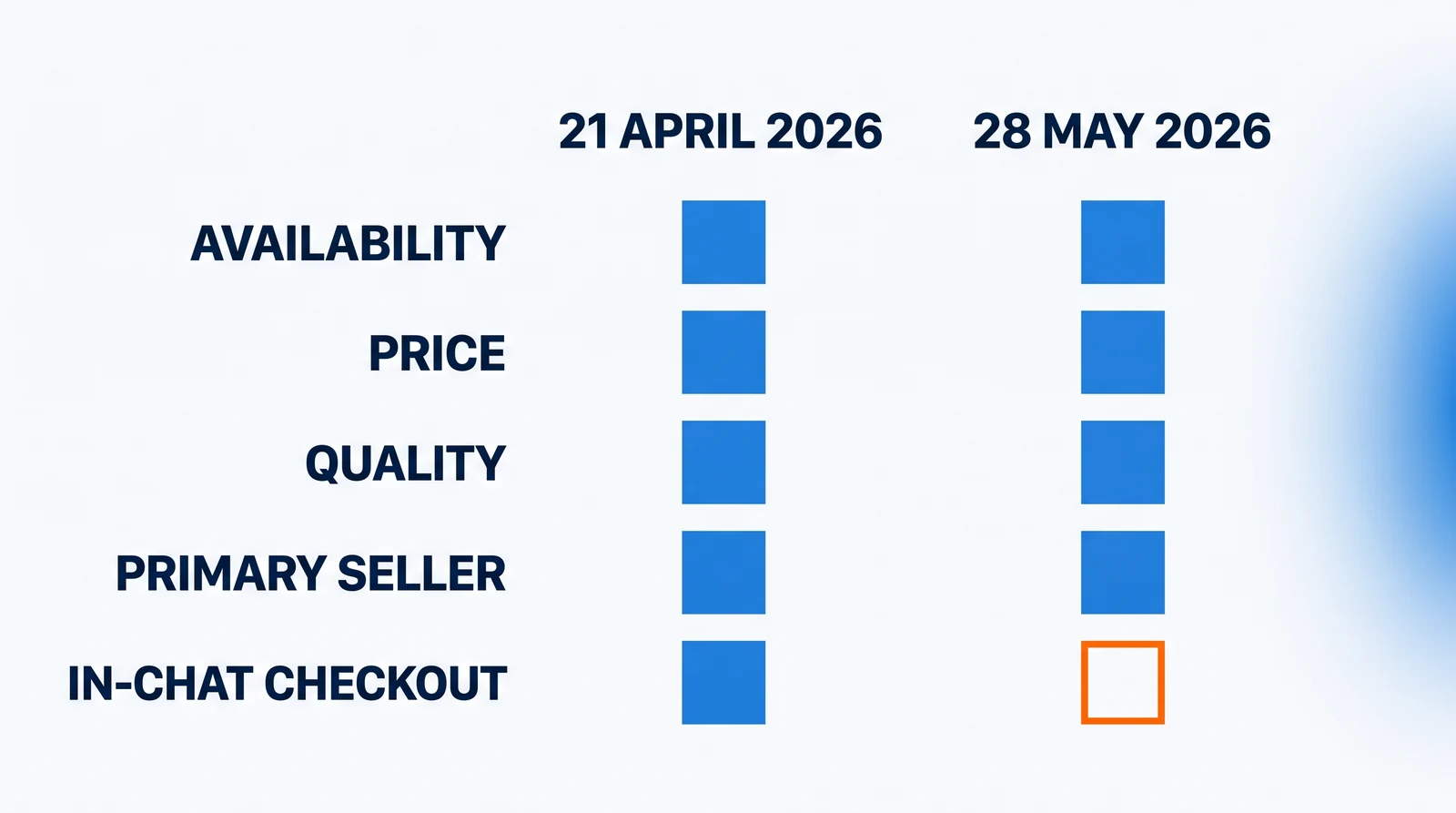
OpenAI's help page changed in 2026 in a way that touched merchants. Until spring, whether a shop offered ChatGPT's in-chat checkout was also one of its merchant-ranking factors; the archived copy of 28 May 2026 no longer includes it, and neither does the live version.
Our software records which pages AI assistants link to when they answer, so the way people believe assistants choose their sources is close to our own market. We have measured nothing about product recommendations. What follows is a read of the companies' own documents, opened on 5 and 6 October 2026, with older wording taken from dated copies in the Internet Archive. Any of them can change after the day we read it.
What does ChatGPT weigh when it picks products?
ChatGPT weighs relevance to your intent above everything else in choosing what to show, by OpenAI's account, and then three named inputs that shape which items it will recommend.
"A product appears in the carousel when ChatGPT perceives it to be relevant to your intent," the page says, and ChatGPT reads that intent from your query and from context such as Memory or custom instructions. The current text dates from 3 October 2026.
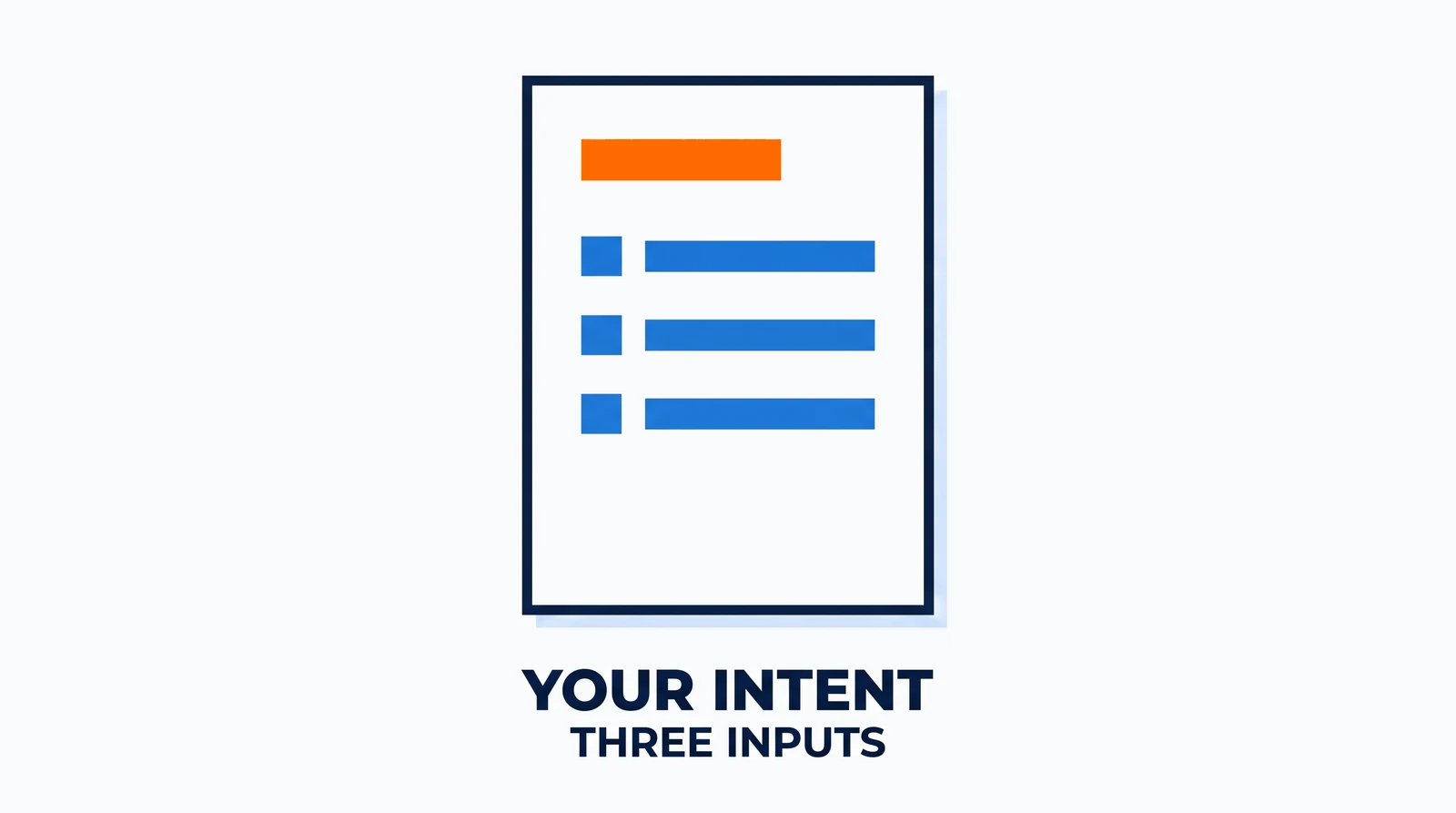
When it decides which items to surface, ChatGPT "considers" three inputs:
- "Structured metadata from first-party and third-party providers (e.g., price, product description) and other third-party content." In plain words: data sent by merchants, data from other companies, and content elsewhere on the web.
- "Model responses generated by ChatGPT before it considers any new search results." We read this as what the model would already say from what it learned in training, before any search runs.
- "OpenAI safety standards and product policies."
The weight of each input changes with what you ask: "Depending on your needs, some of these factors will be more relevant than others." With a budget of $30 (US dollars), ChatGPT will "focus more on price", in the help page's example. In its example about dog costumes, ChatGPT "may consider available options, price, reviews, and ease of use".
The help text names two limits of its own. It warns that "not all available products will necessarily be shown", and that because the model interprets intent, "it can occasionally make mistakes".
The help page lists inputs, not weights. OpenAI never says how much a merchant's data counts against the model's prior answer. Nor does it say how far reviews can move an item up the list.
For an e-commerce team, we read the three inputs this way: only part of the first comes from the shop itself, as first-party data, beside other companies' data and content elsewhere on the web; the second is the answer the model would already give; the third is OpenAI's own policies. A shop's own product information is one input among several, by OpenAI's description. For the kinds of source ChatGPT tends to cite in ordinary answers, as opposed to shopping results, we have looked at that question separately.
Are ChatGPT's product results ads?
ChatGPT's product results are not ads, OpenAI says, and are not shaped by its partnerships; ads appear separately. The help page adds that "Product results are selected independently by ChatGPT".
The company said much the same when it launched in-chat buying. Its announcement of Instant Checkout on 29 September 2025 described the results as "organic and unsponsored, ranked purely on relevance to the user". Merchants using the checkout "pay a small fee on completed purchases", it said, and "Instant Checkout items are not preferred in product results."
The no-ads statement is OpenAI's own claim about ChatGPT, and we cannot check it from outside; nothing we hold tests it.
Which parts of a ChatGPT product result are generated rather than verified?
The generated parts of a ChatGPT shopping result are the shortened title and description, labels such as "Budget-friendly" and the review summary, and OpenAI says it does not verify the reviews or ratings behind them.
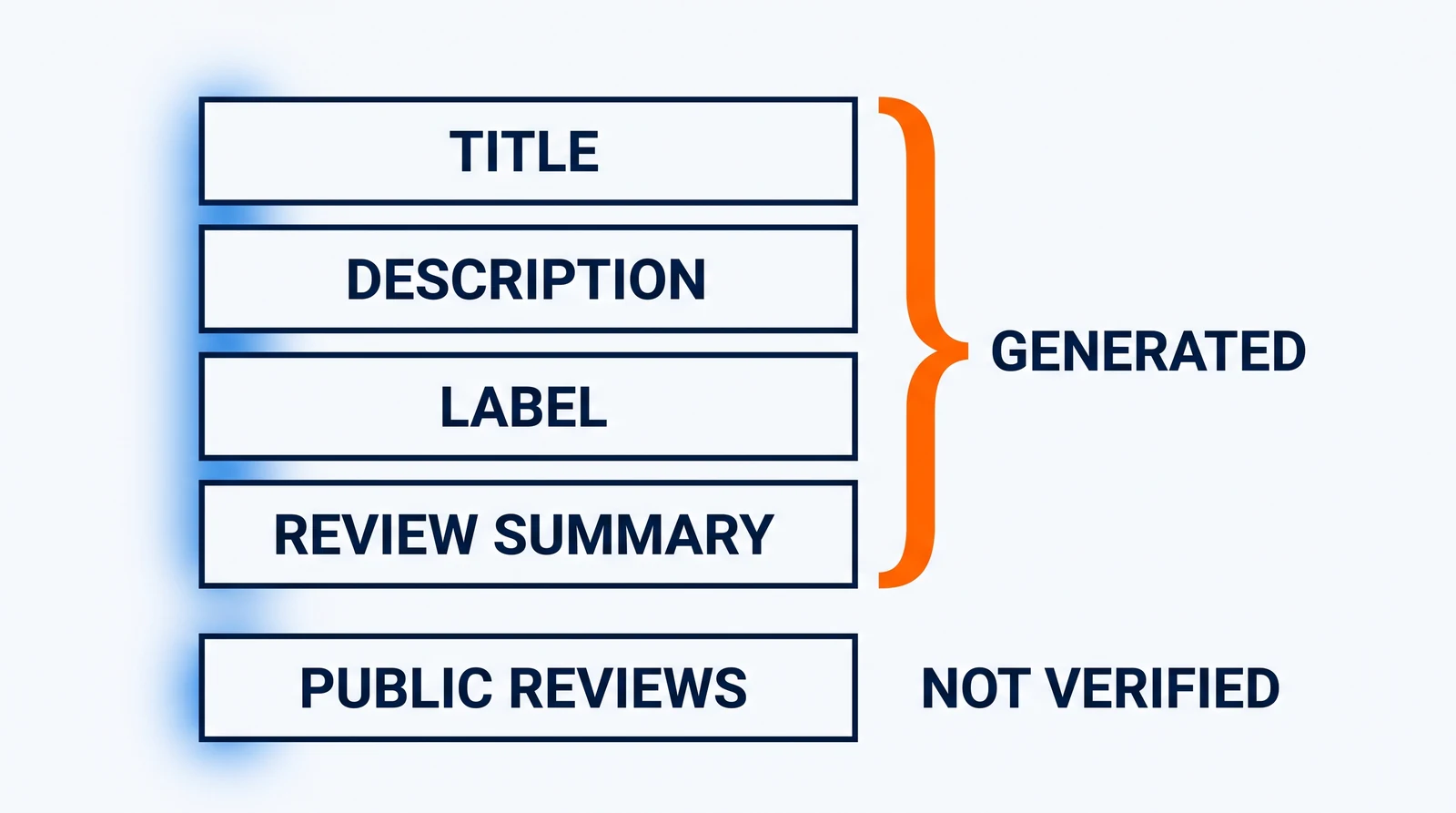
The help text describes each generated piece:
- Titles and descriptions: "ChatGPT may generate simplified product titles and descriptions based on information it receives from third-party providers," because merchants describe the same item in different ways.
- Labels: they are generated by ChatGPT, and "They're not guarantees or verified statements." A "Budget-friendly" label "might mean that reviewers frequently mention good value, not necessarily that it's the lowest price available."
- Reviews: the summaries are "model-generated" and "based on reviews from public websites". Then comes the plain sentence: "Reviews and ratings are not verified by OpenAI."
- Price: the first price shown "may not be the lowest available price". The help text now adds that where another label such as "Instant checkout" applies, the cheapest offer may not carry a "Best price" label.
A shopper who trusts a "Budget-friendly" label is trusting a generated summary, by OpenAI's own description. The practical reading for a shopper is the one the help page gives too: check the merchant's own listing before buying.
For a seller, what reviewers write on public sites can become the words ChatGPT puts beside the item, and nothing in OpenAI's text says those words are checked against the seller's own listing.
How does ChatGPT rank the shops that sell a product?
ChatGPT ranks the shops that sell an item on availability, price, quality and whether each is the maker or primary seller, in the help text's current wording: "Merchants are ranked based on factors like availability, price, quality, and whether they are the maker or primary seller of that item."
That list comes after the choice of what to show: by OpenAI's account, it appears "When a user clicks on a product". OpenAI adds that it expects this to evolve, "such as by personalizing merchant rankings even more to user preferences".
OpenAI's list of merchant factors was longer until spring 2026. The September 2025 announcement named "whether Instant Checkout is enabled" among the factors used when several merchants sell the same item. The help page carried the same clause in every archived copy we read from 14 January to 21 April 2026. The copy of 28 May 2026 does not, nor does any later copy we read, nor the live version on 5 October.
The last archived copy with the clause and the first without it bracket the change; the later one is also the first to carry a sentence saying that Shopify merchants' catalogue data already reaches ChatGPT through Shopify Catalog, and "No additional work is required from individual merchants." The earliest copy we read carries the clause too.
On 24 March 2026, before the edit, OpenAI explained a decision about Instant Checkout. In a post that day about product discovery, it wrote that "the initial version of Instant Checkout did not offer the level of flexibility that we aspire to provide", and that it would let merchants use their own checkout "while we focus our efforts on product discovery". The same post extended its Agentic Commerce Protocol from checkout to discovery: "Through ACP, merchants share product feeds and promotions so their catalogs are fully represented in ChatGPT." The help text does not say why its wording changed, and we do not infer a reason from the dates.
Instant Checkout still appears on OpenAI's help page, as a checkout option rather than a ranking factor. Archived copies show the page describing it as an option that appears "for some eligible products and merchants", beside a caveat that the cheapest offer may lose its "Best price" label to an "Instant checkout" one.
Internet Archive copies are snapshots, so an edit made and reversed between two of them, or made after 5 October, would not be visible to us.
What do Google, Perplexity and Microsoft say about product recommendations?
Google, Perplexity and Microsoft say less than OpenAI about how their AI assistants recommend what to buy, and what they say covers fewer factors, with Perplexity and Microsoft each naming a short list and Google naming relevance. None of the documents we opened from the three sets out, as OpenAI's help page does, which parts of a result are generated rather than verified.
Google's AI Mode bases its organic shopping recommendations on what is "most relevant to a query", Google wrote on 11 February 2026, and Google is testing a separate ad format for retailers, "clearly marked as sponsored". Google's guide to its generative AI features in Search, last updated on 10 July 2026, says AI responses "can include product listings, product information", and that Merchant Center feeds "can help your products and services to be visible" there. Google's guide describes a route into its AI answers, not a rule for ranking what appears in them. The same guide says "Structured data isn't required for generative AI search, and there's no special schema.org markup you need to add." Structured data here means schema.org markup, the code a page uses to label things such as a price or a rating, and we have read the published tests of whether it changes what AI assistants cite separately. On its Shopping tab, which is not AI Mode, Google ranks listings by relevance to the search terms, and advertiser payment may also influence how offers labelled "Sponsored" are ranked, according to its page on how Google Shopping works. The same page says reviews gathered from advertisers and third parties "may have compensated reviewers".
Perplexity's live pages refused our requests, so we read them through Internet Archive copies. Perplexity ranks product listings on criteria similar to those its answer engine uses for sources, "authority and relevance", by its help page on Instant Buy in the latest copy we found, of 19 May 2026. It refines recommendations with past searches, interactions and saved preferences, and decides listings "based on relevance and ratings". It also says merchants who provide "deeper product details such as availability, reviews, pricing, and specifications are more likely to be recommended". Its shopping launch post of 18 November 2024, read through a copy of 23 September 2026, says the cards it shows "aren't sponsored".
Copilot bases the product options it shows on your prompt, "likely engagement", available merchant data and other factors, according to Microsoft's support page on shopping with Copilot, which also says Microsoft "doesn't use potential commissions from other links to influence ranking". Microsoft's Advertising page on agentic commerce, undated when we opened it, puts it this way: "The foundation of agentic commerce is trusted product truth." It says its Merchant Center "will support Universal Commerce Protocol (UCP), enabling richer signals (returns/support policies) so AI can assess products with confidence."
That is four companies and several kinds of document: help and support pages, a search guide, company blog posts and an advertising page. Reading them as one standard for AI recommendations would overstate all of them.
Why don't the guides on this question quote OpenAI's page?
None of the six ranking guides we could read on 5 October 2026 quotes OpenAI's shopping page.
They are six of the eight pages that ranked highest in United States search results for "how do ai assistants recommend products" when we captured them on 17 September 2026; the other two, a forum thread and one company's blog, would not open for us. Most of the six come from companies that sell e-commerce, search or marketing services.
The ranking guides advise the quality and completeness of product data, reviews and ratings, descriptions that match what shoppers ask, and trust signals. Several of those line up with inputs OpenAI names; the guides simply do not cite the source.
OpenAI's shopping help page has been read before: Botify, an SEO software company, summarised its first version on 5 May 2025. What a 2025 reading could not include is the 2026 edit. For a study that compared which pages AI assistants draw on for shopping questions, see our read of the list-format research.
What can a merchant check this week?
Four checks are worth making this week, each tied to an input or a merchant factor OpenAI names: price and stock, the generated words around a listing, who appears as the seller, and what a feed can and cannot do.
- Price and stock. Price is in both of OpenAI's lists, as an example of the data weighed in choosing what to show and as a merchant factor, and availability is on the merchant list. OpenAI also says changes to pricing or shipping can reach ChatGPT with "some delay". Compare what ChatGPT shows a shopper with your own product pages.
- The words around your listing. Labels and review summaries are generated from public reviews and are not verified. Read what ChatGPT says about what you sell, and if something is wrong, use the feedback routes OpenAI documents: the thumbs on each result, the menu for reporting incorrect information, and its report form.
- Whether you are the maker or the main seller. That is a named factor in how shops are ordered once a shopper has clicked an item; OpenAI does not list it among the inputs for choosing what to show. If resellers carry your range, look at which seller appears first.
- A feed, read honestly. OpenAI offers merchants a direct feed, and Shopify stores are already included through Shopify Catalog. The feed documentation itself says of an item's search setting: "Eligibility does not guarantee display."
Keep a dated copy of OpenAI's help page. OpenAI changed its merchant factors in 2026 and updated the page again on 3 October.
Whether a feed, a review programme or nothing at all is worth your money is your call. Nothing in these documents shows that any of them earns a recommendation, and we have not measured it.
Sources
- OpenAI Help Center, Shopping with ChatGPT Search — live page, text updated 3 October 2026 — https://help.openai.com/en/articles/11128490-shopping-with-chatgpt-search — checked 5 October 2026
- OpenAI Help Center, the same page, Internet Archive copy of 14 January 2026 — https://web.archive.org/web/20260114224629/https://help.openai.com/en/articles/11128490-shopping-with-chatgpt-search — checked 5 October 2026
- OpenAI Help Center, the same page, Internet Archive copy of 21 April 2026 — https://web.archive.org/web/20260421113846/https://help.openai.com/en/articles/11128490-improved-shopping-results-from-chatgpt-search — checked 5 October 2026
- OpenAI Help Center, the same page, Internet Archive copy of 28 May 2026 — https://web.archive.org/web/20260528132616/https://help.openai.com/en/articles/11128490-improved-shopping-results-from-chatgpt-search — checked 5 October 2026
- OpenAI Help Center, the same page, Internet Archive copy of 22 June 2026 — https://web.archive.org/web/20260622152221/https://help.openai.com/en/articles/11128490-shopping-with-chatgpt-search — checked 5 October 2026
- OpenAI, Buy it in ChatGPT: Instant Checkout and the Agentic Commerce Protocol, 29 September 2025 — https://openai.com/index/buy-it-in-chatgpt/ — checked 5 October 2026
- OpenAI, Powering Product Discovery in ChatGPT, 24 March 2026 — https://openai.com/index/powering-product-discovery-in-chatgpt/ — checked 5 October 2026
- OpenAI for Developers, Products (product feed reference) — https://developers.openai.com/commerce/specs/file-upload/products — checked 5 October 2026
- Google, What to expect in digital advertising and commerce in 2026, 11 February 2026 — https://blog.google/products/ads-commerce/digital-advertising-commerce-2026/ — checked 6 October 2026
- Google Search Central, guide to generative AI features in Google Search, last updated 10 July 2026 — https://developers.google.com/search/docs/fundamentals/ai-optimization-guide — checked 5 October 2026
- Google Shopping Help, How Google Shopping works — https://support.google.com/googleshopping/answer/9128904?hl=en — checked 5 October 2026
- Perplexity Help Center, What is Instant Buy?, Internet Archive copy of 19 May 2026 — https://web.archive.org/web/20260519092651/https://www.perplexity.ai/help-center/en/articles/10352906-what-is-instant-buy — checked 6 October 2026
- Perplexity, Shop like a Pro, 18 November 2024, Internet Archive copy of 23 September 2026 — https://web.archive.org/web/20260923162915/https://www.perplexity.ai/hub/blog/shop-like-a-pro — checked 5 October 2026
- Microsoft Support, Shopping with Microsoft Copilot — https://support.microsoft.com/en-us/microsoft-copilot/shopping-with-microsoft-copilot — checked 6 October 2026
- Microsoft Advertising, Agentic commerce — https://about.ads.microsoft.com/en/solutions/technology/agentic-commerce — checked 5 October 2026
- Botify, What we have learned about ChatGPT's enhanced shopping experience, 5 May 2025 — https://www.botify.com/insight/what-we-have-learned-about-chatgpt-enhanced-shopping-experience — checked 5 October 2026