Does ChatGPT favor big brands? What a new study found about the names it already knows
In the study we read, ChatGPT favoured the brands its model already knew, and a familiar name could also count against a product. The study measured what the model knew, not company size. A preprint by two University of Toronto researchers found that the model writes companies it knows into its own web searches and mentions some with no supporting page at all. In a test with the facts held equal, the cable provider Spectrum lost ground once it was named, on questions about fiber internet.
The paper, by Mahe Chen and Nick Koudas, was submitted on 10 October 2026 and has not been peer reviewed. The study rests on two 90-day collections of answers to commercial questions in two US markets, home internet and proposal software for architecture, engineering and construction firms: 158,099 answers with 468,037 citations. "ChatGPT" in the paper means OpenAI's public API running GPT-5.4 nano with its web search tool, not the ChatGPT app, and the authors warn that the API need not behave like the app. This page claims nothing for GPT-6, which the company's release notes date in ChatGPT to 7 October 2026.
Our interest, stated early: LiamVi makes software that keeps a record of the sources AI assistants link to, so the companies those answers mention matter to our own work. We have measured nothing about brand mentions ourselves, so each figure here is credited to whoever published it, and everything we read is listed at the end.
What did the study measure?
The Toronto study measured which pages the engines cited over 90 days, which searches ChatGPT ran when the same questions were sent again, and what its model would recommend with no search at all.
The 651 home-internet questions were written for a US fiber internet provider, in a market the paper describes as "dominated by a few large brands". The 55 software questions were written for a small B2B vendor. The two question sets went to ChatGPT, Gemini and Perplexity through their public APIs once a day from 24 June to 21 September 2026.
The authors then sent the questions again, 13 times on 11 days up to 7 October 2026. The API shows the queries the model typed and the pages it got back. Separately, the researchers asked each model, with search switched off, which companies and websites it would recommend for every question. The paper calls that list the model's prior.
The important limit is that the questions are English queries about the US market, written for clients of the authors' monitoring platform rather than drawn from what people actually type.
How do brands get into ChatGPT's searches?
The model itself puts brands into its own searches, and it adds companies it already knows far more readily than others. That is the pattern in the replay of the home-internet questions, each split into about four keyword searches.
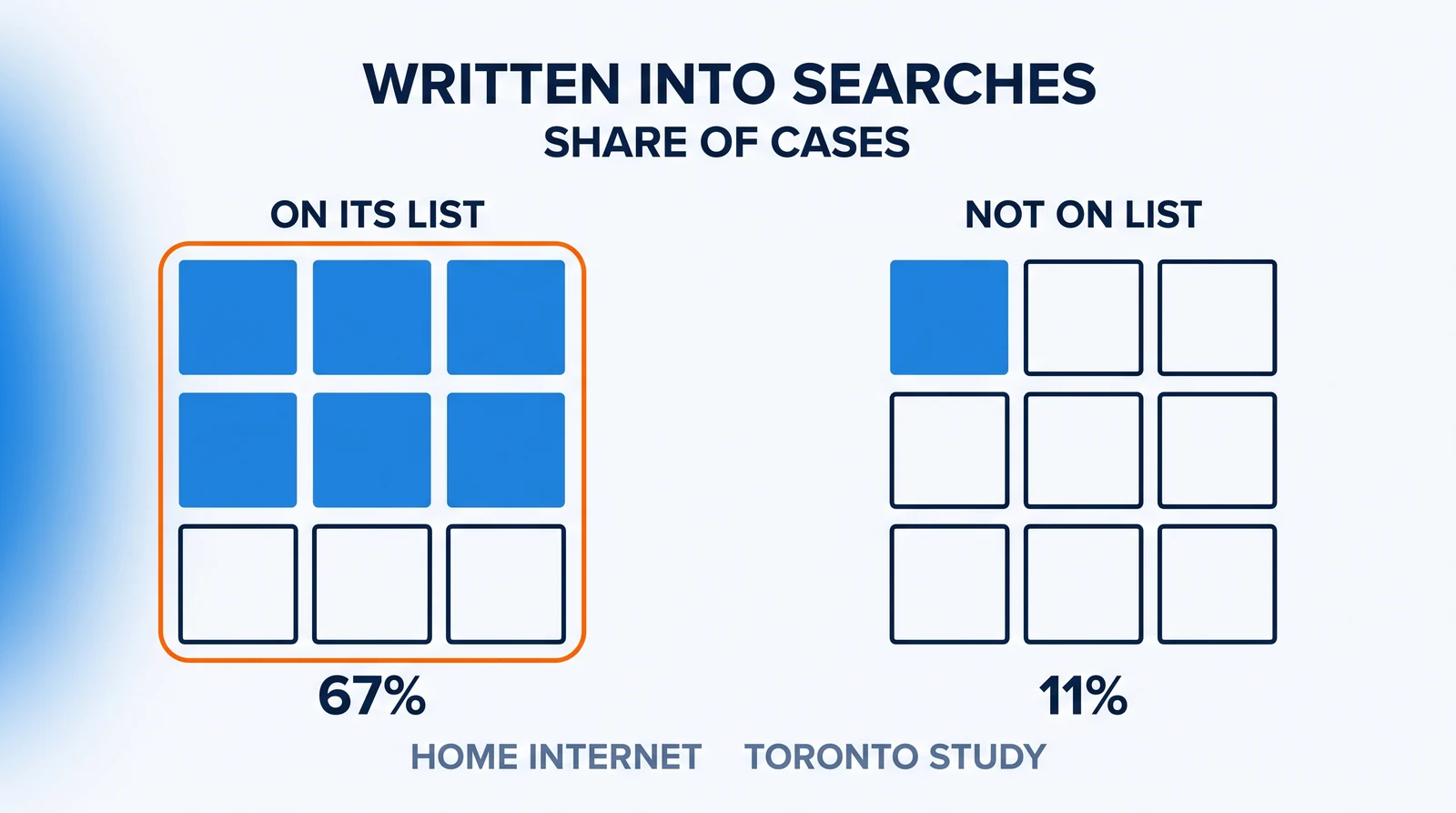
A brand the user had not named appeared in 28% of ChatGPT's search queries; Gemini did the same in 5% of its own. When a company was on the model's no-search list for a question, the model wrote it into its searches in 67% of cases, against 11% of cases when it was not.
At the same position in the model's list of results, a website it already knew had 1.60 times the odds of being cited. Every one of the 22,315 pages cited in the replay was a page the model's own searches had returned.
Those searches rarely found the pages Google finds, though often the same websites. Of the pages the model retrieved, 97% were absent from Google's top 50 results for all of the answer's queries, while the websites of 51% of them did appear there. A high Google ranking, the usual SEO measure, is no stand-in here: "a good rank in classic search is not a proxy", the authors write.
The small-vendor market behaved differently. There the model wrote a brand into 3% of its queries and learned vendor names from a first round of results instead. Training and live search are separate routes into an answer, the same two routes a Wikipedia page can take.
Can ChatGPT mention a brand without citing a page?
In this study, brands in the model's answers were often named with no cited page behind them. Of the model's mentions of a brand the user's query did not include, 46% had no cited page that named that company.
A brand on the model's own list was mentioned with 5.8 times the odds of one that was not, at the same level of support from cited pages. The authors sum up the finding this way: "Pages are thus cited when searched; brands are also named when remembered."
Our reading, not the paper's: a report that counts only the pages an answer links to will miss every mention that arrives with no page behind it.
What happened when the facts were held equal?
Revealing which brands were which was enough to move a product in or out of the model's top three, even when every product was described in the same format and length.
The authors built 60 packets, each a real query with five products. Each product had a profile of 150 to 195 words, written by a second OpenAI model, GPT-5.4 mini, from the brand's own pages with rival names removed, plus one excerpt from a third-party source. Brand names and publisher names were hidden or shown independently, across 1,920 answers. The model ran without search, on these fixed inputs only.
Because every answer's top three is always full, the authors compared each product's change in top-three rate with the change between two identical prompts. For ChatGPT's model, showing brand names moved the rates 2.1 times as much as plain repetition did, and showing publisher names 1.3 times as much.
The direction depended on who was named. On that model, Spectrum's top-three rate fell 33 points once named; the paper reports Google Fiber gaining 12 and Loopio, a small software vendor, 16. In the authors' words, "The name brings in what the model believes about the brand; a cable provider is ranked lower for fiber questions on identical facts."
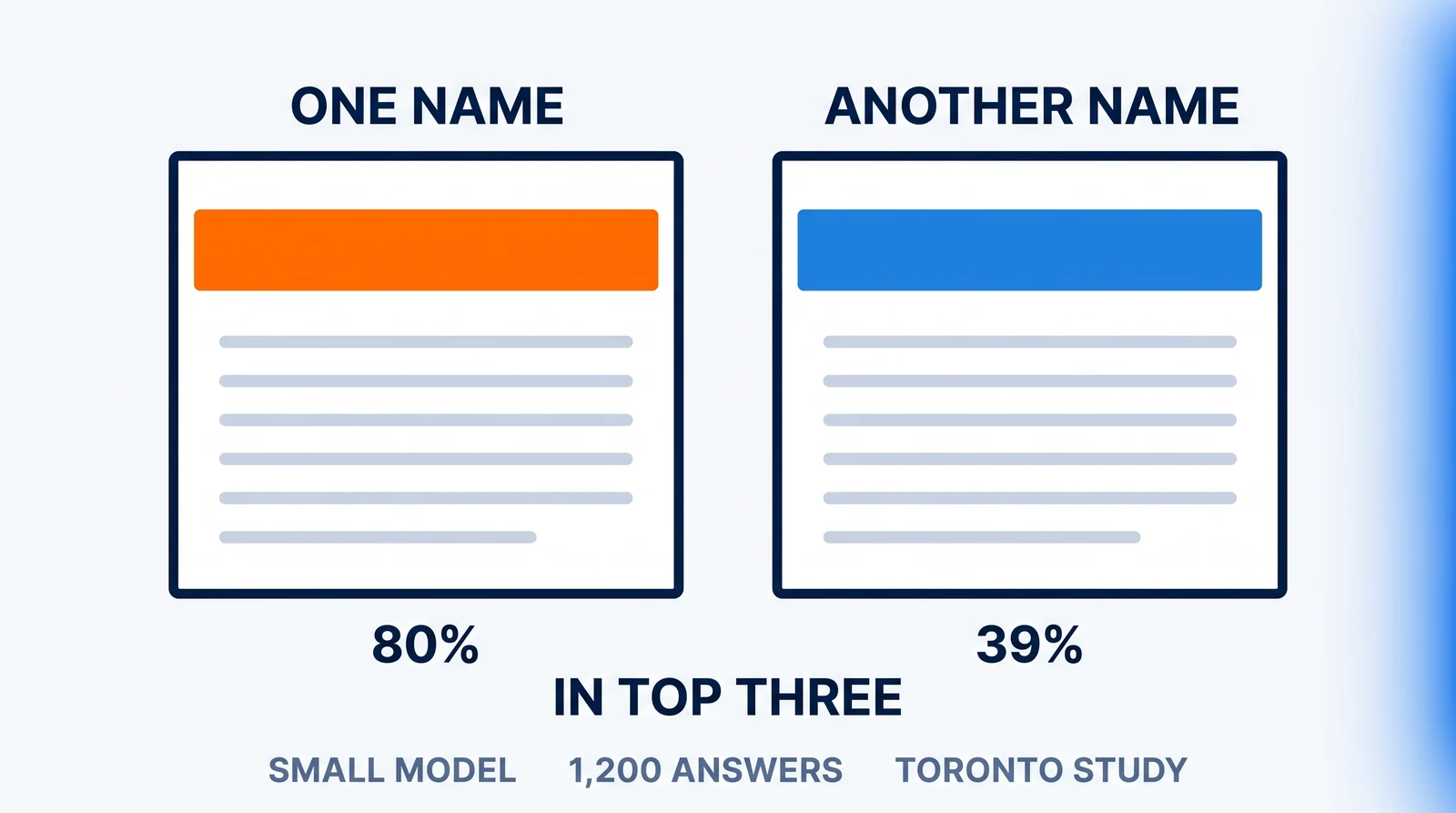
A second version told the model that the names had been assigned at random and carried no information. The model still put the same profile in its top three in 80% of answers under one name and 39% under another, across 1,200 answers.
The authors' own caveat belongs beside every figure here: "We stress that these experiments measure the small models behind the engines on constructed inputs." The test shows what a name does to a model's choice on fixed facts. It does not show what the app does with a live search.
Is favoring known brands the same as favoring big ones?
What the study measured is whether the model knows brands, not how big they are, and it cannot fully separate the two. The authors say so themselves: known brands "also differ in size, coverage and links".
For an established company, the authors write, visibility "is largely set by what the model already believes", and on identical facts the Spectrum result shows that belief can cut both ways. Outside those fixed-facts tests, the paper calls its results "associations".
Across websites, five authority measures went with 21% to 30% more citations for each standard deviation, but once the number of a site's cited pages was held fixed, the link turned slightly negative. In the paper's words, "authoritative websites have more cited pages, not more citations per page." In the small-vendor market, authority had no measurable impact at all. Our own small test points the same way for citations, though not for mentions: across 21 matched pairs, higher-authority domains won 11 of the pairings and lost 10, a sample that, as our research page says, cannot rule out a small effect.
Earlier studies found a preference for familiar names too. Kamruzzaman, Nguyen and Kim reported at EMNLP 2024 that models associated global brands with more positive attributes than local ones. Chu and Hou's preprint Incumbent Advantage, testing skincare products on three commercial models, reported that well-known brands won every recommendation in their tests when specifications were identical, and lost that lead to a competitor with a rating edge of under a tenth of a star. We read both in their abstracts only.
What do the top results for this question say?
Every page we could read among the top results for this question, from MaxAEO and Everything-PR among others, was published before the Toronto study, and most give advice rather than a test.
MaxAEO's founder Chris Han reports a field study in a July 2026 article: 1,248 English-language prompts across 52 B2B software and technology categories, on eight AI products including ChatGPT, for 139,776 answer observations over 14 days in May and June 2026. In that study, employee count, company age and funding explained 22% of the variation in how often brands were mentioned, and adding citation footprint and prompt-specific proof raised that to 41%. The article's headline answer is that "ChatGPT Favors Evidence-Rich Brands More Than Big Brands", and it describes itself as an observational study that "does not claim access to ChatGPT's private ranking logic".
Everything-PR, in a July 2026 article by Ronn Torossian, reports a citation audit by 5W, a firm that combines public relations and digital marketing and shares an ownership group with Everything-PR, as the article discloses. On "a rotating 400-prompt panel", brands with three or more "Tier 1 national placements" in the prior 12 months appeared in ChatGPT category answers at "roughly 3.4x the rate" of brands with only trade-press or owned coverage. The same article says the brands that lose "rely on paid search".
Our reading: the Toronto chain fits beside both explanations and tests neither article's advice.
What can a smaller brand check?
Smaller brands can check two things from what OpenAI documents and what this study measured, and neither is a promise of being mentioned.
The first is the searches. OpenAI's web search guide for developers says a search action "will usually (but not always)" include the queries the model ran. Send the questions buyers in your category ask through the API with the web search tool switched on, and see whether you appear in those searches or only your competitors' do. That is the route the study used, not the app.
The second is the pages. Is there a page, yours or one from a third party, that names you and answers the question in your category? In the small B2B vendor market, a cited third-party page naming a vendor raised the odds that the answer mentioned it 39.7 times; in the home-internet market the same figure was 4.2 times.
The authors also offer a hypothesis, that changing what a model believes about a company might be an effective strategy, and stress that they have not tested it. OpenAI's shopping help page counts the model's own earlier answer, "Model responses generated by ChatGPT" before any new search results come in, among the inputs to its product picks. For FAQ blocks and structured data, which the same paper finds "appear effective only across websites", see what the FAQ evidence shows and what the schema studies tested.
Whether either check matters for an SEO or content team depends on the questions your buyers ask, and that decision is yours. We will read the paper's next version and any second controlled test, and say what changes.
Sources
- Mahe Chen and Nick Koudas, "What Drives AI Citations? Content, Retrieval and Model Knowledge in Generative Engine Optimization (GEO)", arXiv 2610.15033, v1 of 10 October 2026 (checked 20 October 2026) — abstract https://arxiv.org/abs/2610.15033 · full text https://arxiv.org/html/2610.15033
- OpenAI, ChatGPT release notes, entry of 7 October 2026 (checked 20 October 2026) — https://help.openai.com/en/articles/6825453-chatgpt-release-notes
- OpenAI, "Web search" guide for the API (checked 20 October 2026) — https://developers.openai.com/api/docs/guides/tools-web-search
- OpenAI Help, "Shopping with ChatGPT search" (checked 20 October 2026) — https://help.openai.com/en/articles/11128490-shopping-with-chatgpt-search
- Xi Chu and Yupeng Hou, "Incumbent Advantage: Brand Bias and Cognitive Manipulation Dynamics in LLM Recommendation Systems", arXiv 2606.17443, v3 of 10 October 2026, abstract (checked 20 October 2026) — https://arxiv.org/abs/2606.17443
- Mahammed Kamruzzaman, Hieu Minh Nguyen and Gene Louis Kim, "Global is Good, Local is Bad?: Understanding Brand Bias in LLMs", EMNLP 2024, arXiv 2406.13997, abstract (checked 20 October 2026) — https://arxiv.org/abs/2406.13997
- MaxAEO, Chris Han, "Does ChatGPT Favor Big Brands? Evidence and 2026 Tests", 8 July 2026 (checked 20 October 2026) — https://maxaeo.ai/blog/does-chatgpt-favor-big-brands/
- Everything-PR, Ronn Torossian, "Inside ChatGPT's Brand Bias: How OpenAI's Engine Picks Winners", 6 July 2026 (checked 20 October 2026) — https://everything-pr.com/inside-chatgpts-brand-bias-how-openais-engine-picks-winners
- LiamVi, Research: our methods, samples and limits, last updated 12 August 2026 (checked 20 October 2026) — https://liamvi.com/research/
- The results we read for "does chatgpt favor big brands", US search, 19 October 2026: MaxAEO, a LinkedIn post by Gareth Hoyle, a Reddit r/ChatGPT thread, Everything-PR, Be Found Online, simple.ai and Kantar.