Bing Webmaster Tools AI performance report: the citations Microsoft can see, not every assistant's
The AI Performance report in Bing Webmaster Tools counts citations. Microsoft's launch post of 10 February 2026 describes the tab as "a new set of insights that shows how publisher content appears across Microsoft Copilot, AI-generated summaries in Bing, and select partner integrations". Its headline number is "the total number of citations that are displayed as sources in AI-generated answers during the selected time frame". The same post promises: "For the first time, you can understand how often your content is cited in generative answers". Microsoft added Intents, Topics, Citation Share and Compare on 16 June 2026. None of the three Microsoft documents we read names any of those partners, so we do not guess at them.
We make software that records which sources AI answers cite, so we have a stake in how people read this dashboard. We have not measured Copilot citations, and we hold no Bing export for our own site, so this page reads what others published. It draws on Microsoft's three documents on the tab, Google's help article on its own report, two readings of Bing's data and four write-ups comparing the two consoles, all opened on 29 September 2026.
What does the AI Performance report in Bing Webmaster Tools count?
The AI Performance report counts how often your content was visibly shown as a source inside an AI-generated answer, and which URLs were shown. Microsoft's help documentation defines Total Citations as "the total number of times your content was visibly referenced or shown as a source in AI‑generated answers during the selected date range". Beside it sit the number of your URLs cited per day, their daily average across the range, and a count for each URL.
The launch post is unusually plain about what these numbers are not. The total comes "without indicating placement or presentation within a specific answer", and the URL counts reflect "how often pages are cited, not page importance, ranking, or placement". The documentation adds: "AI Performance does not measure rankings, authority, performance, or importance. It simply shows which content was cited." Microsoft calls the release "an early step toward Generative Engine Optimization (GEO) tooling", and a first-party tool that states its own limits this clearly deserves credit for it; CXL adds that the report "is available now at no cost".
The count is not a full record either: the data "is not a complete log of every instance where content may have been referenced", and "Very low or infrequent citation activity may not surface." Totals can also differ between the URL view, the phrase view and the timeline. The tab covers 7 days, 30 days, 3 months or a custom date range, and exports to CSV or Excel.
What is a grounding query, and why is the list a sample?
Grounding, in Microsoft's update of 16 June 2026, is "the source material and web evidence the system uses to support and cite its response". A grounding query is one of "the key phrases the AI used when retrieving content that was referenced in AI-generated answers", so the list shows grouped versions of the phrases the assistant searched with on its way to your content, not what a person typed. The help article says so directly: these phrases "are not full user questions or prompts".
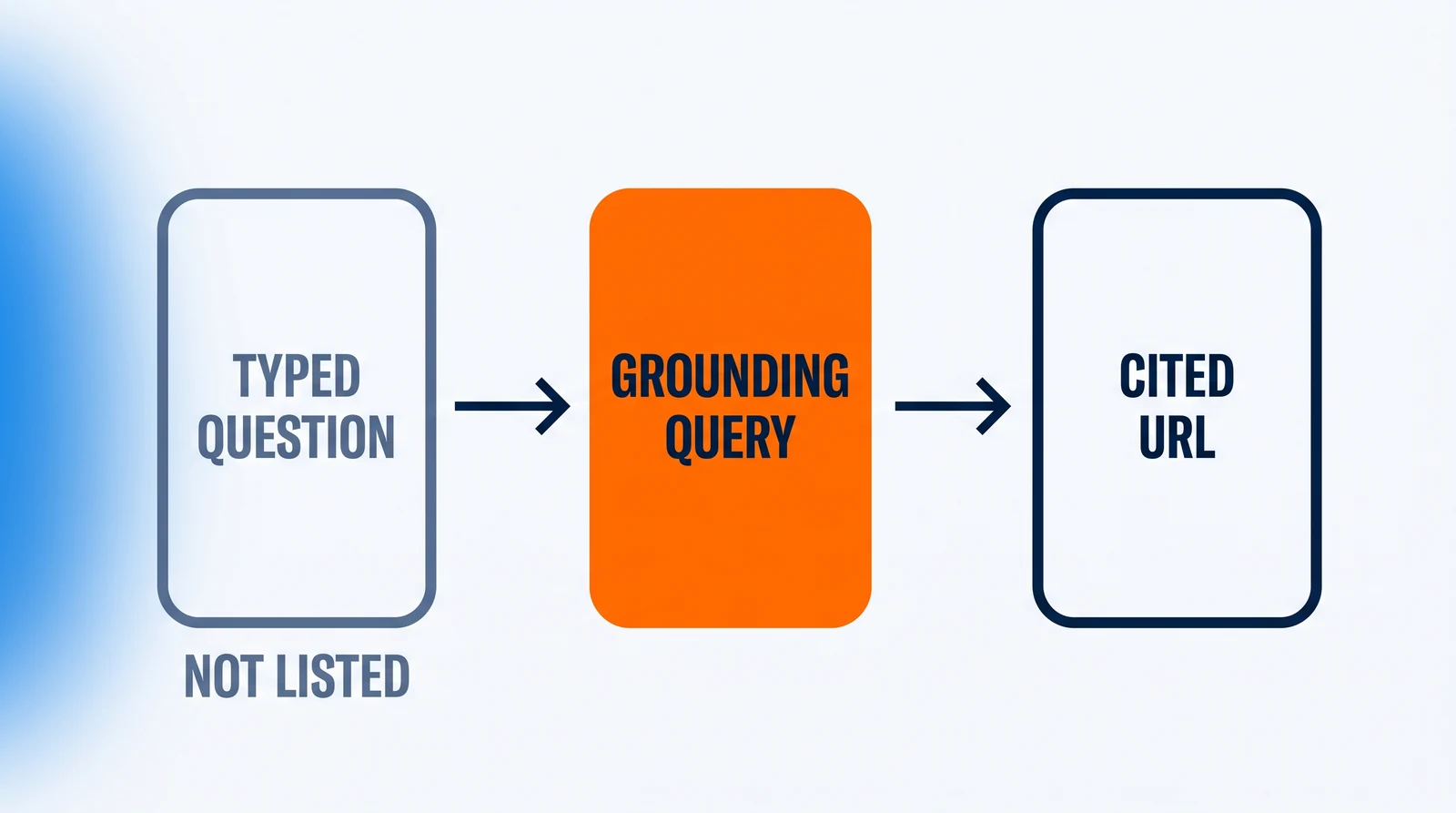
The grounding list is partial by design, because the February post says it "represents a sample of overall citation activity" and the documentation explains that phrases and URLs "may each be sampled over slightly different time windows". The same URL under the same phrase can show one count when you filter by the phrase and another when you filter by the URL. Microsoft says this "does not indicate missing or incorrect data". A single row is therefore a weak basis for a decision.
Since June, two classifier labels, both still in preview, sit on each grounding query. Intents sort phrases by query intent into classes such as Informational, Commercial, Research and Learn and Solve, and Topics gather related phrases into themes; the June post's own note is that "some labels may still be broad".
What does Citation Share measure?
Citation Share, added on 16 June 2026, is your site's citations for one grounding query divided by all citations shown across all sites for that same query. The June post calls it "an observational metric – not a ranking system or a competitive scoreboard", and the help article confirms it does not reveal which other sites hold the rest.
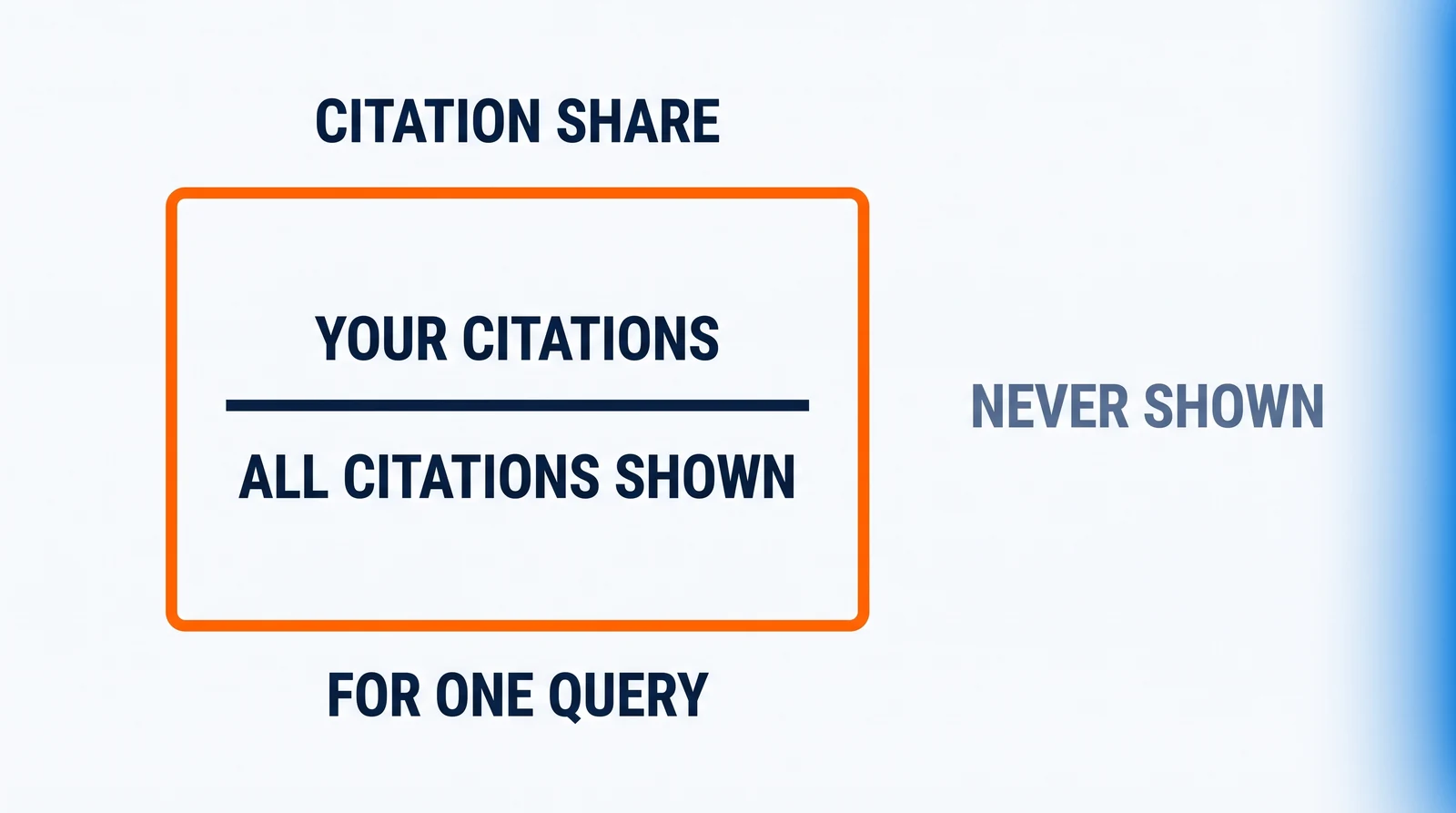
A share of the sources already shown for one phrase tells you how those shown sources were split; it is not the chance that your URL gets picked when someone asks, because everything that was never shown sits outside the count. Compare, the fourth June addition, lays an earlier period over the current view, and Microsoft's FAQ says it "does not explain why the change happened".
Does the Bing report show what other assistants cite?
Microsoft's documentation does not claim that its count reflects assistants beyond Microsoft Copilot, Bing's AI summaries and its unnamed partners, and none of the write-ups we read measured whether it does, ourselves included.
Edward Sturm reads the data more widely in a post of 16 February 2026: "The way that I look at Bing data is as a small representation of Google data." His reasons are that Bing results are often close to Google's and that the large models' "overall outputs are often broadly similar", and he concludes that fixing gaps in Microsoft's coverage means "you're really fixing weak spots in all your AI coverage". That may prove true for some sites. His post offers no measurement for the step from one assistant to all of them, though, so it stays a reading rather than a finding.
Search Influence's export, the most detailed public one we found, reads its own numbers more narrowly. The firm pulled 91 days for its own site, 12 November 2025 to 10 February 2026: 19,717 citations across 86 URLs, one of them taking 69% of those 19,717, and a daily average that fell from 1,520 over 1 to 8 December to 34 in February, which it covered only to the 10th. The firm's own caveat is "This is Copilot only", although the definition also counts Bing's summaries and the partners. It is one site's account of its own content. CXL, after testing the report on its own site, reached a similar view: "the data is real, but it's not representative".
Each published index of cited domains is built from its own assistants and dates, and beyond a small shared core of domains their rankings reorder with the method. A count taken from Microsoft's surfaces is one more such set.
How does it compare with Google's generative AI performance report?
Google's generative AI performance report and Bing's AI Performance report both start from a link to your site inside an AI answer, and the two reports count that link differently.
- Google's Search Console report counts impressions, "how many times links to your site were shown to a user in a generative AI feature on Google Search", for AI Overviews and AI Mode, per the Search Console help article. Two results from one site in the same feature count as one impression in the chart total, the data is grouped by URL, country, date and device with no phrase attached, and the report reached all websites worldwide on 31 August 2026.
- The Bing Webmaster Tools report counts each time your content is displayed as a source in answers on Copilot, Bing's AI summaries and the unnamed partners, per URL and per day, with a sampled list of grounding queries beside it.
Neither documents ChatGPT, Gemini or Perplexity as a surface it covers: Google lists its own two features, and Microsoft names no surface beyond Copilot and Bing's summaries. We have looked separately at what Google's report shows, and what it leaves out.
Others set these two consoles side by side before we did. AEO Table did it on 22 July 2026 and put the point in six words: "An impression is not a citation." Neoval (21 September 2026), JQ AI Systems (23 June 2026) and CXL make related comparisons. AEO Table and Neoval sell AI-visibility monitoring, much as we sell citation software, and their reading of the two reports matches the documentation we opened.
Where does our impressions rule stop?
Our published read that an impressions console cannot tell you whether an AI answer cited you stops at Bing's report. We wrote it in our guide to AI and search optimization and marked it there as a read rather than a measurement. It describes a console that counts how often a link was shown to someone, which is what Google's generative AI report does. Bing's counts the citations themselves, so the read does not describe it, and we would rather say so here than leave it to be read more widely than it holds.
Three limits still apply to the Bing count, and they are Microsoft's rather than ours: it covers only the answers Microsoft reports on, it is sampled, and it shows no clicks.
What people ask about the report
Do citations in the report mean clicks?
A citation in Bing's AI Performance report is not a click, as the help article's FAQ puts it: "A citation indicates that your content was visibly referenced or shown in an AI-generated answer. It does not represent traffic, clicks, or user engagement."
Can I see which other sites were cited?
Bing's Citation Share hides the other cited sites: it gives your percentage of a phrase's sources, but it "does not expose competitor domain names or identify which other sites hold the remaining share".
How do you measure AI performance in Bing Webmaster Tools?
Microsoft offers one measure: the count of times your content was shown as a source on its supported surfaces, read in the AI Performance tab for a verified site over a date range you choose. Export the URLs and grounding queries to work with them. None of it explains why a count moved: the documentation says the trends "cannot be attributed to a specific cause or event".
What the tab can carry, then, is which of your URLs the answers Microsoft reports on cite, on which phrases, and how that changes over time. It cannot carry clicks, other assistants, or the cause of a change. How much weight it deserves depends on how many of your readers use Copilot and Bing, which is yours to judge: your analytics can show visits those surfaces send when the referral survives, not readers who saw a citation and never clicked.
Sources
- Microsoft Bing Webmaster Blog — "Introducing AI Performance in Bing Webmaster Tools Public Preview", 10 February 2026 (Krishna Madhavan, Meenaz Merchant, Fabrice Canel, Saral Nigam): https://blogs.bing.com/webmaster/2026/2/Introducing-AI-Performance-in-Bing-Webmaster-Tools-Public-Preview/ — checked 29 September 2026
- Microsoft Bing Search Blog — "New AI Visibility Insights in Bing Webmaster Tools: Intents, Topics, Citation Share, Compare", 16 June 2026: https://blogs.bing.com/search/June-2026/New-AI-Visibility-Insights-in-Bing-Webmaster-Tools-Intents-Topics-Citation-Share-Compare — checked 29 September 2026
- Bing Webmaster Tools Help — "AI Performance" (the page carries no date): https://www.bing.com/webmasters/help/ai-performance-9f8e7d6c — checked 29 September 2026
- Google Search Console Help — "Generative AI performance report (Search)", rolled out to all websites as of 31 August 2026: https://support.google.com/webmasters/answer/16984139 — checked 29 September 2026
- Search Influence — "Inside Bing's New AI Performance Report: What 20,000 Copilot Citations Taught Us", Will Scott, 12 February 2026: https://www.searchinfluence.com/blog/bing-ai-performance-report-copilot-citations/ — checked 29 September 2026
- Edward Sturm — "How to Use Bing's New AI Performance Report to Get More LLM Citations", 16 February 2026: https://edwardsturm.com/articles/bing-webmaster-tools-ai-performance-report-grounding-queries-get-more-llm-citations/ — checked 29 September 2026
- CXL — "Tracking AI Visibility With Bing Webmaster AI Performance Reporting", Tarek Reslan, 27 February 2026, updated 26 August 2026: https://cxl.com/blog/bing-ai-visibility-tracking-webmaster-tools/ — checked 29 September 2026
- AEO Table — "Google vs Bing AI Visibility Reports: 2026 Metrics & Gaps", 22 July 2026: https://www.aeotable.com/en/blog/google-vs-bing-ai-visibility-reports — checked 29 September 2026
- Neoval — "Google and Bing now report AI visibility. What are they still not telling you?", Zakarya Chami, 21 September 2026: https://neoval.net/blog/what-google-and-bing-ai-visibility-reports-do-not-tell-you — checked 29 September 2026
- JQ AI Systems — "Google Search Console vs Bing Citation Share: What AI Visibility Can You Actually Measure Now?", 23 June 2026: https://www.ai.joaoqueiros.com/blog/google-search-console-vs-bing-citation-share-ai-visibility — checked 29 September 2026
- LiamVi — "AI and search engine optimization in 2026": https://liamvi.com/blog/ai-and-search-engine-optimization — checked 29 September 2026
- LiamVi — "AI Mode citations: which question each published number answers": https://liamvi.com/blog/ai-mode-citations — checked 29 September 2026
- LiamVi — "Most cited websites by AI models": https://liamvi.com/blog/most-cited-websites-by-ai-models — checked 29 September 2026