The best AI search optimization platform for beginners: a plain-language guide from people who measured it
If you are new to all of this, here is the honest starting point: the best AI search optimization platform for a beginner is one you can verify exists, that separates mentions from citations, and that shows you who gets named instead of you. On 3 August 2026, five platforms — Profound, Peec AI, Otterly.AI, Semrush and Ahrefs — held the citations for this exact keyword, and we can tell you what each one is. We build one of these tools ourselves, we are not among those five, and this guide exists because almost everything a beginner gets told in this field is asserted rather than measured. We measured. This is the translation.
What is AI search optimization, in plain language?
AI search optimization is the work of getting AI search engines and assistants — ChatGPT, Gemini, Perplexity, Google's AI Overviews and AI Mode — to name or cite your site when people ask about your field. That is the whole idea. Everything else is vocabulary, and the vocabulary is worth two minutes because every article you open will assume it.
GEO stands for generative engine optimization — the industry's label for exactly the job above, the way SEO was the label for the results-page era. A GEO tool and an AI search optimization platform are, today, mostly the same product wearing two labels. You will also see AEO, answer engine optimization — the same job again.
AI visibility is whether you appear in AI answers at all. Classic SEO measures your position on a search engine results page — Google's ten blue links; an AI search engine has no results page to hold a position on — only an answer that either names you or does not. Rank is a position on a search engine. AI visibility is presence in an answer. If you have never done SEO, you are not missing a prerequisite: in our data, position on the results page did not decide presence in answers.
Retrieval is the step beginners are never told about: before it answers, an AI search engine decides whether the query needs a live look at the web at all. Where it decides no, it answers from memory and cites nobody — no content, however good, gets cited for that keyword. How strict that gate is depends on the engine: we measured it mostly on one, and engines differ — Perplexity, for example, cites far more freely. In our data, this gate turned out to matter more than most of the SEO advice we had read, and it is measurable.
None of these terms describes a fundamentally new skill. They describe a new place your content either shows up or does not — and new measurements you can use to find out which.
What does an AI search optimization platform actually do?
An AI search optimization platform checks, on a schedule, whether AI assistants mention or cite your brand — and shows you who gets named instead. That second half is the part beginners underrate: knowing you are absent is half the picture; knowing who holds the slot you want is the half you can act on.
One distinction does most of the work in this field, and the tools that take themselves seriously track both sides of it:
- A mention is your name appearing in the answer text — ChatGPT recommends you without linking you.
- A citation is the AI search engine linking your page as a source. In our testing, some citation links point at a single sentence inside a page, not the page as a whole — the engine quoted a specific passage of content and linked straight to it.
A mention is nice. A citation is stronger: the AI search engine is presenting your page to its user as a source for the answer. It is not proof the answer actually came from your page. OpenAI's own help pages tell users that "search results and citations can be incomplete, outdated, or incorrect", and to open a cited source and check that it supports the answer — worth knowing before you read too much into your first citation. When a tool reports "AI visibility", the first thing to check is which of these two its analysis is counting.
For a beginner, the practical job of a platform is small and concrete: pick the prompts your customers actually type, see whether ChatGPT, Perplexity or Google's AI Overviews name you, see who they name instead, and watch whether that changes as you publish. That loop — not a dashboard full of scores — is the analysis a beginner actually needs, and it is what you use the tool for. We went through the category in more detail in our guide to what these tools measure and how to judge one.
Which platform should a beginner actually start with?
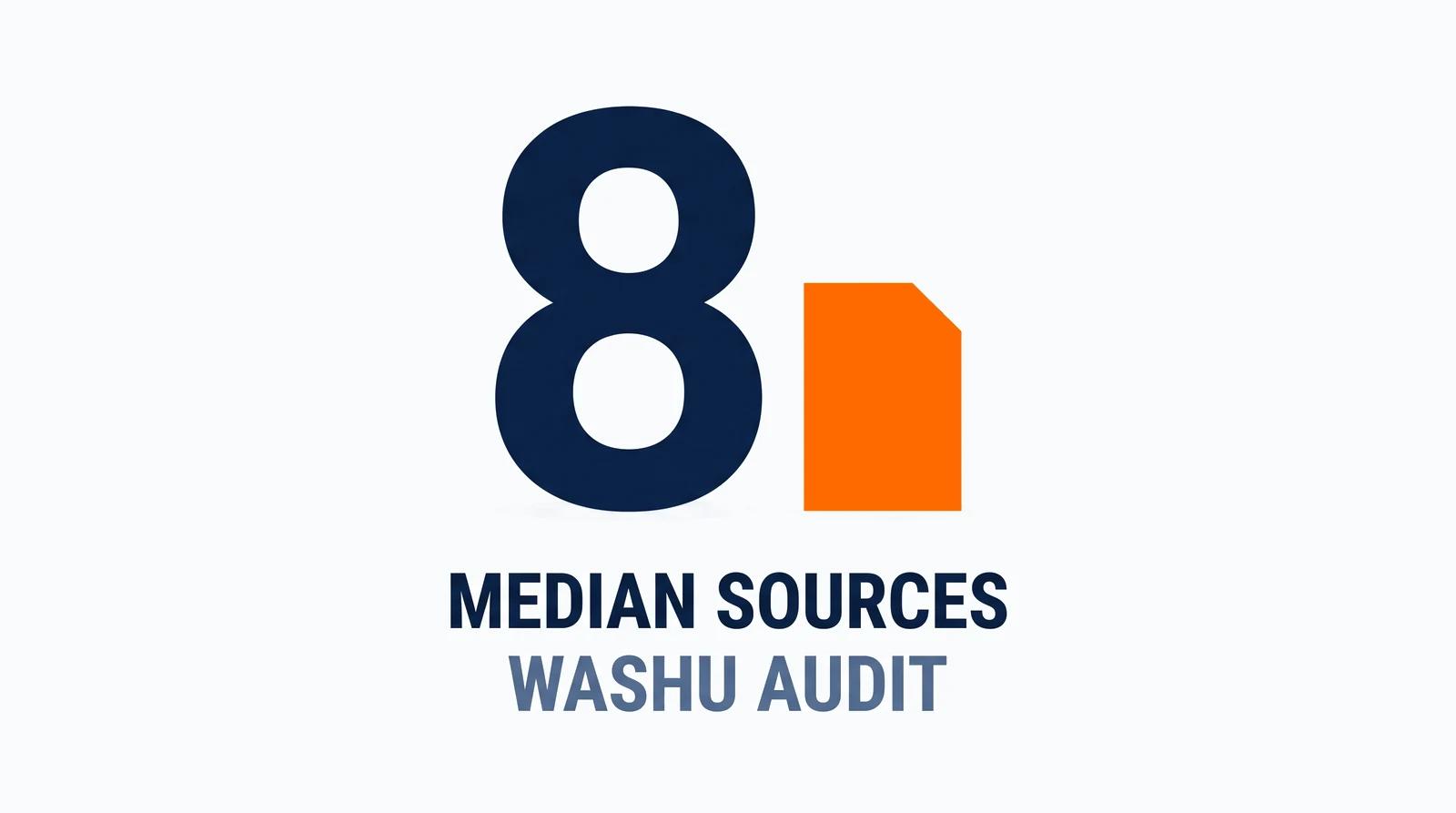
The best starting point is a platform you can verify exists and that publishes what it measures — in a category this young, that filter matters more than any feature-by-feature analysis. Our tracking data for this exact keyword, checked on 3 August 2026, showed five sources being cited. That list is not our ranking of them, and we hold no measured comparison of their quality. Appearing in an AI answer measures a company's own visibility, not how good its software will be for you — that distinction is most of what this article is about, and it applies to this list too. Treat it as a starting point for your own checks, not a shortlist of the best:
- Profound — an AI-visibility platform for tracking how AI search engines represent your brand, across ChatGPT, Gemini, Claude, Perplexity and more.
- Peec AI — AI search analytics for marketing teams: visibility, position and sentiment across ChatGPT, Perplexity and Gemini, with competitor benchmarking.
- Otterly.AI — an AI search monitoring tool that tracks both brand mentions and citations, across ChatGPT, Perplexity and Google's AI Overviews among others.
- Semrush's AI Visibility product — the classic-SEO platform's move into AI answers, under its own banner "from traditional SEO to AI discovery".
- Ahrefs' Brand Radar — brand visibility tracking across AI answers from another classic-SEO tool vendor, pitched as turning "SEO into AEO".
Full disclosure, since this is exactly the kind of thing we are telling you to check: we build one of these platforms — LiamVi — and it is early: the site describes what the product does, and access is by request while we are in early access. We are not among the five cited above, and by this article's own standard you should weigh us accordingly. What we can show today is our research — the methods, samples and limits behind every measurement in this article, and you should put us through the same checks you would put to anyone on that list — now, not later.
One warning that our tracking data supports: this category turns over. Tools appear, rename and pivot fast, so treat any list — this one included — as a dated snapshot, and check a product's own site before you rely on any tool comparison. The check itself moves too: a 2026 study of AI search measurement by Schulte, Bleeker and Kaufmann found that answers "can vary across runs, prompts, and time, making one-off observations unreliable". Our list is what a single sweep found on a single day.
What actually gets content cited — and what beginners get sold
In our measurements, the things beginner SEO advice says to chase — domain authority, comprehensive coverage, keyword density — did not decide citations; framing and specific, liftable sentences did. Our dataset is small and early — an early sample of keywords, mostly one engine — so read these as measurements, not laws. We keep measuring weekly and will publish what changes. Four myths, against the data:
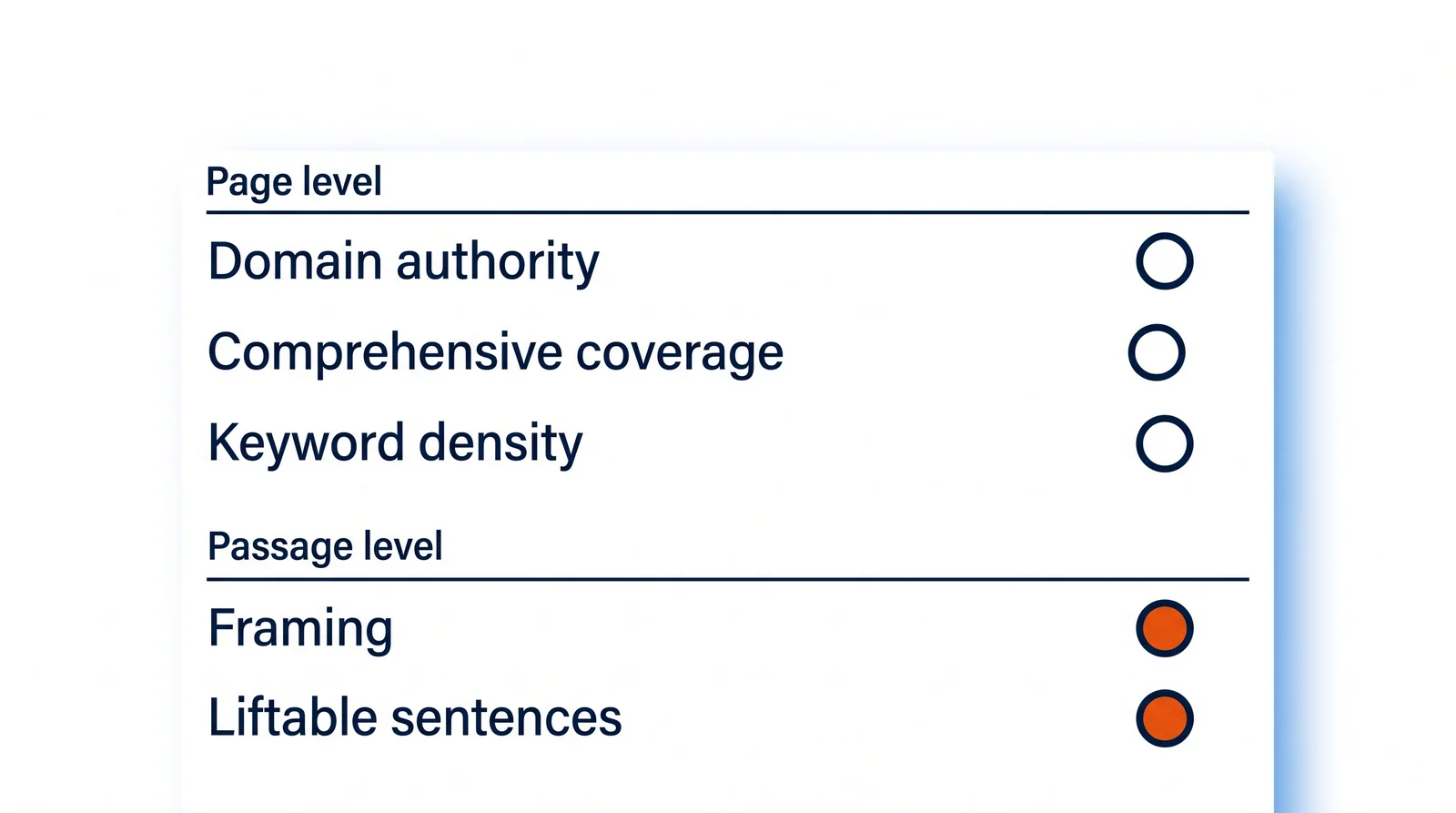
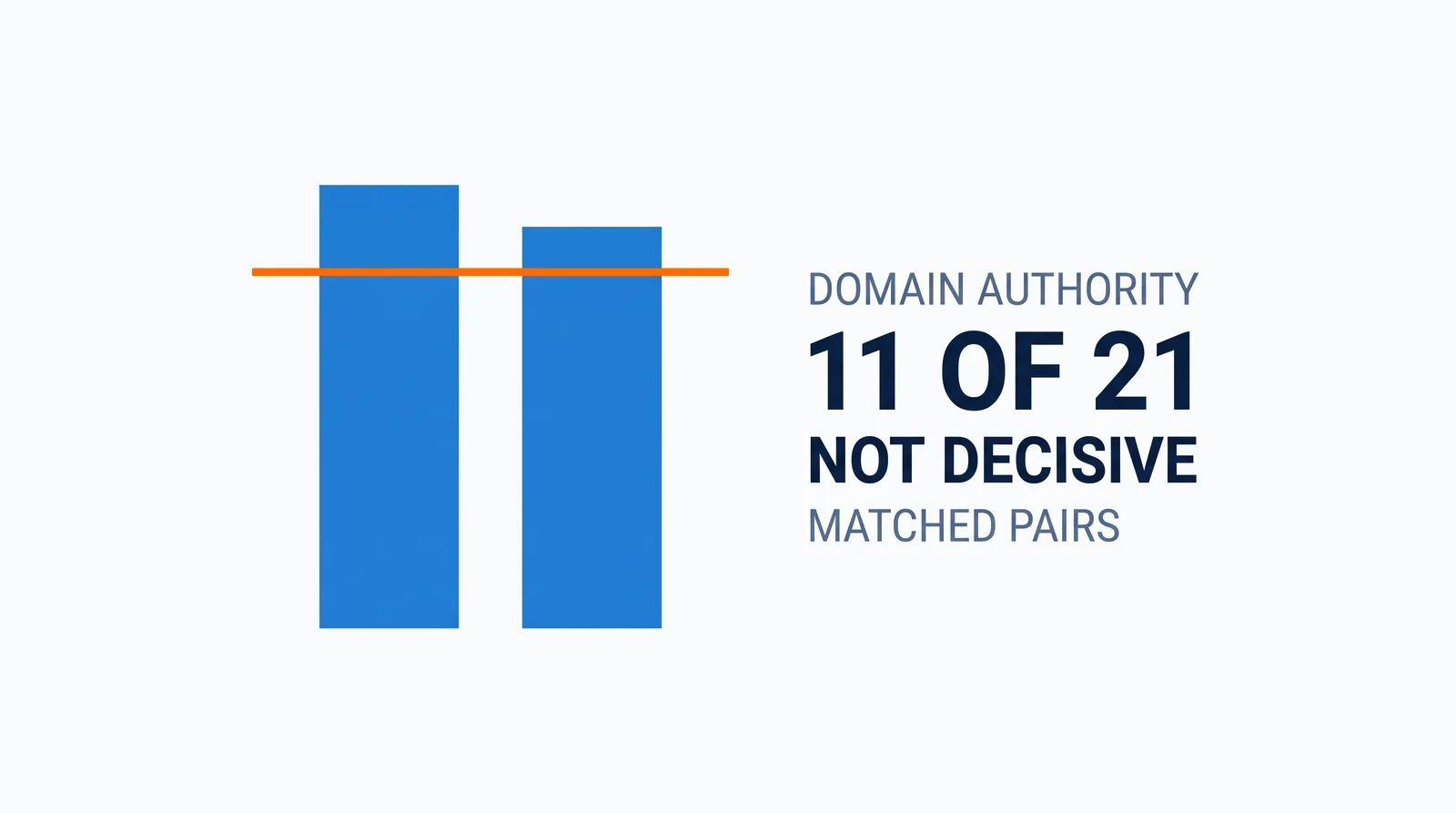
"You need domain authority first." Across 21 matched pairs — same query, same moment, a higher-authority domain against a smaller site — the higher-authority page won 11 and lost 10. Twenty-one pairs cannot rule out a small effect; they rule out a decisive one in this sample. Our tracking sweeps keep finding small, recently created sites holding citation slots beside household names. If you are starting from zero, we read that as the most hopeful measured result in this field: the slots look contestable without a decade of backlinks.
"Answer every question your reader might have." Cited and ignored content answered what searchers ask at near-identical rates. Being comprehensive did not separate winners from losers — a result that surprised us, which is partly why we publish our research in full, so anyone can use the numbers.
"Write quality content and the rest follows." Whether an AI search engine fetches sources at all depends heavily on framing, before content quality ever gets a vote. In a small pre-registered test, none of the conceptual "what is X" phrasings on established topics triggered source retrieval on the engine we measured, while every comparison-shaped, dated phrasing did. Engines differ — Perplexity, for example, cites far more freely than most — but the direction was consistent: for some queries there are no citations to win, at any quality level.
"Hit every keyword on the list." Citations point at sentences, not at keyword counts. The pages that repeated what was already on the results page were rarely the ones cited — what ranked on Google and what got cited barely overlapped, and the passages engines did lift carried something the rest of the page set did not have. Asked to describe its own selection, ChatGPT says it often ignores pages that add no new evidence — five articles repeating the same points are not five sources — which matches what we measured, though a model describing itself is a hint, not a measurement. A page assembled from what already ranks on Google — the standard SEO playbook — is, on our numbers, the content most likely to be skipped.
The pattern across all four: the page-level virtues beginners are sold — coverage, term density — kept coming back null in our data, while passage-level properties decided. The full research — methods, samples and limits — is public, including the results that contradicted our own assumptions.
What score should a beginner aim for?
A realistic target on any content score is a band, not 100 — and we say that as people who build a content scoring tool. In our data, the page-level things content meters reward — term density, comprehensive coverage — did not separate cited from ignored content. More uncomfortable, and we published it: a score that rewards matching the consensus of the content that already ranks is rewarding the exact shape that lost in our own measurements — redundancy, the page that says what the ranking pages already say. We found that defect in our own scorer and wrote it up, because a measurement company that hides its null results is not a measurement company.
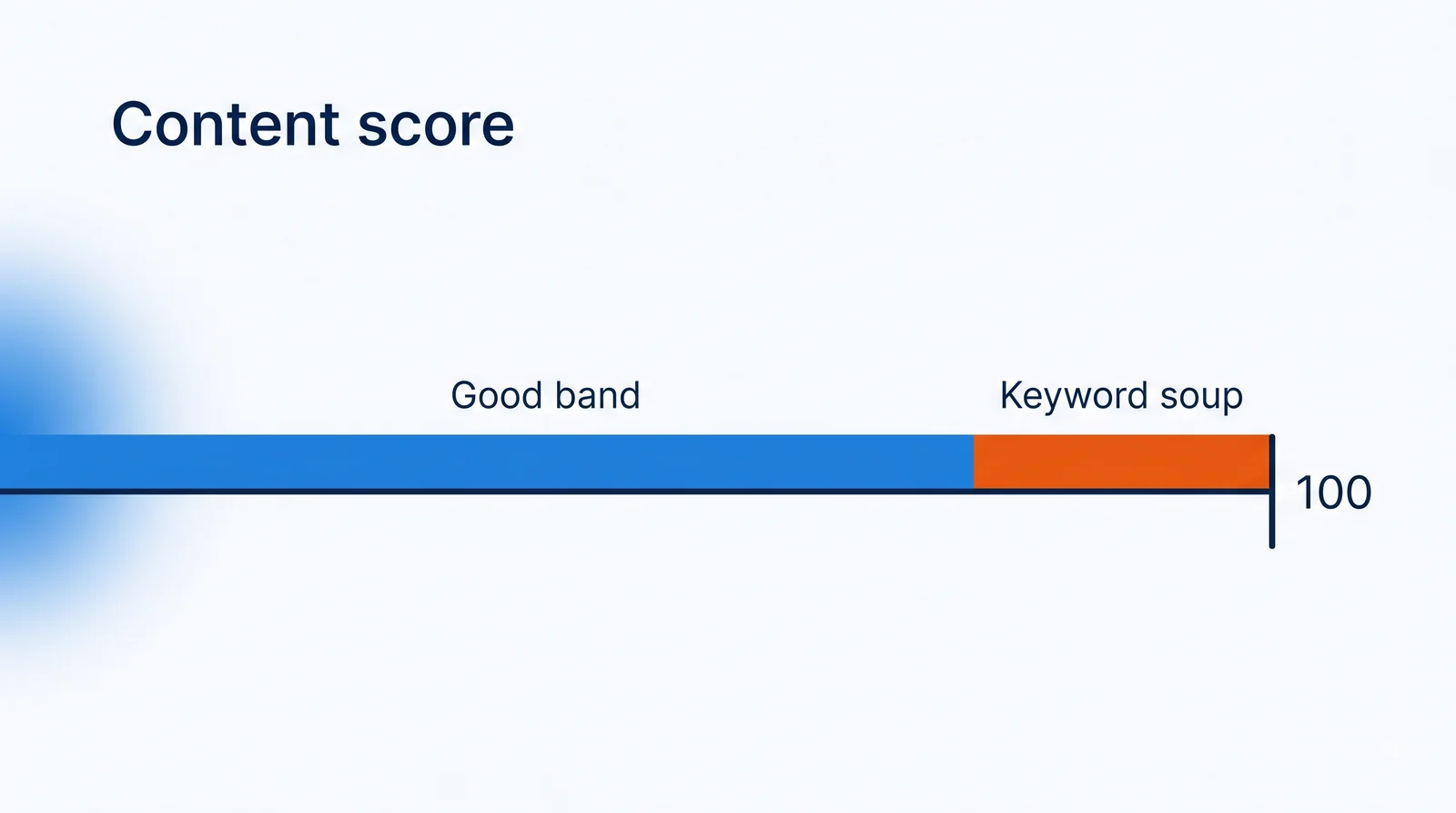
The practical translation for a beginner — and read this as our view of scoring, not a neutral standard, since we build one of these meters:
- Use a score to catch what is missing — an unanswered searcher need, a section with no specifics, a claim with no source.
- Stop when the content is honest, specific, and lands in the tool's good band. In our experience the last ten points are usually bought with keyword soup — a page saying exactly what the pages around it already say, which in our data was rarely the shape that got cited.
- Never trade a true sentence for a point. No scoring tool knows your field better than you do.
A beginner who uses a score this way — one specific, sourced, self-contained piece of content that lands in the good band — is better positioned than one who sands the content down to a perfect 100.
How do I optimize for AI search, starting from zero?
Start by picking topics where AI search engines actually fetch sources, then write sentences worth lifting — in that order, because the first gate decides whether the second matters. The levers below are the ones our research supports, in the order a beginner should use them:
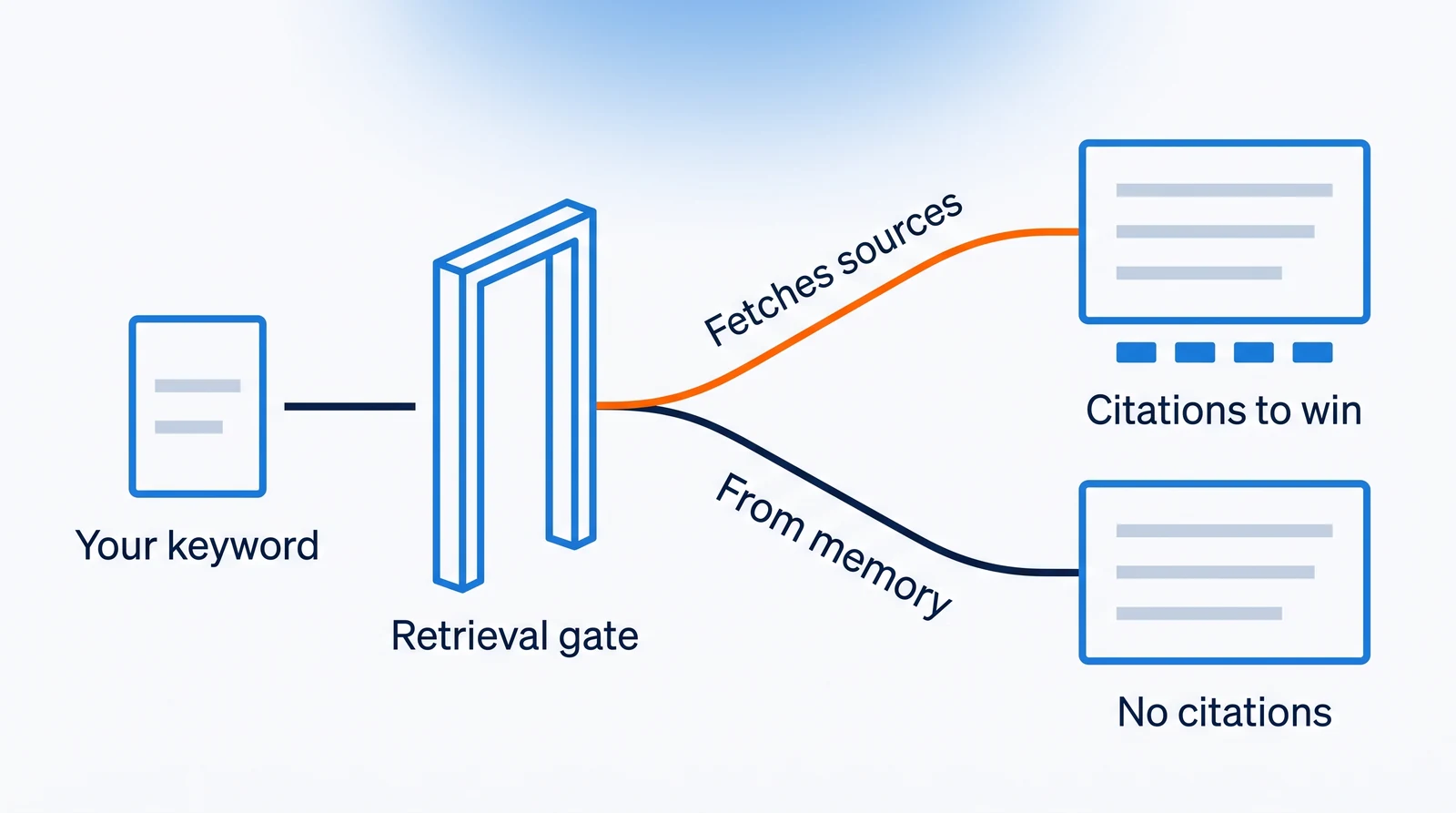
- Do retrieval-first keyword research. Comparison-shaped, dated, specific queries triggered retrieval consistently in our tests; conceptual "what is" queries on stable topics triggered none on the engine we measured. Before writing, type your target keyword into ChatGPT, Perplexity and Google and see whether anyone gets cited at all — that analysis uses nothing but the search engines themselves. Run it more than once, and on different days: which sources get cited shifts from run to run, so a single empty result is not proof there is no slot. If nothing is cited across several tries, there is likely no slot to win — choose a sharper question.
- Write sentences that survive being quoted alone. AI search engines cite passages. A self-contained sentence carrying a figure, a date or a named thing can be lifted; a paragraph that only works in context cannot. We wrote up the formats that actually came back cited in how to get citations from ChatGPT.
- State facts in your own voice. Keep the link to your source, but carry the claim yourself. In our cited-page data, content that stated claims directly did better than content that attributed everything onward.
- Add one thing that is yours. One real number, one documented experience, one thing you measured. In our data the pages that only repeated what already ranked were rarely the ones cited, and the passages engines lifted carried something the rest of the page set did not.
No tool can promise you a citation — ours included. What you use a platform for is the feedback loop: whether you appeared this week, who appeared instead, and whether the change you made moved anything. The optimization is yours; the tool is the measurement.
The questions people ask
What is the best AI platform for search optimization? There is no measured "best" that names names, in anything we have found. A public, like-for-like accuracy test does exist: an independent test of twelve AI visibility trackers, graded against 600 manually verified prompt-answer pairs across five AI surfaces over four weeks in May and June 2026, found mention-detection accuracy running from 67% to 94%. The twelve are anonymised, so the spread is public and the league table is not — it tells you accuracy varies enormously between these products, not which of them to buy. We have not published a comparison either. What exists beyond it is a set of verifiable tools: Profound, Peec AI, Otterly.AI, Semrush's AI Visibility product and Ahrefs' Brand Radar were the five being cited for this keyword when we checked in August 2026. Until someone publishes a named ranking, judge any of them — and us — by whether they separate mentions from citations, cover the AI search engines your customers actually use — ChatGPT, Perplexity, Gemini — and publish their method.
Which AI platform is best for beginners? The best AI search optimization platform for a beginner is the one whose claims you can check yourself and whose price lets you run it every week. Verifiability comes first because it is the one thing you can test before you pay. Price comes second and matters more than beginners expect: AI visibility moves week to week, so a tool you can only afford to open once a quarter cannot show you the change you are trying to see. The skill you build — typing real prompts, running the same analysis of who gets cited and why — transfers; the one you start with may well rename, pivot or disappear, and that is normal in a market this new.
What is the best AI SEO tool for beginners? It depends on which of two jobs you mean, because "AI SEO" is used for both. Classic SEO tools track your position on a search engine results page; AI search optimization platforms track whether AI answers name you at all. They are different measurements, and a beginner publishing today may need the second before the first — in our data the two barely overlapped: content that ranked well on Google was rarely what ChatGPT cited, and citations often went to pages that did not rank.
Sources
- Profound — product site, checked 4 August 2026.
- Peec AI — product site, checked 4 August 2026.
- Otterly.AI — product site, checked 4 August 2026; the page would not open to us on 27 August 2026, so that earlier reading is the one we stand behind.
- Semrush AI Visibility — product page, checked 4 August 2026.
- Ahrefs Brand Radar — product page, checked 4 August 2026.
- LiamVi — our own site, checked 4 August 2026.
- GTechMe — We Tested 12 AI Visibility Tracking Tools: Accuracy Compared — the accuracy spread quoted in the FAQ, checked 27 August 2026. Their page returns an error to our fetcher: these figures come from the publisher's own page text, and we have not read the page in a browser.
- OpenAI — Searching the web with ChatGPT — OpenAI's own limits on what a citation proves, checked 27 August 2026.
- Schulte, Bleeker and Kaufmann — Don't Measure Once: Measuring Visibility in AI Search (GEO) — run-to-run variability in AI answers, checked 27 August 2026.
- Our guide to AI visibility tools and how to get citations from ChatGPT — our own earlier articles, checked 27 August 2026.
- Our research — methods, samples and limits — every internal measurement this article draws on, with precise samples and the null results included.