Why is my website not cited by AI? Three different problems, and how we checked our own record
A website missing from an AI answer has one of three problems, and only the third points straight at the page. Either the answer listed no source at all, or it credited a different kind of site, or it credited pages like yours and not yours. Each calls for a different decision, so start by finding out which you have.
We are in the same position. At our tracker's weekly check of 26 October 2026, liamvi.com was cited on 0 of the 58 topics we track. We build a software tool that measures AI citations, meaning which sources AI answers credit, and this record comes from our own tracker. Below, this article sorts our own zero the same way, then shows you how to sort yours by hand.
What does our own record show?
The record is a zero: in the weekly check of 26 October 2026, the newest when we read the record on 29 October, liamvi.com won a citation on 0 of the 58 topics. On 54 of the 58 topics, another website held the citation. On 4 of the 58, no source was listed for anybody.
All 17 weekly checks since 2 August 2026 have read zero. The number of topics checked has changed from check to check, from 2 to 58: the 12 October check covered 20 topics, and the checks of 20 and 26 October covered 58 each.
The four topics with no source for anybody on 26 October were two about citations in AI answers ("can chatgpt create citations" and "chatgpt citations") and two about generative engine optimization ("gen ai search optimization" and "generative engine optimization checklist").
The record lists eight sites as holding topics we lost. In the platform's own words, a site holds a topic when it is "among the first three sources cited" on it, "counted once per topic". By that count, semrush.com held 12 of the 54, technologyadvice.com 10, tryprofound.com 8, peec.ai 6, help.openai.com and developers.google.com 5 each, and clearscope.io and dataforaisearch.com 4 each. A single topic can count for up to three sites, so these counts do not split the 54 between them; in all, 79 different sites held a lost topic. We first said in public that we were not among the sites credited on our page for beginners choosing a platform.
What the record states, as the tracker reports it to us: it checks topics we chose, about once a week, from the United States and in English. It keeps a row for each topic at each check, with up to five of the sources listed, and records for each topic if we were credited, if another site was, or if no source was listed at all. It does not name the assistants asked or how many times each topic was asked, so we do not state them here, and we have not published the topic list, so these counts cannot yet be checked from outside. It counts citations; we hold no traffic data for these topics, so it says nothing about visits. Read it as a single site's record on its own chosen topics, not a sample of the web and not a measure of any single AI system.
The record shows the zero. It does not show why, and we make no claim about the cause of ours.
What are the three problems?
The three problems are an answer that credits nobody, a different kind of site holding the citation, and a search that credits pages like yours but not yours. They look the same from outside, and the sort is ours: it describes what you can see, not why it happened, and we have not tested it as a diagnosis.
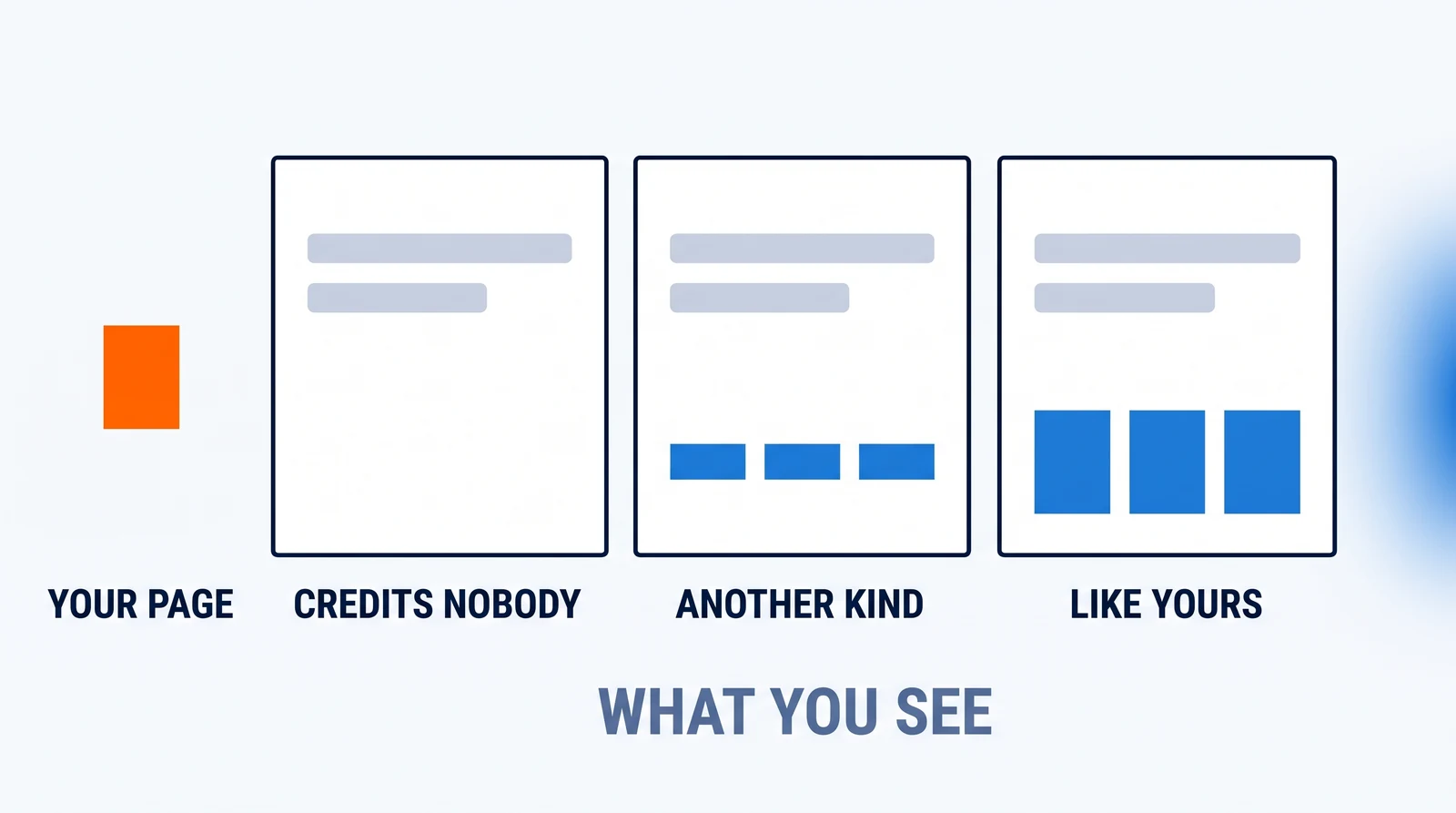
Problem 1 — the answer credits nobody. The question did not draw sources, so there is no AI citation for any website to win. Whether the product is a chat assistant or an AI search engine, a response with no listed source has no citation to give. From outside you cannot tell if a search ran at all; a chat answer or an AI Overview that lists no source only shows that nothing was listed. That does not mean your page is weak. In our record's 26 October check this was 4 of the 58 topics, and in our early harvest, 12 of 33 keywords drew no citation for any page. It is a reading on a day, not a fixed property of the question: of the five topics with no source in our 12 October check, four listed sources on 20 and 26 October.
Problem 2 — another kind of site holds the citation. The response lists sources, and they are a different kind of page from yours, from elsewhere on the web: a product's own documentation, a review publisher or a vendor's page. Who is credited, and what kind of page it is, shows what kind of source that question drew on the day you asked. The useful move is to decide if that slot is yours to contest at all. We think the honest answer is often no.
Problem 3 — a search runs, credits pages like yours, and yours is not among them. This is the problem that points straight at your page, and it is also the problem published research has sorted in detail. Of 949 retrieved pages left uncited in a March 2026 simulation by Tian and colleagues, each paired with a competitor that won the AI citation for the same query, 62.2% failed because the content did not match what the query required. The right topic presented poorly accounted for 27.1% of the 949, a page that could not be properly ingested for 10.1%, and structural disadvantages beyond the content for 0.6%. Its limits sit with those numbers: its data come from a controlled simulation based on two smaller models, gpt-4.1-mini and claude-haiku-4-5, not a test of commercial assistants, and every pair starts from a page the search retrieved, so by design it covers neither Problem 1 nor a page that was never retrieved. From outside, you cannot tell whether yours was retrieved and passed over or never retrieved at all.
Our record can separate Problem 1 from the other two. It cannot, by itself, separate Problem 2 from Problem 3 for our 54 lost topics; that takes reading the sources each topic lists. Here is how that reading goes for a topic of ours. On 12 October, "how to get cited by ChatGPT in 2026" listed no source for anybody. On 26 October, its first three sources were two OpenAI Help Center articles and OpenAI's developer page on its crawlers. We have a blog article on that question, so by our sort the topic moved from Problem 1 to Problem 2. That is a sort, not a cause: the record does not say why those pages were listed and ours was not.
What do the top-ranking pages tell you to do?
The top-ranking pages for this question mostly give an SEO fix-list: crawler access, page structure, authority, an llms.txt file and tracking tools for AI visibility. We reviewed the pages that rank on Google's search engine for this question on 26 October 2026, and the advice is reasonable as far as it goes.
The more useful part is the instruction to look for yourself. Of the four we read in full, three tell you to ask an AI tool directly. ZDNET's July 2026 article tells readers to ask ChatGPT, Perplexity or Google AI Mode 10 to 15 questions they would expect their content to show up for, and to "make a note of who gets cited and how many times." R&A Marketing's June 2026 page is shorter: "Go ask ChatGPT or your preferred AI engine about your specific category right now. See who it names." Search Ai's guide says: "Manually query multiple AI tools with business-related prompts" (Search Ai). MindBees states the limit clearly in its September 2026 piece: "There's simply no guaranteed way of getting your site cited by an AI tool" (MindBees).
None of the pages we reviewed separates a question that credits nobody from one where another site holds the citation, and none shows a dated citation record of its own site. That is the step we add here.
How do you check which problem you have?
Asking the question your page answers, twice, and reading what comes back is the whole check. It costs nothing, takes an afternoon, and needs no tool.
- Write down three to five questions your page should answer, in the words your readers used, not your keyword list.
- Ask each in the AI tool your readers use, such as ChatGPT or Gemini, an AI search engine like Perplexity, or a Google AI Overview where Google shows it, in a fresh chat or search.
- Ask each a second time, and where the tool lets you start a search yourself, use it for this run. OpenAI's help page says its assistant may search on its own or when you start a search by hand, and shows how to regenerate a response with web results. In our own harvest, the same question asked twice could return a different response and different sources, as we wrote in our earlier page on which citation signals have actually been tested.
- For each Google AI Overview or chat response, note: did it list any source? If so, which sites, and what kind of page?
- Sort what each result might mean. No source in either run, with search turned on where you could, is Problem 1 for that day. Sources of a different kind from yours is Problem 2. Pages like yours, without yours, is Problem 3. Give each result a date, and ask again next month.
Two runs on a single day is a small check, and the result can change next week, as our own record shows. It still tells you which problem you are working on before you spend anything on it.
What can you do about each one?
The way to make your website visible to AI depends on the problem. A page check comes before all three for Google's AI features: its documentation says a page must be "indexed and eligible to be shown in Google Search with a snippet" before AI Overviews or AI Mode can show it as a supporting link. Beyond that, only Problem 3 points to work on the page itself.
For Problem 1, stop spending on that question for now, and ask it again next month. A response that credits nobody has no citation for your content to win, so the decision is which questions to pick instead: ones where the user gets an answer with sources.
For Problem 2, decide if you can honestly be a good source for that slot, and a better one than what is there now. Where the credited page is the product's own documentation, that may well be the right answer for the reader. A page that adds nothing to it is unlikely to replace it.
For Problem 3, the work to improve the page is on the page: can it be fetched at all, does it answer the question as the user asked it, and what does it add that the credited pages do not? The prescription for that lives on the page linked in the check above.
None of this guarantees a citation. It tells you where the work is, and where it is not.
What we will do with our own record
The plan is to keep checking our topics every week and to publish what changes, including the day a citation comes, if one does. Which of your own questions is worth the work is your call.
Sources
- Tian, Chen, Tang, Liu and Jia — Diagnosing and Repairing Citation Failures in Generative Engine Optimization — arXiv 2603.09296, submitted 10 March 2026; checked 29 October 2026.
- ZDNET — Ritoban Mukherjee's guide to checking whether AI tools cite a website — 20 July 2026; checked 29 October 2026.
- R&A Marketing — Why AI Is Ignoring Your Content — published 1 June 2026; checked 29 October 2026.
- Search Ai — How to know if your website is cited by AI — published 22 April 2026; checked 29 October 2026.
- MindBees — How AI Is Changing Website Content and AI Citations — 16 September 2026; checked 29 October 2026.
- OpenAI Help Center — its page on searching the web — checked 29 October 2026.
- Google Search Central — AI features and your website — last updated 10 December 2025; checked 29 October 2026.
- The Google results for "why is my website not cited by ai" read on 26 October 2026: searchai-app.com, mindbees.com, zdnet.com, ramarketing.com (a YouTube video, a Quora thread and codeclinic.us could not be read).
- LiamVi's own citation tracker: its weekly checks from 2 August to 26 October 2026, read 29 October 2026, which our research page does not carry yet.