How long should a blog post be for SEO? What we counted on the pages that rank, and how to check your own query
No single word count suits every blog post, and Google says it has no preferred one. Between 14 September and 26 October 2026, we captured 166 Google results pages for keywords we track, and the median page ranking on them ran 2,269 words long. All of those keywords sit in our own field, search engine optimization (SEO) and AI marketing. The middle half of the ranking pages ran from about 1,450 to 3,530 words, and on 111 of the 162 results pages with at least three readable pages, the longest ranking page was at least three times the shortest.
A description of what ranks in one niche is not a recipe and not a cause, and for your next post the spread on a single results page matters more than the median.
We should disclose an interest: we build a content scoring tool, and the word band it sets for each keyword comes from the pages ranking for it, captured the same way as the ones measured here.
What is the ideal length for a blog article?
No single length is ideal for a blog article, and Google says it prefers none. A post needs to be long enough for its topic and the user asking, and the pages already ranking for the question show roughly what that is. Google's page on creating helpful content, last updated on 5 October 2026, asks writers: "Are you writing to a particular word count because you've heard or read that Google has a preferred word count? (No, we don't.)"
Most SEO advice on blog post length still arrives as a number. Five of the six readable SEO guides ranking for this question on 26 October 2026 name a range inside 1,000 to 2,500 words. Page One Power's 2023 guide gives 1,000 to 2,500 as the usual answer and ties the right figure to the searcher's intent and the depth of content needed. BrightEdge, on an undated glossary page, suggests "about 1,500 to 2,000 words" for articles. The newest dated page we reviewed, Rock The Rankings (31 August 2026), opens the other way: "The concept of an ideal blog post length is a myth." All six also say the answer varies, depending on things such as the topic, the audience or the depth a reader expects, and none treats one ideal length as fixed.
Where does the 1,447-word figure come from?
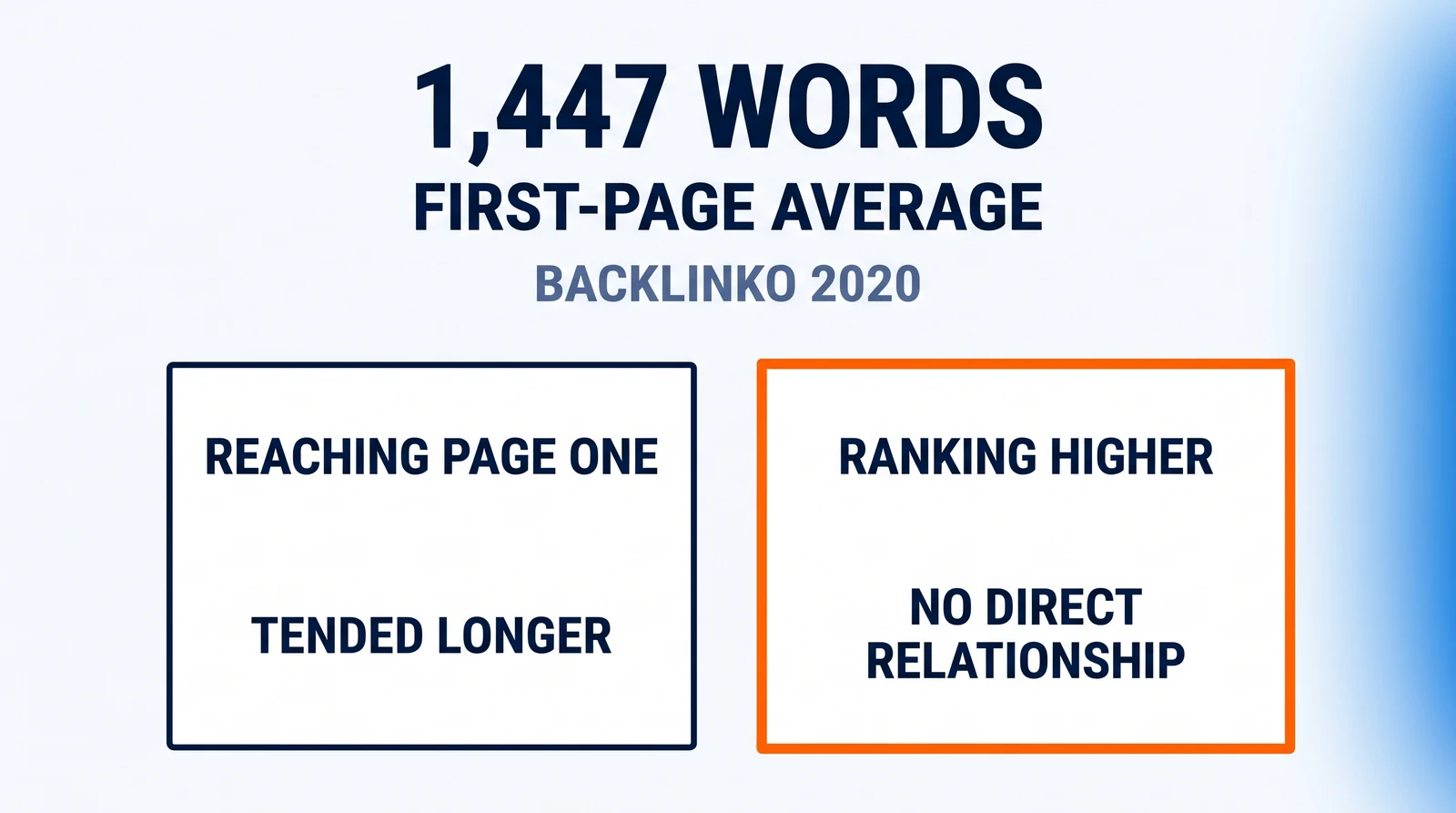
The 1,447-word figure is how long the average first-page Google search result ran in Backlinko's 2020 study with Ahrefs. The ranking factor study took 1,183,628 keywords and the top ten ranking URLs for each, 11.8 million results in all, with the data extracted in the first week of January 2020, as its methods document sets out. The word counts came from a crawl of more than a million of those pages. Long-form content tended to reach the first page, yet a longer page was no more likely to rank higher once there: Backlinko's own page reports "no direct relationship between word count and rankings." The page connects long-form content with backlinks, citing other studies in which longer content tends to earn more of them, and suggests that long-form content "can help you crack the first page. But it won't help you once you get there."
The figure changes as it travels. Shopify's guide (23 January 2026) describes the sample as "11.8 million first-page-ranking blog posts", though the analysis took the top ten results of every kind, not only blog posts. Click Intelligence (3 January 2025) rounds it to close to 1,500. None of these ranges comes with a dated count of its own, and none of the readable ranking pages we reviewed says how far apart the pages on a single results page are.
How long are the pages that rank in 2026?
Pages ranking for our SEO and AI-marketing keywords in September and October 2026 had a median of 2,269 words. That median covers 967 pages read on 166 results pages, captured once per keyword between 14 September and 26 October 2026. We capture the first ten organic Google results for each keyword we plan an article on and fetch each page once, without running its JavaScript, from the United States, in English, on desktop. Of the 1,399 organic results in the 166 captures, 967 came back with 200 words or more. The rest were blocked pages and empty shells, as well as video or social media posts with nothing read, or pages under 200 words, and we left them out. A URL that ranked for two of our keywords is counted twice.
The shortest page among the 967 ran 239 words and the longest 17,682. The middle half fell between about 1,450 and 3,530; 116 were shorter than 1,000 words and 329 ran over 3,000. We use the median because the 18 pages over 10,000 words pull the average up, to 2,834. The pages that rank ran longer in our 2026 captures than the 2020 mean; however, the sample, the measure and the method all differ, so the two numbers do not make a trend.
Position 1 pages averaged 2,140 words in a February–March 2026 crawl of 100,000 ranking pages for 5,000 commercial keywords across 14 sectors, the most recent research on ranking pages we found, published in April 2026 by Visionary Marketing, an SEO agency; its table calls that figure a median and its text an average. Visionary Marketing also found that the raw number of words correlated with rank at 0.18, counting visible body text only. Visionary's spread figures pool pages across keywords rather than within a single results page.
How far apart are the pages on a single results page?
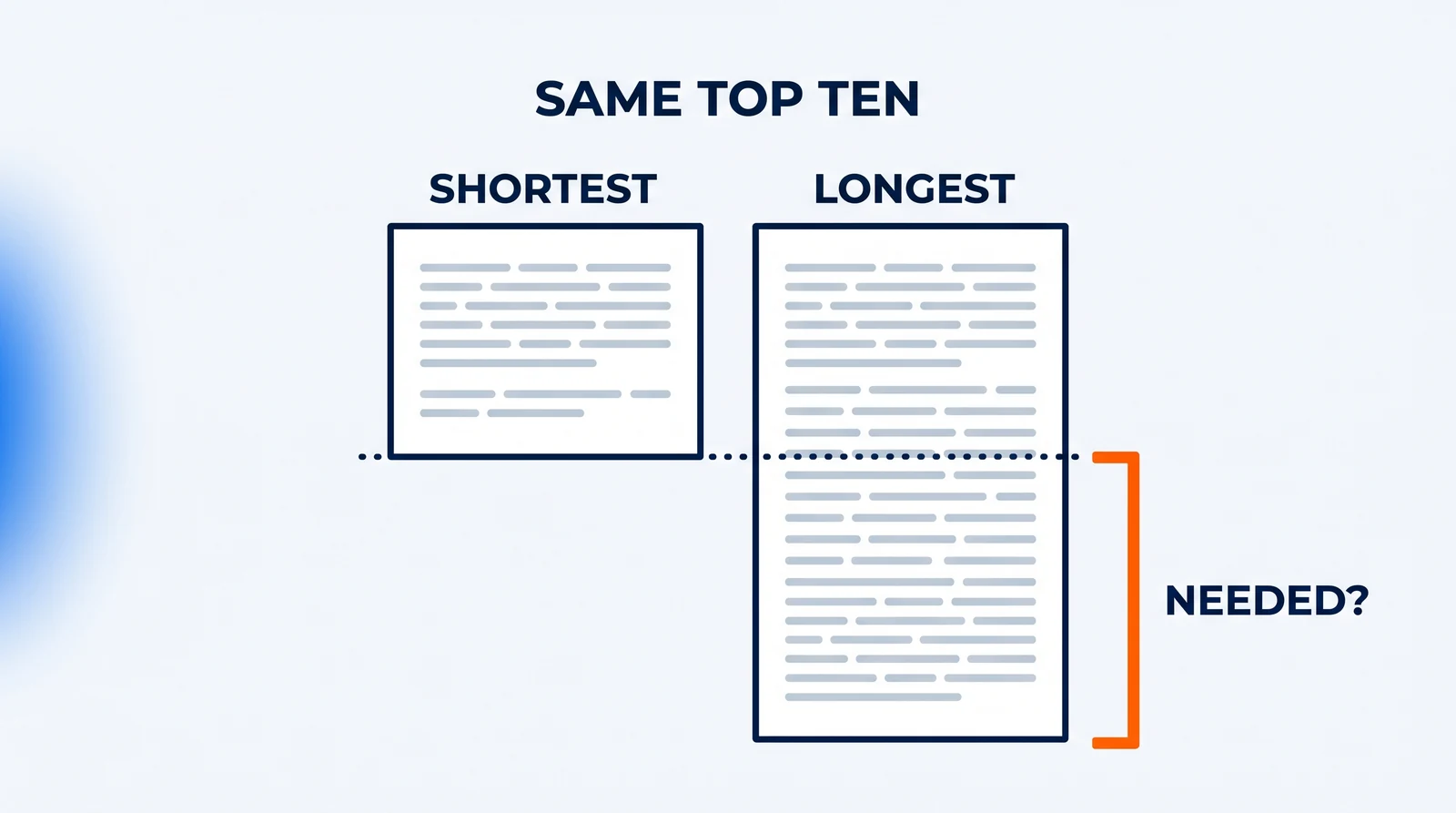
On 111 of 162 results pages we captured, the longest ranking page was at least three times the shortest. Pages ranking for the same keyword are often far apart, and lengths vary widely: the median gap was about 3.9 times. The same search engine results page often ranks a shorter answer and a longer guide together.
This question is a case in point. On 26 October 2026, the six readable articles ranking for "how long should a blog post be for seo" ran from 1,178 to 2,748 words as our platform measured them. That capture is not part of the 166.
We think the spread follows the user. Someone asking for a definition and someone comparing tools can type similar words and need very different depth, so some topics need a short answer and others a full guide, and each page answers the search intent it chose. Pages of very different blog post length rank for the same user question on the same day.
What do these figures not show?
The figures from our 166 results pages do not show that a longer blog post ranks higher because of its length. The 166 keywords are our own candidate keywords in search, SEO and AI marketing, the content marketing niche we work in, written for an audience of marketers where in-depth vendor guides are common; the sample leans long, and it is not a sample of the whole web. We captured each keyword once, in US English on desktop, with our own fetcher, the same way as the captures behind our People Also Ask page, and we captured a single search engine, Google; other search engines and other markets may differ.
The word counts are what our platform's text extractor recorded; we measured no page by hand, so a page's figure can differ from its article body. 82 of the 967 pages read were LinkedIn posts; however, without them the median stays at 2,269, and the three-times gap holds on 99 of 155 results pages.
This is a count of the pages Google ranked, not of the pages AI search tools cite, and it says nothing about AI citations. It also says nothing about search traffic, or about which size earns it. Use it as a description when writing, not as a target.
These figures are small and early, and they are not on our research page yet; we keep capturing, and we will update them as the captures grow.
How do you check the right length for your own query?
Checking your own query takes five steps, a private browser window and a free word counter, and it shows how long the pages ranking for it are. Write to the depth the user's question needs, long enough to cover what the reader came for. Page One Power suggests a similar review of the top-ranking posts; what our figures add is how far apart those pages tend to be.
- Search your exact keyword in a private window, with the search engine set to the market and language you write for.
- Open the top readable results, and skip forums, videos and social media posts; our captures kept the LinkedIn posts they could read.
- Use a word counter on the body of each article and note the number.
- Consider the shortest and the longest. Before writing, see what subject matter the longest covers that the shorter ones do not, and which intent each serves; longer is not the same as more comprehensive.
- Determine which of those parts your audience actually needs, given the purpose of your post, write the content that covers them, and stop.
If the pages are far apart, a shorter article made the same top ten, so matching the longest is not what it takes to appear; whether size moves a result within the ten, our figures cannot say. Copying the longest will not copy whatever earned its place. If you see them cluster, we think the topic may have a settled depth, though a cluster does not prove it, and in that case it is worth knowing before you start writing. A content strategy that sets a single target post length for every article ignores that spread; if your content strategy sets length targets, set them per query from the results page, not from a median.
Our figures describe what ranks for our keywords; your own results page shows what ranks for yours. How long your blog post should be is a call about your audience and your topic, and it is yours to make.
Sources
- Backlinko — search engine ranking study — Backlinko with Ahrefs; page last updated 14 April 2025; checked 26 October 2026.
- Backlinko and Ahrefs — the methods document — data extracted in the first week of January 2020; checked 26 October 2026.
- Google Search Central — guidance on helpful, people-first content — page last updated 5 October 2026; checked 26 October 2026.
- Visionary Marketing — SERP position analysis, 2026 — 100,000 ranking pages, crawled 12 February to 4 March 2026. Published April 2026; checked 26 October 2026.
- Page One Power — Linkarati guide by Sallie Blackmon — published 18 August 2023; checked 26 October 2026.
- BrightEdge — glossary entry — no date shown; checked 26 October 2026.
- Rock The Rankings — guide by Justin Berg — published 31 August 2026; checked 26 October 2026.
- Shopify — guide by Madeline Muzzi — published 23 January 2026; checked 26 October 2026.
- Click Intelligence — guide by Annie Atkins — published 3 January 2025; checked 26 October 2026.
- The search results for this question, read on 26 October 2026: a LinkedIn post, clickintelligence.co.uk, brightedge.com, pageonepower.com, shopify.com, brandconn.com and rocktherankings.com; a Quora thread and a YouTube video could not be read.
- LiamVi's own captures of the top results for 166 of our keywords, 14 September to 26 October 2026 — our research page does not carry them yet.