Does E-E-A-T matter for AI search? What Google's own documents say, and where they stop
For Google's AI Overviews and AI Mode, Google's own documents root the features in the same ranking and quality systems as ordinary search results. We read that to mean the qualities behind E-E-A-T matter there in the same way: as a description of what those systems try to reward, not as a score. For ChatGPT and Claude, nothing comparable is published in the help and documentation pages we read on 5 October 2026. We could not retrieve Perplexity's help page, so this article does not cover Perplexity.
There is a fresh reason to ask the question now. On 1 October 2026 Google updated the document where it explains the framework, and the change is not the ranking-factor sentence that the top SEO results for this question lead with. We compared the live text with a copy the Internet Archive saved on 21 September, read Google's guide to its AI features and its rater guidelines in full, opened OpenAI's and Anthropic's own help pages, and read the published tests of credentials and AI citations that we could open.
LiamVi makes a product that scores drafts and keeps a record of which sources AI answers cite, so whether "authority" earns a citation is a subject close to what we sell. We have not measured E-E-A-T. Every quotation below comes from the company that wrote it, with its date, and the one number of our own is about a different variable, which we name when we get to it.
What does Google mean by E-E-A-T?
E-E-A-T is Google's name for four qualities: experience, expertise, authoritativeness and trustworthiness. Its ranking systems try to identify them through what it calls "a mix of factors". The people-first content page on Google Search Central, revised on 1 October 2026, is direct about what that means: "While E-E-A-T itself isn't a specific ranking factor, using a mix of factors that can identify content with good E-E-A-T is useful." There is no score to raise, and the factors are not listed.
Google does not weight the four qualities equally. "Of these aspects, trust is most important. The others contribute to trust, but content doesn't necessarily have to demonstrate all of them." The Search Quality Rater Guidelines, dated 11 September 2025, put it more bluntly on page 27: "Trust is the most important member of the E-E-A-T family because untrustworthy pages have low E-E-A-T no matter how Experienced, Expert, or Authoritative they may seem."
Google raises the E-E-A-T bar on YMYL topics. The same document says the company's systems "give even more weight to content that aligns with strong E-E-A-T" where a topic could affect someone's "health, financial stability, or safety", the topics it calls Your Money or Your Life, or YMYL. In those terms, writing about medicine or money is held to a higher standard of trust than writing about a hobby.
The document frames all of this as a contrast between "people-first content" and "search engine-first content", and that framing is older than this month. Every top result we could read for this question, five of eight, already says E-E-A-T is not a direct ranking factor, and they are right. What none of them carries is what was added on 1 October.
What changed on Google's page on 1 October 2026?
Google added two passages to its people-first document on 1 October 2026 and removed nothing. One is a section on the quality of a page's main content; the other is a warning against fabricated creator profiles. We know because we compared the live text, line by line, with the copy the Internet Archive saved on 21 September 2026, which still carried the date 10 December 2025. Every other sentence, including the ranking-factor sentence above, was already there.
The first addition defines "main content" as "any part of the web page that directly helps the page achieve its purpose", and says the company's raters "are trained to evaluate these fundamental attributes of the main content":
- Effort: "The extent to which human work went into creating the content or the systems powering it", with the warning that "Attribution or giving credit to other sources doesn't replace the need for original effort."
- Originality: "unique, original information or perspectives that aren't already available on other websites."
- Talent or skill, with the reminder that "not all content requires specialized expertise."
- Accuracy: for YMYL topics, writing that "must be highly accurate and consistent with established expert consensus."
The second 1 October addition is about authors. "Fabricating creator profiles (such as by using AI-generated headshots, made-up names, or false credentials to make content appear as if it was written by human experts) is a form of deception." The text continues: "Any form of deception makes a page untrustworthy to both users and our automated quality systems, and is a signal of a low-quality page."
The fabricated-profile warning is not a new rule for raters. The rater guidelines of 11 September 2025 already list, on page 37, "A webpage or website with "fake" owner or content creator profiles", and give as the example "AI generated content with made up "author" profiles". What changed on 1 October is the audience: an instruction raters have had for at least a year now sits in the document written for site owners. The rest of that document's guidance on authorship, including what it says about bylines, is read in our founder's column on AI-written content, and we do not repeat it here.
Do quality raters decide where a page ranks?
Google's quality raters have no control over where a page ranks. The people-first document says that "Search raters have no control over how pages rank", and adds: "Rater data is not used directly in our ranking algorithms. Rather, we use them as a restaurant might get feedback cards from diners."
The rater guidelines say the same from the human raters' side, and one thing more. On page 6: "No single rating can directly impact how a particular webpage, website, or result appears in Google Search." And: "Ratings are also used to improve search engines by providing examples of helpful and unhelpful results for different searches."
Two of the five top results we could read describe rater feedback as training or refining the company's systems. Google's two descriptions, feedback cards and examples, can both be true, and neither makes a rater's review of your site an input to where it appears.
Google's own advice is to read the guidelines as a self-assessment: reading them "may help you self-assess how your content is doing from an E-E-A-T perspective". The guidelines describe what raters look for and what the systems aim at. They are not a checklist someone ticks against your site.
Does E-E-A-T apply to Google's AI Overviews and AI Mode?
Google's July 2026 guide to its AI features never uses the term E-E-A-T, but it roots AI Overviews and AI Mode in the same ranking and quality systems. It also links the people-first document as its account of quality content. The guide, last updated on 10 July 2026, says the features "are rooted in our core Search ranking and quality systems".
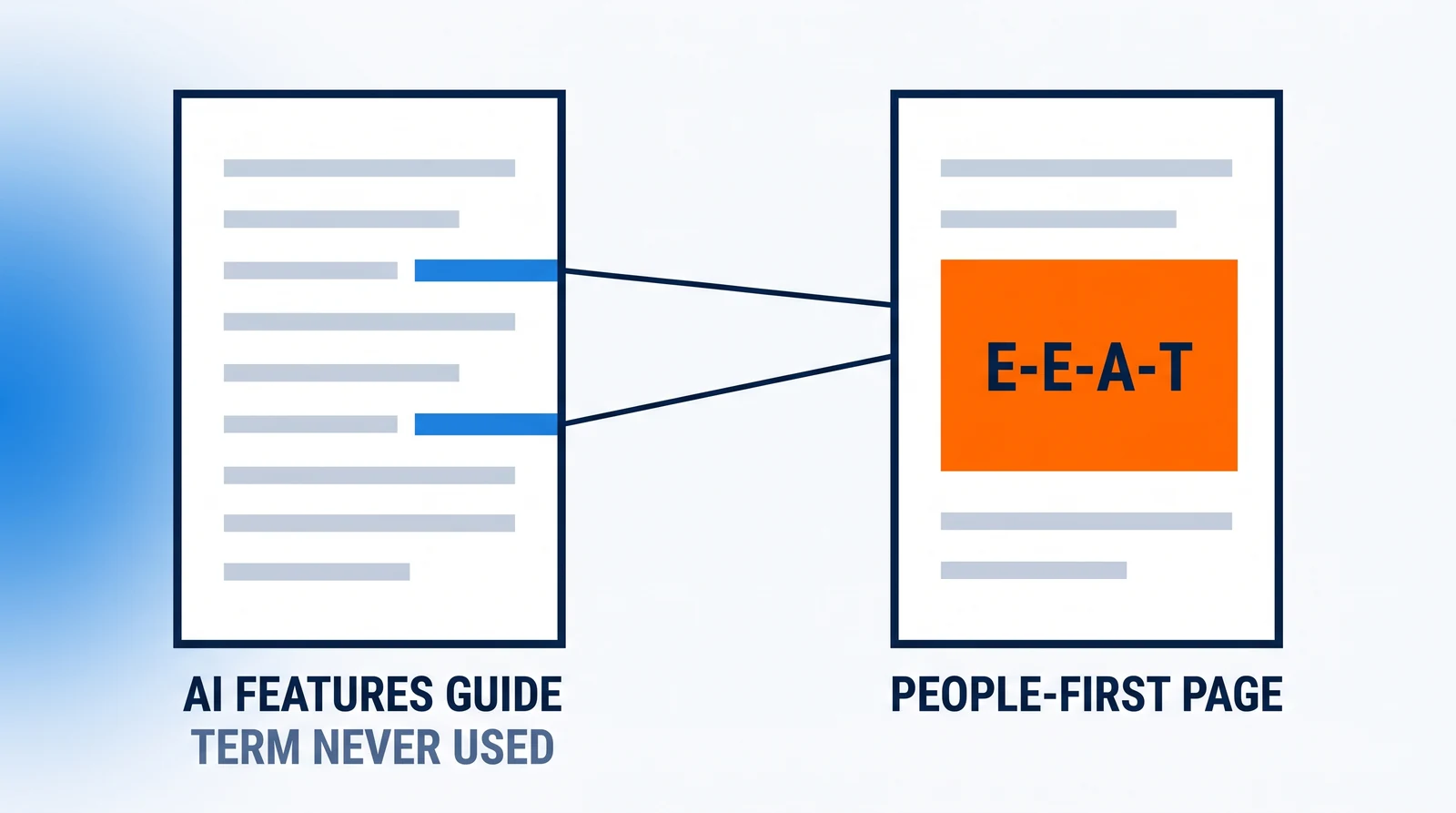
Two further sentences in the guide connect it to E-E-A-T directly. "Our core ranking systems focus on high-quality content while other systems block spam; our generative AI features depend on both", where the words "high-quality content" link to the people-first document. And the guide's closing summary: "Focus on developing unique, expert-led content that provides value beyond common knowledge", with "helpful, reliable, and people-first" linking to the same document again.
We read the July 2026 guide as Google's own answer for AI Overviews and AI Mode. By its links, E-E-A-T applies to AI Overviews and AI Mode the way it applies to the blue links: as a description of what the underlying systems try to reward, not as a separate test an AI answer runs. That is a reading of what Google links to what, not knowledge of how its systems are built.
The July 2026 guide also says no outside tool can see those systems: "No third-party tool has access to our internal ranking or AI systems." That includes LiamVi's scores, which describe a page and do not read anyone's ranking systems. Our reading of the rest of Google's AI-features guide covers what else it says, including the tactics it tells you to ignore.
What do ChatGPT and Claude publish about choosing sources?
OpenAI and Anthropic do not say how ChatGPT or Claude weighs an author or a credential in the four help and documentation pages we opened on 5 October 2026. Neither company uses the term E-E-A-T there, and neither describes how its answer engine weighs a site. What both publish is advice to readers: open the sources an answer cites, and lean on authoritative ones when accuracy matters.
OpenAI's help article on searching the web with ChatGPT tells the user: "Search results and citations can be incomplete, outdated, or incorrect. Open a cited source to check that it supports the answer, review when it was published or updated, and use an authoritative source when accuracy matters."
Anthropic's help article on Claude's web search, modified on 28 September 2026, says that "Every response includes citations, so you can easily verify sources yourself", and its list of tips includes "Use authoritative sources for critical decisions."
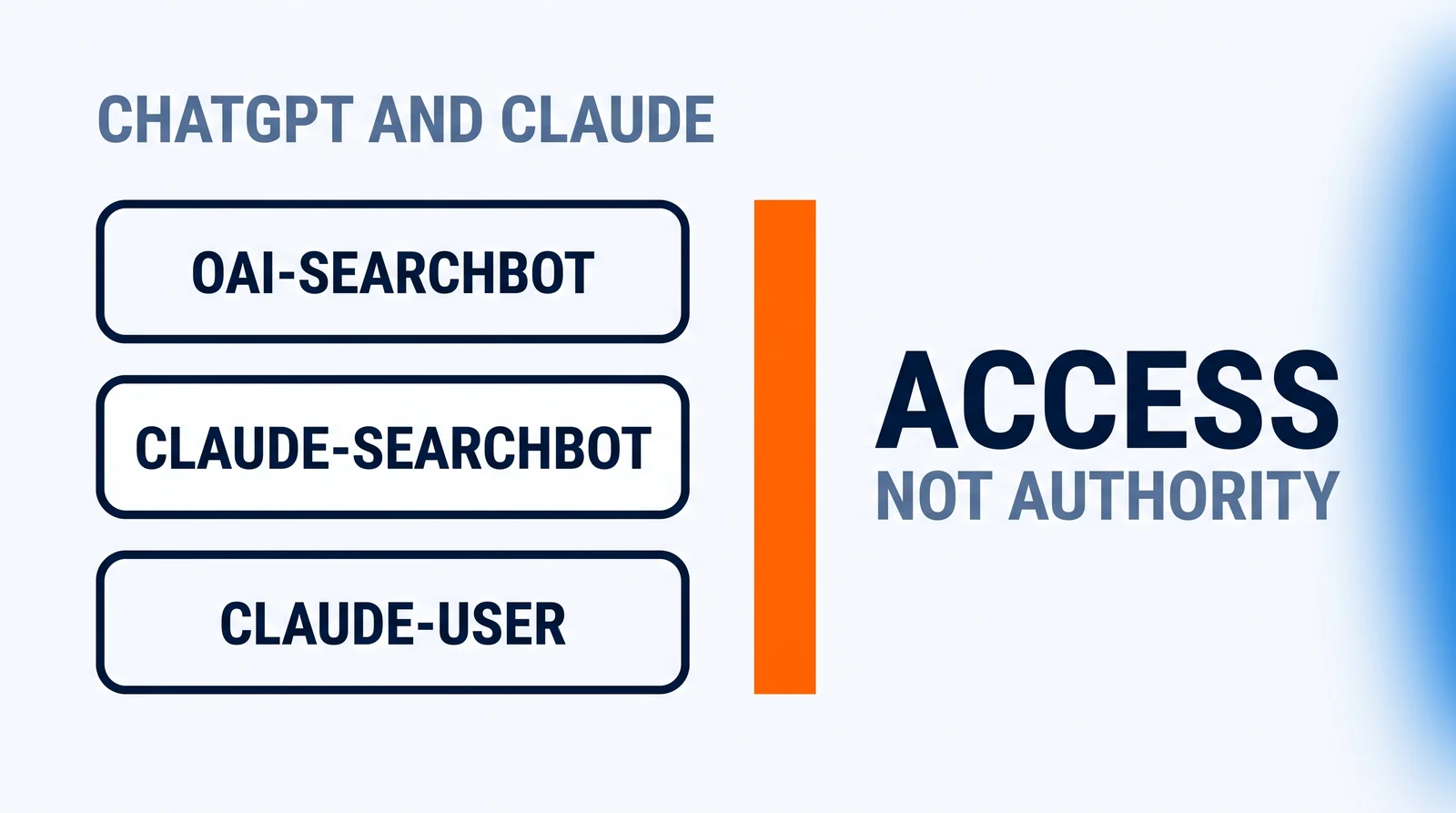
A site owner can act on one documented thing for ChatGPT and Claude, and it is crawler access rather than authority. OpenAI's crawler documentation says: "Sites that are opted out of OAI-SearchBot will not be shown in ChatGPT search answers, though can still appear as navigational links." Anthropic's crawler article names two agents, besides its training crawler, that affect whether Claude can reach a site. Disabling Claude-SearchBot "may reduce your site's visibility and accuracy in user search results", in Anthropic's words. Disabling Claude-User, the agent Claude may use to open a site when someone asks it a question, "prevents our system from retrieving your content in response to a user query". OpenAI's crawler page documents a similar user-initiated agent, ChatGPT-User, and says it "is not used to determine whether content may appear in Search". Crawler access is the one documented condition we found for appearing in either assistant's answers.
That finding rests on those four help and documentation pages. Perplexity's help article on how it works returned an access error when we requested it on 5 October 2026 and again on 6 October, so we make no claim about what Perplexity publishes. If either company documents more about source selection elsewhere, we did not find it; saying that is better than implying a survey we did not run.
What have tests of credentials and AI citations found?
The published tests we could open on 5 October 2026 measure things close to E-E-A-T, not Google's framework itself. They do not point the same way. Such tests exist, so the honest summary is not that nobody has checked; it is that each one counted something different.
The largest test we found is Semrush's study published on 14 January 2026, which scored the visible text of 304,805 URLs that ChatGPT Search, Google AI Mode and Perplexity cited, and of 921,614 URLs in Google's top 20, on 13 content parameters, using prompts run between 15 July and 6 August 2025. Its "E-E-A-T signals" parameter came out 30.64% higher on the cited set, in Semrush's words "the % difference in scores", second only to clarity and summarization. Its advice is to "Strengthen E-E-A-T signals by including author credentials and linking to reliable sources". The parameter is Semrush's own scoring of what the text shows, since the study looked only at "the text visible on the page", so it measures how a page presents expertise and authoritativeness rather than Google's assessment of them. Semrush sells SEO and content tools in the same category as ours.
Seer Interactive's controlled byline test came out mixed. Seer added detailed author bylines to 123 pages of its own blog and compared them with untreated pages: "The bylines didn't deliver the across-the-board citation lift we expected, but some of the signals showed positive indicators." On AI Overviews specifically, Seer "didn't find a statistically significant difference" between the two groups. Seer also counted citations in Bing's AI Performance report, which it notes is still in beta. There, the 123 treated pages "roughly doubled in citations period-over-period compared to a ~34% gain on the control group", and the least-known authors gained most, on a handful of pages per author group. Seer calls those early signals "positive but inconclusive" and says page topics and recency could have influenced them. The case study shows no date on the page; its metadata gives 1 July 2026. We read this test, and the citation playbook it answered, in more detail.
The nearest thing we have measured ourselves is domain authority, which is a third-party link score and not E-E-A-T. In 21 matched pairs, each pair two pages on one keyword from domains of different authority and mostly measured on ChatGPT, the higher-authority domain was cited 11 times and the lower 10. As our research page puts it, "21 pairs cannot rule out a small effect; they rule out a decisive one in this sample." The 21 pairs say nothing about credentials, and we do not stretch them to.
Originality, the second of the new main-content attributes, has one published test of its own, run across 50 keywords in a single July 2026 capture: on Google's AI Overviews, the cited pages were no more original than the top results passed over, in the study we read here. Some figures about the weight of author credentials in AI citations also circulate on agency blogs without a source we could open, so they are not used here.
We think what moves across these tests is what a page shows a reader: a named author, its sources, its specifics. None of them can tell you how ChatGPT or Claude weighs a credential, because neither OpenAI nor Anthropic says so in the pages we read.
What do Google's documents not tell you?
Google's documents publish no weights, no threshold and no list of the signals behind E-E-A-T. They also speak only for Google. The people-first document says "a mix of factors" and names none of them, so no measure of authoritativeness or trustworthiness is published. The rater guidelines run to 182 pages, and in our text search of them the words "AI Overview" do not appear. The AI-features guide never uses the acronym at all.
A practical rule follows for reading anything else on the subject. Anyone quoting a percentage weight for the four qualities, or a share of AI citations it explains, is not quoting Google, because none of the three Google documents we read publishes one. They may have measured something; ask what, and on what sample.
This article rests on documents read on 5 October 2026 and re-checked on 6 October, and Google edits its documents: the people-first document changed four days before we first read it, and again later on 5 October, when "webpage" became "web page" in its main-content definition. We have measured nothing about the framework itself, and our one number of our own is about domain authority, on 21 pairs. We will keep reading these documents and publish what changes.
What can you check on your own pages?
Google's own words support four checks on a site: real author profiles, the four main-content qualities, accuracy on YMYL topics, and crawler access for ChatGPT and Claude. None of them is a promise of citations, from Google or from anyone else, and none is an SEO trick.
- Look at every author profile on your site: each should be a real person with credentials they actually hold. A byline with a made-up name falls under Google's fabricated-profile warning, so if you add author bylines, use real names. That has been a rater instruction since at least September 2025, and since 1 October it is written for site owners too.
- Review one important page against the four main-content attributes, and ask the originality question hardest: what does it carry that is not already available on other websites, such as first-hand knowledge or your own data?
- On YMYL topics, check every claim against established expert consensus, the accuracy standard the document now sets out in its own words.
- If ChatGPT or Claude matter to you, look at your robots.txt and confirm it lets OAI-SearchBot, Claude-SearchBot and Claude-User in. Crawler access is the one documented condition we found for those assistants, and it is about access, not authority.
Whether that work is worth more than other work on your site is your call, and it depends on your topics. What Google documents is a description of what its systems aim at. What OpenAI and Anthropic document for the reader is advice to check an answer's sources; how their systems weigh authority is not in the pages we read.
What people actually ask
These four questions came from the "People also ask" panel on a United States results page for this search, captured when its term list was built on 5 October 2026.
Is E-E-A-T a ranking factor?
Google describes E-E-A-T as a set of qualities, not a specific ranking factor. Its systems try to identify those qualities through a mix of factors; trust matters most, and the bar rises on YMYL topics. Google publishes no E-E-A-T score and no list of the factors.
Can you trust AI search?
A source listed in an AI search answer does not prove the answer right, and OpenAI and Anthropic both tell you to open the sources and check them. OpenAI's help article says search results and citations "can be incomplete, outdated, or incorrect" and tells you to check that a source "supports the answer"; Anthropic's tips say to use authoritative sources for critical decisions.
Is SEO dead now with AI?
Google says ordinary SEO still applies to its AI features. Its July 2026 guide roots AI Overviews and AI Mode in its core ranking and quality systems and treats what some now call AEO as part of ordinary SEO; our reading of that guide covers the detail. For ChatGPT and Claude, the documented condition is that their crawlers can reach your pages. Whether SEO is still worth the effort for your site depends on which of those surfaces your readers use.
What is the 30% rule for AI?
Neither Google document we read on 5 October 2026 mentions a 30% threshold, and we have not tested one. If someone quotes one, ask for the sample behind it.
Sources
- Google Search Central — Creating helpful, reliable, people-first content, last updated 5 October 2026 (the two 1 October additions, then a one-word edit on 5 October) (E-E-A-T, trust, YMYL, raters, the main-content attributes, fabricated creator profiles). Checked 5 and 6 October 2026: https://developers.google.com/search/docs/fundamentals/creating-helpful-content
- Internet Archive — the same page as saved on 21 September 2026, last updated 10 December 2025 (the comparison copy). Checked 5 and 6 October 2026: http://web.archive.org/web/20260921184003/https://developers.google.com/search/docs/fundamentals/creating-helpful-content
- Google — Search Quality Rater Guidelines (General Guidelines), 11 September 2025 (pages 6, 27 and 37). Checked 5 and 6 October 2026: https://static.googleusercontent.com/media/guidelines.raterhub.com/en//searchqualityevaluatorguidelines.pdf
- Google Search Central — Optimizing your website for generative AI features on Google Search, last updated 10 July 2026. Checked 5 and 6 October 2026: https://developers.google.com/search/docs/fundamentals/ai-optimization-guide
- OpenAI Help Center — Searching the web with ChatGPT. Checked 5 October 2026: https://help.openai.com/en/articles/9237897-chatgpt-search
- OpenAI — Overview of OpenAI Crawlers (OAI-SearchBot, ChatGPT-User). Checked 5 and 6 October 2026: https://platform.openai.com/docs/bots
- Claude Help Center — Enable and use web search, modified 28 September 2026. Checked 5 and 6 October 2026: https://support.claude.com/en/articles/10684626-enabling-and-using-web-search
- Claude Help Center — Does Anthropic crawl data from the web, and how can site owners block the crawler? (Claude-SearchBot, Claude-User), modified 7 April 2026. Checked 5 and 6 October 2026: https://support.claude.com/en/articles/8896518-does-anthropic-crawl-data-from-the-web-and-how-can-site-owners-block-the-crawler
- Semrush — How We Built a Content Optimization Tool for AI Search [Study], 14 January 2026 (304,805 cited URLs, 921,614 ranking URLs, 13 parameters). Checked 5 and 6 October 2026: https://www.semrush.com/blog/content-optimization-ai-search-study/
- Seer Interactive — Do Author Bylines Influence AI Visibility? Testing EEAT Elements in GEO, no date on the page, page metadata 1 July 2026 (bylines on 123 pages; AI Overviews and Bing Webmaster Tools results). Checked 5 and 6 October 2026: https://www.seerinteractive.com/work/case-studies/author-bylines
- LiamVi — Research: our methods, our samples, last updated 12 August 2026 (the 21 matched domain-authority pairs). Checked 5 and 6 October 2026: https://liamvi.com/research/