
Cloudflare Pay Per Use: how it works, and who counts the uses you are paid for
Cloudflare put Pay Per Use into beta on 30 September 2026, and the arrangement fits in one sentence: an AI company offers a price for one kind of use of a publisher's content, the publisher accepts or declines, the AI company reports each time it happens, and Cloudflare bills it and pays the publisher. Two lines in the launch post decide most of what follows: "Each AI company defines the use it will pay for and sets a price," and usage "is self-reported". The price, the definition and the count all start with the buyer, and the check the company describes is that each report belongs to a website that signed up.
We have a stake in how this is read. Our own product logs the pages that AI assistants link to in their answers, and we have written that we think a citation is a better unit of value than a crawl, so a product that can bill for "a cited answer in AI search" sits close to both what we sell and what we argued. We have measured nothing about it, we take no part in it, and no payout figure has been published.
What follows reads the company's 30 September post, its 2025 Pay Per Crawl announcement, its July 2026 plan, its 15 September 2026 change to crawler controls and its developer documentation, alongside two reports that read the launch before we did, all opened on 5 or 6 October 2026. We could not find developer documentation for the new product itself on either day, so this is a reading of a launch post rather than a manual.
How does Cloudflare Pay Per Use work?
Cloudflare Pay Per Use runs in four steps: the AI company sets up an offer, the publisher accepts or declines it in its dashboard, the buyer reports each event, and Cloudflare settles both sides once a month.
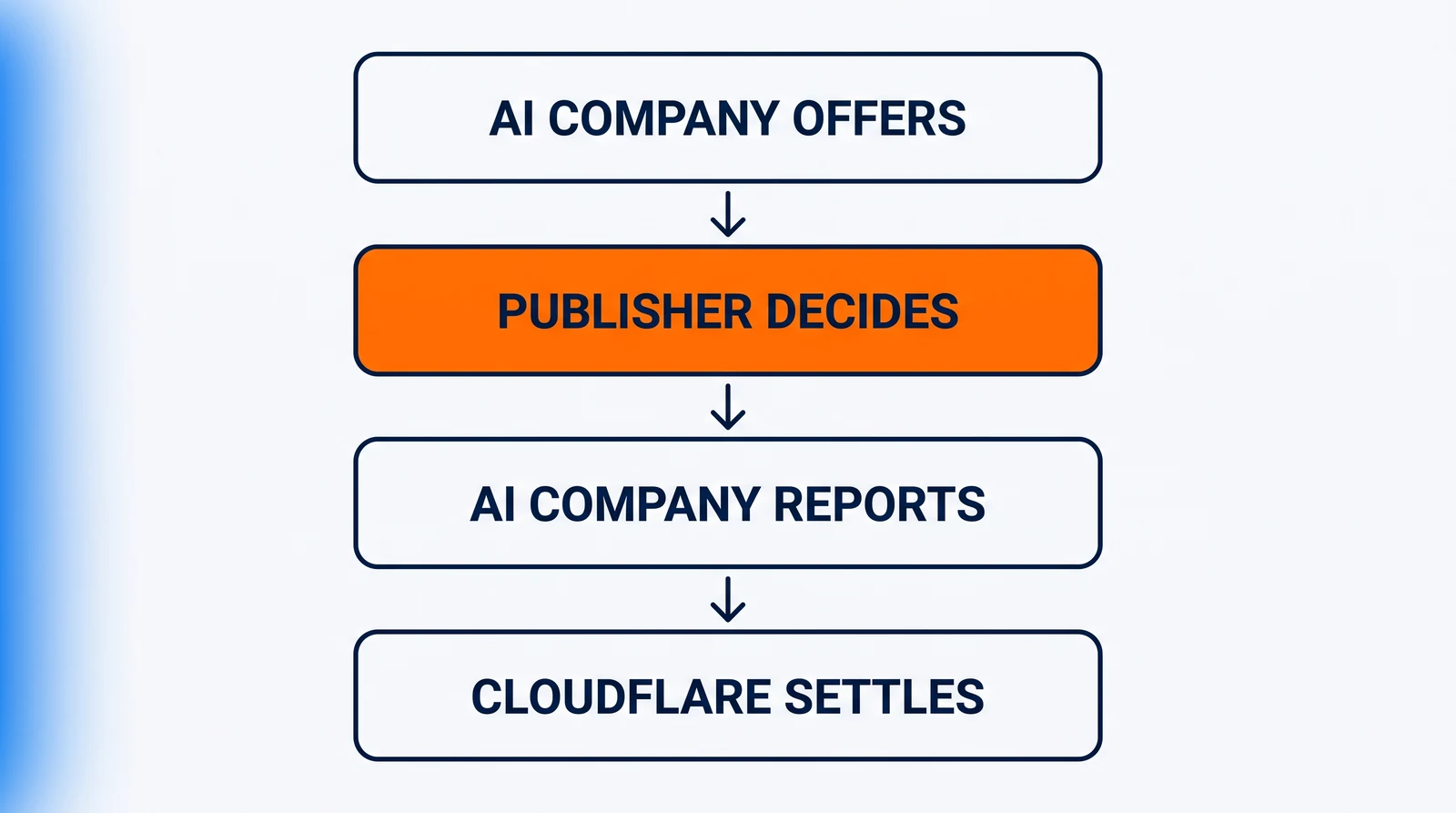
First, the AI company sets up its program: it identifies its crawler, names the event it will buy, sets a price and connects a payment account. Buyers identify their crawling through verified bots, and publishers "retain control over crawler access and downstream uses", so a crawler reaches and indexes a website's content only where the owner's settings allow it.
Second, the publisher decides in its dashboard, where offers appear under Monetize, then Pay Per Use, with the AI company, the event and the offer. A site can accept, or stop taking part later, and needs no change to its own servers. Each program's terms also set what the buyer may do with the content, "including any restrictions on training."
Third, the buyer fetches the list of domains that accepted its offer and reports one line of JSON for each event: when it happened, the URL the content came from, and an event ID. As the post's own example shows, that is the whole record.
Fourth, Cloudflare adds up the reports, charges the buyer and pays publishers monthly. "Publishers decide which offers to accept, and then can see how often their content is used and what it has earned," by domain and over time.
What changed from Pay Per Crawl?
Between Pay Per Crawl and the new product, the price moved from the website owner to the AI company, and the record of a billable event moved from Cloudflare's network to the buyer.
Pay Per Crawl launched in private beta on 1 July 2025 and is still a closed beta in Cloudflare's developer documentation. At launch it let a site owner set one flat price per request for the whole site and choose, for each AI crawler, to allow it free, charge it, or block it with no option to pay. Its current documentation also lets a site exempt chosen pages from charging and switch on dynamic pricing to set different prices for different content, with the site-wide price as the default. A crawler either signalled payment intent or received an HTTP 402 Payment Required response quoting the price, and the company acted as the merchant of record. The older product tied each fee to the moment of access: a billing event was recorded each time a paying crawler's authenticated request received an HTTP 200-level response, and the company then charged the crawler and passed the earnings on.
The September post gives the reason for the change: "AI products fetch far more than they use." It goes on: "Charging for every crawl makes the buyer pay before it knows what it needs, and many buyers won't." Its pitch to AI companies is that some of the content their products need sits "behind a block or a paywall today". Pay Per Crawl "charges for access", while the new product "pays for what happens next", and publishers can choose either model.
In the crawl model, then, the billable event was a request passing through Cloudflare's network, where the company could see it. In the use model, the billable event happens later, inside the buyer's product, where that network is not.
What counts as a use?
A use is whatever the offer defines it to be: "The buyer proposes the definition of the use being paid for." Cloudflare supplies the reporting and payment infrastructure.
The company's own examples cover a wide range: "a cited answer in AI search, a passage quoted in a research agent's report, a product review weighed by a shopping agent, or a recipe adapted by a cooking assistant." Cloudflare's post sketches two example offers. In one, a search service would be charged each time it returns an excerpt from an enrolled page to a customer. In the other, a shopping agent would be charged when an enrolled review shapes a recommendation, and "payment follows use even if the shopper never reads the review." The same article can earn under several offers, each covering a different event.
In July, Cloudflare named two companies it was experimenting with. Ceramic.ai had built what it calls a "pay-per-query" model, compensating publishers who opt in when their content appears in its search results; with You.com, agents could buy a specific piece of premium content on demand. The September post names no buyer, a gap Search Engine Journal also noted.
Who counts the uses, and what does Cloudflare check?
In Pay Per Use, the AI company defines the paid event, sets the price and reports each event itself, and the one check the post describes is a match against the publishers who enrolled. The sentence in full: "Usage is self-reported: the program terms require complete reporting, and Cloudflare checks that each reported use maps to an enrolled publisher."
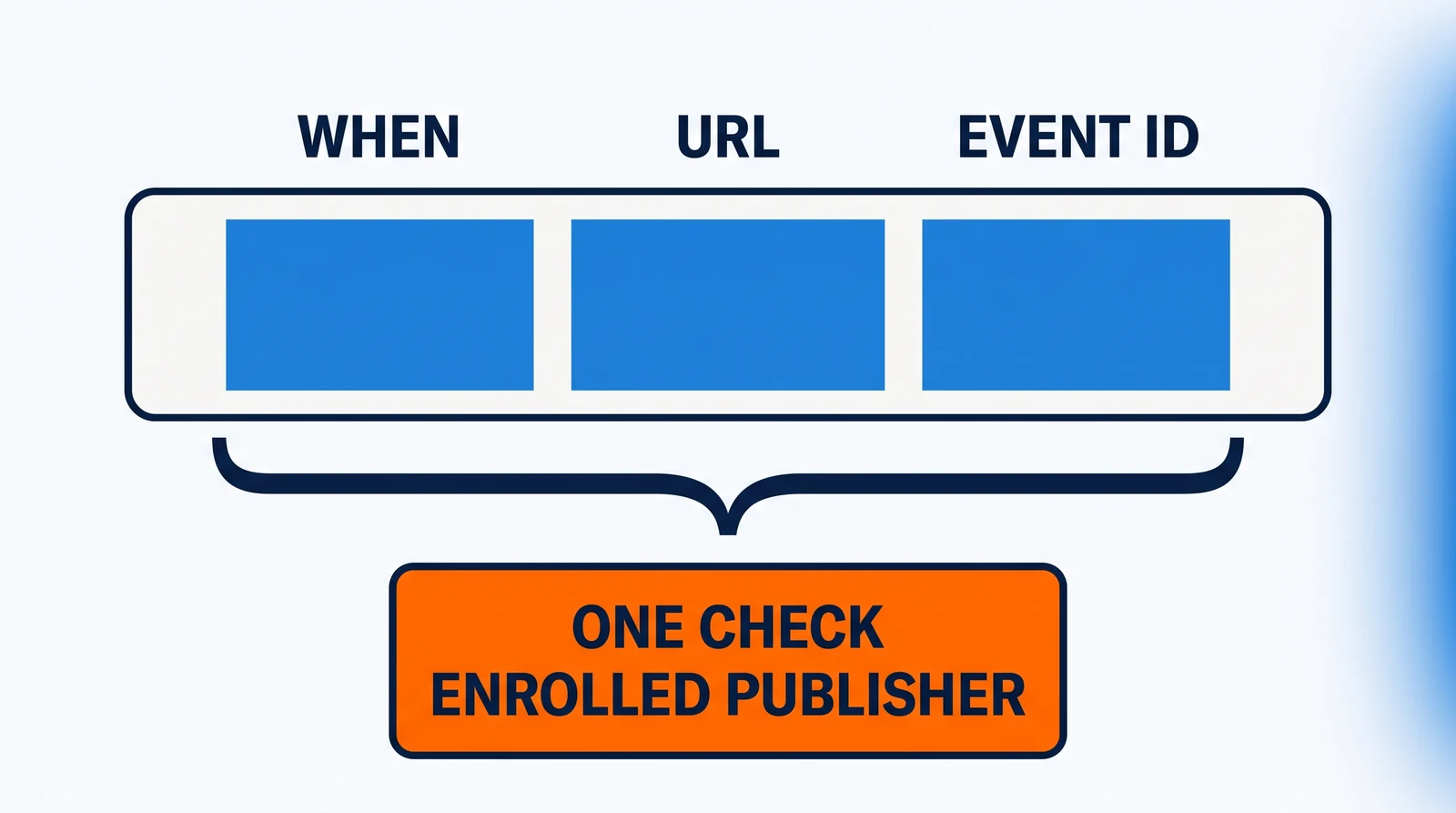
The post describes no other check: nothing about confirming that a reported event happened as described, or that every event was reported. Completeness is an obligation in the program terms.
Search Engine Journal's Matt G. Southern read the launch the same way on 1 October: for a publisher, "the usage data that affects your earnings is provided by the buyer's reports". The digital marketing agency Digital Applied wrote on 30 September that the launch "does not establish complete visibility into unreported uses."
Against that, the program terms require complete reporting, the post says publishers need "reporting they can trust", and Cloudflare is working with AI companies to add context to each report, "such as the keywords that led to the citation, the topic of the request, or the product it powered". Nothing we read suggests any reported count is wrong, and no count has been published that anyone could check.
Which uses could a publisher see for itself?
Some of the post's example uses leave a trace a publisher can check from outside the buyer's product, and some leave none; that is our read, not something Cloudflare says.
A cited answer in a public AI search product leaves a link that others can look for by asking the same question and recording the answer, which is what citation-tracking software, ours included, does. It is a sample of answers taken at chosen moments, not the buyer's full log. An excerpt returned to one customer through an API, or a review that shaped a recommendation the shopper never read, happens inside that product, with nothing outside it to compare.
The September post sets two of the company's views side by side. Business Insights, which is available to Cloudflare's Enterprise Bot Management customers, shows which crawlers visit a website and what they take, with a crawl-to-referral ratio for each bot operator. The earnings screen shows what buyers report. One is Cloudflare's own record of crawler visits; the other is the buyer's account. The company expects the fetch count to be the larger one, so a gap between the two proves nothing by itself.
The same post pairs the new product with the company's own Answer Engine Optimization tool, which shows how assistants answer questions about a site's work. Google's AI contribution pilot rewards a different unit again.
What is not public yet
Cloudflare's 30 September 2026 post names no Pay Per Use buyer, no price and no payout, and nothing else we read from the company fills in the numbers a publisher would weigh an offer by, such as volumes. Search Engine Journal noted the same absence of transaction counts and payouts. What comes next, in the post's words, is one place to "accept or decline offers, counter on price, and price content differently by use."
The September post opens on the publisher losing the visit, "and the revenue that would come with it", and on the point that most publishers will never sign a licensing deal with the companies that build on their work. A negotiated licensing deal is a different arrangement from an offer in a dashboard.
Whether an offer is worth accepting is a call for each publisher, against its own traffic, revenue and terms. Read these as our view of what to look for, not as a neutral checklist: what event the buyer counts, and whether it is one you could ever see from outside; what the terms allow with your content, including on training; and how you leave. The answers to those three sit in each offer, and they are yours to weigh.
What people ask about Pay Per Use
Is Pay Per Use a marketplace, like Pay Per Crawl?
Pay Per Use is a set of offers from identified AI companies that publishers accept or decline, rather than a marketplace where each site names its own price. Pay Per Crawl, launched in 2025, is that kind of marketplace: the site owner sets the price per crawl, a site-wide default that dynamic pricing can now vary by content. In the newer product, Cloudflare handles enrolment, usage records, billing and payment.
Can a publisher still block AI crawlers?
Yes: a publisher taking offers keeps control of crawler access, and Cloudflare's tools still let it block AI crawlers outright. Pay Per Crawl's Block option denies access entirely. On 15 September 2026, Cloudflare added a Disallow AI Training setting: it publishes a no-training preference in robots.txt, lets mixed-use crawlers the company calls Accountable, such as Googlebot, keep crawling for search, and blocks every other training crawler. The same change made Block and "Block on pages with ads" apply to those mixed-use crawlers, which affects search as well as training. New domains that earn money from ads are now offered a preset with Search allowed, Training set to Disallow AI Training and Agent blocked on pages with ads, and the owner can change it. The one-click "Block AI Bots" option, launched in 2025, is to be deprecated in favour of these controls.
What is an AI crawler, in Cloudflare's terms?
An AI crawler, in Cloudflare's current taxonomy, is a bot classed by what it does: Search, Agent or Training. Search bots collect or index content so they can answer questions about it later. Agent bots act for a person, usually in real time. Training bots take content to train or fine-tune a model. A paying AI company has to identify its crawler before any of its events can be billed.
Sources
- Cloudflare — Pay Per Use: when AI uses your work, you should get paid — Rúben Teixeira, Jack Galilee, Kayte Johnston and Sam Else; the beta, the four steps, who defines and reports a use, the enrolment check. Published 30 September 2026; checked 6 October 2026.
- Cloudflare — Introducing pay per crawl: Enabling content owners to charge AI crawlers for access — Will Allen and Simon Newton; the private beta, the per-request price, Allow, Charge and Block, and where billing events are recorded. Published 1 July 2025; checked 6 October 2026.
- Cloudflare docs — What is Pay Per Crawl? — the closed beta. Last updated 28 July 2026; checked 6 October 2026. No developer documentation for Pay Per Use could be found on 5 or 6 October 2026.
- Cloudflare docs — Pay Per Crawl: Advanced configuration — exempting pages from charging, and dynamic pricing with the site-wide price as the default. Last updated 28 July 2026; checked 6 October 2026.
- Cloudflare — Making AI search smarter — Matthew Conroy; the July experiments with Ceramic.ai and You.com. Published 1 July 2026; checked 6 October 2026.
- Cloudflare — Your site, your rules: new AI traffic options for all customers — Jin-Hee Lee and Bryan Becker; the 2025 "Block AI Bots" option and Pay-Per-Crawl marketplace, and Search, Agent and Training. Published 1 July 2026; checked 6 October 2026.
- Cloudflare — Have it both ways: stay discoverable in search while disallowing AI training — Bryan Becker; the Disallow AI Training setting, Block and "Block on pages with ads" applied to mixed-use crawlers, the presets for new domains and the planned deprecation of "Block AI Bots". Published 15 September 2026; checked 6 October 2026.
- Cloudflare docs — Business Insights — bot traffic, the crawl-to-referral ratio, and its availability to Enterprise Bot Management customers. Last updated 16 September 2026; checked 6 October 2026.
- Search Engine Journal — Cloudflare Moves Monetization Gateway & Pay Per Use Into Beta — Matt G. Southern. Published 1 October 2026; checked 6 October 2026.
- Digital Applied — Cloudflare Pay Per Use: Charging AI for Content and APIs — Digital Applied Team. Published 30 September 2026, updated 3 October 2026; checked 6 October 2026.
- LiamVi — AI and search engine optimization in 2026 — our editorial team's view that a citation, not a crawl, is the unit of value, stated there as what the team thinks. Checked 6 October 2026.
- LiamVi — Google's AI contribution pilot — checked 6 October 2026.
- LiamVi — AI licensing deals for news publishers — checked 6 October 2026.