--- title: "What an SEO content writer does, and when a company needs one" primary_keyword: "seo content writer" ---
What an SEO content writer does, and when a company needs one
An SEO content writer researches what people search for, writes the article that answers it, and checks it against its sources before it goes out. The writing is the part you see; the research before it and the checking after it decide whether the article is found and trusted.
We run this work on every article this desk plans, and on 7 November 2026 we opened the pages Google ranked for "seo content writer" ourselves. The results also held job listings and a writers' forum thread; if you are looking for SEO writing jobs, this page is not written for you. It is for the person at a company deciding whether it needs the role, and it shows the work in order: what each step produces, and where it fails.
What does an SEO content writer actually do?
An SEO content writer writes articles meant to be found through a search engine and trusted once found, and the research and the checking are as much of the job as the writing. Google's SEO Starter Guide (last updated 10 December 2025) defines the search half in one sentence: "SEO—short for search engine optimization—is about helping search engines understand your content, and helping users find your site and make a decision about whether they should visit your site through a search engine."
For a writer, that is two duties: help the engine understand the page (one clear topic, in the words people use for it), and help a reader decide to open it and stay (a title that says what the page holds, a first paragraph that delivers it).
SEO writing is writing for a reader's search. You start from what people type, you use the words they actually search with, and you structure the article so that both a person and a search engine can follow it from the question to the answer. The search is where the reader comes from; the reader is still who the article is for.
The role sits inside digital marketing, next to jobs it is easy to confuse with. In practice the work divides like this. Paid search (PPC) and other ads are a separate discipline: the visibility is bought, not earned by the page. Video and social media posting are their own crafts. Technical SEO (site speed, crawling, markup) is closer to how a site is built than to how an article reads, and local SEO listing work is about business profiles and maps. The closest neighbours are copywriting and content marketing. SEO copywriting usually means short, persuasive copy for a page that sells; an SEO content writer produces the long, researched article that answers a question. Content marketing is the wider plan they belong to.
What do the pages that rank say the job is?
HawkSEM, Brafton and Backlinko, the three ranking explainers we could read, each treat writing for search as part of the job, and none of the three publishes a count of its own checks. We read them on 7 November 2026, in the search results Google showed in the United States, in English.
| Page | What its own page lists | Publishes a count of its own checks? | |---|---|---| | The page ranked first, from the agency HawkSEM, last updated 28 September 2026 | "An SEO content writer strategizes, writes, edits, publishes, and optimizes online content designed to appeal to both search engines and human readers." Five tasks, from "Conduct SEO keyword research" and "Learn about their audiences" to "Write!" | No | | A guide from the agency Brafton, dated 16 January 2025 at the top (its foot notes an update in January 2024) | "SEO writing is the implementation of keywords and key phrases within web content to optimize it for search engines." Sections on keywords, ranking factors, title tags, meta descriptions and headers | No | | A guide from Backlinko, last updated 12 October 2026 | "SEO writing in 2026 is the process of planning, creating, and optimizing content to improve your search and AI visibility", organised as "4 Ps": Purpose, Proof, Precision and Portability, with a checklist to run before publishing | No |
Do not read the last column as "they don't check". HawkSEM's article shows it was edited and approved: its byline names a writer, a senior editor and a content manager who approved it. Backlinko tells writers to "Support important claims with evidence that builds trust and confidence in your brand", and gives them a checklist to run before publishing. The difference is narrower, and it is our own reading of the HawkSEM, Brafton and Backlinko pages as of 7 November 2026: none of the three publishes a count of its own checks, so you cannot see how often checking changed what was said.
We could read 3 of the 7 results Google showed. Of the 4 we could not read, three were job listings or a forum thread, not explainers of the role. Three pages is a thin base. Read the table as what these three pages say, nothing more.
What does the work look like, step by step?
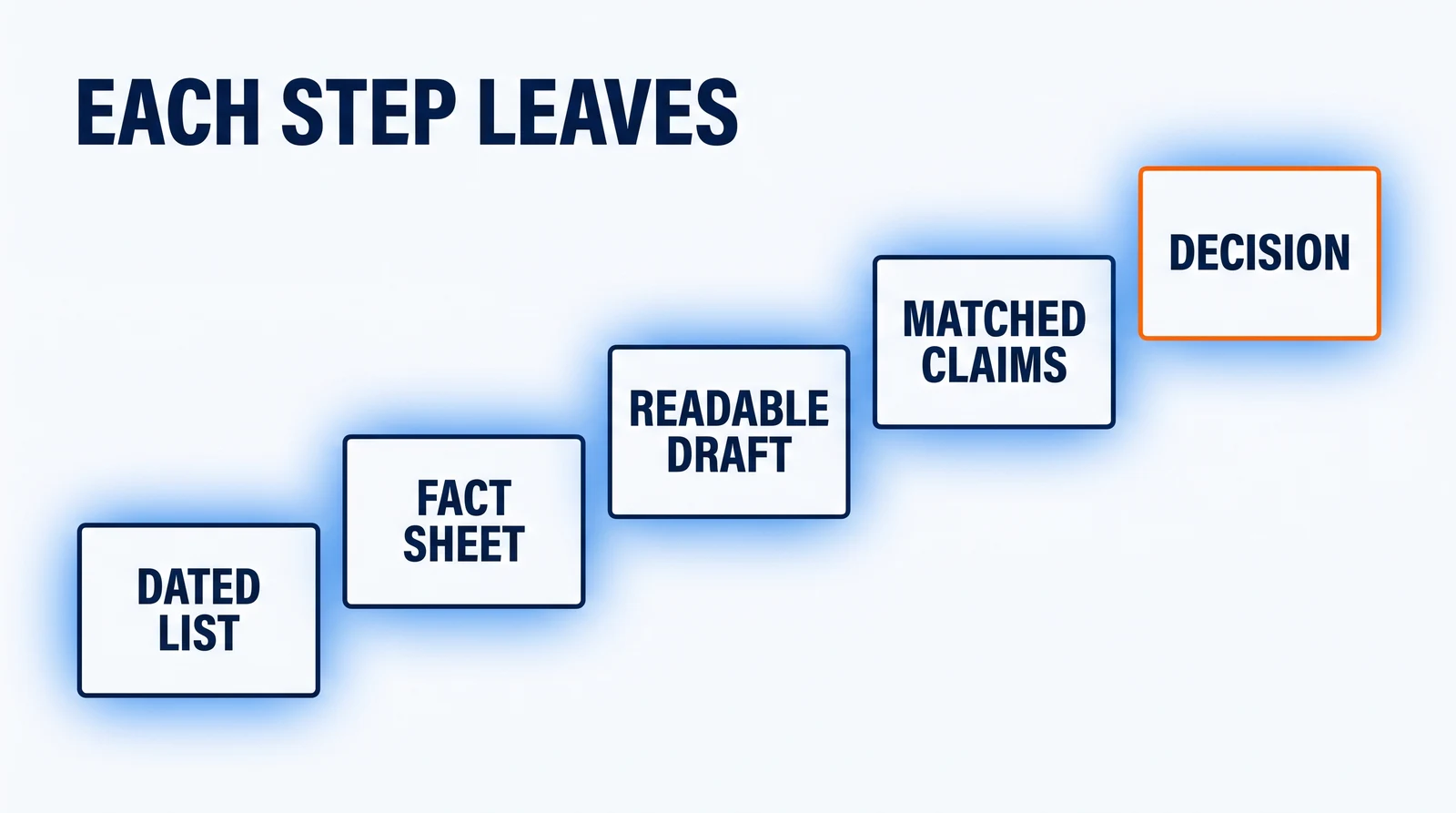
An SEO content writer's work runs in a fixed order, and each step leaves something you can check. This is the order we run at this desk, with what each step produces and how an article fails without it.
Read the search results before writing
The writer reads the pages that already rank for the keyword before a word is written. When this desk plans an article, it builds a contract for the keyword: the pages currently ranking, their word counts, and the People Also Ask questions and related searches from that same results page, each dated. We take the first ten organic Google results and fetch each page once, from the United States, in English, on desktop. The same capture is how we counted how long the pages that rank actually are, and where we start reading the searcher's questions against the results before writing.
It produces a dated list of what the reader is shown and asks next: search intent made visible. When two of seven results are job listings, as here, part of the audience is someone else, and the article must choose its reader. One capture from one location is a snapshot; results differ by country, device and day. Choosing the keyword is a separate job that comes before this step, and this article does not cover it. Skip this step and the article answers a question nobody is asking.
Find the sources before the draft
The facts are found and checked before the draft, not patched in afterwards. Our own pages put it in one line: "Sources are found and checked before the draft is written." An outline rests on its claims: if one dies on its source (the figure is older than it looked, the rule applies in one country only), the section built on it changes, and that is cheaper to learn before writing.
It produces a fact sheet: each claim beside its source, the date it was read, and who it applies to. Skip it and facts get found after the draft to support what was already written.
Write for the reader first, then for the search engine
The draft answers the reader's question in the first sentence under each heading, and the search terms follow from covering the topic, not the other way round. Google's guidance on helpful content (last updated 5 October 2026) defines people-first content as "content that's created primarily for people, and not to manipulate search engine rankings", and says "SEO can be a helpful activity when it is applied to people-first content, rather than search engine-first content." The same page asks whether you are writing to a word count because you heard Google prefers one, and answers itself: "(No, we don't.)"
The Starter Guide covers the parts of the page a writer controls. It says a good title "is unique to the page, clear and concise, and accurately describes the contents of the page", and that "A good meta description is short, unique to one particular page, and includes the most relevant points of the page." It asks writers to "provide headings to help users navigate your pages", and it is blunt about the shortcuts: "Don't just rehash what others already published", and "keyword stuffing is against Google's spam policies". Add an internal link where a related page on your own site answers the reader's next question.
It produces a draft a person would choose to read, one that still sounds like someone explaining what they know. Skip the reader-first order and the article reads like the keyword list it came from.
Check what the article says against what the source says
The check compares every claim with its source, sentence by sentence, once the draft exists. Our pages describe the step in those words: "What the article says is compared with what the source says." Google asks the same of anyone publishing with AI. Its guidance on using generative AI content (last updated 1 October 2026) says "It is critical to manually factcheck and review all AI-generated content for accuracy and trustworthiness before publishing", and it extends that review to titles and meta descriptions.
One failure this check exists to catch is a scope problem: a true fact, stated for more readers than its source covers, such as one country's rule written as if it applied everywhere. It produces claims that match their sources, and a record of the ones that changed.
A fresh review, then a person reads it
A draft is read by a reviewer separate from the writing, and then by a person, before anyone approves it. Our pages describe this stage for client articles as "A fresh review, separate from the writing", after which "a person on our team reads it". The rule underneath is "No step approves its own work.", and for the client, "Nothing is published until you approve it."
It produces a decision someone can be held to. Skip it and the writer approves their own work.
Skipping a step does not make someone a bad writer. But you should know which steps you are paying for, and which you are only assuming.
Should an SEO content writer write to a score?
No: a content score is a check on coverage, not a measure of a good article, and our own test showed why. In one pre-registered trial of 15 articles, our fitted content score (a score fitted to what already ranks) ran the other way from blind quality judgements, at rho −0.61 across the 9 articles it covered. Across all 15 blind-judged articles, each set against whichever score it carried, rho was also −0.61 (our research page, finding measured 28 July 2026 and published 12 August 2026). In plain words: among drafts that all scored well, the ones the score rated higher tended to be the ones the judges rated lower, so what failed was ranking good drafts against each other, not telling bad writing from good.
Our trial, measured on 28 July 2026, covered 15 articles, and every draft in it scored between 71 and 90, so it says nothing about drafts that score badly. The judges were independent reviewer agents, one per article, not people; a blind read by people is prepared and not yet done. And our editing loop had revised each draft until the score cleared 75. That is a confound: it could explain part of the result, and only a trial without that loop would show how much.
So use a score to find what a draft has not covered yet: a question it skipped, a term the topic needs. Never ask a writer to push the number up by repeating words. Keyword stuffing, which Google's Starter Guide places against its spam policies, makes the article worse for the reader whatever the tool says about its SEO performance.
Where does AI fit in an SEO content writer's work?
In Google's own terms, generative AI can be useful for researching a topic and for adding structure to original content, and its guidance on using generative AI content (last updated 1 October 2026) calls manual fact-checking before publishing critical. Separately, in a February 2023 post on AI-generated content, Google wrote: "Appropriate use of AI or automation is not against our guidelines." And: "Using AI doesn't give content any special gains. It's just content."
What Google acts against is volume without value. Its spam policies (last updated 28 August 2026) name scaled content abuse, and one example is "Using generative AI tools or other similar tools to generate many pages without adding value for users". The policy applies "no matter how it's created", so the test is purpose and value, not the tool. Its helpful-content guidance adds that AI or automation disclosures are useful where someone might ask how a piece was created.
Our own practice, stated plainly: we use AI to write our articles, and a person checks it. Our home page says the other half in its own words: "We do not sell a one-click article button, and we never will."
Some people now call writing for AI assistants such as ChatGPT "generative engine optimization", or GEO. The term comes from a 2023 research paper, "GEO: Generative Engine Optimization", which introduced it as a way to help content creators improve their visibility in generative engine responses.
Is SEO dead, or still worth writing for in 2026?
For Google's own AI features, no: Google says optimizing for them is still SEO and needs no special extra steps. Google's documentation on AI features (last updated 10 December 2025) says there are "no additional requirements to appear in AI Overviews or AI Mode, nor other special optimizations necessary", and its guide to optimizing for generative AI search (last updated 10 July 2026) says "optimizing for generative AI search is optimizing for the search experience, and thus still SEO". That is Google speaking about Google's AI Overviews and AI Mode. It says nothing about ChatGPT, Perplexity or Gemini; where that leaves them is the subject of what carried over from SEO now that people also ask AI assistants, a separate piece of ours. Google's pages on its AI features change often.
Our own measurement adds a null. Across 33 keywords measured on 29 July 2026, mostly in ChatGPT, cited pages answered 58.8% of searcher questions and ignored pages answered 58.2% (our research page, as of 12 August 2026). Answering the questions people ask makes an article better for its reader; on that sample, it did not buy citations. The page gives no count of the pages or questions behind those averages, and 33 keywords in three related industries is a small base, which is why we keep measuring and publish what changes.
When does a company need an SEO content writer?
A company needs an SEO content writer when it wants to publish articles regularly and either nobody has the time to do every step, or nobody is checking the facts before they go out. They look different from the outside:
- No time. Articles ship rarely or not at all, because the people who know the subject are busy doing the subject.
- No checking. Articles ship, but they state things nobody opened a source for: a figure from memory, a rule from another country, a quote nobody can find again.
The ranking page from HawkSEM gives its own answers under the heading "Do you need an SEO content writer?": starting a content strategy from scratch, a dip in SEO performance, a new department or product line, being "Spread too thin to create consistent, high-quality content", and reaching new audiences and brand awareness. Those are fair triggers, and the "spread too thin" one is the time problem in other words. None of the five is the checking problem.
This part is our judgement, not a measurement. You probably do not need one when a subject expert on your team has the time to write and someone else checks their facts before anything goes out; the steps are already covered. Nor if you publish one page a year: a writer is a cost for a rhythm, and that is not one.
The rest of the decision is yours. It is a trade between time, cost and checking, and it depends on what your business knows; we cannot make that call for you. Start by looking at which steps your current articles skip, because that tells you more than a job title does. Visibility built on articles nobody checked is visibility for claims you may not want to stand behind.
What people actually ask us
What is meant by SEO writing?
SEO writing is writing for a reader's search: you start from what people type, use the words they actually search with, and structure the article so both a person and a search engine can follow it from question to answer. Google's SEO Starter Guide describes SEO as helping search engines understand your content and helping people decide whether to visit your site.
Is SEO an IT skill?
SEO writing is a writing and research skill, not an IT one. The part of SEO closer to IT is technical SEO, meaning how a site is built, how fast it loads and how search engines crawl it, and in practice that is usually a different job from writing the articles.
What is the difference between an SEO content writer and a copywriter?
In practice, SEO copywriting usually means short, persuasive copy for a page that sells, while an SEO content writer produces the long, researched article that answers a question someone searched.
Does Google penalise articles written with AI?
Not for the use of AI as such. In a February 2023 post, Google wrote that "Appropriate use of AI or automation is not against our guidelines" and that "Using AI doesn't give content any special gains. It's just content." Its spam policies (last updated 28 August 2026) do treat generating many pages without adding value for users as scaled content abuse, "no matter how it's created". This is Google Search's guidance only.
What to check this week
Pick one article you have already published and run three checks. Open the search results for its main keyword and read the top pages: does your article answer what they answer, for the same reader? Pick three facts in the article and open each source: does the source say the same thing, about the same people? Then ask someone who did not write it to read it cold, and note where they stop or doubt. Whatever fails is the part of the job you are missing, and you will know whether the gap is time, skill or checking.
One line about us, since you are reading our blog: we use AI to write our articles; a person checks it, and every article here is made by the same process we offer our clients.
Sources
- Google Search Central, SEO Starter Guide (last updated 10 December 2025), read 7 Nov 2026: https://developers.google.com/search/docs/fundamentals/seo-starter-guide
- Google Search Central, guidance on helpful, people-first content (last updated 5 October 2026), read 7 Nov 2026: https://developers.google.com/search/docs/fundamentals/creating-helpful-content
- Google Search Central, guidance on using generative AI content (last updated 1 October 2026), read 7 Nov 2026: https://developers.google.com/search/docs/fundamentals/using-gen-ai-content
- Google Search Central, Spam policies, scaled content abuse (last updated 28 August 2026), read 7 Nov 2026: https://developers.google.com/search/docs/essentials/spam-policies
- Google Search Central blog, post on AI-generated content (8 February 2023), read 7 Nov 2026: https://developers.google.com/search/blog/2023/02/google-search-and-ai-content
- Google Search Central, documentation on AI features (last updated 10 December 2025), read 7 Nov 2026: https://developers.google.com/search/docs/appearance/ai-features
- Google Search Central, optimizing for generative AI search (last updated 10 July 2026), read 7 Nov 2026: https://developers.google.com/search/docs/fundamentals/ai-optimization-guide
- Aggarwal et al., "GEO: Generative Engine Optimization", arXiv (2023, revised 2024), read 7 Nov 2026: https://arxiv.org/abs/2311.09735
- HawkSEM, What does an SEO content writer do? (last updated 28 September 2026), read 7 Nov 2026: https://hawksem.com/blog/seo-content-writer/
- Brafton, What is SEO writing? (16 January 2025), read 7 Nov 2026: https://www.brafton.com/blog/creation/what-is-seo-writing-the-complete-guide-to-writing-for-search/
- Backlinko, SEO Writing in 2026 (last updated 12 October 2026), read 7 Nov 2026: https://backlinko.com/hub/seo/seo-writing
- LiamVi, our research page and its method (figures as of 12 August 2026), read 7 Nov 2026: https://liamvi.com/research/