--- title: "How to choose a content marketing service: what to ask, and what to get in writing" primary_keyword: "how to choose a content marketing service" ---
How to choose a content marketing service: what to ask, and what to get in writing
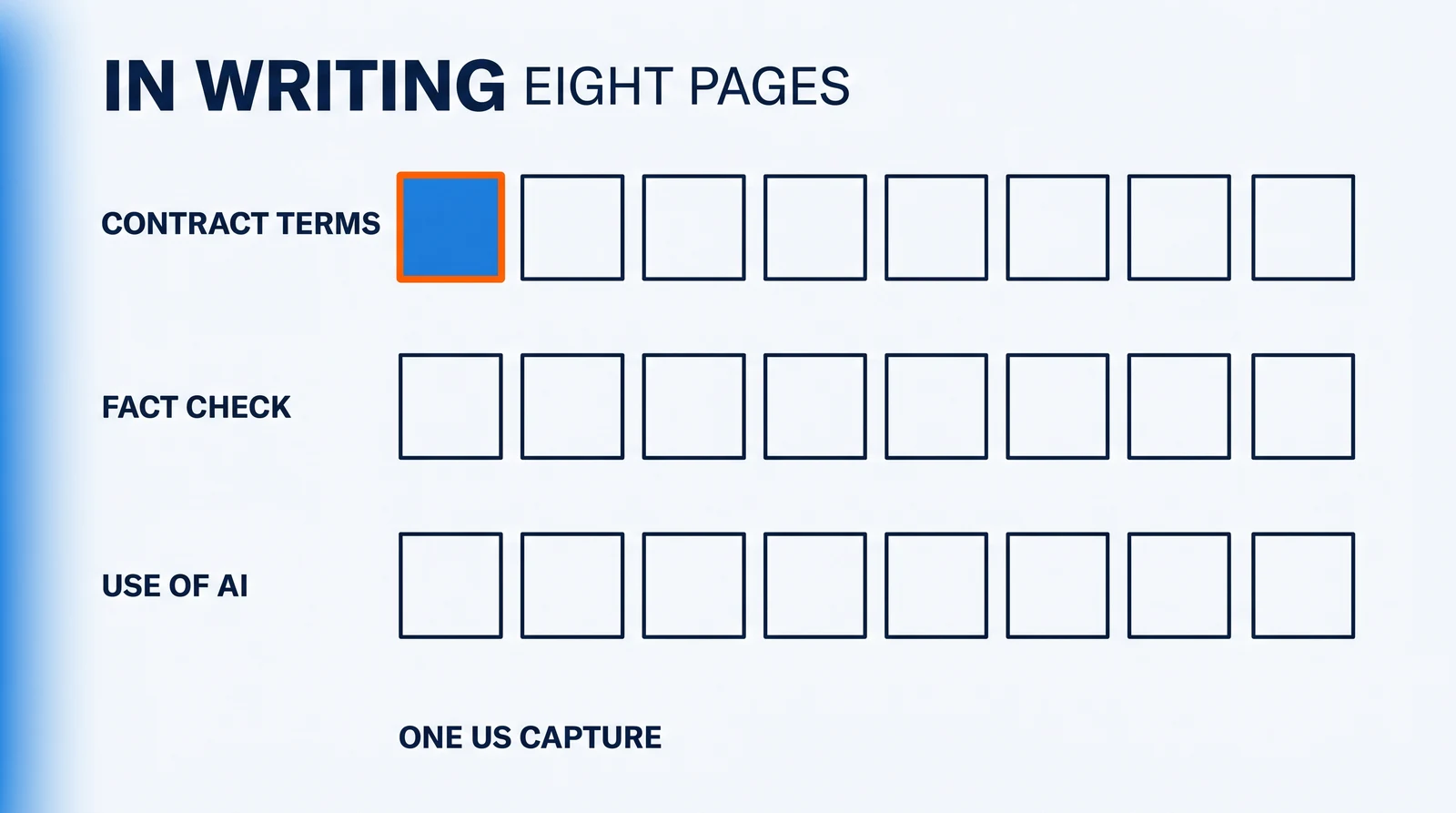
On 8 November 2026 we opened the eight readable pages ranking on Google for "how to choose a content marketing service". The search results we captured were the ones shown in the United States. One of the eight tells you what to put in the contract, and none of the eight tells you to get the service's fact-checking or its use of AI in writing. We counted a page about choosing a content marketing service only if it told you to get the point in writing, or in the contract, before you sign, and asking about it in a meeting did not count.
The eight ranking pages are tips articles, lists of agencies and one agency's own service page, and several of them give useful advice. 4 of the 8 ranking pages tell you to ask about process, quality control or how articles are reviewed, but only as questions in conversation. The one guide that holds up goes further: written about choosing a digital marketing agency in general, it tells you to make sure the contract outlines the scope of work, deliverables, fees, payment terms and ownership of assets, and to read the terms for ending the agreement.
The limit comes first, not last: this is one capture, on one day, in one market. Another day or country would rank other pages, and we read eight pages, not the whole web. One more limit sits inside the count itself: one of the eight pages refused a direct read, so we read it from an archived copy dated 16 May 2026. That copy shows what the page said then, not necessarily what it says today, and if that page now says something else, the count could change.
A small company has a particular reason to want these answers on paper. With no content team of your own, nobody in-house checks the research, the facts or whether your brand still sounds like itself, so the answers have to do that checking for you. The questions apply the same way to an established agency or a smaller provider. What follows is the short list to send, what a good answer to each should contain, and, where we have one, an example from our own desk. Where the answer would be our own terms, ask us for them in writing, so you can hold us to the same list.
What should you ask a content marketing service before you sign?
A small company should ask a content marketing service eight questions before signing, and should get every answer in writing. Send the same eight to every content marketing agency or service on your shortlist:
- Who is the content for, and how do you choose the topics?
- Do you read the pages that already rank before you write?
- Where do the facts come from, and who checks them before publication?
- Is it written with AI, and does a person approve it?
- Who owns the text, and what happens to it if we stop?
- What exactly arrives each week, and what is outside the scope?
- How will we know whether the content is working?
- What does your score or report actually prove?
Read the list as our view of what matters before you sign, not as a neutral standard. We picked these eight because each has an answer you can check. A content marketing agency that does the work can describe it in a paragraph.
Why in writing? Answers can be laid side by side with the others and checked again in six months, when the work has arrived and you want to know whether it matches what you were told. A call leaves you nothing to compare or check. The choice stays yours; the answers just give you something firmer than a sales conversation to make it on.
Each section below takes one question: what a good written answer shows, why it matters, and, where we have one, an example from our own desk with its limit beside it.
Who is the content for, and how are the topics chosen?
A good written answer should name the audience, the business goal the content serves, and how topics are picked and approved before anything is written. This is the content strategy question, and it comes before any single article. A real strategy ties each topic to the audience question it answers and the business goal it serves, where a topic list only names subjects, and the answer should also say when and how the plan is reviewed as results come in. Ask it first, because every later answer depends on it.
For a small company, the answer has to fit your customers, not customers in general. A business-to-business (B2B) buyer and a customer of an ecommerce shop search for different things, ask different questions and need different content, so a strategy written for one will not serve the other. Brand voice works the same way: a provider that cannot describe how your company sounds will drift away from it, draft by draft, and with no content team of your own you may be the only person placed to notice.
The written answer should contain:
- the audience the content is written for;
- the business goal the content serves;
- how topics are found: from what that audience searches for and asks, not from a generic content calendar;
- which channels (the blog, social media, email) are used, and why each one;
- who approves the topic list before writing starts;
- how your brand voice is captured, and how you correct it when a draft sounds wrong.
Then ask where SEO enters the plan. Ask whether it shapes the content strategy from the start, with each topic on the plan chosen from keyword research and from what the search results show for it before the plan is approved, or whether SEO is only applied to each article after it is written. The difference decides whether the plan was built for search at all. A simple test is to ask the agency to show how one topic on its plan was chosen. The next section covers what reading the ranking pages for each article should involve.
The judgement here stays with you. You know your business and your audience in a way no service can from the outside, so read the answer as a first draft of your own content marketing plan: if it describes your customers in a way you do not recognise, that is the moment to correct it, before any article is written.
Does the service read the pages that already rank before it writes?
A good content marketing service opens the ranking pages for the query each article targets and dates its look, and its written answer should name the query and the date the pages were read. In search engine optimisation (SEO), keyword research tells you which words people type into a search engine. Reading the pages that already rank tells you what the results page currently shows for those words: how long those pages are, how they are structured, and which questions they answer. A content strategy built on the first without the second is a list of words with no picture of the competition for each one.
The written answer should contain:
- the query each article is written for;
- the date the ranking pages were captured;
- the pages opened, and which ones could not be read;
- the word range the piece will be written to;
- the terms and questions the ranking pages share.
Here is what that looks like on our desk. Before we write any article, we build a search contract for its query, and this article has one. Its file was built on 8 November 2026. The ranking results in it are the ones shown to searchers in the United States. It holds a word band of 3,300 to 5,500 words, which is the range this piece has to land in. It holds a list of 110 terms, each with a range of uses, which are the words the ranking pages share and so the vocabulary the subject is usually discussed in. It holds the 9 ranking results with their word counts: the 8 readable pages from the opening, one of them read from an archived copy, plus 1 further result that could not be read at all and so sits outside the eight. And it holds a checklist of 6 rules for how the piece is built, such as sections that open with the answer and passages that still make sense when lifted out on their own.
The limit belongs right here. The contract tells us what the ranking pages share; it does not tell us that matching them will rank anything, and we do not read it that way. A service that tells you its research "guarantees" a position is describing a hope, not a method. What a file like this gives a buyer is a dated record of what the research found before the writing started, one you can look back at later.
Two related questions are worth asking alongside this one. The first is length: before you agree a word count, it is worth knowing how long the pages that rank actually are, and how to check your own query. The second is keywords. If a service talks about its keyword strategy, ask what that list actually does to the writing, and ask to see the score records behind its answer.
Where do the facts come from, and who checks them before publication?
A good written answer about facts should name the sources a content service treats as proof, the person who checks each claim, and what happens to a draft when a claim fails. This matters more than writing quality in a sample, because a sample shows you the prose and hides the research. An article can read well and still carry a wrong fee, a misquoted rule or a statistic nobody can trace.
The written answer should name:
- the primary sources it relies on: the body that sets a rule, the company's own documents, the original study;
- whether those sources are visible to the reader in the published piece;
- a check that can send a draft back before it goes out;
- what is cut when a claim cannot be sourced.
On its page Do you need an SEO?, which is advice on hiring an SEO, Google suggests you consider a similar question: "Do they cite official Google documentation as supporting evidence for their recommendations?" That is advice about hiring someone for SEO, not a rule for content services, but the principle carries over. An expert's say-so is not a source. If a content marketing agency cannot point to where a claim came from, the claim rests on its confidence, and confidence is not something you can audit.
On our desk, every article goes through a sources check that can ask for fixes before publication, and we keep a count of those fixes across our own articles. Ask any service for the equivalent. If it has no count, ask for one example of a claim its check removed or corrected.
It also helps to know who does this work, and the question for the service is a plain one: whose name is on the fact check, and what happens to a draft after one of its claims fails?
Is it written with AI, and does a person approve it?
A good written answer says plainly whether AI writes the drafts and names who approves each piece before it is published. Yes or no, and a role, not a phrase like "AI-assisted workflows". You are asking because you need to know what you are paying for and who answers for it.
One search engine's published position is worth knowing before the call. In its 2023 guidance, Google says its focus is on "the quality of content, rather than how content is produced", and that "Appropriate use of AI or automation is not against our guidelines." What Google does act against is purpose, not the tool: its spam policies, last updated 28 August 2026, define scaled content abuse as many pages "generated for the primary purpose of manipulating search rankings and not helping users", "no matter how it's created". All of this is guidance for one search engine, and it is silent on how any other company treats AI-written pages.
One more question comes from the guidance on creating helpful content, where Google asks: "Is the use of automation, including AI-generation, self-evident to visitors through disclosures or in other ways?" The wording is soft. It says disclosures are something to "consider" adding "when it would be reasonably expected", not a requirement. So the question for a provider is not whether it uses AI, but whether it will tell you, and your readers where that is reasonably expected, how it does.
Our own answer is short: we use AI to write our articles; a person checks it. The scoring tool we build is another product, with an answer of its own, and a separate page explains why that scoring tool does not write the draft.
Two more things to ask here. First, how the service learns your brand voice: a fair answer names what it reads (your existing pages, a style guide, past posts) and how you correct it when a draft sounds wrong. Second, if you worry that the articles will read like AI, ask the service what it has actually tested rather than what it believes, and ask what that test does and does not tell you.
Who owns the text, and what happens to it if you stop?
A good written answer says, in the signed agreement, who owns each article once it is paid for, and what you keep, and can still use, if you stop the service. It is also the question where the default rules may surprise you.
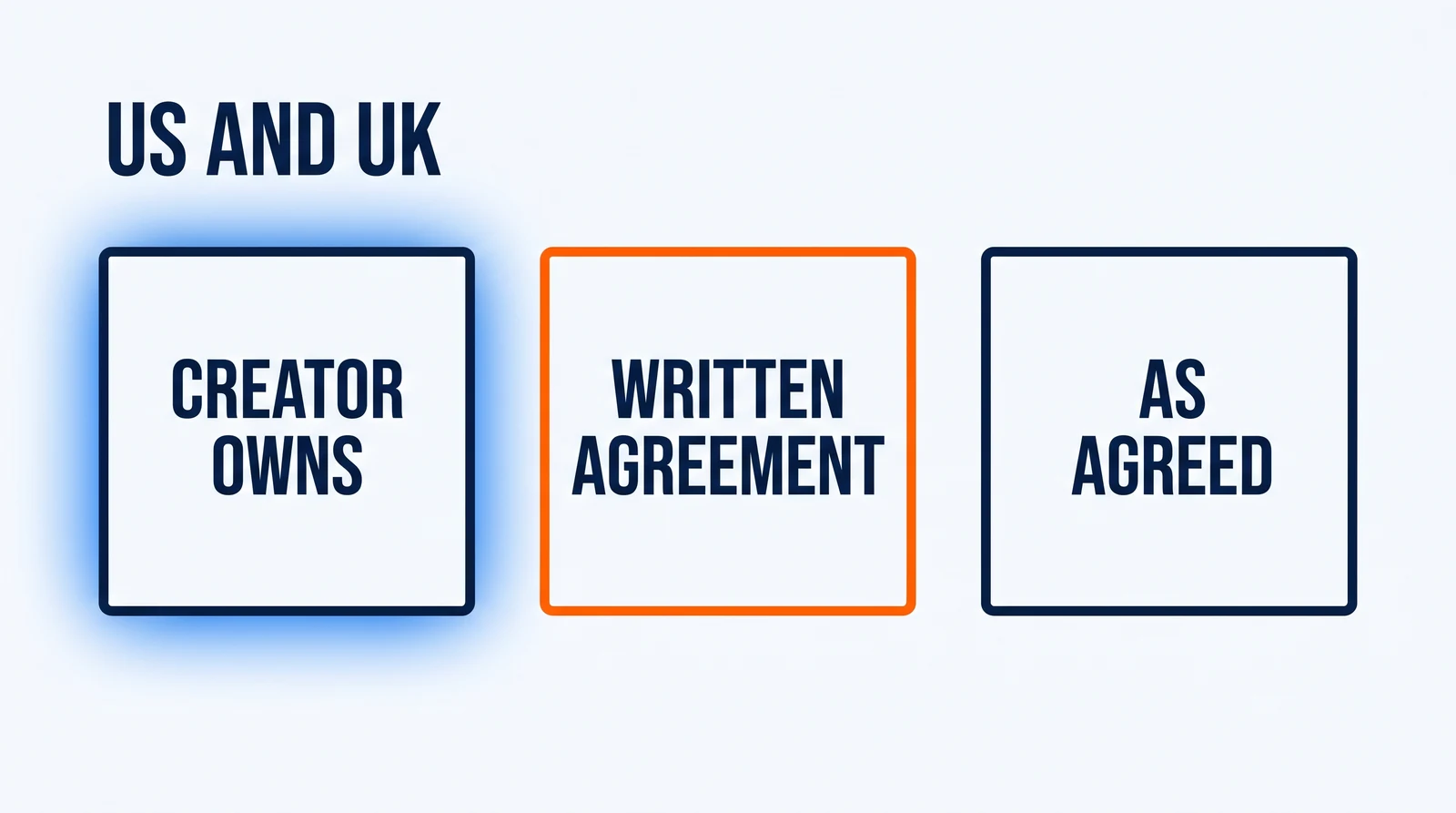
In the United States, copyright starts with the author, and for work a contractor makes, the first owner is not the buyer unless a signed written agreement says otherwise. US copyright law says copyright "vests initially in the author or authors of the work" (17 U.S.C. §201(a), published by the U.S. Copyright Office). Work done by a contractor counts as a "work made for hire" only in a set of listed categories, and only "if the parties expressly agree in a written instrument signed by them" (17 U.S.C. §101). Outside that, ownership moves only by a transfer, which under §204(a) "is not valid unless an instrument of conveyance, or a note or memorandum of the transfer, is in writing and signed by the owner of the rights conveyed". Whether a given article falls into one of those categories is a question for a lawyer, not for us.
The United Kingdom starts from the same place. The UK Intellectual Property Office's guidance on ownership of copyright works, published in 2014, says that when you commission work, the first owner is the person or organisation that created it, "and not you the commissioner, unless you otherwise agree it in writing". Rules differ by country, so check yours; the US and the UK are two examples, not a global rule.
AI adds one more reason to ask. The U.S. Copyright Office's 29 January 2025 release on its Part 2 report says the outputs of generative AI "can be protected by copyright only where a human author has determined sufficient expressive elements". That does not mean AI-assisted text cannot be owned; the same release says using AI to assist "does not bar copyrightability". It does mean it is worth asking, in writing, how much of each article a person shapes.
The one ranking page of the eight that held up says the same thing in plainer words: make sure the contract covers ownership of assets, and pay attention to the terms for ending the agreement. Get these in writing:
- who owns each article once it is paid for;
- whether that is a full assignment of the rights or a licence to use them;
- what you can keep, and keep using, after you stop;
- how much notice either side must give to end the agreement;
- what happens to work in progress on the day it ends.
Ask in the same agreement who keeps the work behind the articles when the arrangement ends: the content strategy and topic plan, the keyword research, and any brand voice guide or notes made for your company, and in what form each is handed over. Without them, whoever writes for you next has to rebuild the plan, the research and the notes on how your brand sounds.
The cost question sits here too: ask what the fee covers in rights, not only in articles, because two quotes for the same number of pieces can leave you with very unequal rights over the long term. We are not lawyers, and this is not legal advice. Where the stakes are high, ask a lawyer to read the agreement before you sign it.
What exactly arrives each week, and what is outside the scope?
A good written answer lists every deliverable with its format, length and date, and lists just as plainly what the service does not do. Vague scope is easy to prevent at the start and hard to fix later. The one ranking page that held up names scope of work and deliverables first in its contract advice, and it is right to.
The deliverables should be named in writing:
- which formats: blog articles, social media posts, email marketing, video scripts, or whichever are offered;
- how long each piece is;
- how many arrive, and on which days;
- who publishes each piece, you or the service, and where each one goes: your blog, your social media accounts or your email list;
- how revisions work, and how many rounds are included.
The channel pieces need their own line in the answer. If social media posts, email marketing such as a newsletter, or video are part of the offer, a good written answer says whether each piece is written for its channel or cut down from an article, who creates it, who approves it, and who posts it, on whose brand accounts. A post written for one social channel and a paragraph lifted from an article are two separate jobs, and the answer should say which one you are paying for.
Then ask what sits outside. Content marketing is often sold beside other kinds of digital marketing, and the boundaries are not obvious from a proposal. Start with the word SEO. In a content proposal it can mean the work done on each article: keyword research, headings, internal links and page titles. Technical SEO is a separate job on the site itself, such as site speed or crawl problems, which is development work more than writing, and a proposal may or may not include it. Ask which of the two the proposal means. It may also leave out PPC and other paid media, social media management on a channel like LinkedIn, ecommerce product pages, copywriting for your own sales pages, or B2B lead generation campaigns. A full digital marketing agency might do all of these; a content marketing agency might do none of them. Neither is wrong. What matters is that you ask which are in and which are out, so the price you are quoted covers what you think it covers.
One more question helps: "If we need something that is not on this list, what happens?" A good answer tells you whether it is quoted separately, refused, or folded in, and who decides. A marketing agency that cannot say what it does not do has not decided yet.
How will you know whether the content is working?
A good written answer says what will be measured, from which report, how often, and what the service will not promise. The advice on hiring an SEO quoted earlier is useful here too. On its Do you need an SEO? page, Google suggests asking: "What kind of results do you expect to see, and in what timeframe? How do you measure your success?" Google is also blunt about the answer to avoid: "If they guarantee you that their changes will give you first place in search results, find someone else." That is advice about SEO services, but the same test applies to any content strategy.
Ask which reports the numbers will come from. For search, the main one is Search Console. Google's documentation on AI features says sites appearing in AI Overviews and AI Mode "are included in the overall search traffic in Search Console", inside the Performance report under the Web search type. Since 31 August 2026, Search Console has also had a separate Generative AI performance report for all websites, which shows impressions in those two features. Know its limit: as documented, that report shows impressions in those two AI features only, and it tells you nothing about any other assistant. Anyone who promises to report on more than that should say where the extra numbers come from. Beyond search, ask which analytics will be read for traffic and engagement on your site, and who holds the access to those accounts: you, or the provider.
If social media posts, email or video are part of the work, ask which numbers will be reported for each channel, whose account each number comes from and which report shows it. Then ask how those numbers connect to the goal agreed in the strategy. Keep the limit in mind: ask what each channel's number can and cannot show, and do not read a channel figure on its own as proof that a post brought a customer, including a sale a platform credits to itself.
Then ask how the reporting connects the content to what you count as a business result: enquiries, qualified leads, sales, or the goal you named when the strategy was agreed. For each one, ask which record it is counted from, such as your own enquiry inbox, your customer records or your sales log. Ask what the agency can attribute to the content and what it cannot, because a reader who found you through an article may still have called or written in some other way. And ask who holds that data, you or the agency. Which of these results matters most is your judgement to make, and the agency's reporting should be built around your answer, not its own.
Case studies deserve the same scrutiny, and a case study is only worth as much as what you can check in it. A checkable case study shows:
- the dates the work ran;
- the report the numbers came from;
- the starting number, not only the rise;
- how many pages or months it covers;
- a business like yours: a small company, a business-to-business firm or an online shop.
Our house rule is that a rate never appears without its denominator, and it is a fair rule to apply to anyone's claims about growth, engagement, reach or lead generation. A rise in percentage terms tells you little until you know what it rose from, so ask for the raw numbers behind it, and ask for one case study from a business like yours.
Then agree the timeline and the audience you are measuring against. Return on investment (ROI) is the question every owner eventually asks, and the honest written answer is that a service can promise the work, not the result. It can commit to what it will deliver, when, and what it will report; it cannot commit to what Google, or your audience, will do with it. Any answer that blurs those two is the one to read twice.
One last question closes the loop: what changes in the content strategy when the numbers come in? Ask which articles get updated, which topics are dropped from the plan or added to it, how often that review happens, and who makes the call, the agency or you. A report that changes nothing in the plan is only a cost.
What does a service's score or report actually prove?
A score proves only what it was tested against, so a good written answer says what the service's content score was checked against and what that test found. If a provider shows you a score for each draft, the number is only as good as the test behind it.
We asked it of our own score, and the answer went against us. We tested our fitted content score against cold reads in a trial of 15 drafts, and it ran the wrong way: rho −0.61 across the 9 articles our score covered, out of the 15. In plain words, the drafts our score rated higher did not read better to the cold readers; the two ran in opposite directions. Every draft in the trial scored between 71 and 90. The cold reads were done by independent reviewer agents, one per article; a person's blind read of the same articles is prepared and not yet done. The page also logs a confound, a limit on the finding: our editing loop revised each draft until the score cleared 75, so the weaker-scoring drafts received more editorial work than the strong ones. Our research page states the limit in its own words: "What failed was not the meter's ability to tell bad writing from good; it was the meter's ability to rank good writing against itself. Small n, one narrow band." We keep measuring, and we publish what changes.
We measured that trial on 28 July 2026 and published the result on 12 August 2026. So ask any service, including us: "What did you test this score against?" A score with a published test behind it is a measurement you can weigh. A score with no test behind it is a guess with a decimal point, and you are entitled to treat it as one.
How to use these questions this week
The best use of these eight questions is one email, sent to every content marketing agency on your shortlist, with the answers requested in writing. Give each recipient the same deadline. You do not need a call to start.
When the replies come back, lay them side by side and read each against the lists above. A provider that will not answer on paper has given you its answer.
Then narrow the shortlist to the two or three content marketing agencies whose written answers held up. Ask each for a few blog posts it has published for a business like yours, or for a case study that passes the checks listed under the measuring question. Ask to speak to one of its current clients. And ask whether the work can start with a short first period, or a single piece, before any long-term contract, and what notice ends it.
The judgement about fit is yours: you know your business, your audience and your budget, and we do not. If you want to try the list on us, LiamVi runs a done-for-you service, and you can book a call to put these same questions to us and ask for our answers in writing.
What people actually ask us
Is it a bad sign if a content marketing service uses AI?
A provider using AI is not, on that fact alone, a bad sign. In its 2023 guidance for its search engine, Google says "Appropriate use of AI or automation is not against our guidelines", and that its focus is on quality rather than how content is produced. The sign to watch for is a provider that will not say how it uses AI, or will not name who approves each article before it is published. Ask both questions before you sign.
How long should the articles be?
The articles should be as long as the ranking pages for the query and the evidence need, and no longer. There is no single right length across topics, so agree the range for each query in writing, checked against the pages that actually rank for it. If you want to check a query yourself before you agree a number, our page on how long the pages that rank actually are walks through how to do it.
What if a service will not put its answers in writing?
A content marketing provider that will not put its answers on paper has told you what you need to know, so treat the refusal as your answer. Only a written reply can be compared against the others on your shortlist and checked again later, when the work has arrived. An agency that prefers to answer only on a call is asking you to rely on memory, and memory is a poor basis for an agreement.
Do I own the articles a service writes for me?
Who owns the articles depends on your agreement with the service and on your country's law. In the United States, copyright starts with the author, and a contractor's work moves to you only through a signed written agreement (17 U.S.C. §§201 and 204). The UK Intellectual Property Office says the creator is the first owner of commissioned work unless you agree otherwise in writing. This is not legal advice; ask a lawyer where the stakes are high.
Sources
- Copyright Law of the United States, Chapter 1 (§101) — U.S. Copyright Office — checked 9 November 2026
- Copyright Law of the United States, Chapter 2 (§§201, 204) — U.S. Copyright Office — checked 9 November 2026
- Ownership of copyright works — UK Intellectual Property Office, GOV.UK — checked 9 November 2026
- Copyright Office releases Part 2 of its AI report (NewsNet 1060) — U.S. Copyright Office — checked 9 November 2026
- Google Search's guidance about AI-generated content — Google Search Central — checked 9 November 2026
- Spam policies for Google web search — Google Search Central — checked 9 November 2026
- Creating helpful, reliable, people-first content — Google Search Central — checked 9 November 2026
- Do you need an SEO? — Google Search Central — checked 9 November 2026
- AI features and your website — Google Search Central — checked 9 November 2026
- Generative AI performance report — Search Console Help — checked 9 November 2026
- Content scores did not match what readers valued — LiamVi research — checked 9 November 2026