Rank tracking accuracy in 2026: what the 'poisoned results' reports measured, and how to check your own rankings
Since late September 2026, a rank tracker could store a complete, normal-looking Google results page whose results had been replaced, and report the change as a ranking drop. That is the finding of a study by Nozzle, a company that sells rank tracking, first published on 10 October 2026 and updated on 19 October; Nozzle calls these pages "poisoned". The word is Nozzle's. This page reads that study on its own terms, describes what other SEO tool makers have posted about their data, and sets out a check to run on your own website before you believe a fall in position.
Nozzle is itself a rank-tracking vendor, as are Sistrix, SE Ranking and DemandSphere, quoted further down, and each figure comes from that company's own collection. None of the reports we read quotes Google on these pages: PPC Land wrote on 13 October that Google "has not commented publicly" on Nozzle's figure or a second vendor's. Why Google would serve such pages is therefore a question this page leaves open.
Our interest first. We build AI visibility software that tracks which sources AI search tools such as ChatGPT cite, and our own keyword research reads the same kind of automated capture of search results, bought from a data supplier. That includes the results page we read for this article's own keyword, captured on 19 October 2026, a day after the study's latest data, when Nozzle still counted 7.0% of SERPs as swapped. We have measured nothing about swapped pages and have not checked our own captures for them. The 37 captures behind our own count of how often two keywords share results were taken between 26 August and 9 September 2026, inside Nozzle's baseline weeks and before the period it counts began on 13 September.
What does rank tracking help you monitor?
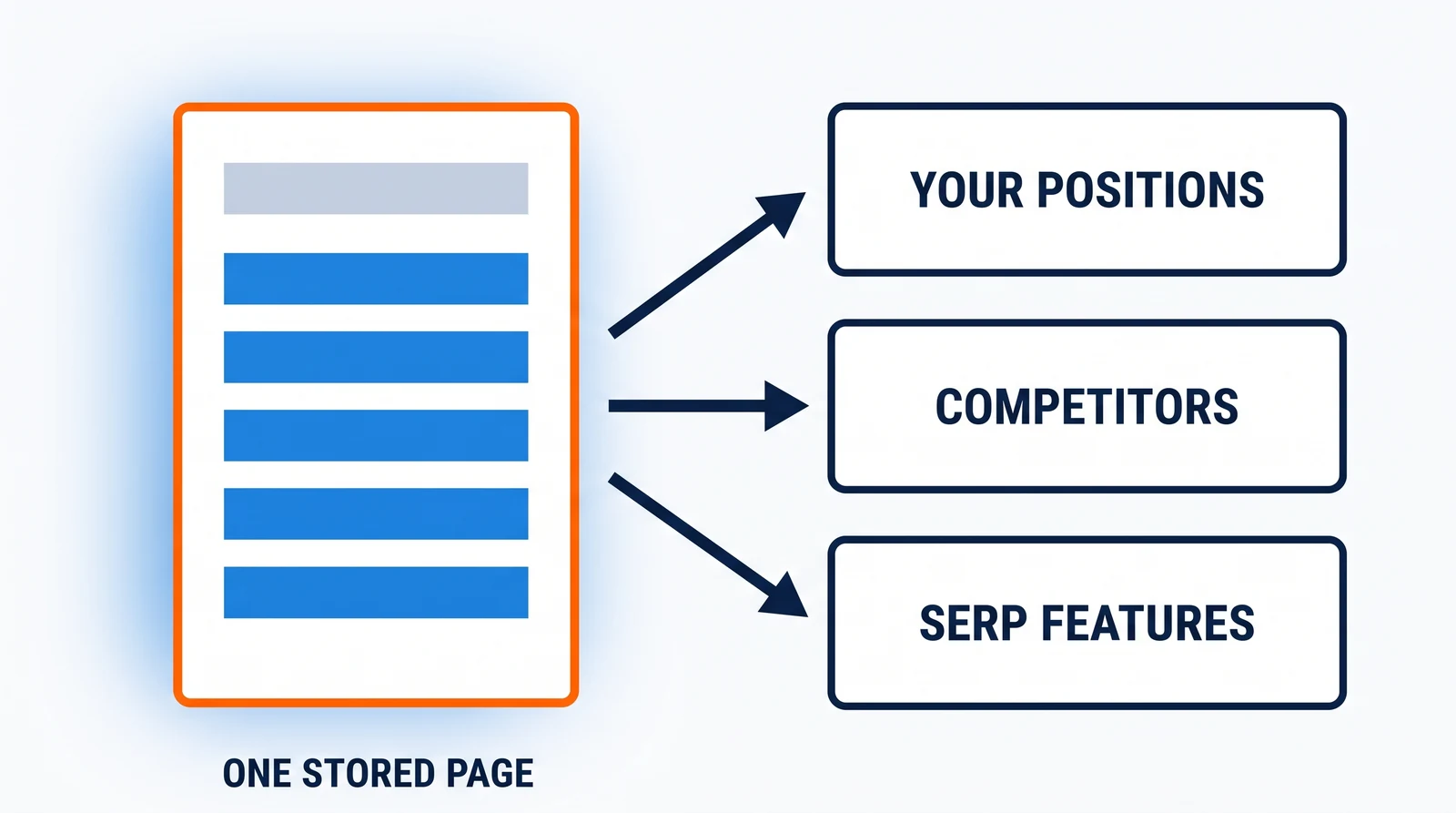
A rank tracker records where a website's pages appear in Google's results for chosen keywords, checked on a schedule from the location and device you use. The schedule is often daily; the device is desktop or mobile; the location is a country, a city or a postal code for local SEO work. Over time a rank tracking tool gives you a record of your own positions, a competitor's positions for the same keywords, and which SERP feature appears on the results page (SERP), such as an AI Overview, a local pack or a video block. A third-party rank tracker builds that record by loading Google's results pages automatically, many times a day, and storing what comes back.
What did Nozzle's study find?
Nozzle's rule flagged 8.4% of the 27.0 million results pages it judged from 13 September to 18 October 2026 as swapped, against 0.17% in its baseline from 20 August to 9 September. Nozzle's own summary of what that looks like: "complete, normal-looking pages whose results have been swapped out. Nothing on the page gives it away. Each keyword's own history does."
Two dates explain why some accounts give 13 September as the start and others, such as Search Engine Journal's report of 14 October, give 20 September. On Nozzle's page, 13 September is the day its requests to Google "started failing in large numbers", and the day its counted period begins. The SERPs that still came through were normal until 20 September, "when poisoned SERPs first appear". The share passed a quarter of the SERPs judged on 27 to 29 September, 28.6% on the 29th, ran at 6 to 15% a day from 1 to 13 October and fell to 3 to 7% a day from 14 October. Nozzle's update puts 18 October at 7.0% and says it is "too early to call it over".
A swapped SERP carries no error message and no captcha, and it uses the same template as a normal one. What changes is which site holds each search result. On the flagged SERPs, the organic results kept 22.0% of the sites on the keyword's previous page, against 88.1% in the baseline. Facebook, Instagram, Reddit, YouTube, Quora and LinkedIn appeared more often in their place.
Nozzle's own reading is that this is Google's response to the bulk collection of its results to feed AI answers, and that rank trackers, which collect results pages the same way, are caught in it. That is the company's interpretation. Google has not said so in any report we read.
How did Nozzle decide a page was swapped?
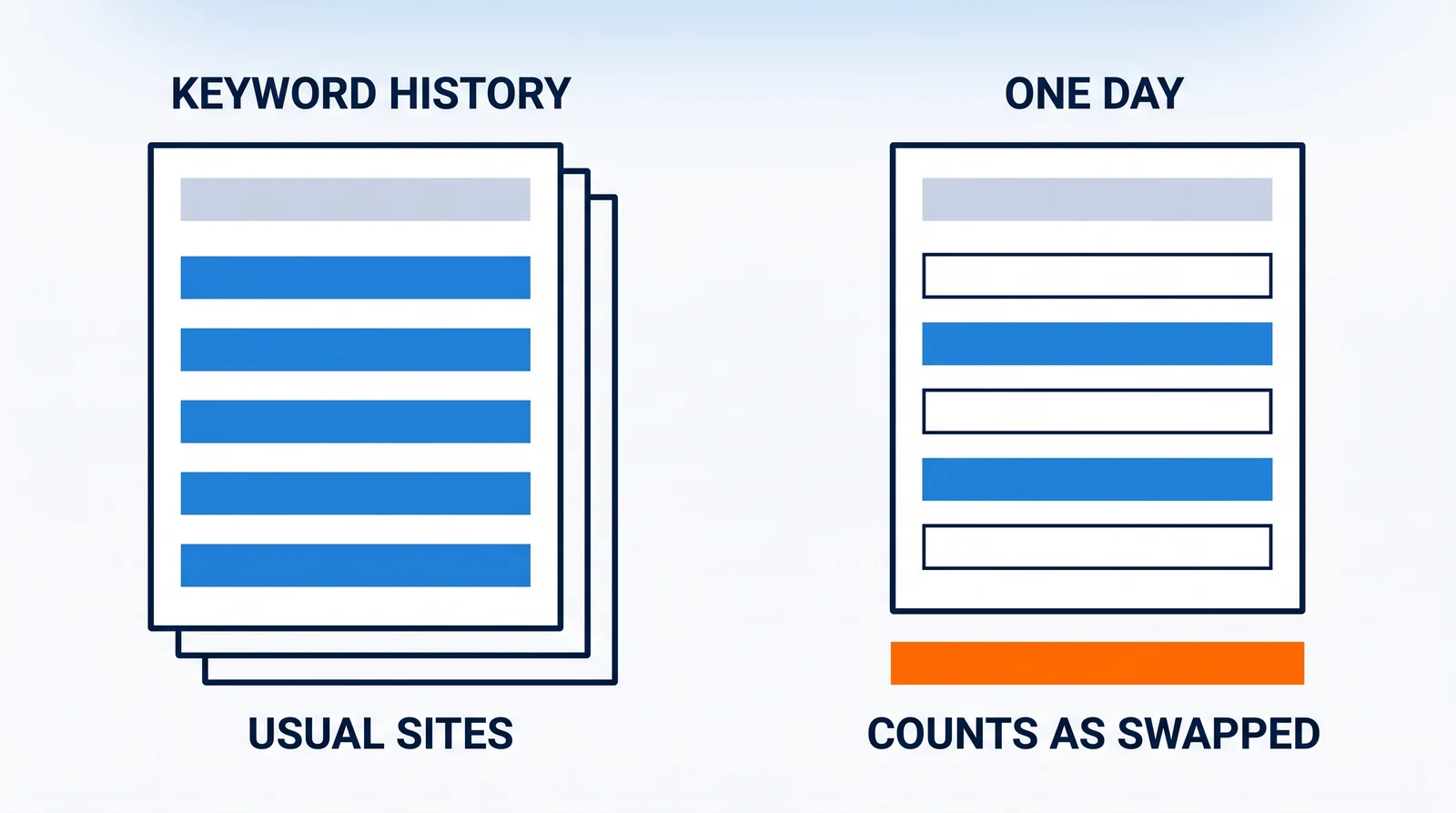
Nozzle judged each SERP against the keyword's own history, never against anything visible in a search result. A keyword's usual sites are the ones in its top 10 on at least 60% of its SERPs in the baseline weeks. A SERP counts as swapped when fewer than half of those usual sites appear anywhere on it. The first version of the study also required the sites to come back on a later SERP; the version of 19 October drops that condition, so a day's figure is final when it is published.
That rule carries its own limits, and Nozzle states most of them:
- The SERPs come from the keyword sets Nozzle collects for its customers, across 52 countries, on desktop, iPhone and Android. That is a large sample, but not a random draw of searches.
- The share depended on the route a request used. Between 30 September and 13 October, one of Nozzle's collection routes returned 1 to 8% swapped SERPs a day and another 13 to 32%.
- Because the test no longer waits for the usual sites to return, a lasting change can count too. Nozzle's answer is the return rate: of the swapped SERPs at least two weeks old, 92.7% had the usual sites back within two weeks, against 98.7% of the baseline SERPs that met the same test.
- It measures pages served to automated collection. It does not say how often a person searching saw one, and "poisoned" is a vendor's classification, not Google's description of these pages.
By our reading, the test on any single day cannot tell a swapped SERP from a genuine reshuffle that removes most of a keyword's usual sites; only the days that follow separate them. One finding cuts against a common worry in local SEO: the same phrase tracked nationally and locally, in the same country on the same device, came out at 7.9% and 8.0% across 21,647 such pairs.
What does a swapped page do to a tracked ranking?
A swapped SERP makes a tracked site look as if it fell out of the top 10 for a day or two. Where a project's own site was one of a keyword's usual sites, it sat outside the top 10 on 60.2% of swapped SERPs, against 2.7% in the baseline and 10.0% on the same keywords' other SERPs since 13 September, in Nozzle's data.
The spells were short: 79% were a single SERP, and 68.9% of the swapped SERPs checked again within three days had the usual sites back, two days at the median. Nozzle reads that as the tell, "A real ranking change stays", but Google's guidance on traffic drops says small fluctuations in position can happen at any time, "including moving back up in position, without you needing to do anything". A fall that reverses fits a swapped page; it does not prove one.
The same page feeds every report built on it. Competitor positions are read from the same SERP, so on a swapped page a competitor can appear to fall and an unrelated site can show up in its place. Any visibility score your SEO tool builds from those positions moves with them, by our reading of how such scores are put together. SERP feature tracking reads the same page too: the AI Overview feature appeared on 45.9% of swapped SERPs against 53.6% in the baseline, and the local pack kept 64.2% of its businesses against 85.8%.
The same fortnight held a real ranking event. Google's own Search Status Dashboard records the September 2026 spam update starting on 24 September and running 13 days and 16 hours, so Nozzle's worst days, 27 to 29 September, fall inside it. A fall in that window can be a swapped page or a genuine movement, and the tracker's record alone does not say which. The 10.0% points the same way: on SERPs Nozzle did not flag, the tracked site sat outside the top 10 more often than in the baseline too, and the study does not separate real movement from anything else on those pages.
Is your rank tracker accurate right now?
No single figure says how accurate a rank tracker is in this window, because the share of swapped SERPs in Nozzle's data moved with the market and the kind of search. In the United States it was 8.6% of 16,543,677 judged SERPs; in the United Kingdom, 3.6% of 2,581,505; Australia, India and Canada each ran above 10%. "Near me" searches came out at 12.8% against 8.2% for everything else, which matters for local SEO. Phrases searched fewer than 100 times a month ran at 10.0%, against 6.3 to 7.2% for busier ones, and the most navigational brand searches were lowest, at 5.2%.
The keywords a tool tracks for a local business, a long-tail content website and a brand will not carry the same share of swapped pages. Rank tracking accuracy for your site is something to check on your own keywords, not a number a specific study can give you.
What have other rank trackers said?
Sistrix, SE Ranking and DemandSphere have each posted notices to their SEO customers about unreliable results pages, several of them listed by Search Engine Roundtable on 12 October, in their own words and with figures that count different things.
Sistrix's support page, modified on 7 October 2026, says that since September it has seen results for some queries that "look like genuine search results but contain different websites". It now collects such a keyword again until a result passes its checks, so some keywords update less often than a project's settings ask, and it has switched off on-demand updates since September.
SE Ranking's status page, in an update of 15 October 2026, said that for "roughly 2% of all tracked results" Google was still sometimes returning "incomplete or unreliable results pages", which can show a false drop or a keyword as not ranking. On 19 October it marked the incident resolved and said its customers' data had been corrected for all affected dates. SE Ranking describes incomplete pages and missing positions, not swapped ones.
DemandSphere wrote on 7 October 2026 that what it calls spurious results had "impacted ~11% of our daily SERPs", and asked readers not to take that 11% "as the final number". Its post does not describe how the figure was measured.
The figures are a share of judged pages, of tracked results and of daily pages respectively. They describe different collections at different moments, and no figure from an SEO tool you use can be ranked against another's or against Nozzle's.
How do you check a ranking drop against Google's own data?
Search Console is the one source here that does not depend on a scraper, so the check starts there; the later steps read your tool's own record more carefully. Compare the tool's reading with the Performance report's position for the same query, page, country and device over the same days. Several of the SEO pages that rank for this question already suggest that comparison, and the seven steps that follow are how we would run it, not an industry standard. What matters in this window is setting it up so that two accurate readings of different things are not mistaken for a disagreement.
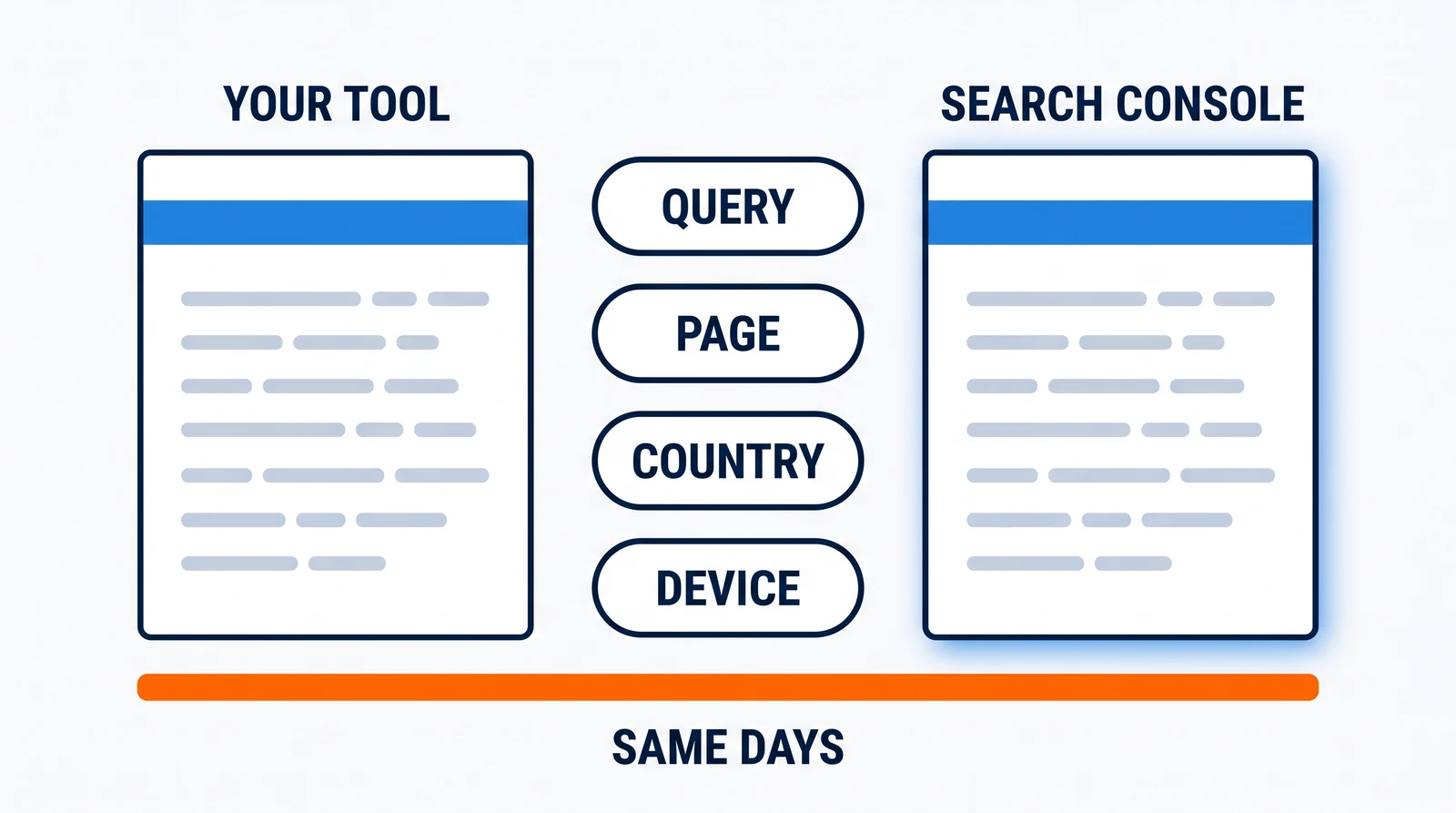
- Use the Performance report's filters to set the query, the page, the country and the device you use in your tool, desktop or mobile.
- Use a date range that covers the fall and the weeks before it, and read every day of the range on the graph.
- If impressions and clicks held and average position barely moved, the website did not lose the ranking across that country and device. The report groups by country, not by city or postal code, and averages position over impressions, so a fall your tool tracks from one city can still be real there. Nozzle's page puts it more strongly: "If a site 'disappears' and Search Console still shows impressions and clicks, nothing happened to the site."
- Look at each competitor that usually shares page 1 with you for that keyword. If most of those competitor sites fell out on the same day, the page is a likelier cause than your website; that is the pattern Nozzle's rule flags.
- Give a one-day dip at least three days before it goes into an SEO report; most of Nozzle's swapped SERPs had the usual sites back by then. Three days is a floor, not a verdict: after a core update, Google's guidance is to wait at least a full week after it completes and compare that week with a week before it began.
- Open the stored copy of the results page if your tool's dashboard keeps one. SE Ranking's help page describes this check: if the saved page is unusually short and your site is missing, the collection is the likely cause. Nozzle's advice is to compare against the keyword's usual page-1 sites over the previous weeks rather than against yesterday alone, because yesterday's page may have been swapped too.
- Mark 24 September to 8 October on the report. The spam update ran then, so a lost position that holds through every step above may be real.
A tool's reading can be accurate for the page it received and still describe a page searchers may never have been shown. Whether to report a fall, wait, or ask your vendor about it is your call; the check tells you which line to trust, not what to do about it.
What can Search Console not tell you here?
The Performance report shows an average position over real impressions, so its number will rarely match a rank tracker's single reading from one place, even when both are accurate. The metric's help page defines it as the topmost position of your link, averaged across the searches in which it appeared, and the Performance report's own help says results are specific to "the time, place, device, and recent history of the person searching". Three further limits follow:
- A query with no impressions in your date range shows nothing to compare, and a position in either can be accurate while the two still differ.
- The newest days can be preliminary and may change in the next few hours.
- Average position was among the metrics Google says were not logged accurately in the period from 13 May 2025 through 27 April 2026. The current window falls after that fix, but a year-on-year comparison across it is not clean; our read of that logging error sets out which lines it touched.
You now know what to set the same, which dates to mark and how long to wait before a one-day dip goes into a report. What a fall that survives the check means for your tool's accuracy, your site and the SEO reports you send your clients is a judgement that stays with you.
Sources
- Nozzle, "Poisoned Google SERPs", 10 October 2026, updated 19 October 2026 (data through 18 October): https://nozzle.io/research/poisoned-google-serps/ (checked 20 October 2026)
- Search Engine Roundtable, 12 October 2026: https://www.seroundtable.com/third-party-google-rank-tracking-broken-42272.html (checked 20 October 2026)
- Search Engine Journal, 14 October 2026: https://www.searchenginejournal.com/analysis-google-is-poisoning-search-results-for-rank-trackers/592873/ (checked 20 October 2026)
- PPC Land, 13 October 2026: https://ppc.land/google-returns-wrong-results-on-11-of-demandspheres-daily-rank-checks/ (checked 20 October 2026)
- Sistrix, "Why Google ranking data collection is changing", modified 7 October 2026: https://www.sistrix.com/support/google-ranking-data-collection/ (checked 20 October 2026)
- SE Ranking status page, updates of 15 and 19 October 2026: https://status.seranking.com/ (checked 20 October 2026)
- SE Ranking help, "Google rankings: missing positions for some keywords", updated 25 September 2026: https://help.seranking.com/hc/en-us/p/google-rankings-delay (checked 20 October 2026)
- DemandSphere, "Spurious data in Google SERPs", 7 October 2026: https://www.demandsphere.com/blog/spurious-data-google-serps/ (checked 20 October 2026)
- Google Search Status Dashboard, Ranking incident history: https://status.search.google.com/products/rGHU1u87FJnkP6W2GwMi/history (checked 20 October 2026)
- Google Search Central, "Debugging drops in Google Search traffic", last updated 10 December 2025: https://developers.google.com/search/docs/monitor-debug/debugging-search-traffic-drops (checked 20 October 2026)
- Google Search Central, "Google Search's core updates and your website", last updated 10 December 2025: https://developers.google.com/search/updates/core-updates (checked 20 October 2026)
- Google Search Console Help, Performance report metrics: https://support.google.com/webmasters/answer/7042828 (checked 20 October 2026)
- Google Search Console Help, Performance report (Search results): https://support.google.com/webmasters/answer/7576553 (checked 20 October 2026)
- Google Search Console Help, Data anomalies in Search Console: https://support.google.com/webmasters/answer/6211453 (checked 20 October 2026)
- The results Google returned for "rank tracking accuracy" in US searches in our capture of 19 October 2026: onelittleweb.com, reddit.com (r/SEO), advancedwebranking.com, screpy.com, semrush.com, keyword.com, agencydashboard.io, facebook.com, accuranker.com