What does noarchive do now? Google ignores it, and Bing stops reading it for AI in 2027
In Google Search, nothing: Google lists noarchive among the historical rules it ignores. On Bing, the tag is still Microsoft's preference against using a page for AI training and grounding, and Microsoft has set a date to end that. After 1 March 2027, NoArchive and NoCache "will no longer be read as a preference for training or grounding", in the words of Microsoft's announcement of 30 October 2026.
What follows is a reading of the two companies' own documents, not an experiment. We make software that records the sources AI answers point to, but have run no test of how Google or Bing handles the tag.
We reviewed the top-ranking pages for this word on 3 November 2026: two SEO glossaries, a Google community thread from January 2024, a 2011 post on Google's Instant Previews and a Japanese post of 3 October 2024 on Google's change. The glossaries define the tag, accurately for its original purpose, as a request that search results show no cached copy of the page. None of the five names Microsoft's announcement. Four of the five carry a date, and the newest is 3 October 2024.
What does noarchive do on Google now?
In Google Search, noarchive now does nothing. Google's robots meta tag documentation files it under historical rules that "aren't used by Google Search and are ignored", and states: "The noarchive rule is no longer used by Google Search to control whether a cached link is shown in search results, as the cached link feature no longer exists."
Google's log of documentation updates dates the move to 2 October 2024, eight days after it recorded that the `cache:` search operator "no longer works in Google Search". The same entry answers the question a site owner asks next: "You don't need to remove the meta tag, as other search engines and services may be using it."
If your concern is Google Search's AI answers rather than its old cache link, the tag is not the control Google documents for them. Google points to `nosnippet` and a Search Console setting instead, which we read on our page about Google-Extended and AI Overviews.
What does noarchive do on Bing today?
Since September 2023, Microsoft has read noarchive as a request to keep a page out of Bing Chat answers and out of model training. Its announcement of 22 September 2023 set three outcomes:
- Noarchive: "Content tagged NOARCHIVE will not be included in Bing Chat answers, not be linked to in the answers", and Microsoft would not use it "for training Microsoft’s generative AI foundation models".
- Nocache: the content may appear in Bing Chat answers, but "We will only display URL/Snippet/Title in the answer".
- Both tags: "If content has both NOCACHE and NOARCHIVE tags, we will treat it as NOCACHE."
Tagged pages stayed in search results in every case: "content with the NOCACHE tag or NOARCHIVE tag will still appear in our search results." The tag is the ordinary robots meta tag:
``` <meta name="robots" content="noarchive"> ```
Microsoft's own FAQ on the new preferences now describes that design: the two tags "were built to control cached pages in search and treated training and grounding as a single decision".
What replaces noarchive at Microsoft?
At Microsoft, two separate preferences take over from the old tags: one for AI training and one for AI grounding. Microsoft says they "will replace existing Microsoft preferences NoArchive and NoCache for training and grounding". Grounding is the use of a page to inform an answer as it is written.
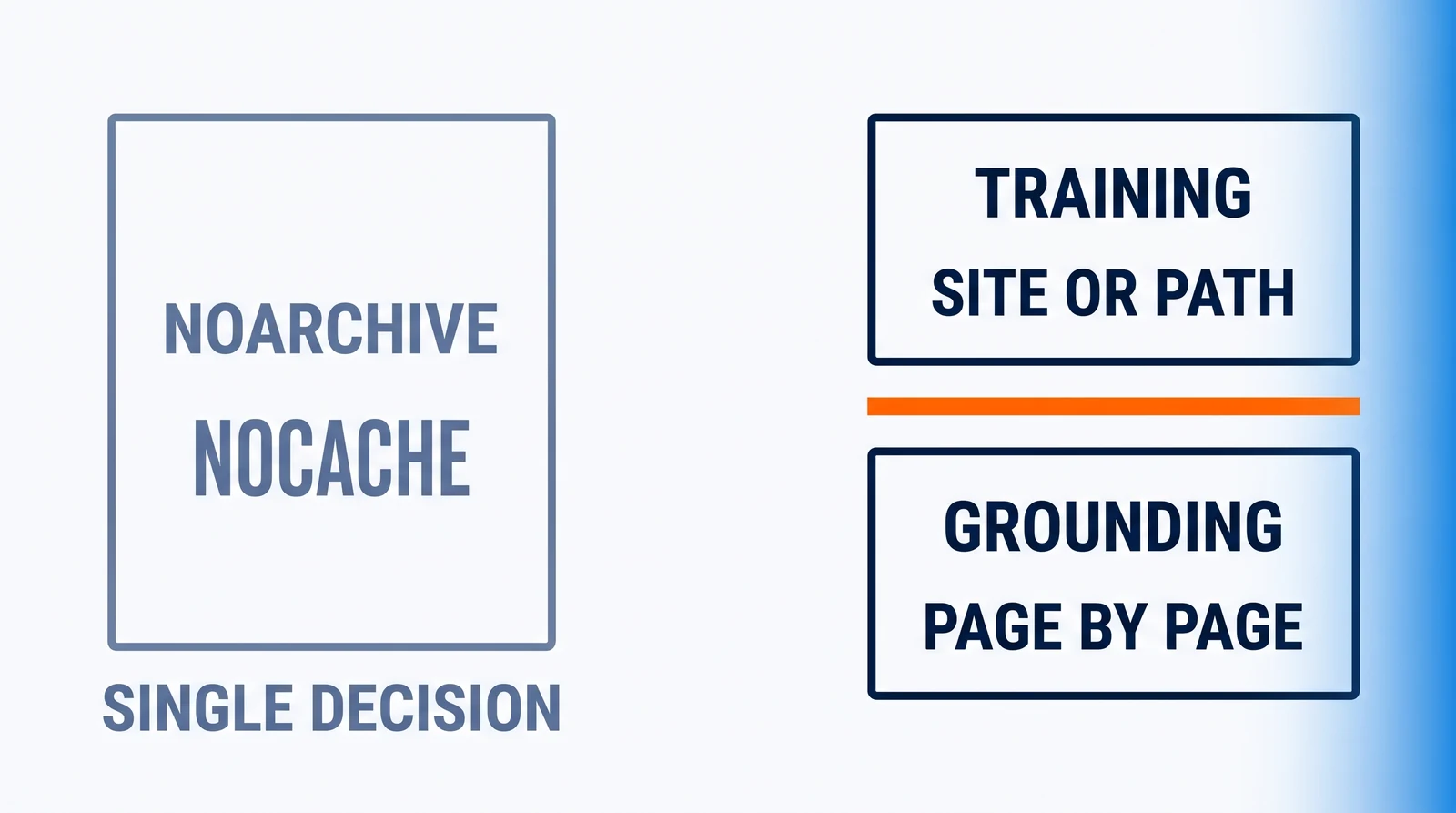
Microsoft's training preference is the shared robots.txt line `__usage_ai-training`, set "for a site or path", which a page-level tag can override. What robots.txt can and cannot do about training is the subject of our page on robots.txt and AI training.
The grounding preference is set page by page only, and Microsoft spells it out: "There is no site-wide robots.txt grounding preference." It takes three values. Allow is the default. DisallowExtended "limits grounding use to Microsoft-operated experiences such as AI Mode, AI Overview, Copilot, and Microsoft 365, and excludes grounding services Microsoft provides to third parties", Web IQ among them. Disallow keeps the page out of grounding altogether. A meta tag or an HTTP header carries the value:
``` <meta name="Bingbot" content="ai-grounding:disallow"> X-Robots-Tag: Bingbot: ai-grounding:disallowextended ```
None of this touches search. "These usage preferences do not change eligibility for traditional Bing search results," the announcement says. Bing Webmaster Tools' AI Performance report counts the citations Microsoft can see on its own surfaces, with the limits set out on our page about that report.
When does Bing stop reading noarchive for AI?
Bing stops reading the tag for AI after 1 March 2027, or from 1 February where it finds the new preferences. Four dates matter, and the transition steps apply only to sites that use NoArchive or NoCache:
- 15 December 2026: temporary grounding preferences open in Bing Webmaster Tools, "only available for sites using NoArchive or NoCache as of that date".
- 1 February 2027: Microsoft starts honouring the new preferences as it crawls. Where it finds them on a site, it will "disregard any NoArchive and NoCache preferences that may remain on that site".
- 1 March 2027: to keep pages out of grounding, Microsoft asks you to "(1) publish your AI Grounding preference on your pages; and (2) record a temporary grounding preference in Bing Webmaster Tools (BWT)", and to publish any training preference by the same date.
- 30 September 2027: any temporary preference still in place expires.
The temporary setting exists because a page tag only counts once Microsoft has recrawled the page. The FAQ says so directly: "Publishing the page-level preference alone does not make it effective before recrawl." A site that records nothing by 1 March will see its tagged pages "default to Allow for grounding until Microsoft recrawls them". There is no temporary setting for training.
Once the new preferences cover a use, Microsoft "will go back to the original definitions of these terms in traditional search". The FAQ says the tags were built for cached pages in search, which is what the glossaries describe.
Should you keep noarchive in your templates?
Whether to keep the tag depends on why it is in your templates, and the choice is yours; we do not recommend keeping or removing it. Set against the documents, the goals separate:
- For Google's old cached link: the tag does nothing now, and Google says you need not remove it.
- To keep pages out of Microsoft's AI answers: a grounding preference on each page, plus the temporary preference in Bing Webmaster Tools before 1 March 2027 if your site carries the tag on 15 December 2026.
- To stay in Microsoft's own answers but out of the grounding services it provides to third parties: DisallowExtended.
- To keep pages out of training: the training preference, by the same date.
- If the tag is a template default nobody chose: after 1 March 2027 Bing reads it for neither use, and Microsoft's default for both is Allow.
Microsoft attaches its own warning: "If you select DisallowExtended or Disallow for grounding, you will see reduced brand visibility in AI experiences." It adds that "Neither choice guarantees inclusion, traffic, or payment." Those are Microsoft's statements, not our estimate. What you weigh against them, and for which pages, is a decision only your site can make.
Sources
- Microsoft Bing Blog, "Your content, your choice: clearer preferences for training and grounding", Krishna Madhavan (30 October 2026; checked 3 November 2026) — https://blogs.bing.com/search/2026/10/your-content-your-choice-clearer-preferences-for-training-and-grounding/
- Bing Webmaster Tools Help, "FAQ - New AI Preferences" (undated; supports the 30 October 2026 announcement; checked 3 November 2026) — https://www.bing.com/webmasters/help/new-ai-preferences-2t1cc16d
- Microsoft Bing Webmaster Blog, "Announcing new options for webmasters to control usage of their content in Bing Chat", Fabrice Canel (22 September 2023; checked 3 November 2026) — https://blogs.bing.com/webmaster/2023/9/Announcing-new-options-for-webmasters-to-control-usage-of-their-content-in-Bing-Chat/
- Google Search Central, "Robots meta tag, data-nosnippet, and X-Robots-Tag specifications" (last updated 24 March 2026; checked 3 November 2026) — https://developers.google.com/search/docs/crawling-indexing/robots-meta-tag
- Google Search Console Help, "Search generative AI control" (undated; rolled out to all websites as of 31 August 2026, by Google's account; checked 3 November 2026) — https://support.google.com/webmasters/answer/16908024
- Google Search Central, "Latest documentation updates", entries of 24 September and 2 October 2024 (checked 3 November 2026) — https://developers.google.com/search/updates
- The ranking pages we reviewed for "noarchive" (US results, 3 November 2026): validbot.com, seoisrael.com, support.google.com, semclubhouse.com and suzukikenichi.com.