Do AI detectors actually work? What one detector said about eight articles we write with AI
On the one thing we could test, yes: the AI detector we used labelled all eight of our articles it read as AI, and every one of them was written with AI. Every article on this blog is drafted with AI and read by a person on our team before it goes out; the site says so, and its home page adds: "We also do not claim our articles are 'undetectable' or 'human-written'." So when we pasted our own newest pages into GPTZero, an AI detection tool, we already knew the right answer.
The test covered 8 of the 10 articles we picked. Articles nine and ten on the list were never read: the free credits ran out after the eighth, and the owner closed the test there rather than run a second sitting. We do not estimate them.
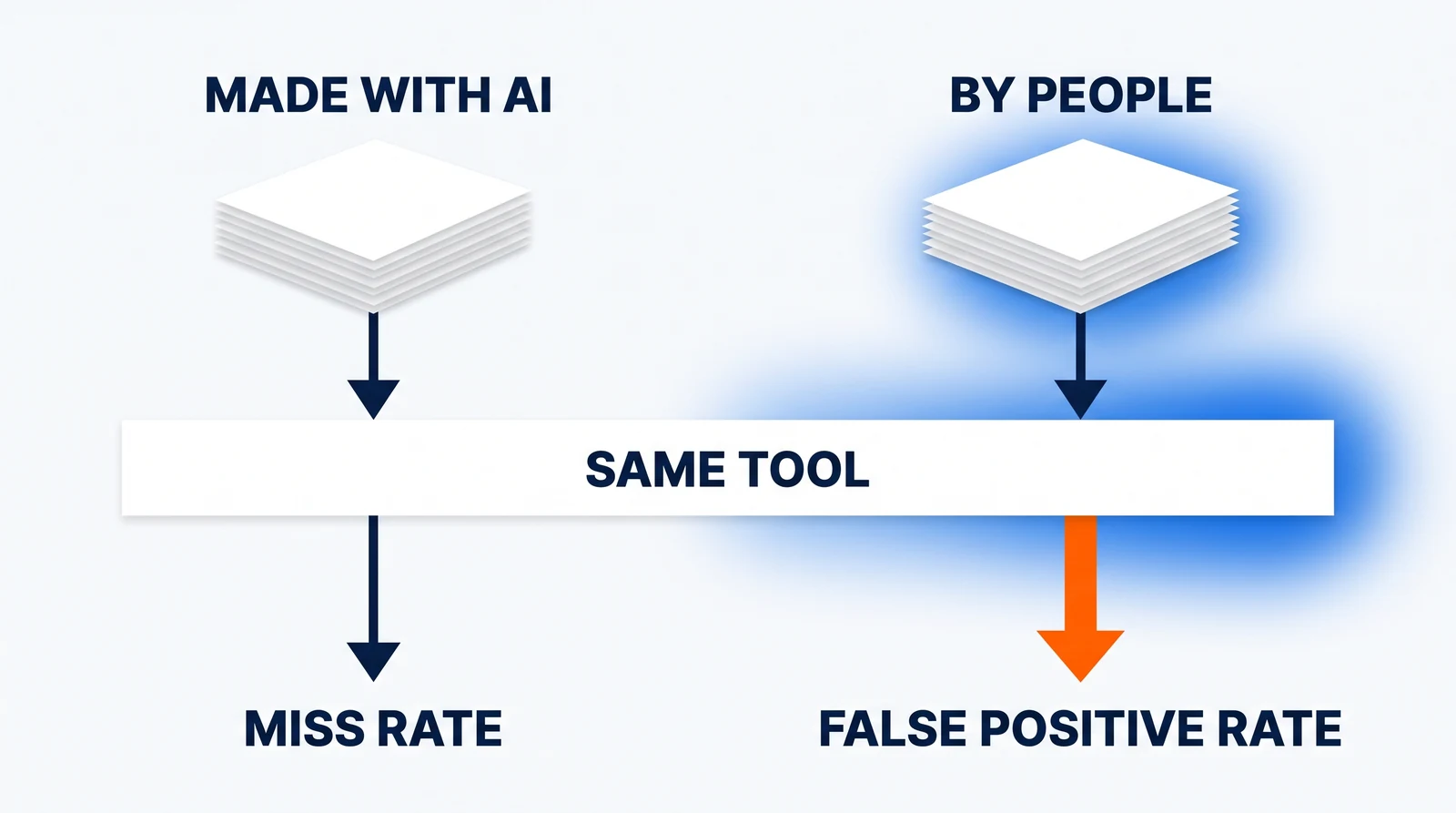
Being right eight times on pages made with AI, however, tells you very little about the question most people are really asking: how often an AI detector is wrong about someone's own writing. This page reports what GPTZero returned, how we ran it, and why that result proves less than it looks.
What did the detector say about each of our articles?
GPTZero labelled all eight articles it read as AI 100%, with 0% under the other two labels. Here are its readings in the order they were taken, all on 5 November 2026, each the only reading of that article (seven were cut to fit the free page's limit):
- How long should a blog post be for SEO? — AI 100% / Mixed 0% / Human 0%. Pasted whole.
- Can robots.txt block AI training? — AI 100% / Mixed 0% / Human 0%. Cut; last section kept: "How do you decide what to put in your file?"
- Does location affect AI search results? — AI 100% / Mixed 0% / Human 0%. Cut; last section kept: "What does this mean for an AI visibility number taken from one place?"
- Does blocking Google-Extended affect AI Overviews? — AI 100% / Mixed 0% / Human 0%. Cut; last section kept: "What do the vendor counts add?"
- Do AI crawlers render JavaScript? — AI 100% / Mixed 0% / Human 0%. Cut; last section kept: "What do pages that rank actually send without JavaScript?"
- Most cited websites by AI models — AI 100% / Mixed 0% / Human 0%. Cut; last section kept: "How should you read the next ranking of AI citations?"
- Does ChatGPT favor big brands? — AI 100% / Mixed 0% / Human 0%. Cut; last section kept: "What can a smaller brand check?"
- How does Google choose AI Overview sources? — AI 100% / Mixed 0% / Human 0%. Cut; last section kept: "What can a site owner check?"
- ChatGPT citation tracking — not read.
- Rank tracking accuracy in 2026 — not read.
Each of the eight result screens carried the same sentence: "We are highly confident this text was AI generated." The count is simple: of the 10 articles on the list, 8 were read, and all eight came back as AI 100%.
How did we run the test?
We picked the ten articles by a rule set down before the test, applied by a script. The rule: the ten most recently published articles live on our blog on 4 November 2026, newest first, taken from the blog's own publish dates rather than chosen by a person. The ten were our newest ten live articles out of 62, published from 26 October to 4 November 2026. Choosing by recency means they are not a random sample of the blog; they are simply our latest work, all made the same way: an AI tool, a large language model (LLM), drafts each article, and a person checks it.
Our operator pasted each article by hand into GPTZero's checker on 5 November 2026, from the title down to the line before its list of sources. Each article went through once, that first result is the one reported here, and nothing in any article was changed to move a result.
The setting did not stay the same across all eight, and that matters for reading them:
- Readings one and two ran on GPTZero's free page with no account, shown as "Basic Scan".
- After those scans the free page asked for an email. The operator signed in with a free account, and readings three to eight ran as "Advanced Scan" on that account's free credits, which went from 10K to 0 across those six. Nothing was paid.
- The model label on the result screen read "Model 4.1o" on seven readings and "Model Latest" on one, the fifth.
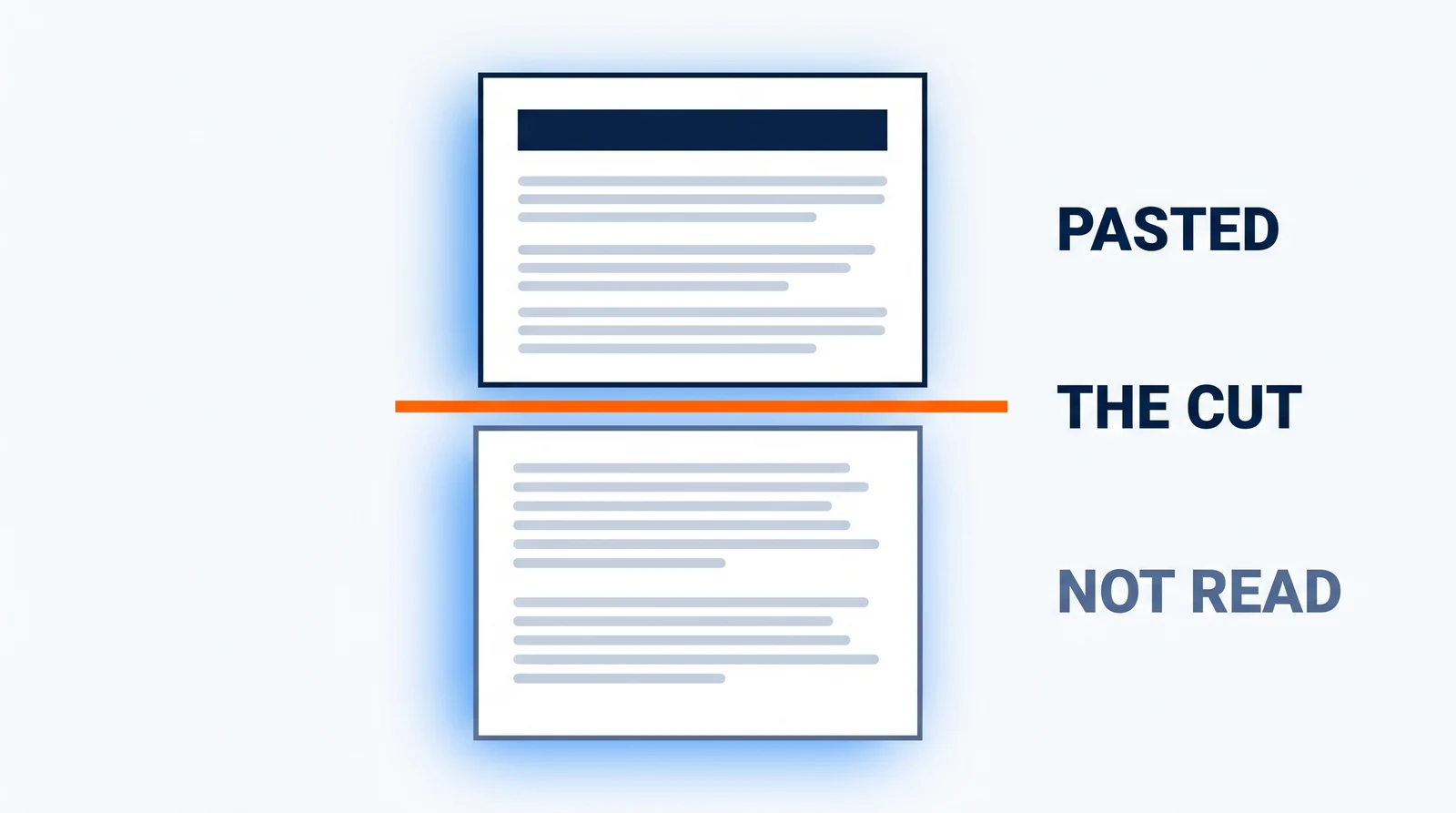
- The free page took 10,000 characters without an account when we looked on 3 November 2026. One article fitted whole, at 9,577 characters. The other seven went in cut: whole paragraphs removed from the end until the article fitted, never split into parts and never edited in the middle.
So the scan type changed after reading two, the model label differed on reading five, and seven of the eight never saw the end of the article.
What does a detector's percentage claim to measure?
GPTZero's percentage is an estimate of how likely a text is to be AI-generated, not a count of who wrote each sentence. That is how its own words read, as far as we hold them: when we read its free page on 3 November 2026, it described the result this way: "GPTZero will suggest what percentage of your text is likely to be AI-generated and highlight the specific phrases it has detected."
The result screen our operator saw frames it slightly differently. Its heading reads "Chance this entire text is", followed by the three labels shown in each line above. One wording sounds like a share of the article; the other sounds like a chance about the whole of it. We read the screen and that one line on the free page. We did not read GPTZero's methodology or any fuller explanation it publishes, so we do not say which reading is right, and we do not interpret "Mixed 0%" beyond what the screen showed.
We think one thing follows either way. A reading of "AI 100%" is the tool's output, not a measurement of how much of an article a model typed. Our articles are drafted using AI and then sourced, scored, revised and checked by a person before they go out. The result screen does not separate any of those steps, and nothing on it claims to.
What can eight readings on pages made with AI show?
Eight readings show that GPTZero did not miss on eight pages made with AI. That is about all AI detection can show from one test like this, on 5 November 2026, and five limits sit on it:
- No comparison set. There were no pages known to be written without AI beside ours. A false positive is a tool calling a person's writing AI, and the false positive rate is the number that matters to anyone whose own work gets checked. Our test cannot measure it at all.
- One reading each. It is one tool, a judgement based on one reading per article, on one day. Another version, another day or another tool could return something else, and we tested none of that.
- The cut. Seven of the eight went in cut at the free limit. The closing sections of those seven were never read.
- Only our newest pages. The eight read are the first eight of the ten, published from 28 October to 4 November 2026, all drafted by the same process and the same kind of LLM. The readings say nothing about any other writer's pages, and nothing about our own older ones.
- No way to tell why. "AI 100%" on AI-generated text is what a working detector should return. It is also what a tool that labels nearly everything as AI would return. Eight readings on known AI-generated text cannot tell them apart; only a set of texts known to be by people can.
This is a small and early result, and we say so. The record is ours, it is dated, and we will publish it with its method on our research page; it is not there yet.
What would a test that can answer the question need?
A better test puts pages known to be written by people beside the AI ones, run through the same tool in the same way. Without that second set, a result can show that a tool notices AI-generated text, but not how often it accuses someone wrongly.
Studies with that design exist. A peer-reviewed paper in the journal Acta Neurochirurgica, published on 7 August 2025, took 250 articles published in four neurosurgery journals before ChatGPT was released and generated 250 matching texts with each of three ChatGPT versions, 1,000 texts in all. GPTZero gave an average AI-likelihood score of 5.88% across the 250 published originals and 99.58% across the 250 generated by GPT-4o. The paper's own conclusion is careful: "none of the detectors achieved 100% reliability in distinguishing AI-generated content."
Limits travel with those figures. A low average, however, does not say how many of the 250 originals were flagged as AI, so it is not a false positive rate either. The paper's authors also used only abstracts and introductions, "due to the word limit in the free versions of chatbot detectors", which is the same kind of cut our test had to make. It tested GPTZero before the paper was submitted in May 2025, not the version our operator used in November 2026.
What do the top-ranking pages on this question cover?
The ranking pages are mostly aimed at teachers and researchers judging other people's writing. Of the five ranking pages we reviewed on 5 November 2026, four serve instructors, academics or researchers, and one serves a writer checking their own drafts before publishing.
MIT Sloan's teaching technology page, titled "AI Detectors Don't Work. Here's What to Do Instead.", calls AI detection software "far from foolproof" and spends most of its length on what instructors can do instead. Illinois State University's faculty centre explains how detection works and reviews published studies. Both rest on other people's tests, which is the right way to write a guide for teachers.
Two of the five report a tool's readings on a passage or three their author made. None of the five reports readings on its own published articles, chosen by a stated rule. A page from a company that sells one of these tools also ranks for the question; we did not open it, so we do not count or describe it.
What should you check instead of a detector score?
Check the sources and the facts; an AI detection score checks neither. GPTZero and tools like it judge how the text reads to their model. It does not tell you whether a figure is right, whether a quote matches its source, or whether the source exists at all. Those are the checks that decide whether an article made using AI can be trusted, and in our own process they come first. We set out how we check the sources and claims in an AI draft in a separate piece.
If you publish for search, Google's published documentation describes no AI-content detector; its policies are about what a page is for and what it adds. We do not re-argue that here.
If you do run an AI tool like this on your own work, three habits make the result easier to read:
- Read the tool's own definition of its score before you trust the number.
- Write down which AI tool and version you used, the scan type and exactly what you pasted, including where you cut it.
- Treat one reading as one reading. A tool tested only on AI-generated text has told you nothing about how it treats your own writing.
Whether AI detection belongs in your process at all is your call, and it depends on who reads your work and why. What our eight readings can tell you is narrower: one tool, on one day, recognised eight articles made using AI as AI. It cannot tell you whether it would have treated a person's article fairly, and neither can any test without that second set of pages.
Sources
- GPTZero result screens, eight readings on our own articles, read by hand by our operator on 5 November 2026 (our own record, not yet published).
- GPTZero's free checker page: its description of the result and its 10,000-character limit, as read by our desk on 3 November 2026 (not linked).
- LiamVi home page, the disclosure sentences, checked 5 November 2026: https://liamvi.com/
- Acta Neurochirurgica (2025), "Can we trust academic AI detective? Accuracy and limitations of AI-output detectors", doi:10.1007/s00701-025-06622-4, checked 5 November 2026: https://pmc.ncbi.nlm.nih.gov/articles/PMC12331776/
- MIT Sloan Teaching & Learning Technologies, "AI Detectors Don't Work. Here's What to Do Instead.", checked 5 November 2026: https://mitsloanedtech.mit.edu/ai/teach/ai-detectors-dont-work/
- Illinois State University, Center for Integrated Professional Development, "Why Don't AI Detectors Work?", checked 5 November 2026: https://prodev.illinoisstate.edu/instructional-resources/pedagogy/ai/detectors/
- Ranking pages reviewed on 5 November 2026: MIT Sloan Teaching & Learning Technologies; Illinois State University ProDev; The Effortless Academic; a personal Substack review; the Acta Neurochirurgica study on PMC (a detector vendor's page in the same results was not opened).