ChatGPT for SEO: what it flagged when it checked our own drafts
ChatGPT read 72 finished drafts of our own articles cold, and it said "Not yet" to 55 of them. Each of those 55 verdicts named a problem with the evidence: a claim stronger than its source, a study we had missed, a sample or a date stated wrongly. None of the 55 named the prose. Gemini read the same 72 drafts under the same prompt and said "This is a good article" to 51 of them; when it said "Not yet", 16 of its 21 verdicts were about how the article read: keyword stuffing, sentences that sounded machine-made, or a voice that sounded defensive.
Most of the guides that rank for ChatGPT for SEO (search engine optimization) tell you a person must check what it writes. We reviewed them on 3 November 2026. Of the ten we read, seven say a person must check or oversee what ChatGPT produces, and three suggest using ChatGPT itself to check a draft. None of the ten top-ranking pages we reviewed reports what ChatGPT found when someone used it to check a finished draft. This article is that report, from a single desk.
Our interest first: the software we sell keeps a record of which pages get cited when AI assistants answer, so how AI-assisted writing gets checked is close to our own work, and the articles counted here are the articles on our own website. And the limits, in the same breath as the numbers: one desk, 72 reads of 65 articles, two reviewers, a single prompt, eleven weeks. These are two language models' verdicts on our own drafts. They are not human readers, and they are not a measure of who was right.
How do we use ChatGPT for SEO checking?
ChatGPT is the last outside reader each of our articles meets before approval, and it reads the finished text, not a draft in progress. Gemini reads the same text at the same step.
Our home page says it to the people we write for: "We use AI to write your articles." Our own articles are made the same way: we use AI to write each one, and a person checks it before it is published. Before any outside reader sees an article, it passes our own gates: every source is opened and checked, the draft is scored against the pages that rank in search engine results for its keyword, and an editorial review checks it against our own rules. Only the finished text goes to the cold reads.
A person then pastes the finished article into a fresh ChatGPT chat and a fresh Gemini chat, with nothing about who wrote it, which website will publish it or why. The accounts' memory and personalization settings were not recorded, so "fresh" here means a new conversation, not one we can show was free of context from earlier use. The two reviews are saved into a file named for the article. The prompt is the same every time, and it is ours, so you can copy it whole:
``` You are reviewing an article. You have been given no information about who wrote it, where it will be published, or why — that is intentional. I want a completely cold read of the text on its own merits.
Review it honestly on exactly these dimensions: 1. WRITING — does this read like a knowledgeable human wrote it, or does it feel machine-written or keyword-stuffed anywhere? Point to specific passages. 2. INFORMATION — is the information good? Do the claims hold together logically? If any claim seems wrong or does not make sense to you, RESEARCH it before objecting, and back your objection with a source — a link or a named reference. An unsupported "this seems wrong" does not count. 3. PROFESSIONALISM — would this pass as the work of a serious professional publication? Anything that undermines trust (structure, tone, sloppiness, oversharing internal details)? 4. READER VALUE — did you learn something? Would you cite or share this?
Rules: do NOT rewrite the article. List at most five issues, ranked by importance, each with the specific passage it refers to. Then end your review with exactly one of these two lines and nothing after it:
VERDICT: This is a good article VERDICT: Not yet, because [one sentence]
The article follows below. --- ```
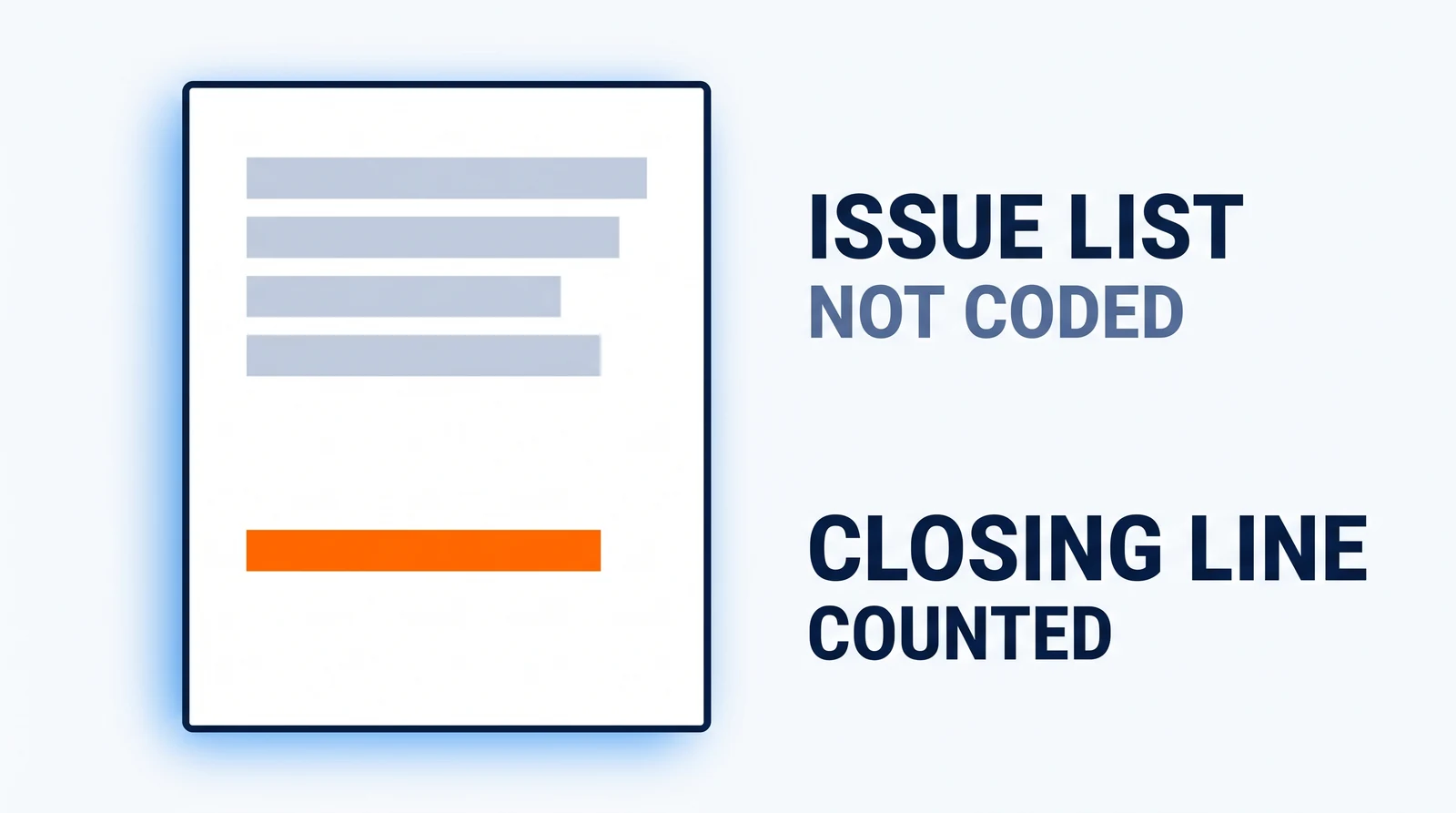
The task it sets has four parts — the prose, the facts, the polish and the value to a reader — caps the list at five issues, and makes the reviewer commit to a closing line. That closing line is what we counted. The issue lists above it were not coded: a review could name a prose problem among its five issues and still close on the evidence, and our count would not show it.
The count covers every review file we held when we counted on 3 November 2026, going back to late August: 72 reviews of 65 articles, because 7 articles were read twice after a rewrite or a re-run. Each file holds exactly two verdict lines, and we read which reviewer wrote each from the label above it. The versions were whatever the two accounts served on those dates; for most reads they were not recorded.
These reads are not the cold reads of an earlier trial with reviewer agents, which tested our content score against blind quality judgements. That was a separate measurement for a different purpose, and the two are never added together.
What did ChatGPT's verdicts flag in our drafts?
ChatGPT ended 55 of its 72 reviews of our drafts with "Not yet", and all 55 of those verdicts named a problem with the evidence; the other 17 ended "This is a good article". We counted the verdict sentences, the line each review ends on, and none of the 55 named the prose.
The evidence problems those verdicts named came in a few recurring kinds. A claim went further than the source behind it. A study existed that we had missed, or a study contradicted us. A sample, a figure, a date or a denominator was stated wrongly, or a detail had gone out of date between our check and the read. In each case the objection was about the quality of the evidence, not the sentence carrying it. We hold no count per kind, so we give none.
Our article on whether FAQ sections help AI citations shows the pattern. It said it had found a single published study that measured the visible FAQ section. ChatGPT's review opened by saying the article "misses a directly relevant SE Ranking study, and that omission changes the evidence picture": a second SE Ranking study, on Google's AI Mode, published on 15 December 2025. We opened it before changing anything. It said what the review said: across 2,328,533 pages, those with an FAQ section in the main content averaged 4.9 AI Mode citations, against 4.4 for pages without. We classed the point as a real miss, and the article now carries both studies. Our own sources file had noted that study and never opened it for an FAQ figure. The outside reader caught what we were too close to see.
These are articles we went on to publish. So 55 of 72 counts finished articles, already through our own gates, whose ChatGPT review still closed on an evidence objection, and we would rather you heard it from us.
What did Gemini's verdicts flag that ChatGPT's did not?
Gemini said "This is a good article" to 51 of the same 72 drafts, and 16 of its 21 "Not yet" verdicts were about how the article read. Its verdicts fell on the prose far more often than on the facts.
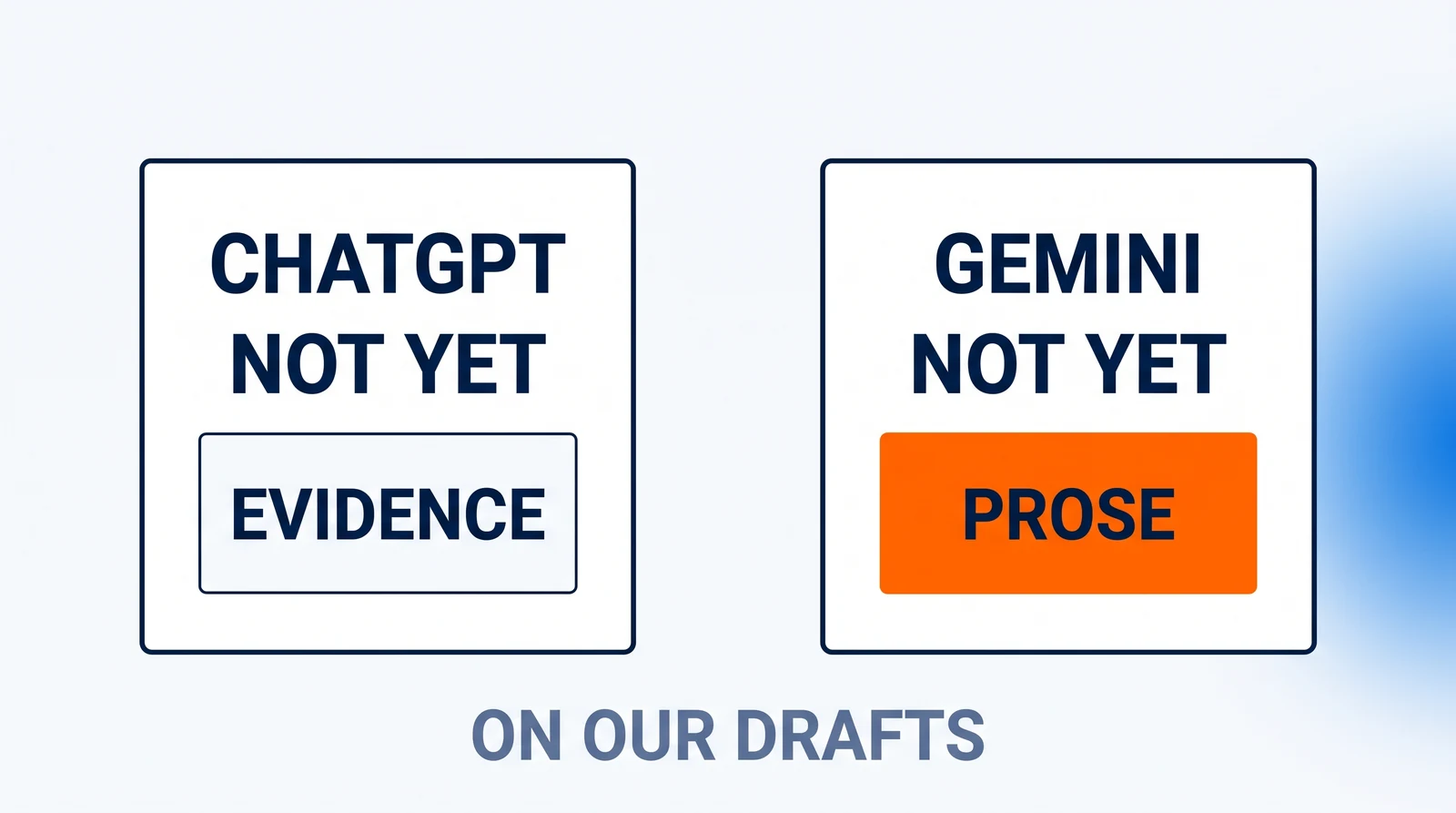
Those 16 named three kinds of problem. Gemini's verdicts on our 72 drafts named keyword stuffing or inserted keywords 6 times. Prose that read as machine-made came up in 4. The largest group named a voice: defensive, self-referential, or over-explaining our own process. A verdict can name two kinds, so the kinds add up to more than 16. The other 5 verdicts named something else: a link to a staging site, a broken table and a citation to a page not yet published, pages we had left unread from the search results, a raw block of search results left in the text, and statistics that needed reconciling.
Set side by side, the two reviewers' verdicts on each article fell like this: - Both "This is a good article": 13 of 72. - Both "Not yet": 17 of 72. - ChatGPT "Not yet" while Gemini said "good": 38 of 72. - ChatGPT "good" while Gemini said "Not yet": 4 of 72.
Those pairs are what two accounts returned on the dates they read, with the versions mostly unrecorded; they are not a fixed comparison of the two products.
The most important case for anyone who writes for search is a single sentence. In our article on ChatGPT citation tracking, Gemini quoted the line "ChatGPT citation tracking does this for ChatGPT." and called it "painfully redundant", saying it "reads like a naked attempt to insert an exact-match SEO keyword". It was right. The sentence repeated the article's target phrase and added nothing, so we cut it whole and accepted the lower score that came with the cut. That matters because our own scorer's keyword-stuffing flag had not fired on that draft. A sentence in a draft optimized for its keyword can be a keyword too many and still pass a meter.
Can ChatGPT generate SEO content that holds up?
An AI language model generates the first draft of each article in this count, and in the closing verdicts on these reads the evidence fell short far more often than the prose did.
Our drafts are AI-generated content in the plain sense: generating the first version is the AI's task, and our own checks work on it from there. By the time the outside reader saw them, every claim had been sourced, every draft scored and every article edited. Even so, ChatGPT's closing verdicts on those 72 AI-drafted articles named an evidence problem in 55 and the prose in none. Gemini's verdicts, which named the prose far more often, passed 51 of the same 72, and only 4 of its 21 "Not yet" verdicts said the prose read as machine-made.
We think that is the useful answer to whether ChatGPT can handle content creation for SEO: in the closing verdicts on our drafts, the words drew far fewer complaints than claims that did not match their sources, and a fresh reader told to back every objection with a source raised points our process had not. That is a reading of 72 verdicts on our own content writing, not a test of whether ChatGPT can generate or create SEO articles that hold up for anyone else.
Why would two models read the same draft so differently?
Two reviewers given the same prompt can put different problems first, and in their closing verdicts on our 72 drafts ChatGPT and Gemini did. We think the prompt leaves room for that choice; it is a reading, not a finding.
The prompt asks for four things and a ranked list of five. ChatGPT's verdicts named research problems, which fits the prompt's demand for a source behind every objection. Gemini's verdicts more often named the reading experience. However, we have not tested why. It could be the versions, the account settings, the day, how each conversation handled a long pasted article, or the kind of article we write, which carries a lot of dated sources and stated limits.
What we can say is narrower: on our 72 packs, under our prompt, the two reviewers' closing verdicts named different kinds of problem. That is not evidence that either reads evidence or prose better in general, and we are not ranking them. Ours is a single desk's set of articles on a single subject.
Is a "not yet" a ruling?
A "not yet" verdict from a cold reader is a signal to check, not a ruling. On our drafts, every factual point was checked against its primary source before anything in the article changed, and some points were refused, each with a written reason.
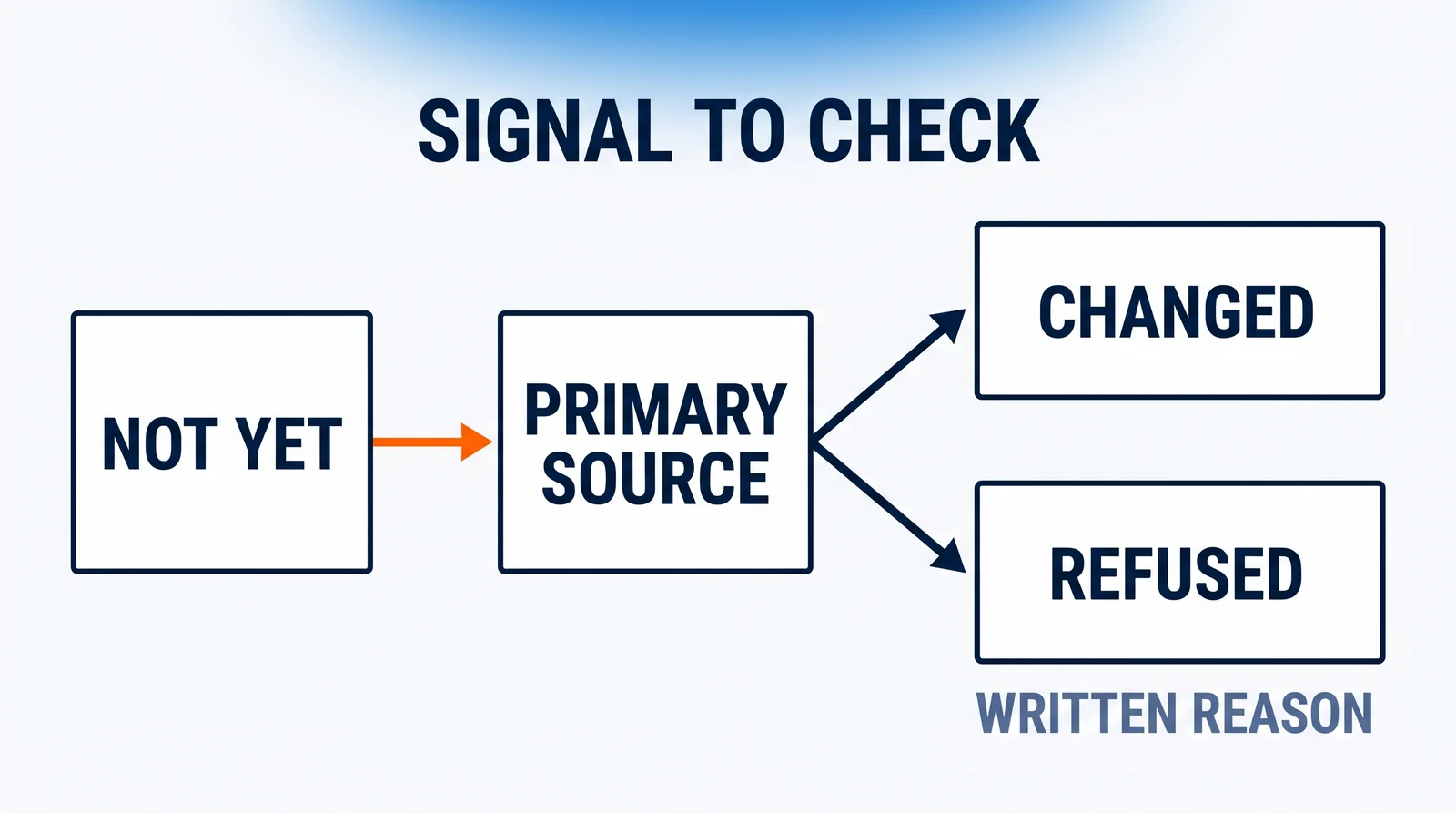
Our article on how AI assistants recommend products shows why. Gemini called the disclosure near the top "clunky and defensive". That paragraph says what our software records and that we had measured nothing about product recommendations. It is the conflict-of-interest disclosure the article needed, so it stayed, with only its date corrected. A reviewer with no context cannot know why a sentence is there; the editor who has the context decides.
We do not publish an adoption rate. Our records of what was adopted, adopted in part or refused use several formats, and we have not counted them in a single format, so any rate we gave you would be a guess. What we can say is that the verdict line never approved or blocked any of our articles on its own.
A cold read does not replace an editor or a primary source; it is another reader, with no stake in the article. It is also not an AI-content detection tool, and not a writing tool; and nothing here measures whether a detector would flag these drafts. If your question is whether Google treats AI-written pages differently, that is a separate question with its own answer.
How to use ChatGPT as the checker of your own SEO content
ChatGPT is the checker we use on the finished text, in a new conversation, with nothing about who wrote it. Every objection it raises is then something to verify, not an order. That is the workflow we ran on these 72 reads and found useful; we have not tested it against other ways of working. The checking step costs two pastes per article.
Three of the ten pages that rank for this search already point this way, in their own words. Juma's guide prints a prompt that asks ChatGPT to "Highlight any technical inaccuracies". Backlinko says it can be used "to proofread your work to check it is mostly factually accurate (emphasis on the "mostly")". mrs.digital suggests asking it to "Evaluate and provide feedback on first drafts". What none of the ten says is what came back. On our drafts, this is what we would do again: - Paste the finished article, as it will appear on your website, not a draft still in progress. A cold read of a moving text tells you little. - Include the title and the headings in the paste. A second ChatGPT point on our FAQ article was that its title claimed more than the article's method could support. - Start a new conversation, and leave out the brand, the author and the target keyword. A new conversation can still draw on the account's memory when it is on; OpenAI's help page describes a temporary chat started as Unpersonalized as not using memory, custom instructions or plugins. We think a reviewer that knows who wrote the piece reads the text less closely; we have not tested it. - Use the prompt above, or your own version of it, but keep the rule that every objection needs a source. - Open each source yourself before you change a word. In our reads the review was right about the missed study, and it still had to be checked. - Use a second reviewer as well. On our drafts, Gemini's closing verdicts named the prose where ChatGPT's did not. - Read "This is a good article" as no approval and "Not yet" as no block. The decision stays with whoever knows why each sentence is there.
None of this makes a page rank, get cited by an AI assistant or pass a detector, and we do not claim it does. If you came here for the other meaning of the search, getting your pages cited by ChatGPT rather than using it, how ChatGPT picks the pages it cites is the place to start.
What you do with a "not yet" is your call, whatever your SEO strategy. Ours was to check it, and sometimes to keep the sentence.
What this count cannot tell you
The 72 cold reads are one desk's record of its own drafts, not a test of either reviewer or a search engine's judgement. They cover 65 articles on a single subject, read by two reviewers under a single prompt over eleven weeks, with the versions mostly unrecorded and the account settings not recorded. We coded the closing verdict lines ourselves, not the issues listed above them, and what matters most is what they are not: a measure of accuracy, or a human judgement. We keep running these reads on every article we publish, and we will publish the count again when it has grown.
Sources
- SE Ranking, "How to optimize for AI Mode: Global domain traffic matters 3x more than content", published 15 December 2025, updated 27 March 2026 — https://seranking.com/blog/how-to-optimize-for-ai-mode/ (checked 3 November 2026)
- OpenAI Help Center, on temporary chats and on Memory — https://help.openai.com/en/articles/8914046-temporary-chat-in-chatgpt and https://help.openai.com/en/articles/8590148-memory-in-chatgpt (checked 3 November 2026)
- The top-ranking pages we reviewed for this search (US results, 3 November 2026): tandem.buzz, setupad.com, pageoptimizer.pro, juma.ai, backlinko.com, mrs.digital, neilpatel.com, Kailash Bhandari on linkedin.com, blog.hubspot.com and semrush.com.
- Our own 72 cold-read review files (late August to 3 November 2026), held by the desk and not yet published (counted 3 November 2026).