Keyword research for SEO: the keywords we set aside before writing, and why
Most of what we research never becomes an article. Planning the week of 9 to 15 November 2026, our desk built a results-page record for 50 keywords between 2 and 4 November, chose 6 of them to write, and set the other 44 aside, each under a written reason. The largest reason, for 20 of the 44, was that the results page Google returned was not a page of articles at all: it was forums, listings, tool pages, or pages that could not be read.
Keyword research is usually described as finding the right words to target. Our records suggest the more important part of the process is deciding which ones to leave alone, and writing down why. We counted these decisions at 05:29 UTC on 4 November 2026, from our own planning files, while the planning for that week was still open, so a later record could change the count. It covers a single desk, a single week and our own software, and it counts decisions made before writing, not results. When we counted, none of the six pages had been published, so nothing here says anything about rankings or traffic.
An interest to declare first: the software that builds these results-page records is ours, and we sell it. That is why we hold the files this count comes from, and it is also a reason to read the method below before you trust the numbers.
What do guides to keyword research for SEO tell you to do?
Guides to keyword research teach you how to build a list of searches to target. We reviewed the top-ranking pages for "keyword research for seo" on 4 November 2026; seven were readable, and we read all seven in full: seoClarity, The Digital Ring, Neil Patel, Squarespace, SEO Review Tools, Moz and Stratabeat. Six of the seven give steps or a guide; the seventh, seoClarity's, is a product page that describes the same workflow. Five of the seven tie the work to a content, keyword or SEO strategy. Start from a seed term or a core topic, use a tool to pull a longer list of related ideas, judge each by search volume, difficulty and search intent, group what is left, then target each group with a page.
Several also include steps beyond the list itself. Squarespace's guide has a step to find and evaluate keyword gaps, which it describes as terms other sites are not focusing on or not doing well with. SEO Review Tools' steps include grouping terms into topics and intent clusters, then assigning a focus keyword to each page. Neil Patel's guide, last updated on 5 May 2026, puts the goal of the process in a single line: keyword research is "the process of finding and analyzing the search terms your audience uses to determine which ones are worth targeting and why". That last part, which ones and why, is what this article is about.
None of the seven top-ranking pages we read publishes a count of what its own process set aside. We searched the full text of each for wordings such as "we rejected", "we dropped", "set aside", "ruled out" and "of N keywords", and found no such count on any of them. That is not a fault in the guides. They are written to teach the steps, not to report a team's decisions, and the steps are sound. What a guide cannot show you is what a real list looks like after the tests have run, because that depends on whose website the list is for.
How did we decide what to write?
Our desk chose what to write with five tests and a written record. Every candidate went through the same five, and the outcome went into a register before anything was drafted. The first test needs data; the other four need judgement about the topic and our own site, and the register is where that judgement is kept.
The data comes from a results-page record our engine builds for each candidate. It runs a Google search in a single location (the United States, for every record in this count), reads the ranking pages, and records three things: the length range those pages run to, the terms they share, and whether the search engine results page (SERP) is made of articles at all or mostly of listings, forums and product pages. For this article's own search term, the analysis gives a length range of 2,300 to 3,900 words, 110 terms the ranking pages share, and 7 of 9 search results that could be read. Building the record does not decide anything. It is built first so that everyone judging a topic starts from the same Google results, with the same data in front of them, rather than from memory.
The five tests:
- The results page. Is what Google ranks for this query a set of articles a new article could stand beside? If it is mostly listings, forum threads, tool pages or unreadable pages, we set it aside.
- Our own website. Does a page already published on our own domain answer the same question on the same topic? If it does, we treat a second page as competing with our own.
- What we would add. Do we hold something the ranking pages do not, such as a count, a record or a decision of our own? If the honest answer is no, the article would repeat them.
- A page per question. Is this the same question as another query we are writing for in the same week? If so, the two related wordings share a page.
- The question itself. Does the SERP show that searchers mean what we assumed? We use the results page to identify the search intent, and sometimes Google reads the words as a different question on a different topic.
A query that passes all five is written. Several of the 44 failed more than one test, so for this count each sits under a single reason, by a fixed rule: a results page that was not articles comes first; otherwise the first reason its register row names. Counting every failure would make the total larger than the list.
What did we set aside, and on what ground?
Our desk set aside 44 of 50 keywords for the week of 9 to 15 November. Twenty of the 44 fell on the results page, and the other 6 of the 50 passed every test. Here are the 44, by the reason each is counted under:

- The results page was not articles: 20 of the 44. For 7 of those 20, our engine's own listing test flagged the results page. The other 13 we set aside after reading the ranking pages ourselves and finding forums, question-and-answer threads, tool pages or pages that could not be read.
- A live page of ours already answers it: 14 of the 44.
- The same question as another page chosen for the same week: 7 of the 44. Each was folded into its sibling as another wording of the same page.
- Nothing of our own to add: 2 of the 44.
- Another question entirely: 1 of the 44.
So 34 of the 44 were either a results page that was not articles or a question our own website already answered. The test that asks what we would add, which sounds like the hard one, was the counted reason for 2 of the 44.
Three of the 44, in the register's own words, show what each kind of decision looks like.
The broad term `keyword research` was set aside on its results page. Our register records that "5 of 8 ranking rows are tool product pages or a tool listicle". The engine's listing test did not fire on it; we read the eight results ourselves and found the page was mostly products.
The query `is seo dead with chatgpt` was set aside because our own website already answers it. The register says it was "still owned" by our live page on AI and search engine optimization, which was opened again when the decision was made.
The query `noarchive meta tag` was folded into the page we wrote for the same week on noarchive itself, under the register's rule of "one page per object". Someone searching for the meta tag and someone searching for the directive want the same explanation, so they get the same page.
The six that passed are on blocking AI bots, the noarchive directive, using ChatGPT for SEO, writing for SEO, fact-checking AI content, and this page. Each rests on a record or a decision of ours that the pages ranking for it do not hold.
What goes into a set-aside record?
A set-aside record is a dated row in our register. Each row holds five things: the query exactly as it was searched, the date of the test, the name of the test it failed, and the evidence, meaning the page we opened or the results page we read, with what we found and the data behind it. The fifth is the column we find most useful: what would change the decision.
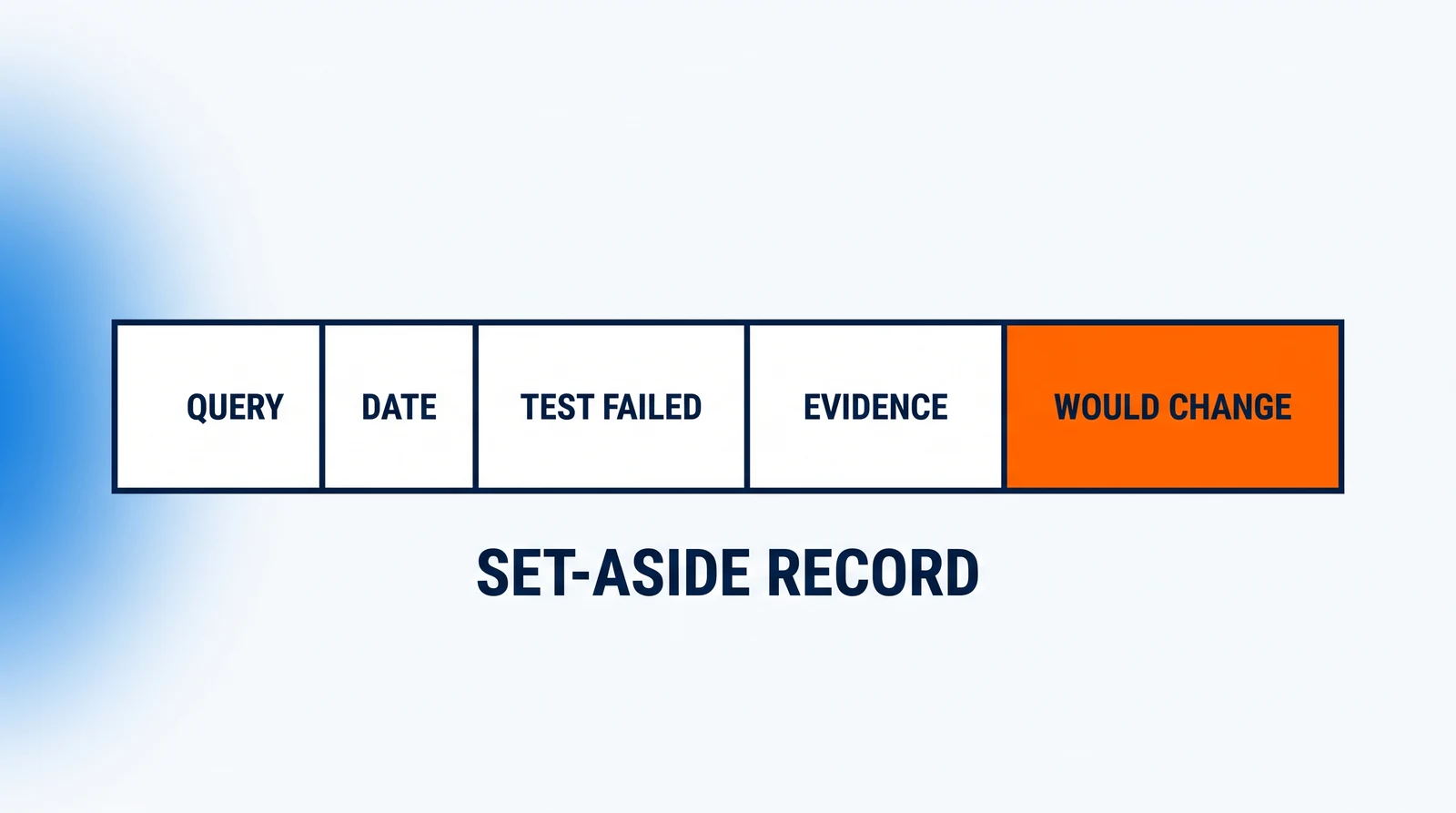
That last column is what makes a set-aside different from a deletion. A query parked on its results page comes back if the results page turns into articles. One set aside because our own page answers it comes back if that page is retired or goes out of date. The register's own rule is that a refused row is not tested again by a later planning pass unless its evidence column has changed. That rule exists because, before it, we kept re-running the same tests on the same queries and reaching the same answer.
The record is also where the reasoning can be challenged. Anyone on the desk can open a row, read the evidence, and disagree with it using our own notes rather than a memory of why something was dropped. We think that matters as much as the count: a list of reasons you can check is worth more than a list of decisions you cannot explain.
Why were search volume and difficulty never the reason?
None of the 44 set-asides was decided by search volume or by a difficulty score. Each of the five tests asks about the results page, our own site, what we could add, or what the searcher means, and every set-aside falls under one of those.
The guides' metrics are not wrong, and they are important for other decisions. Search volume tells you how many people type a query each month, a difficulty score estimates how hard it would be to rank among the current pages, and search intent helps you understand what the searcher wants. They are useful for ordering a list, and both volume and difficulty help you see where a higher effort may pay off. In our week they did not decide where the list stopped. Neil Patel's guide makes a related point about small numbers: "Don’t automatically filter out low-volume keywords." A query can be small and still worth a page, and it can be large and still not be a page of articles.
The broad term `keyword research` is the clearest case on our list. Its search volume data shows far more monthly searches than any query we chose to write, and it still fell at the first test, because a searcher typing it is mostly being shown products.
We think the results-page test fired most that week for a specific reason: many of the week's topics were AI crawler settings that had changed recently, and the results pages for those were still mostly forum threads and help pages. That is a belief, not a measurement. A week of queries on older topics could look different, and we have not tested it; we have no data on it either way.
What this count does not show
The count shows how our desk decided, not whether it decided well. It covers a single week, 50 candidates and our own engine, and every number here is a count of decisions taken before writing, not an outcome. The six chosen pages are scheduled to publish from 9 November, and none had been published when we counted, so there are no rankings, clicks or citations to report for them here.
The count was taken while the planning was still open. We stated it as of 05:29 UTC on 4 November 2026; any record built for the same week after that time would change the totals.
We tried to count earlier weeks the same way and could not: the records from those weeks are in other shapes, and we are not going to claim a wider figure we have not counted by a single method.
The register that holds these reasons is our own planning file. It is not yet published as a research page, so a reader cannot check the rows themselves yet; what you can check is the method above, and you can use it on your own data.
How to run the same checks on your own keyword list
You can run the same five tests on your own list. You need three things: the results page, your own website and a written note. You do not need our engine for any of them, and you can start with the next topic on your list.
Start with the results page, before you count anything. Run a Google search for the term and see what ranks before you look at its volume data. If the top search results are forums, product pages or listings, an article will be standing among things that are not articles, and you may decide it is not worth the work. The same reading applies to the People Also Ask questions Google shows beside the results; read the questions against the results before you write, because the questions sometimes belong to a different reader.
Search your own website for the question. Not the wording, the question behind it. Use a Google search limited to your own domain, and identify any page that already covers the topic well. If a live page of yours already answers it, the better move is often to improve that page rather than add a second one that competes with it.
Check whether two queries are really one page. Before you plan two articles on two related wordings of the same topic, ask whether a searcher typing either one wants the same explanation, and compare their results pages. Our count of how often two keywords actually return the same pages found that most pairs share no ranking page at all, so the question matters more than the match.
Ask what you would add. Read the top three ranking pages Google shows on the topic and write a sentence about what your article would say that theirs do not. If you cannot write that sentence, the article would repeat them.
Write the reason down when you set a search term aside. A line each: the date, the test it failed, the evidence, and what would change your mind. A list of reasons helps you understand your own pattern after a month, and it stops you researching the same query again in six weeks because you forgot why you dropped it.
Once a query passes, the list of related terms the ranking pages share is also useful while you write, but it is a check, not the plan for the article; our notes on writing to a term list go into that part. Which of these tests matters most for your website and your content strategy is your call. Ours are shaped by what we built and what our blog already covers, so treat them as the tests we chose for our own site, not as a standard.
What people ask us about choosing keywords
Is a high-volume keyword always worth an article? No, and volume is a poor way to pick a target on its own. In our week, the broadest search term on the list, with the highest search volume, was set aside because its results page was mostly product pages, while every page we chose to write had fewer searches. Volume tells you how many people ask; the results page tells you whether an article is what they are shown.
Should I drop a query because its difficulty score is high? We did not drop any of our 44 on difficulty. A high score tells you the ranking pages are strong; it does not tell you whether you have something to add. Decide on what you would add first, use the score to set your expectations, and target it only if the first answer is yes.
What is an example of a keyword worth setting aside? One your own website already answers. Fourteen of our 44 set-asides for the week of 9 to 15 November 2026 were questions a live page of ours had already covered, and by our own rule a second page on the same question would have competed with the first.
Sources
- Top-ranking pages for "keyword research for seo" reviewed on 4 November 2026: seoClarity (https://www.seoclarity.net/keyword-research/), The Digital Ring (https://thedigitalring.com/insights/how-to-do-seo-keyword-research-a-step-by-step-guide), Neil Patel (https://neilpatel.com/blog/keyword-research/), Squarespace (https://www.squarespace.com/blog/how-to-do-keyword-research), SEO Review Tools (https://www.seoreviewtools.com/keyword-research-tool/), Moz (https://moz.com/learn/seo/what-is-keyword-research), Stratabeat (https://stratabeat.com/keyword-research/).
- Neil Patel, "How to Do Keyword Research for SEO: 2026 Update", updated 5 May 2026: https://neilpatel.com/blog/keyword-research/ (checked 4 November 2026).
- Squarespace, "How to Do Keyword Research: A Beginner's Guide", updated 24 October 2025: https://www.squarespace.com/blog/how-to-do-keyword-research (checked 4 November 2026).
- SEO Review Tools, "Free Online Keyword Research Tool 2.1", updated 11 June 2026: https://www.seoreviewtools.com/keyword-research-tool/ (checked 4 November 2026).
- Our own planning register and results-page records for the week of 9–15 November 2026, counted 4 November 2026 at 05:29 UTC (not yet published).